


More news on this day
Cambodia is rapidly closing the gap with regional tourism powerhouses as heritage travel surges across Southeast Asia, with new data and forecasts indicating that 2026 could deliver record-breaking visitor numbers for the region’s most iconic cultural sites.
Get the latest news straight to your inbox!
Regional Heritage Travel Surges Past Pre‑Pandemic Highs
Across Southeast Asia, heritage tourism is entering a new phase of expansion as international travel returns to, and in many cases exceeds, pre‑pandemic levels. According to recent regional assessments, the travel and tourism sector contributed well over 9 percent of ASEAN’s combined GDP in 2024, with most member states reporting double‑digit growth in international arrivals compared with 2023. Analysts highlight Vietnam, Thailand and Indonesia as key drivers of this rebound, powered by long‑haul markets from Europe and North America alongside robust regional demand.
Vietnam has publicly reported a strong run of arrivals through 2024 and early 2025 as travelers flock to UNESCO‑listed sites such as Hoi An Ancient Town, the Complex of Hue Monuments and Ha Long Bay. Thailand has seen sustained recovery on the back of Bangkok’s urban appeal and the historic city of Ayutthaya, while Indonesia continues to draw heritage visitors to Borobudur and Prambanan in Central Java as well as Bali’s temple landscapes. Industry forecasts tied to the ASEAN Tourism Forum in early 2026 point to another year of expansion, with international arrivals across the bloc expected to surpass previous records if current momentum holds.
Myanmar, despite ongoing instability that continues to limit mass tourism, remains part of the regional heritage narrative, with travel reports noting continued niche interest in Bagan and other cultural sites via tightly controlled itineraries. Regional tourism outlooks emphasize that when conditions allow, Myanmar’s vast inventory of temples and archaeological zones will likely rejoin the wider Southeast Asian surge.
Within this context, Cambodia is increasingly positioned as a core player rather than a peripheral stop, benefiting from travelers who now treat mainland Southeast Asia as a multi‑country cultural circuit rather than a single‑destination trip.
Cambodia’s Visitor Numbers Approach New Milestones
Recent statistics from Cambodia’s tourism authorities and economic briefings show how quickly the country has rebounded. In 2024, Cambodia welcomed roughly 6.7 million international visitors, generating an estimated 3.6 billion dollars in revenue and edging slightly above its 2019 arrival total. These figures, cited in trade and business reports, indicate that overall demand for the country’s cultural and natural attractions has largely recovered, even as some individual sites continue to lag behind historic peaks.
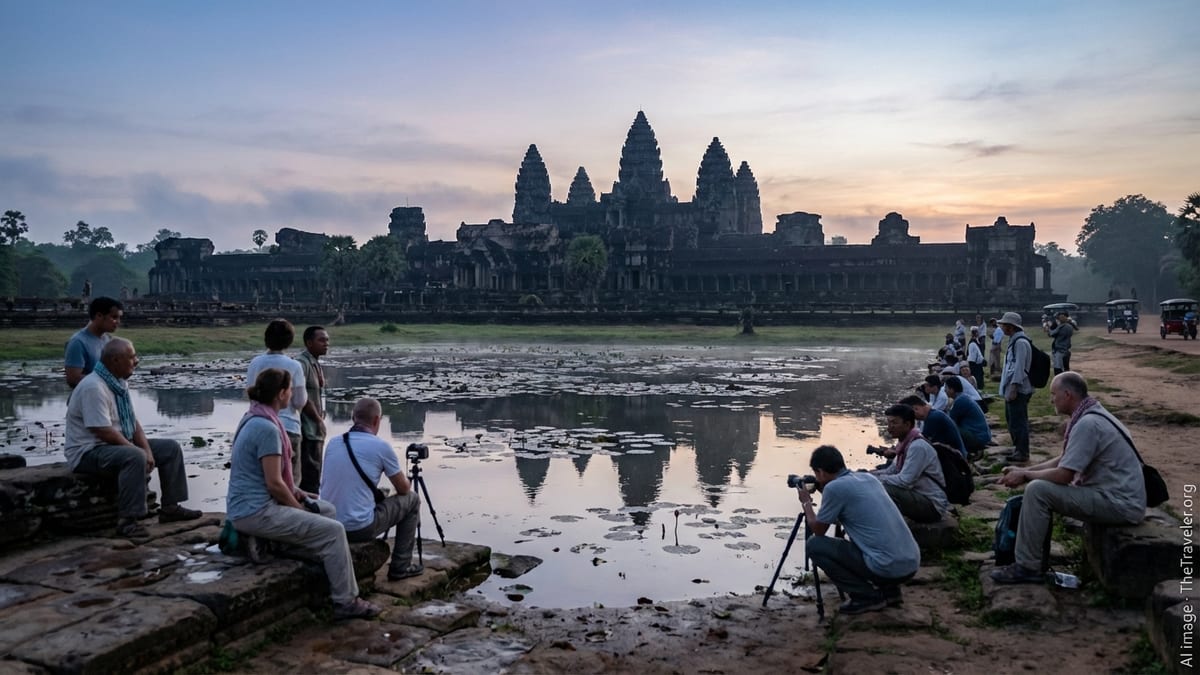
Heritage remains the primary magnet. Travel and commerce publications underline that Angkor Archaeological Park in Siem Reap continues to anchor Cambodia’s tourism brand, while Phnom Penh’s historic districts, the riverside town of Kampot and coastal areas around Sihanoukville round out an increasingly diverse itinerary. International tourism is estimated to account for close to a tenth of Cambodia’s GDP, underscoring how central the sector is to the national economy.
Forward‑looking assessments published in late 2025 and early 2026 suggest that, barring major global disruptions, Cambodia’s international arrivals could set fresh records in 2026 as new air links mature and confidence strengthens among key markets such as China, Vietnam and long‑haul Western countries. Analysts point to the return of group travel, higher‑spending independent visitors and a growing interest in extended multi‑country trips that combine Cambodia with Vietnam, Thailand or Laos.
At the same time, policy commentary stresses that the recovery remains uneven. Specialist tourism outlets in early 2026 have highlighted softer demand at certain points in 2025, especially at Angkor, and flagged the need for more diversified products beyond the temple complex. These caveats have not dampened the overall medium‑term outlook, which remains broadly positive and increasingly tied to regional rather than purely national dynamics.
Airports, Visas and Investment Reshape Access to Angkor
Improved air connectivity is a central pillar of Cambodia’s push to capture a larger share of the region’s heritage boom. Trade and aviation briefings note that Siem Reap Angkor International Airport opened to commercial operations in late 2023, replacing the old city‑side facility with a higher‑capacity gateway designed explicitly to support long‑haul tourism growth. In 2025, Cambodia also brought the new Techo International Airport near Phnom Penh and the Dara Sakor Airport in Koh Kong province into operation, bolstering both capital and coastal access.
These new airports are already reshaping visitor flows. Data sets compiled by airport operators and hospitality companies show strong year‑on‑year growth in arrivals via Phnom Penh and Siem Reap through 2024, with business and leisure traffic from China, Vietnam, Indonesia and Thailand particularly prominent. Tourism analysts argue that better direct connectivity to secondary Southeast Asian cities, not only to global hubs, is making it easier for travelers to add Cambodia to existing itineraries focused on Vietnam or Thailand.
Visa policy is another key lever. As part of a broader effort to stimulate demand during a slower phase of 2025 and early 2026, Cambodia has announced a pilot visa‑free program for Chinese visitors running from mid‑June to mid‑October 2026, reflecting similar initiatives elsewhere in the region. Industry commentary suggests that this measure is aimed at both short‑term visitor boosts and long‑term market confidence, given China’s historical importance as a source market for Angkor Wat in particular.
Investment in visitor infrastructure at heritage sites is also accelerating. UNESCO reports on Angkor reference ongoing projects to improve paths, signage and visitor management to protect fragile temple structures while enhancing the experience for larger crowds. Local tourism development plans for Siem Reap emphasize new cultural performances, evening markets and community‑based excursions designed to encourage longer stays and higher local spending.
Vietnam, Thailand, Myanmar and Indonesia Drive a Shared Heritage Story
The wider region’s trajectory is amplifying Cambodia’s prospects. Vietnam’s year‑on‑year arrival growth through 2024 and early 2025, widely reported in regional media, reflects strong demand for historic port cities and imperial capitals that pair naturally with a trip to Angkor. Multi‑destination packages promoted by tour operators now commonly link Ho Chi Minh City, the Mekong Delta and the temples of Angkor, while independent travelers connect Hanoi or Da Nang with Siem Reap via new and upgraded routes.
Thailand, traditionally the region’s largest inbound destination, remains a key feeder for Cambodia. Tourism commentary notes that many visitors now transit through Bangkok, combining the capital’s palaces and the historic city of Ayutthaya with temple‑hopping in Siem Reap. Improved overland connections and streamlined border processes along shared crossings are slowly making cross‑border heritage circuits more viable for time‑rich travelers.
Indonesia’s heritage assets, especially Borobudur and Prambanan, continue to benefit from infrastructure upgrades and controlled visitor caps that aim to protect the sites while sustaining growth. Published coverage points to rising demand for themed itineraries that frame Borobudur, Angkor and Bagan as a trio of monumental Buddhist and Hindu complexes, even if conditions in Myanmar currently constrain the full realization of this concept. Niche tour operators and cultural institutions continue to reference this shared civilizational arc in their marketing and educational materials.
This regional story line, in which Cambodia sits alongside Vietnam, Thailand, Myanmar and Indonesia as one of several indispensable heritage pillars, is increasingly shaping how travelers plan their trips and how policymakers coordinate tourism strategies.
Balancing Record Growth With Sustainability and Community Benefit
Behind the headline numbers, a parallel debate is unfolding about how to manage Southeast Asia’s heritage tourism surge without repeating the overtourism pressures of the late 2010s. Reports from UNESCO and regional development banks emphasize the importance of visitor caps, alternative circuits and community‑based tourism to distribute economic benefits more evenly and reduce stress on iconic sites such as Angkor, Hoi An or Borobudur.
In Cambodia, sector analyses published in 2025 and 2026 warn that an overreliance on Angkor Wat leaves the industry vulnerable to shocks and seasonal slumps. Commentators have called for stronger promotion of lesser‑known temple complexes such as Koh Ker and Beng Mealea, as well as cultural landscapes along the Mekong, ecotourism in the Cardamom Mountains and coastal heritage in Kampot and Kep. Recent data on ticket sales for secondary sites show early progress, but on a much smaller scale than Angkor itself.
Policymakers are responding with a mix of incentives and regulatory adjustments. Domestic media coverage in 2026 describes renewed tax exemptions for tourism businesses in Siem Reap, efforts to lower ticket and parking fees during low seasons and experiments with new events and festivals designed to spread demand across the calendar. Partnerships with development agencies are channeling funds into training programs for local guides, conservation staff and small hospitality enterprises near heritage zones.
Observers note that the stakes are high. If forecasts for 2026 hold and Southeast Asia surpasses earlier records for international arrivals, Cambodia and its neighbors will need to ensure that soaring visitor numbers translate into durable economic gains and better protection for the very cultural treasures that attract travelers in the first place. The choices made this year on infrastructure, pricing and conservation could define the region’s heritage tourism model for the rest of the decade.