


Landing in Cancun can feel like stepping straight into vacation mode, but first you need to clear passport control, collect your bags and pass customs. Wait times at Cancun International Airport can range from a breeze to a bottleneck, especially in high season. This guide explains what to expect from the moment your plane’s doors open to the moment you meet your transfer, with realistic timing estimates, examples, and tips for using the new e-gates to speed things up where possible.
Get the latest updates straight to your inbox!
How Busy Is Cancun Airport and When Are Waits Longest?
Cancun International Airport is one of the busiest airports in Latin America, handling tens of millions of passengers a year, with a heavy concentration of international vacation flights from the United States, Canada and Europe. In practice, this means that a wave of arrivals can hit passport control at the same time, especially on Saturdays and during winter and spring school holidays.
On a typical weekday in October, an early afternoon flight from Dallas or Atlanta might find immigration lines moving steadily, with total time from aircraft door to exit in 30 to 45 minutes for travelers with carry-on only. By contrast, a Saturday in February with multiple arrivals from Chicago, Toronto and London can see lines snaking back toward the gates, and some travelers taking more than an hour just to clear passport control.
Seasonality matters. Peak periods at Cancun generally include late December through early January, most of February and March for spring break, and Easter week. Flights landing between roughly 11 a.m. and 4 p.m. tend to be busier, because many North American departures are timed to arrive then. Very early morning arrivals, such as red-eyes from major hubs, and late-night flights often encounter shorter lines, though baggage and customs can still back up if several planes land together.
Because passenger volumes and airline schedules shift year by year, it is wise to treat any timing estimates as approximate. Online flight trackers and forums provide anecdotal reports, but the safest approach is to assume longer waits during holiday periods and on weekends, and to build a generous buffer into any onward ground or air connections.
From Aircraft Door to Immigration: First Steps After Landing
Once your plane parks at the gate in Cancun, the clock on your arrival process effectively starts. Deplaning can take 5 to 20 minutes depending on aircraft size and where you are seated. A narrow-body aircraft arriving from Miami might empty quickly, while a fully booked wide-body arriving from Madrid can take considerably longer, particularly if buses are used instead of a jet bridge.
After leaving the aircraft, you follow overhead signs for “Migración” or “Immigration.” In Terminals 3 and 4, the signage is bilingual and fairly clear, but walking distances can still be several minutes, especially if your gate is at the far end of the concourse. Families with small children, elderly passengers, or anyone managing heavy carry-ons should factor in another 5 to 10 minutes just for this walk.
At the entrance to the immigration hall, airport staff or signage will direct you to the appropriate queue. Typically there are separate lines for Mexican citizens and for foreign visitors. Airlines flying in from hubs such as Houston, Dallas, or Mexico City may already have warned passengers about documents to have ready, but it is worth using the walk from the aircraft to prepare: passport in hand, any entry information your airline provided easily accessible, reading glasses out if you need them.
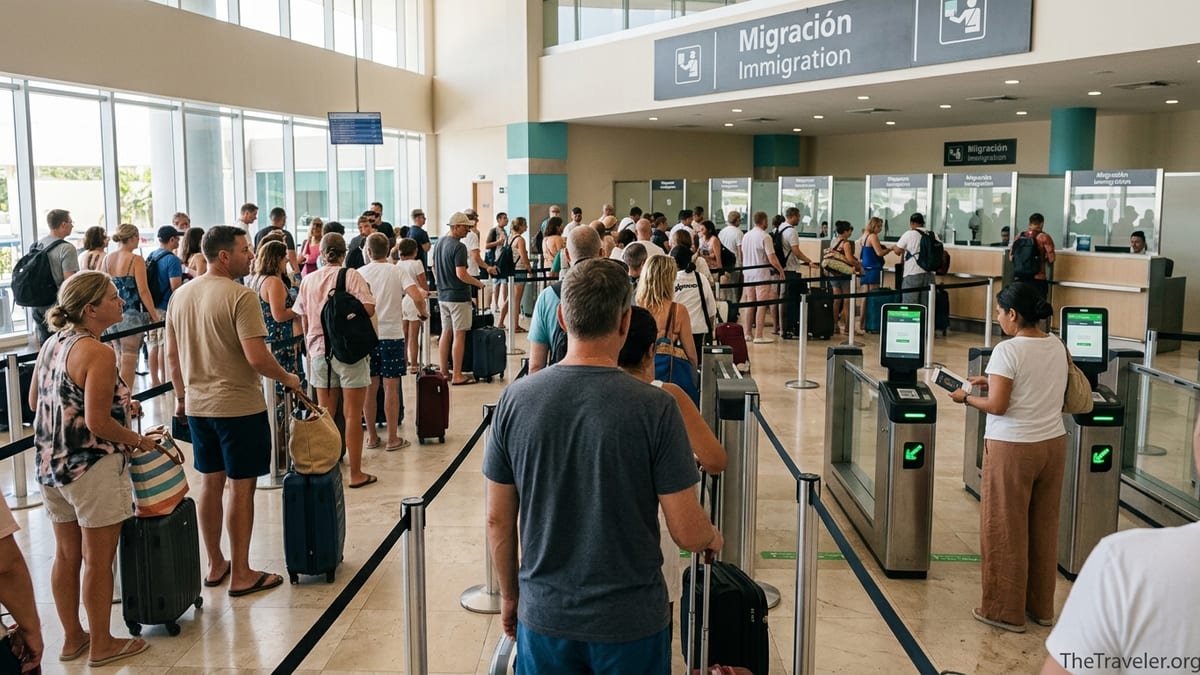
If you arrive at the same time as several other large aircraft, you may find the line backed up into the corridor outside immigration. This is common in mid-day waves. In off-peak scenarios, you might step straight up to an e-gate or officer with almost no wait. Both experiences are normal at Cancun, which is why timing can vary so widely from day to day.
Passport Control: Manual Desks and the New E-Gates
Passport control in Cancun is handled by Mexico’s National Migration Institute. Historically, every passenger stood in line to see an officer at a manned desk, where passports were inspected and questions asked about length and purpose of stay. Over the past few years, however, Cancun has installed automated e-gates and kiosks in Terminals 3 and 4 to speed up processing for eligible travelers.
These e-gates are designed for travelers with modern electronic passports, often from countries that send large numbers of tourists to Cancun such as the United States, Canada, and many European nations. In practical terms, the experience looks similar to automated passport control kiosks in major U.S. or European airports: you approach an available gate, place the photo page of your passport on a glass scanner, stand still for a quick facial recognition photo, and wait for the system to validate your details. If successful, the glass doors open and you proceed without speaking to an officer, unless you are randomly pulled aside for additional questions.
The time savings can be substantial. Travelers who previously waited 30 to 60 minutes in a line of several hundred people can sometimes pass through an e-gate in under five minutes when enough gates are open. Frequent Cancun visitors report going from jet bridge to the baggage carousel in barely ten minutes on quiet days, especially if they are seated near the front of the aircraft and walk briskly to immigration before lines build.
However, not everyone can or should use the e-gates. Young children often need to go through staffed desks, and some nationalities or travelers with specific visa types may be directed to manual processing. If you are traveling as a family with children under the minimum age for e-gates, staff may ask adults to use the regular line so you can stay together. Travelers with worn or damaged passports, or with names or biometric details that have caused issues in other automated systems, might also find it safer to choose the staffed desks to avoid repeated errors and delays at the gates.
Baggage Claim: Where Lines Can Flip After Fast Immigration
Once you clear immigration, you follow signs to baggage claim. This usually involves going down an escalator or ramp into the arrivals hall, where electronic screens show which carousel is assigned to your flight. In many cases, especially when immigration has been quick thanks to e-gates, you may arrive at the carousel before bags from your flight begin to appear.
On a typical off-peak afternoon, checked luggage from a flight from New York or Los Angeles might start arriving 10 to 20 minutes after the first passengers reach the carousel. If immigration was crowded and slow, your suitcase might already be circling when you arrive. If you sailed through an almost empty e-gate area, you may find yourself waiting by the belt watching ground staff load luggage in batches.
Recently, some travelers have noticed that the bottleneck at Cancun has effectively moved from passport control to baggage claim. When hundreds of passengers clear immigration in a matter of minutes, the baggage handling system and staff sometimes struggle to keep up. In busy periods, this can lead to a situation where passengers who spent only five minutes at immigration are left waiting 30 minutes or more at the carousel, especially if thunderstorms or ramp congestion have slowed unloading.
Checked luggage services like AirTags and other Bluetooth trackers have become popular tools for peace of mind here. For example, a traveler arriving from Chicago might open their phone and see that their suitcase icon has just moved off the aircraft onto the baggage system. Even though they may still wait in person, they at least know the bag made it to Cancun. Travelers aiming to exit the airport as quickly as possible often plan to pack light and bring only carry-on bags, skipping baggage claim entirely when airline rules allow.
Customs: The Red and Green Light System Explained
After you pick up your luggage, you proceed directly toward customs. Cancun uses Mexico’s well-known red and green light system at customs checkpoints. You place your bags on the belt or beside you, step up to a small pedestal, and press a button. A random automated selection determines whether a green or red light appears. A green light typically means you are waved through without inspection. A red light indicates that customs officers will conduct at least a brief inspection of your luggage.
The process is straightforward but can surprise first-time visitors. Imagine a family of four arriving from Toronto. They push their luggage cart up to customs, the parent presses the button, and a green light appears. Officers nod and they walk straight into the arrivals hall. Right behind them, a couple from London presses the button and sees a red light. They are asked to move to the side table where an officer might open a suitcase or ask questions about electronics or food items. The inspection may last only a few minutes if nothing unusual is found.
The red and green lights are designed to be random, and even travelers who receive a green light can be asked to step aside for further inspection if customs officers see something that warrants a closer look. For instance, multiple new electronics still in sealed boxes, or large quantities of food or liquids, can trigger additional checks. Travelers carrying items close to the duty-free allowance, such as higher-end spirits or electronics, should keep receipts handy and be familiar with Mexico’s duty-free limits to avoid surprises.
In terms of timing, customs usually adds only a few minutes for most travelers, especially those who get a green light. However, if several red lights occur in a row while officers are already occupied with detailed inspections, a small queue can form. During the busiest holiday weekends, this might add 10 to 20 minutes to your total arrival time. Once you pass customs, you exit into a busy corridor filled with transfer companies, hotel representatives, and timeshare salespeople calling out to arriving passengers.
How Much Time to Allow After Landing
Because Cancun’s wait times are highly variable, the safest approach is to plan with a buffer. For most travelers on international arrivals, a realistic door-to-curb estimate on a normal day runs between 45 and 90 minutes from scheduled landing time. This includes deplaning, walking to immigration, passport control, baggage claim, customs, and getting outside to meet transportation.
On a quiet Tuesday in late September, a couple arriving from Houston with carry-on only, who are eligible for e-gates, might complete the entire process in about 25 to 40 minutes. They deplane near the front, walk straight into a nearly empty e-gate area, get a green light at customs, and walk out to meet a pre-booked shuttle. By contrast, a family of five arriving on a Saturday afternoon in March from Minneapolis, with checked bags and young children who need manual passport processing, might easily spend 90 minutes or more before exiting, particularly if they encounter a long line at immigration and a red light at customs.
If you are connecting onward on a separate ticket from Cancun, for example to a domestic flight to Merida or Mexico City, it is prudent to allow at least three hours between scheduled arrival and your next departure, especially in peak season. This cushion accounts for potential delays at immigration and baggage claim, as well as time needed to check in again and re-clear security. For pre-booked private transfers to hotels in the Hotel Zone or Playa del Carmen, most operators build in some flexibility and track your flight, but it is still sensible to tell them your actual flight number and expected arrival time rather than guessing.
Travelers arranging shared airport shuttles or bus connections to destinations such as Tulum or Valladolid should check the specific terms of their tickets. Some services run on fixed schedules and may not wait for delayed passengers. In these cases, choosing a departure at least 90 to 120 minutes after your scheduled landing can reduce stress, particularly during December through March or major holiday weeks.
Tips to Reduce Your Wait and Make Arrival Smoother
Although you cannot control how many other planes land at the same time as yours, you can make choices that reduce your own wait and frustration. One of the most effective strategies is to travel with carry-on luggage only whenever feasible. Passengers with no checked bags skip the entire baggage claim step and can head straight from immigration to customs, often cutting 15 to 30 minutes from their total time in the terminal.
Your choice of flight time can also influence your experience. Early morning arrivals, around 7 to 9 a.m., and later evening flights outside the mid-day rush are often less congested. For instance, a 7:30 a.m. arrival from Miami in shoulder season might see immigration lines only a few people deep, while a 1 p.m. arrival from the same city in February could encounter substantial crowds. When comparing ticket options, it can be worth favoring flights that arrive at less popular times, even if they are slightly more expensive.
Once you land, moving promptly but calmly from the aircraft to the immigration area can help you get ahead of the crowd from your own flight. Using restrooms on the plane before landing allows you to skip the restroom stop that many passengers make right after deplaning, which can put you behind several hundred people. Having one person in your party head straight to the line while another quickly takes children to a nearby restroom, where permitted, can also minimize delays.
Preparation of documents is another easy win. Keep passports, any entry details provided by your airline, and hotel address readily accessible in a small pouch or travel wallet. Remove passports from bulky covers before you reach the front of the line or the e-gate scanner. If you wear glasses for reading, have them on when you step up to the kiosk or officer so you can follow instructions quickly. Small details like these may shave only seconds off your own processing, but multiplied by hundreds of passengers they significantly influence how fast lines move.
Understanding and Using Cancun’s E-Gates Wisely
For eligible travelers, e-gates are often the single biggest factor in shrinking immigration wait times. The key is understanding when and how to use them effectively. As you enter the immigration hall, look for signs indicating automated gates or kiosks. Staff may direct passengers with electronic passports into a separate line that leads to the machines. If the e-gate line is short and appears to be moving steadily, it is usually worth using, as each transaction can take under a minute for a straightforward case.
However, if you see a very long queue for e-gates while staffed officer lines are relatively short, it can be smarter to choose manual processing, especially if traveling with children or if you have any doubts about your passport’s condition. A scratched or unreadable chip, a very recent name change, or previous issues with automated border control elsewhere are all reasons to consider going straight to an officer instead of gambling on repeated gate errors that could send you back to the end of the line.
Before stepping into the e-gate booth, remove your passport from any cover, hold the photo page flat on the scanner when indicated, and follow on-screen prompts carefully. Stand still when instructed for the camera, and avoid wearing hats or sunglasses that obscure your face. If the system cannot match your facial image to the data in your passport, or if it flags an error in your details, you may be directed to see an officer. This is normal and does not imply a problem beyond the technical mismatch.
Families should pay attention to age rules and guidance from staff. In some installations, adults can process through the e-gate individually while minors are handled at staffed desks. Coordinating where to regroup after the gate, such as near a specific pillar or sign in the immigration hall, helps prevent confusion if part of the family is diverted to manual processing while others clear via the machines more quickly.
The Takeaway
Arriving at Cancun International Airport involves several steps that can vary in length depending on the season, time of day, and how many flights land around the same time. Passport control is often the main variable, but with the expansion of e-gates and automated processing, many travelers now clear immigration far faster than in the past. Baggage claim and customs remain potential pinch points, particularly when hundreds of passengers reach the carousels at once or when the red and green light system triggers multiple inspections in a row.
For most travelers, planning on 45 to 90 minutes from scheduled landing to meeting your driver or boarding a bus provides a realistic cushion. Those arriving in peak holiday periods, with checked bags and young children, should expect to be toward the upper end of that range and possibly beyond it on the busiest days. Choosing flight times that avoid mid-day peaks when possible, traveling with carry-on only, and being ready to use e-gates when eligible are all practical ways to shorten your wait.
Ultimately, the goal is to start your vacation with as little stress as possible. Treat immigration and customs as the final small hurdle before the beach rather than a battle to be won. A bit of timing awareness, some document preparation, and a realistic expectation of how long the process can take will go a long way toward ensuring that your first hour in Cancun is smooth and predictable.
FAQ
Q1. How long does it usually take to get through Cancun Airport immigration and customs?
On an average day, expect about 45 to 90 minutes from landing to exiting the terminal, including passport control, baggage claim and customs, with shorter times outside peak season and peak hours.
Q2. Are e-gates available at Cancun Airport and who can use them?
Yes, Cancun has e-gates in the main international terminals, generally for travelers with modern electronic passports from major tourist-sending countries, though final eligibility and rules are determined by Mexican immigration officers on the day.
Q3. Can families with children use the e-gates in Cancun?
Children below a certain age often cannot pass through e-gates independently and may need to use staffed desks, so families should follow staff instructions and may be asked to stay together in the manual lines.
Q4. What is the red and green light system at Cancun customs?
After collecting bags, you press a button that randomly shows a green or red light; green usually means you proceed without inspection, while red means customs officers will at least briefly check your luggage.
Q5. How much time should I allow between landing in Cancun and a separate onward flight?
If you have a separate domestic or international connection, allowing at least three hours between scheduled arrival and departure is sensible, especially in high season or on busy weekends.
Q6. Is it better to arrive in Cancun in the morning or afternoon to avoid long lines?
Early morning and later evening arrivals are often less crowded, while late-morning and early-afternoon flights, especially on weekends and during holidays, tend to face the longest immigration lines.
Q7. Will traveling with only carry-on luggage really save much time?
Yes, skipping checked bags usually saves 15 to 30 minutes because you avoid waiting at the carousel and can go straight from passport control to customs and then out to meet your transport.
Q8. What documents should I have ready for Cancun immigration?
Have your valid passport, any entry information or confirmation your airline has sent, your accommodation details, and if applicable, proof of onward travel easily accessible before you reach the officer or gate.
Q9. What happens if I get a red light at customs?
If you get a red light, you are directed to an inspection area where an officer may ask questions, check bags and review receipts; if everything complies with Mexican regulations, you are usually cleared within a few minutes.
Q10. How far in advance should I book my airport transfer from Cancun?
Booking transfers at least a few days in advance is recommended, especially in peak season, and you should provide your exact flight number so the operator can monitor delays and adjust pickup timing accordingly.