


For budget‑conscious travelers landing at Cancun International Airport, the ADO bus is one of the most reliable and affordable ways to reach downtown Cancun, the Hotel Zone and Playa del Carmen. Services and routes have changed in the last couple of years, including a new direct Hotel Zone route, so advice from older blogs is often out of date. This guide brings together the latest information and real‑world tips to help you navigate ADO buses at Terminals 2, 3 and 4 without confusion or costly mistakes.
Get the latest updates straight to your inbox!
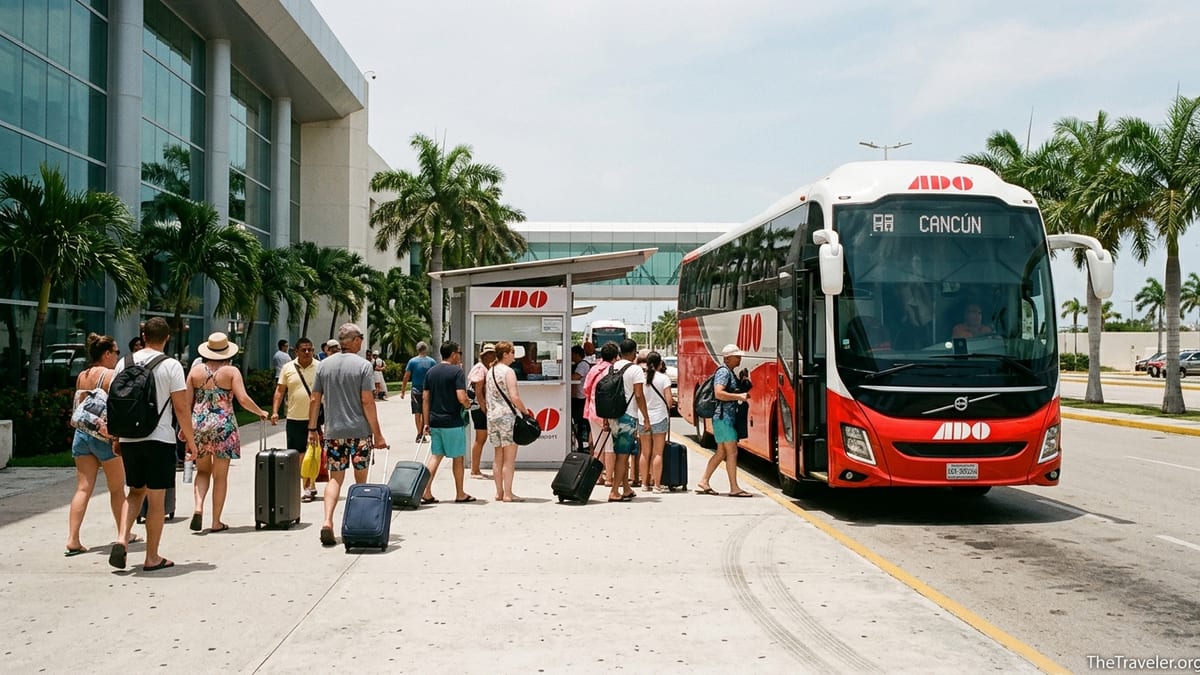
Understanding ADO at Cancun International Airport
ADO is a long‑distance bus company that operates across southeastern Mexico and holds the main concession to run public buses from Cancun International Airport into downtown Cancun and along the coast. Unlike private shuttles or taxis, ADO buses run on fixed routes and schedules, with tickets sold per seat rather than per vehicle. For solo travelers or couples, this usually works out far cheaper than booking a dedicated transfer, especially if you are heading to downtown Cancun or Playa del Carmen.
At Cancun airport, ADO currently offers three core routes that matter to most visitors: the long‑standing airport to downtown Cancun route, the popular airport to Playa del Carmen route, and, since 2025, a newer airport to Hotel Zone service that continues past downtown to a fixed stop near Punta Cancun. Typical one‑way fares in mid‑2026 are around 270 Mexican pesos from the airport to Playa del Carmen and roughly 140 to 170 pesos to downtown or the Hotel Zone, though exact prices can vary by season and should always be checked at the time of booking.
The key thing to understand is that ADO does not operate like a city bus. Buses are modern, usually air‑conditioned coaches with luggage holds underneath, assigned seats and tickets that correspond to a specific departure time. When you buy a ticket at the airport, you are reserving a seat on a particular bus, whether you are boarding at Terminal 2, 3 or 4. This is why timing and knowing your terminal matters.
In practice, that means your experience with ADO depends on when your flight lands, which terminal you arrive at, and where you are ultimately staying. A couple heading to a guesthouse near the ADO Terminal in downtown Cancun will have an almost door‑to‑door ride, while a family going to an all‑inclusive in the mid‑Hotel Zone might combine an ADO bus with a short ride on the local R1 or R2 city buses along Boulevard Kukulcan, or a taxi from the ADO downtown terminal.
Where to Find ADO at Terminals 2, 3 and 4
All three main international terminals at Cancun airport have ADO ticket points, but the layout and feel of each terminal is slightly different. In every case, the basic sequence is the same: clear immigration, collect your luggage, pass customs, walk through the gauntlet of timeshare and transfer sales desks, reach the public exit, and then look for red ADO branding near the doors leading outside.
At Terminal 3, where many North American airlines arrive, travelers typically exit into a bustling hall filled with transport counters. Here, the ADO kiosk is usually on the right‑hand side before you step out into the heat. You buy your ticket inside, then proceed out to the curb where an ADO representative will direct you to the correct waiting area. The actual bus stop is a short walk straight ahead, in the row of buses and shuttles. First‑timers are often surprised by how many people in matching shirts try to sell them private transfers; ignoring those pitches and heading straight for the official ADO counter saves both time and money.
In Terminal 2, which handles a mix of domestic and some international flights, the process is similar but the building feels smaller. After exiting customs, look for the ADO desk close to the exit doors toward the ground transportation area. Many Mexican domestic travelers use this terminal, so you will likely see locals lining up to buy ADO tickets to downtown Cancun or Playa del Carmen. This is a good sign you are in the right place. The bus usually pulls up just outside on the same level, and staff will call out destinations such as “Cancún Centro” or “Playa del Carmen.”
Terminal 4, serving several international carriers, has a more modern layout and often feels more spacious. Here, the ADO ticket stand is typically found in the main arrivals hall or just outside near the bus bay. One common complaint from travelers is that tickets bought at Terminal 4 kiosks or from third‑party counters can appear more expensive than at other terminals or online. That is one reason many frequent visitors either buy online in advance or, when practical, walk or take the airport’s internal shuttle to another terminal for better prices and more frequent departures. Practically, most travelers will simply buy at their arrival terminal, but being aware of price differences can help you decide if it is worth planning ahead.
Routes: Downtown Cancun, Hotel Zone and Playa del Carmen
The classic ADO route from Cancun Airport to downtown Cancun runs frequently throughout the day and remains the backbone of the system. Buses usually terminate at the main ADO Bus Terminal in central Cancun, located near Avenida Tulum. For travelers staying in hostels or budget hotels in El Centro, this is extremely convenient; you can often walk to properties around Parque Las Palapas or along Tulum Avenue in 5 to 10 minutes, or take a short taxi ride. From the downtown terminal, you can also connect to local buses heading along the Hotel Zone or to other parts of the city.
Since March 2025, ADO has operated a direct route from Cancun Airport through the Hotel Zone, ending near the Punta Cancun area around kilometer 9 of Boulevard Kukulcan. This service typically runs a handful of times per day, roughly every two hours in the late morning and afternoon, and is designed for visitors staying in the northern half of the Hotel Zone, close to large resorts, the convention center and nightlife around Forum Cancun. Instead of stopping at individual hotels, the bus uses a fixed stop, and passengers then walk or take a short taxi or local bus ride to their exact property. Prices have generally been quoted in the range of 140 to 170 pesos, making it one of the best‑value ways to ride straight into the Hotel Zone without a private transfer.
The airport to Playa del Carmen route is probably the most used ADO service among independent travelers. Buses run from Terminals 2, 3 and 4 and typically terminate at the ADO “Turística” station just off Fifth Avenue in Playa del Carmen, very close to the pedestrian zone and the Cozumel ferry pier. In late 2025 and mid‑2026, travelers report paying around 250 to 280 pesos one way, depending on departure time and how far in advance the ticket is purchased. For example, a couple landing around midday at Terminal 3 could buy tickets for a bus departing within 30 to 45 minutes and be in central Playa del Carmen roughly 60 to 75 minutes later, walking distance from beachfront hotels and many vacation rentals.
One nuance that often confuses visitors is that some Playa del Carmen buses may stop at two different ADO terminals in town: the Turística terminal near Fifth Avenue and the Alterna terminal closer to 20th Avenue. From the airport, most services still use the Turística stop, but return services to the airport sometimes depart from Alterna. Always confirm which terminal your ticket indicates so you do not show up at the wrong station for your return flight.
Buying Tickets: Counters, Machines and Online Options
There are three main ways to get ADO tickets from Cancun airport: buying at the airport from an official counter or kiosk, purchasing from a ticket machine where available, or booking online in advance through ADO’s official sales channels. For most casual travelers, the simplest method is to walk up to the red ADO counter in the arrivals area and ask for the next bus to your destination, whether that is “Cancún Centro,” “Zona Hotelera” or “Playa del Carmen.” Staff will show you the next available departure time and price, and you can pay in Mexican pesos by cash or, usually, by credit or debit card.
Some frequent visitors prefer to buy tickets online before they fly, especially during peak holiday periods such as Christmas, Easter or mid‑summer, when buses can sell out in the mid‑afternoon. Booking a seat on, for instance, the 15:00 bus from Terminal 3 to Playa del Carmen gives peace of mind if your flight is scheduled to land around 13:30. The trade‑off is that if your flight is significantly delayed, you may need to change your ticket. ADO staff can often help rebook you on a later departure, but this is not always guaranteed and may involve a small fee or fare difference.
At the airport, it is worth checking carefully that you are buying from an official ADO agent rather than a third‑party transport company with similar colors or branding. Real‑world reports mention salespeople quoting prices in US dollars that are significantly higher than the pesos rate you would see on ADO’s own platforms. As a rule of thumb, if someone suggests a one‑way ride to downtown Cancun for the equivalent of 25 to 30 US dollars per person, you are almost certainly not dealing with the standard ADO bus service. Genuine ADO tickets to downtown usually cost a small fraction of that.
Another practical point is that ADO operates on fixed schedules. When you are at the airport counter, ask the agent to tell you the departure time, expected travel time and which terminal in Playa del Carmen or downtown Cancun you will arrive at. For example, if they tell you the next bus to Playa del Carmen leaves at 14:10 and arrives about 15:25, you can decide whether to take that or wait for a slightly later departure that might align better with your hotel check‑in time. This information also helps if you need to coordinate with friends or a host picking you up at the final stop.
Luggage, Seating and Onboard Experience
ADO buses from Cancun airport are full‑size coaches with under‑floor luggage compartments where larger suitcases and backpacks are stored. When boarding, staff will usually open the hold, place your luggage inside or allow you to do so, and then close it before departure. It is common practice for them to hand you a small luggage tag corresponding to your bag. Keep this slip safe, as it may be checked when you retrieve your luggage at your final stop, especially at busy terminals like downtown Cancun or Playa del Carmen.
Inside the bus, seats are typically assigned according to the seat number printed on your ticket, although in less busy departures passengers may sit more freely. The seating layout is generally 2 + 2 across the aisle, with reasonably comfortable recline and air conditioning set quite cool. Many travelers recommend carrying a light sweater or scarf, even in the Caribbean heat, particularly if you tend to feel cold in strong air‑conditioning. Overhead racks accommodate small backpacks and daypacks, but it is wise to keep valuables such as passports, electronics and wallets with you rather than in the under‑floor luggage compartment.
Most airport routes do not have onboard restroom facilities as consistently as longer intercity runs, so it is best to use the bathrooms in the terminal before boarding, especially if you are traveling with children. The ride from Cancun Airport to downtown typically takes around 25 to 35 minutes depending on traffic, while the journey to Playa del Carmen is closer to an hour or a little more. The Hotel Zone route can vary depending on traffic along Boulevard Kukulcan; mid‑day runs may move quickly, while late‑afternoon buses can encounter congestion near major resorts and shopping centers.
Food and drink rules are generally relaxed, but considerate. Many locals and experienced travelers bring a bottle of water and a small snack from the airport convenience stores to enjoy on the ride, taking care not to leave trash behind. Strongly scented or messy foods are best avoided out of courtesy to other passengers. Earphones, downloaded playlists or podcasts, and an offline map of Cancun or Playa del Carmen on your phone can make the trip pass more comfortably, especially if you are tired after a long international flight.
Using ADO to Connect with the Hotel Zone and Downtown Transit
For travelers whose hotels are not immediately next to an ADO stop, the bus is often just the first leg of the journey. If you take the classic airport to downtown route, you will arrive at the main ADO terminal in central Cancun. From there, many visitors transfer to local city buses like the R1 or R2 that run along Boulevard Kukulcan through the Hotel Zone. These city buses are far cheaper than taxis, usually costing only a handful of pesos, and they make frequent stops along the strip at well‑known landmarks such as Plaza La Isla, Coco Bongo, and large resort clusters.
A common real‑world example: a solo traveler staying at a mid‑range hotel near kilometer 11 of the Hotel Zone might first ride ADO from the airport to downtown Cancun, then walk out of the ADO terminal, cross Avenida Tulum and board an R1 bus marked “Zona Hotelera.” After about 15 to 20 minutes, the bus will reach the stop closest to their hotel, from which they can walk the final few hundred meters. The total cost would likely be under 200 pesos, significantly less than a direct taxi from the airport.
If you instead use the newer airport to Hotel Zone route, the bus will carry you directly to Punta Cancun, which is particularly convenient if you are staying near the convention center, Forum area or popular nightlife spots. From that fixed stop, you can either walk to nearby hotels or hop on a local city bus heading further down the strip toward places like the Iberostar, Hard Rock or Secrets resorts. While this still involves a transfer, it avoids back‑tracking through downtown Cancun, saving both time and the additional bus ride into the Hotel Zone.
For Playa del Carmen, onward connections are also straightforward. The Turística terminal is only a block or two from Fifth Avenue, where many boutique hotels, hostels and vacation rentals are located. Travelers heading to large resorts north or south of town often use taxis or pre‑arranged shuttles from outside the ADO station. Others walk across town to catch colectivos or regional buses heading on to Tulum, Akumal or various cenote areas, using Playa del Carmen as a hub rather than their final stop.
Common Mistakes and How to Avoid Them
One of the most frequent mistakes first‑time visitors make is following the wrong crowd after exiting customs. The corridors at Cancun airport are lined with aggressive timeshare and transport salespeople who often encourage arriving passengers to stop at their desks for “information” or a “free shuttle presentation.” Travelers who intend to use ADO sometimes find themselves being steered toward private shuttles or taxi services instead, only realizing later that they paid far more than necessary. To avoid this, walk straight through the sales area without engaging and look specifically for the official ADO counter with clear red branding.
Another common error is misunderstanding where the ADO bus actually goes. Older guidebooks and blog posts may say that ADO only runs to downtown Cancun, not the Hotel Zone, while some more recent social media posts focus exclusively on the new Hotel Zone route. In reality, ADO offers both, but on different schedules and with different price points. If you simply ask for a ticket “to Cancun” without specifying “Centro” or “Zona Hotelera,” you may end up with the less useful option for your particular hotel. Always clearly state your destination and, if possible, show staff the address or the name of your hotel on your phone.
Timing is another area where travelers slip up. For example, someone with a 21:00 arrival into Terminal 4 might read about the Hotel Zone bus and plan to use it, only to discover at the counter that the last Hotel Zone departure was in the early evening. In that case, the fallback would be the late‑running downtown Cancun bus, combined with a city bus or taxi to reach their hotel. Checking the day’s latest schedules on ADO’s official channels before you fly can help you gauge whether the Hotel Zone route will realistically match your arrival time, or if you should plan on the downtown connection instead.
On the Playa del Carmen side, a regular pitfall is showing up at the wrong terminal for the return bus to the airport. Some tickets specify departure from the Alterna station rather than the Turística one closer to Fifth Avenue. Travelers who head to the wrong terminal at 05:30 for an early‑morning flight can find themselves scrambling. When you purchase your return ticket, double‑check which terminal is printed on it and, if you are unsure, ask staff to point it out on a map or describe nearby landmarks so you know exactly where to go.
The Takeaway
Used correctly, the ADO bus network at Cancun International Airport is one of the most efficient and cost‑effective ways to reach downtown Cancun, the Hotel Zone and Playa del Carmen. It combines the reliability of a scheduled coach service with prices that are a fraction of most private transfers, particularly for solo travelers and couples. Understanding the differences between the downtown, Hotel Zone and Playa del Carmen routes, and knowing which terminal you will arrive and depart from, turns what might seem like a confusing system into a straightforward part of your trip.
By going straight to the official ADO counter, confirming your exact destination, and paying attention to the schedule printed on your ticket, you can avoid common pitfalls such as overpaying for unofficial services, missing the last Hotel Zone departure or turning up at the wrong terminal in Playa del Carmen. Pair the ADO bus with local city buses or short taxi rides, and you have a flexible, budget‑friendly way to move between the airport, downtown and the coast, freeing up more of your travel budget for meals, activities and the Caribbean experiences you came for.
FAQ
Q1. Does the ADO bus go directly from Cancun airport to the Hotel Zone?
Yes, ADO now operates a direct route from Cancun Airport to a fixed stop in the Hotel Zone near Punta Cancun, with several departures most days. It does not stop at individual hotels, so you may still need a short local bus or taxi ride to reach your exact property.
Q2. How much does the ADO bus from Cancun airport to Playa del Carmen cost?
In mid‑2026, typical one‑way fares from Cancun Airport to Playa del Carmen are around 250 to 280 Mexican pesos per person, depending on schedule and demand. Prices can change, so always verify the live fare when you buy.
Q3. Where is the ADO bus stop at Cancun airport?
Each main terminal, 2, 3 and 4, has an ADO ticket point in or just outside the arrivals area. After buying your ticket at the red ADO counter, staff will direct you to the designated bus bay immediately outside the terminal, where the coaches pull in to pick up passengers.
Q4. Can I buy ADO tickets online before I arrive?
Yes, you can usually purchase tickets online in advance for routes such as Cancun Airport to downtown, Hotel Zone or Playa del Carmen. This can be useful in busy seasons, although if your flight is delayed you may need to speak with staff to change your departure time.
Q5. Is it safe to put my suitcase in the luggage compartment?
On ADO airport routes, large suitcases and backpacks go in the under‑floor luggage hold. Staff typically issue a luggage tag that matches your bag. It is generally considered safe, but you should keep valuables like passports, money and electronics with you in the cabin.
Q6. How long does the ADO bus take from Cancun airport to downtown?
Travel time from Cancun Airport to the main ADO terminal in downtown Cancun is usually about 25 to 35 minutes, depending on traffic. It can be slightly longer at peak times or during roadworks, so factor in a margin if you have connections or appointments.
Q7. What if my flight is late and I miss my scheduled ADO bus?
If you miss the specific departure printed on your ticket because of a delay, ADO staff at the airport can often move you to the next available bus on the same route, subject to seat availability. Policies can vary, so it is best to speak politely with the counter staff as soon as you arrive.
Q8. Does ADO stop at all hotels in Cancun or Playa del Carmen?
No. ADO buses serve fixed terminals and, in the Hotel Zone, a single designated stop. In Cancun, that is the downtown ADO station; in Playa del Carmen, usually the Turística terminal near Fifth Avenue. From there, you connect by local bus, taxi or pre‑arranged transfer to your specific hotel.
Q9. Can I pay for ADO tickets in US dollars?
Official ADO counters quote prices in Mexican pesos, and payment is typically taken in pesos or by card. Some third‑party sellers around the airport may quote in US dollars at unfavorable exchange rates. To avoid overpaying, it is better to pay in pesos or use a card at the official counter.
Q10. Is ADO the best option if I am traveling with a large family or lots of luggage?
For solo travelers or couples, ADO is often the most economical choice. For larger families or groups with many bags, the combined cost of multiple ADO tickets plus taxis or local buses at the destination may approach the price of a private shuttle, which could be more comfortable and direct. It is worth comparing both options for your specific group size and hotel location.