


Landing at Cancun International Airport for the first time can feel overwhelming. The terminals are busy, there are dozens of people selling transfers, and signs are mostly in Spanish. With a bit of preparation, however, you can walk through arrivals, choose the right transport to your hotel, and start your vacation with far less stress. This guide explains how Cancun Airport works today, with real-world examples of what to expect and how to move between the airport, downtown, and the Hotel Zone.
Get the latest updates straight to your inbox!
Understanding Cancun International Airport and Its Terminals
Cancun International Airport (CUN) is Mexico’s second-busiest airport and the primary gateway to the Riviera Maya. It currently has four passenger terminals plus a fixed-base operation area for private aviation. Terminals 2, 3, and 4 are where most international visitors arrive and depart, and a free inter-terminal shuttle connects all terminals landside roughly every few minutes. In practice, you might land in one terminal and depart from another on your return, so it is helpful to know the basic layout before you arrive.
Terminal 2 is the oldest and most complex terminal, handling a mix of domestic flights and international services to destinations in the Americas and Europe. Many Mexican carriers and some European leisure airlines use this terminal. Terminal 3 focuses heavily on international flights from the United States and Canada, so if you are flying on a major U.S. carrier there is a good chance you will arrive here. Terminal 4 is the newest facility and hosts a mix of Mexican, U.S., Canadian, and European airlines, with a more modern design and often more spacious waiting areas.
If you have a connecting domestic flight within Mexico, there is a reasonable chance one segment will use Terminal 2 and the other Terminal 4. In that scenario, follow the signs for the free terminal shuttle after customs; it operates outside the secured area and is clearly signed. The ride between terminals usually takes under 10 minutes, and you should avoid anyone trying to sell you a paid taxi just to change terminals. Some travelers report being quoted around 40 US dollars for this unnecessary hop, which you can safely decline in favor of the free shuttle.
Private and charter flights generally use Terminal 1, which most leisure tourists will never see. If a tour operator charter has you arriving at a different terminal than indicated on your ticket, check the airport’s latest terminal allocations a day or two before flying or verify with your airline’s app, since occasional operational changes do occur during peak seasons.
What to Expect on Arrival: Immigration, Customs, and the “Gauntlet”
On arrival you will first pass through immigration, where you may encounter lines at peak times, especially on Saturdays and around major holidays. Have your passport and completed entry form ready if your airline has not already shifted to electronic pre-clearance. After passport control you will collect your luggage and pass customs screening. Random inspections are common, and officers may ask you to place bags on an X-ray belt or open them, so avoid packing restricted food items or large amounts of liquids outside checked baggage.
Once you exit customs through the final sliding doors, you enter what many frequent visitors call the “gauntlet.” This corridor is filled with timeshare salespeople and unofficial transport sellers who often present themselves as if they are airport staff or part of your tour package. They may hold clipboards, wear branded polo shirts, or ask which hotel you are staying at. Unless you have pre-booked transportation and can clearly match the logo and name to your voucher, it is better not to stop. Politely say you already have transport arranged and keep walking until you reach the outdoor curbside area.
An example many first-time travelers share is being approached by someone who says, “I am with your resort, come this way to confirm your shuttle,” only to discover it is a timeshare presentation invitation. Genuine pre-booked shuttles or transfers will have your name on a printed sign and will meet you at designated numbered meeting points outside the terminal buildings, not inside the main corridor. If you are unsure, ask to see a company name that matches what is on your voucher or booking email and do not hand over your luggage until you are comfortable.
Before leaving the secure area, this is also a good moment to visit an ATM if you need pesos for buses or small purchases. ATMs inside the terminal, especially those operated by major Mexican banks, typically offer more reliable service than stand-alone machines in tourist areas. Many services around Cancun Airport accept U.S. dollars, but you will often get better value by paying in Mexican pesos, especially for buses and local taxis.
Getting from Cancun Airport to the Hotel Zone and Downtown
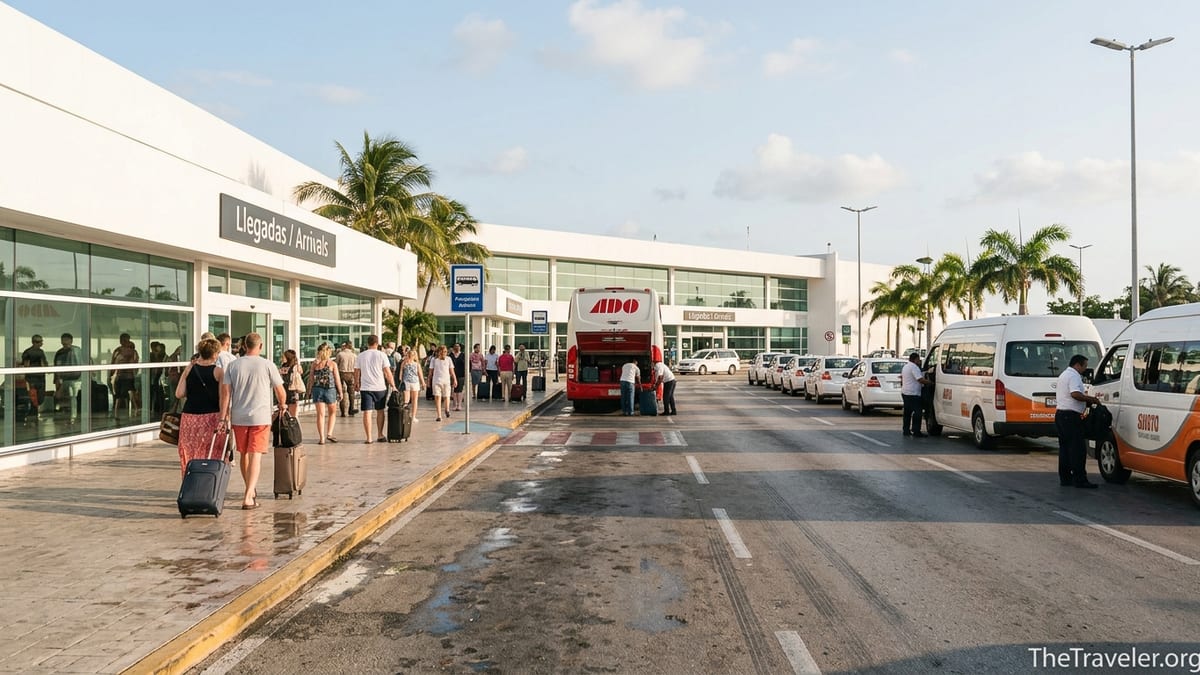
After exiting the terminal building, you have several ways to reach the Hotel Zone or downtown Cancun: the ADO bus network, shared shuttles, private transfers, official airport taxis, and rental cars. Which option is best depends on your budget, the size of your group, and how much luggage you are carrying. First-time visitors often prefer pre-booked shuttles for their simplicity, but cost-conscious travelers frequently choose ADO buses combined with a short taxi or local bus ride.
ADO, the main intercity bus company in the region, runs frequent coaches from Terminals 2, 3, and 4 to downtown Cancun’s main bus terminal and to other destinations such as Playa del Carmen and Tulum. Typical one-way fares from the airport to downtown Cancun are usually in the range of the equivalent of about 5 to 8 US dollars per person, payable in pesos. Departures commonly run every 20 to 40 minutes during the day, and tickets can be bought at ADO counters inside the terminals or from staff near the marked bus bays just outside. Buses are air-conditioned, have luggage holds, and are designed with tourists in mind.
In recent years ADO has also introduced a direct service from the airport to the Hotel Zone, dropping passengers near Plaza Fiesta in the Punta Cancun area around kilometer 9 of Boulevard Kukulcan. As of 2026 this route generally costs in the ballpark of about 170 Mexican pesos one way per passenger, although schedules and pricing can change seasonally. This can be a good compromise if you are staying in the northern or central Hotel Zone and prefer not to change to a local bus downtown. From the drop-off point, some travelers walk to nearby hotels like Krystal Cancun or the hotels around the convention center, while others grab a short taxi ride further along the strip.
For those staying in downtown Cancun, the standard ADO bus to the main terminal is the easiest choice. From there you can take a city taxi to your hotel for a typical fare in the region of 200 to 300 pesos, or hop on a local R1 or R2 public bus that runs out to the Hotel Zone for a modest flat fare, usually the equivalent of around 1 US dollar. This ADO plus local taxi or bus combination is especially attractive to solo travelers or couples on a budget, adding up to significantly less than a private shuttle straight from the airport.
Shuttles, Taxis, and Private Transfers: How Much You Will Likely Pay
Cancun Airport is full of transport companies offering shared and private shuttles to the Hotel Zone and beyond. A shared shuttle is usually the next cheapest step after the bus, with prices commonly starting around 25 to 30 US dollars per person one way to most hotels in the Hotel Zone, depending on the company and season. In practice, you might see shared rates such as about 27 dollars per person with a reputable operator for a van that stops at several hotels along the route. Shared shuttles can be good value for solo travelers who do not want to handle buses and luggage changes.
Private transfers, where a driver and vehicle are reserved exclusively for your group, usually charge a flat rate per vehicle. For a family of four or a small group with luggage, these can often work out at around 40 to 80 dollars per vehicle for a one-way trip to the Hotel Zone, depending on the level of service and vehicle type. Mid-range providers often advertise prices in the range of about 40 to 60 dollars each way for a standard van to hotels around kilometer 9 to kilometer 16. Higher-end operators offering SUVs or luxury vehicles frequently start closer to 100 dollars per vehicle each way.
Official airport taxis are regulated, with fixed zone pricing posted at booths outside the terminals; however, the airport does not prominently publish tariffs online. Recent traveler reports indicate that one-way taxi fares to the main Hotel Zone commonly run in the neighborhood of about 30 to 50 dollars, with higher prices possible at peak times or for late-night arrivals. Some visitors have been quoted substantially more, especially if they do not ask for the official rate beforehand. A typical pattern is a quoted price of around 65 to 80 dollars for a last-minute taxi when pre-booked shuttles are sold out, which most travelers can avoid by organizing transport ahead of time.
A practical example: a couple arriving mid-afternoon might compare options and find an ADO bus to downtown for about 8 dollars each plus a 15-dollar taxi to their Hotel Zone property, for a total around 31 dollars. A shared shuttle for the same trip might be approximately 30 dollars each, totaling 60 dollars, but with the convenience of being dropped directly at the hotel. A private van booked in advance could cost roughly 50 dollars total, which is more than the bus combination but offers door-to-door service and no waiting for other passengers. For many first-time visitors, that predictability is worth the difference.
Car Rental, Driving, and When It Actually Makes Sense
Almost every major international rental car brand has a presence at Cancun Airport, alongside numerous local agencies. Desks are usually located in the arrivals area or just outside the terminals, and many companies operate shuttle vans to off-airport lots. Daily base rates advertised online can look very low, sometimes under 20 dollars per day, but Mexican liability insurance rules and additional fees significantly increase the real cost. At the counter, it is common for travelers to see their expected total double or even triple once mandatory insurance is added.
For a week-long stay, a realistic all-in price for a basic compact car with full local insurance coverage often ends up in the approximate range of 40 to 70 dollars per day once everything is included, depending on season and demand. First-time visitors should plan based on the higher end of that range and treat any rock-bottom offers with skepticism. Choosing a well-known international brand or a highly rated local company tends to reduce issues with disputed damage charges or surprise add-ons.
Driving in and around Cancun is relatively straightforward compared with major cities, but there are a few things to be aware of. The main road from the airport to the Hotel Zone and downtown is a multi-lane highway where traffic moves quickly, and lane discipline can be loose. Speed bumps, known locally as topes, appear suddenly near intersections and resort entrances, and local taxis and buses may stop abruptly to pick up passengers. Police checkpoints are not unusual on the highway toward Playa del Carmen and Tulum, and visitors should keep copies of rental documents and identification handy.
Renting a car makes the most sense if you plan to explore beyond Cancun, especially if you want to visit places like cenotes between Puerto Morelos and Tulum, or make day trips to archaeological sites such as Chichen Itza or Coba on your own schedule. For travelers who plan to stay mostly within the Hotel Zone and join organized excursions that include transport, a rental car is often more hassle than benefit, given parking fees at some hotels and the availability of hotel pickups for many tours.
Departures from Cancun: Check-in, Security, and Timing
For departing flights from Cancun International Airport, airlines and the airport generally recommend arriving at least three hours before scheduled departure for international flights and two hours for domestic flights. During peak seasons such as Christmas, Easter, and summer school holidays, it is wise to treat these as minimums. Historically, security bottlenecks and long check-in lines have occurred on weekend mornings, especially in Terminals 3 and 4, so building in extra buffer time is prudent.
Most major airlines offer online check-in and mobile boarding passes, but you will still need to queue to drop checked luggage. Bag-drop lines can be just as long as full check-in lines, so do not assume a mobile boarding pass automatically shortens your wait. Once past security, the departure areas in Terminals 3 and 4 include a wide selection of duty-free shops, pharmacies, fast-food outlets, and sit-down restaurants. Prices for food and drinks inside security are generally above downtown levels; as an example, a simple coffee and pastry might cost the equivalent of 7 to 10 US dollars.
When returning to the airport from the Hotel Zone, many travelers ask how early they should leave. Traffic can be heavy around hotel checkout times, particularly between late morning and mid-afternoon. A rule of thumb many repeat visitors use is to plan at least one hour for the journey from a mid-zone hotel to the airport, including potential traffic, plus the recommended pre-flight arrival time. If you are staying in downtown Cancun, you can often reach the airport in 25 to 40 minutes outside rush hours, but it is still better to be conservative.
For those using ADO buses back to the airport, tickets can be bought in advance at the downtown terminal or online, but many people simply arrive 20 to 30 minutes before the bus they want and buy on the spot. Keep in mind that popular departure times may sell out on busy days, particularly for buses to Playa del Carmen and Tulum that connect with international flights, so securing a seat earlier in the day can reduce stress.
First-Time Cancun Tips to Avoid Common Airport Mistakes
First-time Cancun visitors tend to encounter the same pitfalls at the airport, and a few simple habits can help you avoid them. One of the most important is to be clear about your transport plan before you land. Decide whether you are taking the ADO bus, a shared shuttle, a private transfer, or a taxi, and know roughly what it should cost. For example, if you know that a private transfer to your Hotel Zone resort should be somewhere in the range of 40 to 70 dollars per vehicle, you are less likely to accept an on-the-spot offer of 120 dollars for the same route.
Another key tip is to ignore anyone who tells you the ADO bus is not running or that there is no free inter-terminal shuttle. Both services are well established. If an unofficial promoter insists that buses are “finished for the day” and that you need their much more expensive taxi, walk on and look for the official counters or ask uniformed ADO staff. Similarly, if you need to change terminals for a departure, follow airport signs to the free shuttle rather than accepting paid offers.
Carrying some pesos on arrival will make your first few hours easier. Even if you plan to charge most expenses to a card, having enough local currency for bus tickets, small snacks, and tips is helpful. Typical tipping expectations include a small tip for shuttle drivers who help with bags and housekeeping staff at your hotel. At the airport, tipping is not required for standard check-in or security interactions, and you should be cautious about accepting unsolicited bag-carrying help from individuals who then demand high tips.
Finally, be careful with your time after arrival. It can be tempting to linger at duty-free shops near baggage claim or browse airport kiosks, but if you are planning to catch an ADO bus or shared shuttle, getting to the transport area promptly gives you more flexibility with departure times. Similarly, on your return, do not underestimate lines at security or immigration for flights to the United States and Canada. If a hotel or shuttle company suggests a pickup time that feels late, ask them directly how much buffer it leaves before your flight and consider requesting an earlier pickup if you are not comfortable.
FAQ
Q1: Which terminal will I most likely arrive at in Cancun?
Most international visitors from the United States and Canada arrive at Terminal 3 or Terminal 4, while some flights from Mexico and Latin America use Terminal 2. Always confirm with your airline before travel, as terminal assignments can change.
Q2: How do I find the ADO bus when I exit customs?
After clearing customs and walking past the timeshare desks, continue outside to the curbside area and look for the official ADO counter or uniformed staff directing passengers to the marked bus bays. Buses to downtown Cancun and other destinations board from clearly signed platforms near the terminals.
Q3: Is it safe to take the ADO bus from the airport?
The ADO buses from Cancun Airport are generally considered a safe and reliable option widely used by locals and tourists. They are modern, air-conditioned coaches with luggage stored in the underfloor bays. As with any bus travel, keep valuables with you in the cabin rather than in checked bags.
Q4: How much should I expect to pay for a taxi to the Hotel Zone?
Recent reports suggest official airport taxi fares to most Hotel Zone hotels typically run in the range of about 30 to 50 US dollars one way, depending on distance and time of day. Always ask for the official rate at the taxi booth before agreeing to a ride.
Q5: What is the cheapest way to get from Cancun Airport to the Hotel Zone?
The least expensive option is usually the ADO bus to downtown Cancun combined with a local bus or city taxi to your hotel. ADO tickets to downtown generally cost the equivalent of 5 to 8 dollars, and local buses or taxis add a modest extra cost, especially if you are sharing with companions.
Q6: Is a private shuttle worth it for first-time visitors?
For many first-time travelers, a pre-booked private shuttle is worth the extra cost because the driver meets you with a sign, takes you directly to your hotel, and eliminates negotiating at the airport. This can be especially appealing after a long international flight or when traveling with young children or several large suitcases.
Q7: How early should I arrive at Cancun Airport for my departing flight?
Plan to arrive at least three hours before international departures and two hours before domestic flights. During peak holiday periods or if you are checking bags with a popular airline, consider adding an extra 30 to 60 minutes to account for possible long lines.
Q8: Can I use rideshare apps like Uber from Cancun Airport?
Rideshare services in Cancun have been subject to changing regulations and are not consistently allowed to pick up directly at the airport terminals. Even when available in the city, most visitors to and from the airport rely on official taxis, pre-booked shuttles, or ADO buses rather than rideshare pickups at the terminal curb.
Q9: Should I rent a car at Cancun Airport?
Renting a car makes sense if you plan to explore multiple towns, beaches, or archaeological sites on your own schedule. If you are mainly staying at a resort in the Hotel Zone and joining tours that include transport, a rental car may not be necessary and could add unnecessary cost and stress.
Q10: Are there currency exchange and ATMs at Cancun Airport?
Yes, there are ATMs and currency exchange counters in the arrival areas of the main terminals. Many travelers prefer to use bank-operated ATMs to withdraw pesos at relatively competitive rates and avoid exchanging large amounts of cash at airport kiosks, which often offer less favorable terms.