


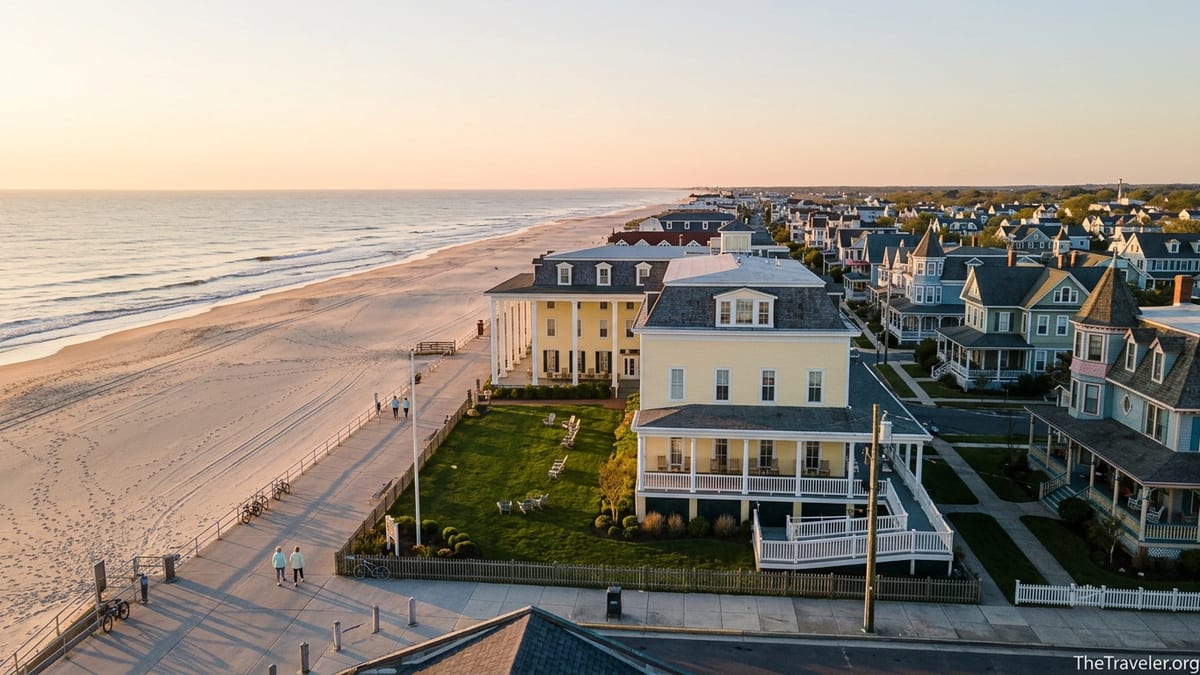
Stand on the wide promenade in Cape May, New Jersey, and it is easy to forget what year it is. Painted Victorian houses line quiet streets, waves roll against a broad curve of sand, and people meander to dinner in flip-flops rather than race to make reservations. America’s oldest seaside resort has spent centuries reinventing itself, yet the city’s intact Victorian district and deliberately slower pace make a visit feel less like a beach weekend and more like a gentle trip back in time.
Get the latest updates straight to your inbox!
A National Historic Landmark That Still Feels Lived In
Cape May sits at the southern tip of New Jersey, where the Atlantic Ocean meets Delaware Bay. The entire city is designated as the Cape May Historic District, a National Historic Landmark, thanks to its extraordinary collection of Victorian-era buildings. More than 600 structures in and around the compact downtown have been preserved or carefully restored, many in exuberant late-19th-century styles with turrets, gingerbread trim, and wraparound porches that look almost theatrical in the right evening light.
Unlike some historic districts that feel museum-like or staged, these buildings in Cape May are still very much in use. Grand old homes now operate as bed-and-breakfasts, small inns, or year-round residences. Walk along Ocean Street on a summer morning and you will see guests lingering over coffee on second-story verandas, or innkeepers watering overflowing flower boxes under striped awnings. The result is a town where history is not cordoned off behind ropes, but woven into daily routines.
This deep-rooted sense of place came in part from necessity. After a devastating fire in 1878, Cape May rebuilt in brick and embraced the ornate architecture of the period. When other Jersey Shore resorts chased neon boardwalks and high-rise motels, Cape May leaned into preservation. By the 1970s, when the historic district was formally recognized, the town’s Victorian character had become its signature and, today, its greatest asset for travelers looking for something quieter and more human-scale.
For visitors, this means you rarely need a car once you arrive. The center of town is compact and walkable, with the historic district, beaches, promenade, and harbor all within a few minutes of each other. That easy walkability enhances the feeling of stepping into a slower era, where daily life unfolds at the pace of your own feet.
Strolling the Promenade and Classic Beaches
Cape May’s Atlantic-facing shoreline stretches in a gentle arc, edged not by a raucous amusement boardwalk but by a paved promenade lined with benches, lampposts, and understated pavilions. In summer, families push strollers along the oceanfront after dinner, older couples claim the same bench at golden hour each evening, and joggers weave between them at an unhurried pace. It feels more like a European esplanade than a typical New Jersey boardwalk.
The beaches themselves are wide and soft, with lifeguards on duty in season and designated swimming areas marked by flags. Beach tags are required in summer, and while prices change slightly from year to year, seasonal tags typically cost in the ballpark of around 40 dollars when purchased at full rate, with discounts offered if you buy before the peak season. Day tags are usually well under that, making a spontaneous afternoon at the water’s edge an accessible splurge for most visitors. Tags can be purchased at kiosks, beach entrances, or through digital systems that let you show proof of purchase on your phone, a rare modern twist in a place that otherwise feels pulled from another century.
Different sections of the shoreline have distinct personalities. The central beaches near Congress Hall and the convention center are ideal if you want quick access to hotels, snack stands, and restrooms, while the Cove Beach at the western end is beloved for its sunset views over the bay side of the cape. In the early evening, clusters of beach chairs appear as people gather to watch the sky change color, often staying long after official lifeguard hours have ended.
Even on peak summer days, the rhythm here stays gentler than at bigger boardwalk towns. There are no roller coasters roaring over your head, just the low hiss of waves, the soft murmur of conversation, and occasionally the clip-clop of a horse-drawn carriage passing behind the dunes. Step off the sand, rinse your feet at one of the public showers, and you are never more than a few quiet blocks from tree-lined streets and painted porches.
Victorian Houses That Turn a Walk Into Time Travel
Cape May’s streets are a living architecture lesson. Entire blocks of the historic district are devoted to late-19th-century homes decked out in ornate woodwork, elaborate color schemes, and fanciful details that seem designed to surprise: a fish-scale shingled tower here, a delicately carved sunburst there. Some houses follow a refined Italianate or Second Empire style with mansard roofs and arched windows, while others embrace exuberant “gingerbread” flourishes that cue the eye at every turn.
A slow walk along Columbia Avenue, Hughes Street, or Jackson Street reveals one postcard scene after another. Many homes have historical plaques that note the year of construction and the original owners. You might pass a former sea captain’s house painted in deep marine blue with white trim, or a lovingly restored cottage in pastel pink and sage green, now welcoming guests as an inn. In the late afternoon, when the sun slants across the porches and ceiling fans spin lazily overhead, it can be hard to believe you are a short drive from the Garden State Parkway.
One anchor in this sea of Victoriana is Congress Hall, a grand yellow hotel that first opened as a boarding house in 1816 and was rebuilt in brick after the 1878 fire. It occupies an entire city block between Beach Avenue and the downtown streets, and today still serves as a full-service resort hotel with restaurants, a lawn dotted with blue-and-white striped cabanas, and rocking chairs lined up on the veranda. In summer, its front lawn hosts lawn games and family activities that echo the genteel seaside traditions of the 19th century.
On quieter side streets, many of the city’s famed bed-and-breakfasts operate in restored Victorian houses, each with its own personality. Some offer four-poster beds, parlors with antique settees, and formal multi-course breakfasts served on china. Others mix historic details with more contemporary interiors but still retain period features like stained-glass transoms or intricate staircase railings. Staying in one of these properties means that the experience of time travel continues even when you close your door for the night.
Unhurried Days: Trolleys, Walking Tours, and Simple Rituals
Part of what makes Cape May feel slower is that the most satisfying experiences here do not revolve around big-ticket attractions. Instead, the town invites visitors to trade a packed itinerary for simple rituals: a morning walk on the promenade, an hour on a shady bench on the Washington Street Mall, a late-afternoon bike ride through quiet streets while the cicadas buzz.
To get your bearings, you can join one of the popular trolley tours that loop around the historic district. Tickets are often sold from small kiosks near the Washington Street Mall, and rides typically last about 45 minutes. The open-sided red trolleys glide past notable houses and hotels while guides share stories of sea captains, Victorian socialites, and the great fire that reshaped the town. For travelers who prefer to move at their own speed, self-guided walking tour maps from local visitor centers highlight clusters of historic houses and churches you can explore independently.
The town’s scale makes it ideal for walking. Visitors frequently arrive, park their car near their inn or hotel, and then do almost everything on foot for the rest of their stay. A new county walking guide, produced in partnership with Rutgers University and local officials, showcases the fact that Cape May County has more than 100 miles of walking trails and parks, with Cape May itself serving as one of the most inviting hubs for casual walkers. Routes include not just the beachfront and downtown streets but nearby neighborhoods and nature trails that reveal another side of the peninsula.
Evenings tend to follow a gentle script. After dinner, people drift back to the mall or the promenade for ice cream and window-shopping. Street musicians sometimes set up on a corner, playing acoustic guitar or saxophone. Horse-drawn carriages clip past, offering narrated rides through lamplit streets for those who want an even more old-fashioned experience. Rather than the thump of late-night bars, the dominant sounds are conversation, music drifting from open restaurant doors, and the distant crash of surf.
Washington Street Mall: Small-Town Heart, Not Mega Mall
At the center of this time-travel experience is the Washington Street Mall, a three-block pedestrian zone that has become Cape May’s social hub. Here, a cluster of low-rise Victorian and early-20th-century buildings has been closed to traffic and reimagined as an outdoor main street, with brick walkways, planters, and plenty of benches. It is an easy stroll from many hotels and only a couple of blocks from the beach, so it naturally draws people at multiple points in the day.
Instead of chain retailers, the mall leans heavily on independent shops and eateries. You might browse a family-owned bookstore in one building, then step into a candy shop selling hand-dipped chocolates and saltwater taffy next door. Boutique clothing stores share the blocks with a fudge shop, a peanut butter specialty store tucked just behind the main drag, and galleries that showcase coastal art and photography. These businesses evolve over time, but the overall feel of browsing local, often family-run places remains consistent.
Because cars are kept out, the mall is unusually relaxed even when it is busy. Kids dart around with ice cream cones, couples linger over outdoor café tables, and multigenerational families plan their evening from a central bench. Holiday periods add another layer of charm, as storefronts string up lights and seasonal trolley tours depart from nearby to show off decorated inns and the famous Physick Estate dressed for the season.
For many visitors, a day in Cape May naturally orbits around the mall. Mornings might start with coffee at a small café there before heading to the beach, then shift to an afternoon of shopping and people-watching in the shade, and end with a return visit after dinner for dessert or a stroll. The mall has become a kind of open-air living room for the city, the clearest expression of Cape May’s slower, more communal pace of life.
Staying in Style: From Grand Hotels to Intimate B&Bs
Where you stay in Cape May shapes how you experience its time-travel charm. For those drawn to grand history, Congress Hall remains a landmark choice. Often described as one of America’s oldest seaside resort hotels, it combines its bright yellow exterior and deep verandas with modern amenities, including restaurants, a pool, and live music or lawn events in summer. Guests can step from their room straight onto the great lawn, then cross Beach Avenue to the sand in less than a minute.
Another storied option is the Chalfonte Hotel, a white-frame building with deep porches and a reputation as one of the oldest continuously operating hotels in Cape May. It leans into its historic character with creaky floors, ceiling fans, and traditional Southern-inspired fare in the dining room, offering an experience that feels like a cross between a summer camp for adults and an old-fashioned seaside retreat.
For many travelers, though, the quintessential Cape May experience comes from its bed-and-breakfast inns. Properties listed on local tourism sites include dozens of Victorian houses transformed into upscale inns, some with just a handful of guest rooms. Breakfasts often feature homemade baked goods, locally roasted coffee, and seasonal fruit, served either in an elegant dining room or on a breezy porch. Off-season, when rates tend to drop significantly compared with peak July and August weekends, these B&Bs can become surprisingly affordable for couples or solo travelers seeking a quiet escape.
Not everyone wants lace curtains and antiques, of course, and Cape May accommodates them too. There are updated motels and boutique hotels with a lighter, surf-inspired style, as well as family-friendly properties that offer kitchenettes, pools, and easy parking a short walk from the sand. What unites most of these options is scale: even the larger hotels tend to top out at a few stories, preserving the intimate, human-level streetscape that makes the whole town feel like an earlier era.
Slow Food, Local Farms, and Simple Pleasures
The slower pace in Cape May extends naturally to how people eat and drink. Rather than a wall of fast-food counters near the beach, you will find a mix of sit-down restaurants, casual seafood joints, bakeries, and coffee shops woven into both the beachfront and historic district. Many of the higher-end restaurants emphasize locally sourced ingredients and seasonal menus, reflecting the surrounding farms and fisheries of Cape May County.
One particularly striking example of this farm-to-table connection is Beach Plum Farm, a working farm just a short drive from downtown. Owned by the same hospitality group as several well-known Cape May hotels and restaurants, it supplies a substantial portion of the pork, eggs, and produce served in places like the Blue Pig Tavern at Congress Hall and the Ebbitt Room at the Virginia Hotel. Visitors can wander the farm’s paths, see heritage-breed pigs and chickens, and have breakfast or lunch at a rustic outdoor café that spotlights the farm’s own harvest.
Seafood is a natural highlight, given Cape May’s role as a major fishing port. At the harbor, casual dockside spots serve fried flounder, scallops, and shrimp baskets consumed at picnic tables overlooking the fishing fleet. In town, refined rooms in Victorian buildings present local scallops, crab cakes, and seasonal fish with white-tablecloth service, often in dining rooms lined with period moldings and candlelit mantels. Whether you order from a take-out window or sit under a crystal chandelier, you are rarely far from the source.
Ice cream, fudge, and saltwater taffy play their own starring roles in this leisurely lifestyle. Longstanding candy makers hand out generous samples as visitors debate flavors in glass cases, while ice cream shops on and around the Washington Street Mall stay open late in summer, keeping queues of families and teenagers moving steadily. Grabbing a cone and wandering without a particular destination might be the most quintessential Cape May ritual of all.
The Takeaway
Cape May’s power lies in how it slows people down almost by accident. You arrive for the beach and the pretty houses, then find yourself slipping into a rhythm dictated by porch swings, tidal cycles, and dinner reservations made days rather than minutes in advance. The absence of towering condos and loud boardwalk rides is not a lack but a deliberate choice, one that has preserved the scale and character that made this “summer city by the sea” famous in the first place.
For travelers used to screen-saturated, hyper-scheduled lives, a few days here can feel quietly radical. Mornings belong to walks and coffee on verandas, afternoons to swims and naps behind striped umbrellas, evenings to unhurried meals and aimless strolling. The Victorian architecture might be what first suggests time travel, but it is the unpressured pace of daily life that truly transports you.
Whether you stay in a grand historic hotel, a porch-wrapped B&B, or a modest motel a few blocks from the sand, you will be surrounded by a town that has consciously chosen to stay small, walkable, and deeply rooted in its own past. Cape May is not a place you “do” so much as one you inhabit for a while, at a tempo closer to the clop of a carriage horse than the buzz of a smartphone. For many visitors, that is precisely the point.
FAQ
Q1. When is the best time of year to visit Cape May for a slower-paced trip?
The calmest periods are typically late spring, from around mid-May to early June, and early fall, from mid-September into October. The weather is often mild, the ocean can still be warm in early fall, and crowds are lighter than in peak July and August. Winter weekends, especially around the holidays, can also feel magical, with decorated inns and special trolley tours but far fewer people.
Q2. Do I need a car once I arrive in Cape May?
If you are staying within or near the historic district, you can comfortably spend most or all of your visit without driving. Beaches, the Washington Street Mall, many restaurants, and historic sites are within walking distance. However, a car is useful if you want to explore nearby attractions like wineries, Beach Plum Farm, the lighthouse, or Cape May Point without relying on rideshares or seasonal shuttles.
Q3. How much should I budget for beach access?
In summer, Cape May’s beaches require beach tags for anyone above a certain age, typically young-teen or adult. Prices vary by season and year, but as a rough guide, daily tags usually cost under 15 dollars per person, while full-season tags have recently been around 40 dollars at regular rates, with discounts offered for early purchase. Many hotels and rentals include beach tags as part of the nightly rate, so it is worth checking before you buy your own.
Q4. What makes Cape May different from other Jersey Shore towns?
Cape May stands out for its intact Victorian architecture, National Historic Landmark status, and relatively low-key beachfront. Instead of a loud amusement boardwalk, it offers a paved promenade, historic houses, and a downtown built around a pedestrian mall with locally owned shops and restaurants. The focus is on walking, dining, and lingering over simple pleasures rather than on thrill rides or nightlife.
Q5. Is Cape May a good destination for families with children?
Yes, though it is more about relaxed, low-tech activities than big attractions. Families enjoy the guarded beaches, bike rides through quiet streets, mini-golf, visits to the nearby zoo, and simple routines like evening ice cream on the Washington Street Mall. Many hotels and inns are used to hosting children, but some Victorian B&Bs cater primarily to adults, so be sure to confirm policies before booking.
Q6. Can I visit Cape May as a day trip?
A day trip is very doable, especially if you are coming from elsewhere in South Jersey or via the ferry from Delaware. With one day you can walk the promenade, spend a few hours on the beach, explore the Washington Street Mall, and perhaps fit in a trolley tour or a lighthouse visit. That said, staying overnight, even just one or two nights, allows you to experience the quieter mornings and evenings that define the town’s slower rhythm.
Q7. What should I wear and pack for a visit here?
Cape May is casual, even at its finer restaurants. In summer, lightweight clothing, sandals, a hat, and a light sweater for breezy evenings are usually sufficient, along with the usual beach gear: swimsuits, cover-ups, and sunscreen. In spring and fall, pack layers and comfortable walking shoes since you will likely be spending a lot of time on foot exploring the historic district and waterfront.
Q8. Are there activities in Cape May if the weather is bad?
Yes. You can tour historic houses like the Emlen Physick Estate, visit the Harriet Tubman Museum, spend extra time browsing bookstores and galleries on the Washington Street Mall, or linger over long lunches and coffees in town. Many hotels and B&Bs have cozy parlors, board games, and porches sheltered from the rain, which pair nicely with a book and a pot of tea on stormy days.
Q9. Is Cape May suitable for travelers who prefer not to drive at all?
For visitors who arrive by bus, ferry, or rideshare and then want to stay car-free, Cape May is one of the more practical choices on the Jersey Shore. Once you are settled in the historic district, most daily needs are within walking distance. Depending on the season, local trolleys, jitneys, or taxis can help you reach outlying attractions like wineries or the lighthouse without renting a car.
Q10. How far in advance should I book lodging during peak season?
For July and August, especially over holiday weekends or if you have your heart set on a particular Victorian inn or oceanfront room, it is wise to book several months in advance. Congress Hall, the Chalfonte, and the most popular bed-and-breakfasts can fill up quickly. Shoulder seasons usually offer more flexibility, though booking a few weeks ahead still provides better choice and pricing than waiting until the last minute.