


Cape Town International Airport sits just 20 kilometres from the city centre, which makes many travellers wonder: with a layover of a few hours, can you actually leave the airport to see headline sights like Table Mountain, the V&A Waterfront or even the Cape Winelands? The answer is yes, in some cases, but timing, traffic, luggage and safety all matter. This guide breaks down what is realistic for different layover lengths and how to make the most of a stop in South Africa’s “Mother City.”
Get the latest updates straight to your inbox!
Understanding Cape Town Airport and Layover Logistics
Cape Town International Airport (CPT) is about 20 kilometres from the central city and the V&A Waterfront, with typical road travel times of roughly 20 to 30 minutes in light traffic and up to 45 minutes in busy periods. That sounds close, but when you add immigration, security and boarding buffers, your usable layover time shrinks quickly. For instance, if you land at 09:00 and depart again at 15:00, you do not have six free hours; you should allow about one hour after landing to clear formalities and at least 90 minutes back at the airport before your next flight.
Traffic patterns are another key variable. Data compiled on the airport commute shows that weekday morning peak around 07:00 can push airport to city journeys to around 70 minutes, roughly four times off peak travel times, while late evenings and midday weekends are often much faster. In practical terms, a 5‑hour layover that falls entirely in the middle of a weekday rush may be too tight for a trip up Table Mountain, while the same layover on a quiet Sunday afternoon could feel surprisingly relaxed.
Transport options are straightforward. Most visitors use app based ride services, prebooked private transfers or metered airport taxis, all of which run directly from the terminal forecourt to downtown and the Waterfront. A widely used public option is the city’s MyCiTi bus from the airport to the Civic Centre, where you can connect to routes serving the Waterfront and other central areas; this is slower but cheaper and has fixed fares that are typically under the equivalent of a few US dollars for the airport segment plus the once off cost of the reloadable card. For short layovers, door to door road transfers are usually worth the extra cost because they minimise uncertainty.
When planning, always think in blocks of 30 minutes instead of optimistic best cases. Figure at least 1 hour to reach central Cape Town from CPT in normal conditions each way, even though it is often faster, and build in a firm 90 minute buffer before your departing flight’s scheduled time, or 2 hours if it is an international sector. Once you do that math, you will see why certain excursions make sense only beyond a specific minimum layover length.
Minimum Layover Times: When Is It Safe to Leave the Airport?
A common question is: what is the minimum layover that still allows you to leave the airport without worrying about missing your onward flight? For domestic to domestic connections on a single ticket you may be able to stay airside and never clear immigration, in which case this guide is less relevant. For any itinerary where you must clear immigration, collect luggage or recheck bags, a conservative rule of thumb is that you need at least 6 to 7 hours between scheduled arrival and departure to consider a quick city outing, and 8 hours or more if you want time for Table Mountain.
With a 4 to 5 hour layover after entering South Africa, you generally do not have enough margin to go far. By the time you deplane, clear passport control, potentially collect and recheck luggage, and then return 90 minutes before your next flight, your actual available window could be barely 90 minutes. That may be enough for a coffee at an airport cafe or a nap at the onsite hotel, but not for a relaxed visit to the Waterfront. The risk of a small inbound delay turning into a missed connection is simply too high.
From around 6 to 7 hours, the V&A Waterfront becomes a realistic option for many travellers. For example, if your flight lands at 10:00 and your onward flight leaves at 17:00, and you clear formalities by 11:00, you could be at the Waterfront by roughly 11:30 and comfortably head back to the airport between 14:30 and 15:00. That gives you two to three hours to stroll the harbour, eat a full meal and perhaps do a bit of shopping before returning with a good safety margin.
For Table Mountain, most visitors should think in terms of 8 to 10 hours or longer. The cableway is subject to wind closures, queues and weather changes, and even on a quiet day you will want at least 90 minutes at the summit to justify the trip. Seen realistically, that means allowing about four hours for transport, ticketing and waiting, plus two hours on the mountain and your airport buffers. Anything shorter than about an 8 hour layover feels rushed and vulnerable to delays, particularly in high season when visitor numbers spike.
V&A Waterfront: The Most Realistic Layover Excursion
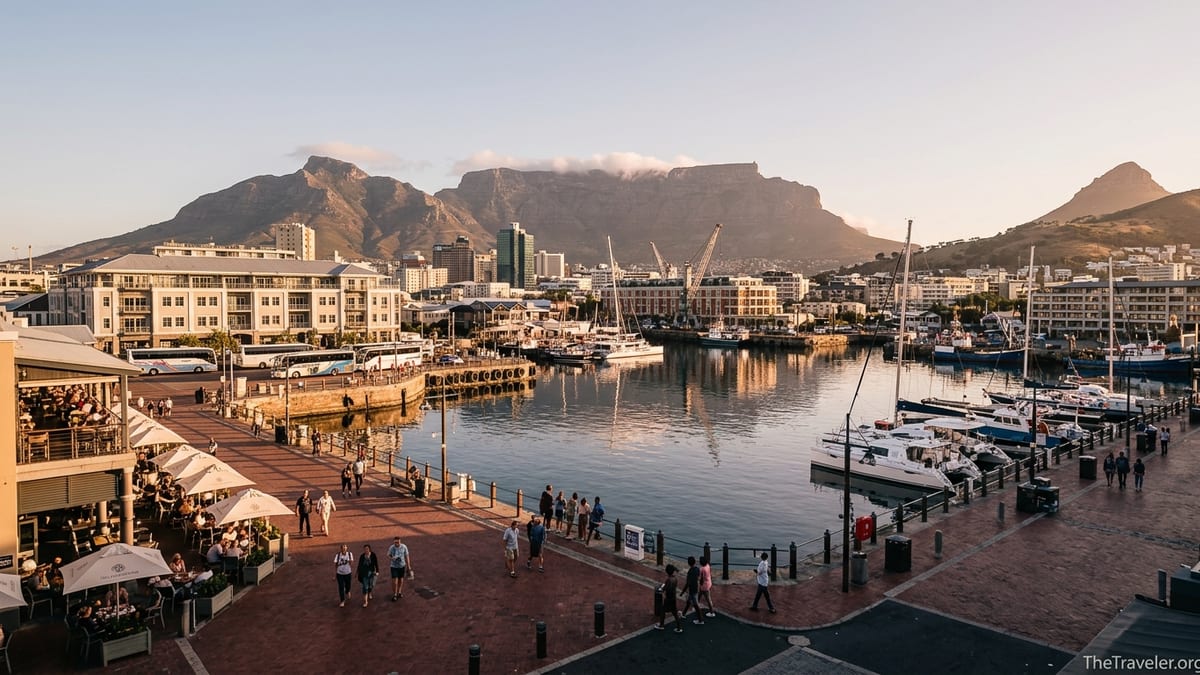
For many travellers with 6 to 10 hours in Cape Town, the V&A Waterfront offers the best mix of accessibility, safety and atmosphere. It is one of South Africa’s most visited attractions, a redeveloped working harbour filled with restaurants, open air plazas, shopping arcades, hotels and views of Table Mountain across the water. Local tourism reports consistently list it among the city’s top experiences, alongside the Table Mountain Aerial Cableway and Cape Point, and it is designed for short, self guided visits.
Getting there from the airport is simple. Outside peak hours the ride by taxi or app based car should take around 20 to 30 minutes each way. Many private transfer companies quote flat rates that are competitive with metered taxis and can be prebooked so that a driver is waiting in arrivals with a sign. If you prefer public transit and have a slightly longer layover, the MyCiTi airport bus will drop you at the Civic Centre in the City Bowl, where you can change to a Waterfront bound bus, adding maybe 15 to 20 minutes of walking and waiting but saving money.
Once at the Waterfront, even a very short visit can feel rewarding. You might stroll the main quays, pause at one of the yellow picture frames looking back at Table Mountain, and then sit down for a quick seafood lunch with harbour views. In practice, travellers on tight schedules often choose restaurants in the main shopping complex or around the clock tower precinct specifically because service is used to pre theatre and pre flight rushes. If you have three hours or more to play with, you could also duck into the aquarium, browse South African design boutiques for local ceramics and textiles, or simply people watch along the promenade.
In terms of safety, the Waterfront is one of the most intensively managed public spaces in Cape Town, with visible private security, CCTV coverage and a layout oriented around pedestrian areas. Crime statistics for the precinct in the year to March 2026 show reported incidents dropping compared with the previous year and well below pre pandemic levels, reflecting the high level of management. That does not mean you should be careless; it is still wise to keep phones secure, ignore persistent touts and avoid carrying your passport and all your cards in one wallet. However, visitors who stick to the main areas during daytime and early evening typically describe the experience as comfortable and low stress.
Table Mountain: Is It Worth It on a Layover?
Table Mountain is the symbol of Cape Town and its cableway, which whisks you from the lower station on Tafelberg Road to the summit plateau in about five minutes, is consistently ranked as one of the city’s top attractions. Standing on the top, 1 067 metres above sea level, you get panoramic views of the city, Atlantic coast and surrounding peaks. For many travellers, the temptation to squeeze in a quick cable car ride during a layover is strong. Whether that is sensible depends almost entirely on your timing and risk tolerance.
The lower cable station is roughly 25 to 30 kilometres from the airport, and most transport guides suggest a travel time of 35 to 50 minutes by road in normal conditions. This is already longer than the trip to the Waterfront, and unlike the harbour, the cableway has two potential bottlenecks: weather and queues. High winds, particularly common in the summer months, can force temporary or all day closures of the cableway, and when that happens there is little to do at the base except take photos and perhaps head to a backup viewpoint like Signal Hill.
On a quiet shoulder season weekday morning, an efficient traveller with a 9 hour layover might still have a great Table Mountain outing. Suppose you land at 08:00, clear immigration by 09:00 and reach the cableway station by 09:45 with a pre booked ride. If winds are calm and the queue is short, you could be on the summit by 10:15, enjoy views and short walks until 11:30, descend, and be back at the airport by around 13:00 to 13:30. That still leaves a comfortable buffer before a 15:30 departure. But if you duplicate that scenario during peak holiday season, and stand in a 60 to 90 minute queue for tickets and boarding, the math becomes far more precarious.
The safest way to include Table Mountain in a layover is to treat it as a bonus rather than a must do. Check same day conditions and cableway status as soon as you land. If operations are suspended due to wind, pivot quickly to a Waterfront or City Bowl plan. If the cableway is running and you can see that visibility is good, decide how late you are willing to risk arriving back at the airport and stick to a fixed cut off time for leaving the mountain. Remember that cloud can blow in over the “tablecloth” surprisingly fast, turning blue skies into whiteout and making navigation at the summit more confusing for first time visitors.
Bo-Kaap, City Bowl and Quick Culture Fixes
If you have a mid length layover of about 6 to 8 hours and prefer a cultural city walk to the more managed Waterfront environment, Bo-Kaap and the adjacent City Bowl are attractive alternatives. Bo-Kaap, famous for its brightly painted houses and cobbled streets, lies just above the central business district on the slopes of Signal Hill. Many travellers combine a short guided walking tour there with coffee in the City Bowl and a taxi back to the airport.
From the airport, a taxi or rideshare into the City Bowl area usually takes 25 to 40 minutes outside peak traffic. A common strategy is to ask the driver to drop you near Bree Street or Longmarket Street, walk up into Bo-Kaap for an hour of photos and exploration, then return downhill for lunch at one of the central cafes before heading back to CPT. This can work well on a weekday late morning or early afternoon, when offices are open and streets are busy, providing a sense of normal city life.
Safety here is more nuanced than at the Waterfront. The central city and Bo-Kaap are generally fine for daytime visits on main streets, but you should be alert to opportunistic theft and avoid quieter side alleys. Many solo travellers, especially women, choose to join a small group walking tour or hire a private guide who meets them in the city, both for context and for local awareness. You would not, for example, want to wander around empty CBD streets at dusk with luggage in tow.
Because this area is compact, it is a good choice if you have slightly less time than is ideal for Table Mountain but more than is truly necessary for a Waterfront only visit. A traveller landing at 11:00 with a 19:00 departure might spend two hours in Bo-Kaap and the City Bowl, then move to the Waterfront for an early dinner before heading back to the airport, provided they keep a close eye on the time and prebook their return transfer.
Stellenbosch and the Winelands: Only for Long Layovers
Stellenbosch and the surrounding Cape Winelands are around 35 to 45 kilometres from the airport by road, depending on your route, and normally take 30 to 45 minutes to reach in light traffic. Many wine estates lie beyond the town itself, so you may need another 10 to 20 minutes to reach your tasting room or lunch reservation. This immediately makes Stellenbosch a stretch for most layovers shorter than 10 to 12 hours once you factor in airport buffers.
For travellers on very long daytime layovers, however, a Winelands excursion can be deeply rewarding. Imagine you land at 07:00 on a summer morning with a 21:00 onward flight. You could clear immigration by 08:00, meet a prebooked driver and be at a Stellenbosch estate by 09:00 or 09:15 for a leisurely breakfast. From there you might do two wine tastings, walk through the historic oak lined streets of the town and have a late lunch under the vines before heading back towards Cape Town by mid afternoon. With a firm plan to arrive at CPT around 18:30, you still maintain a comfortable margin for check in and unforeseen delays.
In practice, the main constraint here is alcohol and fatigue. Very few travellers should be self driving on a tight schedule after multiple tastings, so budgeting for a private driver or small group tour that can collect you from and return you to the airport is essential. Some tour operators will customise a half day Winelands itinerary for layover passengers, but you should confirm that they understand your flight times and are willing to build in buffers.
Because Winelands roads can be dark and poorly lit after sunset, and because evening traffic back towards Cape Town can be slow on popular routes, a Stellenbosch layover trip is best kept to daylight hours with a target return to the airport well before nightfall. As a rule, if your total available time on the ground, after immigration and before check in, is under eight hours, it is wiser to stick to city based activities.
Luggage, Safety and Practical Airport Tips
Luggage is one of the biggest headaches for layover excursions. If your bags are checked through to your final destination on a single ticket, you may be able to transit without seeing them, which simplifies everything. If you must collect and recheck them, or if you are travelling on separate tickets, consider using the luggage storage facilities at the airport or arranging with an airport hotel or transfer company to store larger suitcases while you explore with only a small daypack.
Carrying wheelie bags into town is possible but not ideal, especially if you plan to walk around Bo-Kaap or use public transport. At the Waterfront it is relatively easy to roll a suitcase between the taxi drop off and nearby cafes, and many hotels there will store bags for guests even before check in or after check out. Still, for a truly relaxed layover it helps to leave anything non essential at the airport and take only valuables, medication and a change of clothes.
General safety advice in Cape Town is pragmatic rather than alarmist. Tourist zones like the V&A Waterfront, Camps Bay beachfront, much of the Atlantic Seaboard, the Winelands and popular attractions like the Table Mountain cableway see millions of visitors each year without serious incident. At the same time, the city does have higher levels of inequality and crime than many travellers are used to. The practical middle ground is to move confidently but not carelessly: use official taxis or verified ride apps, avoid walking alone at night in quiet areas, keep cameras and phones in use but not dangling, and decline unsolicited offers of “help” with ATMs or directions.
On the mountain and coastal trails, a different safety logic applies. If your layover includes any hiking, stick strictly to popular, well signposted routes during daylight, and avoid secluded paths or twilight starts. For most layover visitors with limited local knowledge, it is better to save serious hiking for a longer dedicated stay and focus on manageable, well serviced attractions during the stopover itself.
The Takeaway
Whether you can visit Table Mountain, the V&A Waterfront, Bo-Kaap or Stellenbosch on a Cape Town layover depends less on distance and more on time, traffic and your appetite for risk. The airport’s proximity to the city makes short excursions tempting, but when you factor in immigration, security and boarding buffers, only layovers of around 6 hours or more leave you realistic room to venture out.
For most travellers with mid length stopovers, the V&A Waterfront is the standout choice: close enough for comfort, lively yet managed, and easy to navigate in just a few hours. Table Mountain becomes viable from about 8 to 10 hours upward, and even then works best as a flexible bonus subject to weather and queue conditions. Cultural forays into Bo-Kaap and the City Bowl can slot into similar time frames, while Winelands adventures around Stellenbosch really require a full day style layover and a professional driver.
If you decide to leave the airport, plan conservatively: prebook transfers, use secure luggage storage, agree a fixed time to turn back towards CPT and resist the temptation to squeeze in just one more photo or tasting. Handled that way, even a brief stopover can give you a real feel for Cape Town’s harbour light, mountain backdrop and vineyard horizons, transforming what would have been idle hours in an airport lounge into a travel memory that anchors your whole trip.
FAQ
Q1. What is the minimum layover time to visit the V&A Waterfront from Cape Town Airport?
The V&A Waterfront is realistically possible with a layover of about 6 to 7 hours or longer between scheduled arrival and departure, assuming average immigration and security times and normal traffic.
Q2. Is Table Mountain doable on a layover, and how many hours do I need?
Table Mountain is best attempted with at least 8 to 10 hours of layover time, because you must factor in 35 to 50 minutes of travel each way, possible queues, and weather related cableway delays.
Q3. Can I visit both Table Mountain and the V&A Waterfront on the same layover?
Combining both is only sensible on very long layovers of around 10 to 12 hours or more, and even then it works best if you prioritise one sight and treat the second as a brief add on.
Q4. What is the safest area to visit on a short Cape Town layover?
The V&A Waterfront is generally considered the safest and most managed area for short, independent visits, with extensive private security and infrastructure oriented around tourists.
Q5. Is it worth going to Stellenbosch or the Winelands on a layover?
Stellenbosch is only worthwhile on a long daytime layover of 10 to 12 hours or more, ideally with a private driver or organised tour that can manage timing and road conditions.
Q6. Where can I store my luggage at Cape Town International Airport?
The airport has paid luggage storage options, and some airport area hotels and transfer companies will hold bags for guests; check the latest details with your airline or ground handler before arrival.
Q7. Are taxis and ride hailing apps reliable for getting to and from the airport?
Yes. Licensed airport taxis and major ride hailing services are commonly used by visitors, and prebooking a car for both arrival and return can reduce stress on a tight schedule.
Q8. Is it safe to walk around Bo-Kaap or the City Bowl during a layover?
Daytime walks on main streets in Bo-Kaap and the central city are generally fine, but you should stay aware of your surroundings, avoid quiet side alleys and keep valuables secure.
Q9. What should I do if the Table Mountain cableway is closed when I arrive?
If the cableway is closed due to wind or weather, pivot to backup options such as the V&A Waterfront, Signal Hill viewpoints, or a City Bowl and Bo-Kaap walking tour instead.
Q10. How early should I be back at Cape Town Airport before my departing flight?
Plan to be back at the terminal at least 90 minutes before a domestic departure and around 2 hours before an international flight, adding extra time in peak season or if you must recheck luggage.