


Cape Town International Airport is the main gateway to South Africa’s Western Cape, and for years the iconic red-and-blue MyCiTi airport bus has been the go-to budget transfer into the city. In 2026, that bus still exists, but the details matter: services, fares and practical alternatives have all shifted in recent years. This guide brings you up to date on what is running now, what MyCiTi used to offer, and how to choose the best airport transfer option for your budget and style of travel.
Get the latest updates straight to your inbox!
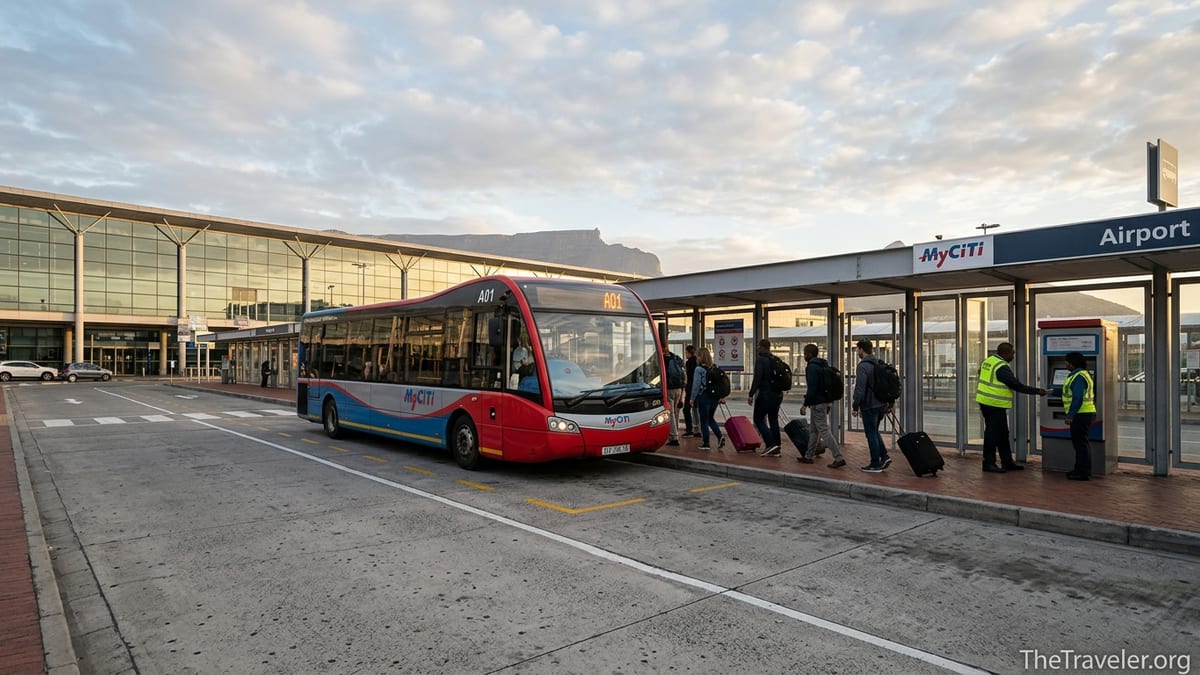
Is the MyCiTi Airport Bus Running in 2026?
As of mid-2026, the dedicated MyCiTi airport service between Cape Town International Airport and the Civic Centre bus station in the central business district is operational. The route is still known as the A01 Airport service and forms part of Phase 1 of the MyCiTi bus network that links the airport with Cape Town’s CBD and onward services to the Atlantic Seaboard, City Bowl and Table View corridor. Timetables can shift with seasonal demand or occasional planned disruptions, but there has been no long-term suspension of the airport link.
The A01 bus runs from the MyCiTi station directly outside the main terminal building. The station is signposted from both arrivals and departures; you exit the terminal, follow the “Public Transport” and “MyCiTi bus” signs, and reach a dedicated enclosed platform with turnstiles and ticket kiosks. Buses typically run every 20 to 30 minutes during the day, with slightly longer intervals late at night or very early in the morning. Operational hours usually cover early-morning departures through late evening, making it usable for most daytime and evening flights.
Fares use the standard MyCiTi structure with a premium surcharge for airport trips. City transport policy documents indicate that the airport premium is a fixed add-on to the distance-based fare, and public examples show that a one-way airport trip with the surcharge comes out roughly in the range many travelers quote as “about 80 to 100 rand,” depending on time of day and fare product loaded on the card. That puts the MyCiTi airport bus at a fraction of the cost of a typical metered taxi or rideshare for solo travelers and budget-minded visitors.
Service alerts, such as temporary stop relocations during events, sometimes appear on the MyCiTi website but generally concern in-city routes. When there are changes affecting the airport service, they are normally published as planned disruptions rather than surprise cancellations. In other words, unless there is a rare city-wide strike or extreme weather event, you can currently plan around the A01 as a functioning, reliable airport-to-city link.
What MyCiTi Used to Offer and How It Has Evolved
When MyCiTi first launched its airport service in the early 2010s, it was one of the flagship features of Cape Town’s new bus rapid transit system. Back then, paper timetables showed a simple, premium airport route linking the airport to Civic Centre every 20 minutes, with a slightly higher flat fare compared to ordinary city routes. The focus was on offering a modern, predictable alternative to informal taxis and more expensive private shuttles, in line with what you would find in cities such as London, Vancouver or Sydney.
Over time, MyCiTi moved to a fully cashless, smartcard-based fare system using the blue myconnect card. That meant no more paying the driver directly. Instead, travelers needed to buy a card, load credit or a pass, and tap in and out. Even before the pandemic, this caught some first-time visitors off guard: arriving passengers would turn up at the airport station, only to learn they needed to queue at the kiosk for a card before boarding. However, the trade-off has been lower fares for regular users and more consistent boarding times at busy stations like Civic Centre and the V&A Waterfront stops.
In recent years, fare products have diversified further. City mobility documents outline options such as 1-day, 3-day and 7-day passes, plus monthly passes targeted at commuters. These packages apply network-wide and include the airport, although the airport premium often remains a separate component built into the total fare. Adjustments in October 2024, when MyCiTi reduced some fares in response to lower diesel costs, highlighted how sensitive airport pricing can be to fuel and operating expenses, but the basic principle of a small premium for airport trips has stayed intact.
Operationally, the broader MyCiTi network has expanded and been fine-tuned, with additional corridors and more buses across the metro. The airport service, however, has largely retained its straightforward role: a point-to-point connector between the airport and the CBD interchange. What has changed most for travelers is not that the bus exists or not, but how you plan your journey, pay for it and connect onward to your final destination in suburbs the original system barely touched.
How to Use the MyCiTi Airport Bus Step by Step
Using the MyCiTi airport bus in 2026 is simple once you know the steps, but it can be confusing if you arrive unprepared after a long-haul flight. The key requirement is a myconnect card, which is a reusable smart card used across the MyCiTi network. Current guidance indicates that a new card costs around 40 rand, which you buy from a station kiosk or participating retailers in the city. At the airport, the MyCiTi station kiosk serves as your one-stop point for getting the card and loading credit or a pass.
On arrival, follow the signs to the MyCiTi station before leaving the secure airport precinct. At the kiosk window, you request a myconnect card and tell the attendant that you are going into the city. Staff are used to international visitors and can usually suggest an appropriate amount to load for a one-way or return trip plus some extra for local travel. A typical example would be buying a card for around 40 rand and loading 100 to 150 rand of travel credit if you plan to go into town and use buses during your stay. Payment is normally accepted in cash or by card, but systems occasionally go offline, so keeping a small amount of local cash is wise.
Once you have loaded your card, you enter the station through the automated gates by tapping your card on the validator. LED lights and a beep confirm a successful tap. Inside the station, overhead screens indicate the next A01 departure and platform. When the bus arrives, you board through the doors adjacent to the station platform; there is no need to show anything to the driver, as your tap at the gate has already registered the start of your journey. You tap out at the exit gates when you arrive at Civic Centre or your transfer station, which calculates the final fare based on distance and any applicable premium.
A recent upgrade announced in 2026 allows passengers to top up their myconnect cards online via the official app and website. This is especially useful for frequent visitors or long-term travelers: you could, for instance, load extra credit from your guesthouse using a local card before heading to the Waterfront or Camps Bay. For a short city break, though, most new arrivals still buy and load their cards directly at the airport kiosk and rarely need to worry about topping up again before departure.
Alternatives to MyCiTi: Taxis, Shuttles and Rideshares
Although the MyCiTi airport bus is the most visible public option, it is far from the only way to get between Cape Town International Airport and the city. Inside the arrivals hall, you will find booths for official airport taxi operators and private shuttle companies. Authorised airport taxis generally charge a fixed or metered rate to central Cape Town; depending on traffic and exact drop-off point, that can add up to several hundred rand, often in the region of 350 to 500 rand for a trip to the CBD or V&A Waterfront. The upside is door-to-door convenience and the ability to split the fare among several people.
Private shuttle services, including those branded as airport transfer or shuttle operators, tend to work on pre-booking. Some hotels and guesthouses in areas like Gardens, Tamboerskloof and Sea Point partner with these companies and can arrange shared or private shuttles for guests. Prices vary widely but a common pattern is a per-vehicle rate similar to taxis for private rides, and a per-person rate for shared shuttles that can be competitive with rideshares if you are alone. One typical real-world example is a guesthouse quoting around 400 rand for a private transfer from the airport for up to three passengers, which becomes cheaper than the bus if you factor in MyCiTi cards and multiple fares.
Rideshare services operate at Cape Town International as well, though pickup procedures can change as the airport updates its traffic and drop-off policies. In many cases, rideshares pick up in dedicated ride-hailing zones or general parking rather than immediately outside arrivals. Fares into the city often start in the same broad range as metered taxis, sometimes slightly lower in off-peak hours. A couple landing in the evening might, for example, see an estimated fare of 250 to 350 rand to the CBD on their app, which is more than double the cost of two MyCiTi tickets but offers a direct trip to their hotel without a walk or transfer.
For visitors staying well outside the central areas served directly by MyCiTi, such as parts of the Southern Suburbs without nearby stations, these door-to-door options may be more practical than trying to piece together buses and trains. They are also the better choice late at night, when safety considerations and lower passenger volumes mean that even locals often prefer point-to-point car-based transport over waiting for public buses in quiet areas.
Budget Traveler Strategies: Cheapest Ways Into Cape Town
For backpackers and budget travelers, the MyCiTi airport bus is usually the anchor of a low-cost arrival strategy. If you are heading to a hostel around Long Street, Gardens or the CBD, the A01 to Civic Centre plus a short walk or onward bus ride is still one of the most cost-effective legal options. For example, a solo traveler might spend in the region of 40 rand on a new myconnect card and around 70 to 90 rand on the airport trip, totaling roughly 110 to 130 rand to reach central Cape Town. That compares favorably with a 300 to 400 rand taxi for one person.
Another budget-friendly pattern is for small groups to mix MyCiTi with walking or short e-hailing hops. Two friends arriving together, both planning to explore the city by bus during their stay, could buy myconnect cards, take the A01 to Civic Centre, then connect to another MyCiTi route to Sea Point or Green Point using the same card credit. Their combined cost might sit around 250 to 300 rand in total, whereas a door-to-door taxi to Sea Point could easily exceed 400 rand in moderate traffic. For three or four people with luggage, though, the equation starts to shift, and a pre-booked shuttle or rideshare might work out almost the same price per person with less faff.
Some travelers look to even cheaper ways to reach the city by combining MyCiTi with other public transport like Golden Arrow buses or Metrorail trains. Golden Arrow, a long-running bus operator across Cape Town, runs services in corridors like Voortrekker Road and Bellville. In theory, one could leave the airport by a local bus or taxi to a nearby hub and then switch to Golden Arrow or rail. In practice, this often introduces complexity, uncertainty and safety trade-offs that are not worth the small savings for short-term visitors unfamiliar with local conditions.
The most realistic ultra-budget advice is simple: plan around the MyCiTi airport bus as your baseline, avoid unregistered informal taxis outside the terminal, and make smart use of walking within safe, busy areas. For example, if your guesthouse in Gardens is about 15 to 20 minutes’ walk from Civic Centre and you arrive in daylight, you could reasonably walk up through the well-trafficked streets of the CBD, reducing your total spend to the cost of the MyCiTi trip alone. At night or with heavy luggage, consider a short rideshare hop from Civic Centre instead of a full taxi from the airport.
Connecting From the Airport Bus to the Rest of the City
Once you reach the Civic Centre station on the A01, you are standing at the heart of the MyCiTi network. This is where many visiting travelers switch from an airport journey to local exploration. Station signage indicates route numbers and destinations: buses fan out toward Table View and Blouberg, the V&A Waterfront, Sea Point, Camps Bay, Hout Bay and various city bowl neighborhoods. If you are heading to popular tourist areas like the Waterfront or Green Point, you simply exit the A01 platform, follow signs to the relevant platform and board the next bus using the same myconnect card.
Connections are handled within the same fare structure, with your card balancing out distance traveled rather than treating each segment as a completely new ticket. That means you do not pay a separate, full-price fare for each bus as long as your overall journey falls within MyCiTi’s time and distance rules. For instance, a traveler going from the airport to a guesthouse in Sea Point might ride A01 to Civic Centre, then switch to a route along the Atlantic Seaboard. The airport premium is attached to the portion between the airport and city, but the incremental cost of the onward leg inside town is relatively small.
Reaching areas outside the MyCiTi footprint requires more creativity. For the Southern Suburbs, many locals combine MyCiTi with Metrorail where services are running, or simply switch to minibus taxis or rideshares at key points such as Claremont or Wynberg. Visitors unfamiliar with local minibus practices often find this intimidating, so sticking to a MyCiTi plus rideshare combination is usually the safer, simpler choice. As an example, someone staying in Rondebosch might opt to ride the A01 into town, then call a rideshare from Civic Centre or the nearby Foreshore rather than figuring out multiple bus and train transfers.
It is also worth thinking about your departure from Cape Town when you plan your arrival route. If you expect to check out of your accommodation in the early afternoon and fly in the evening, staying within an easy walk or short MyCiTi ride of a main corridor can make it far simpler to get back to the airport by bus. Travelers who split their stay between the city and outlying wine regions, such as Stellenbosch or Franschhoek, may combine a MyCiTi trip from the airport into town with a separate intercity shuttle or tour transfer onward, then return to Cape Town by road and finish with MyCiTi from Civic Centre to the airport.
The Takeaway
In 2026, the core reality is straightforward: Cape Town’s MyCiTi airport bus is running, and for most independent travelers it remains the best-value legitimate way to get between the airport and the central city. The A01 airport service connects a clearly signposted station at the terminal with Civic Centre, where you can fan out across the broader MyCiTi network or walk to nearby accommodation in the CBD. Fares rely on the cashless myconnect card system, with an added airport premium that still keeps typical costs firmly in budget territory compared with private cars.
What has changed over the past decade is less about the existence of the bus and more about how you plan and pay for your journey. Smartcards, day passes and online top-ups are now standard, and digital tools like the trip planner and mobile app make it easier to check timetables before you land. At the same time, rideshares, authorised airport taxis and private shuttles offer strong competition on convenience, particularly for groups, late-night arrivals and travelers heading to areas beyond the immediate reach of MyCiTi routes.
For the average visitor, the most sensible approach is to decide where you sit on the spectrum between cost and convenience. Solo backpackers and city-break travelers staying near the CBD can almost always rely on the MyCiTi airport bus without issue. Families with small children, people with bulky luggage and those arriving after dark might prefer to pay more for a direct car-based transfer. Understanding how MyCiTi works, and what it does and does not cover, lets you make that choice with eyes open rather than at the mercy of the arrivals hall hustle.
FAQ
Q1. Is the MyCiTi airport bus to Cape Town city centre currently operating?
The MyCiTi A01 airport service between Cape Town International Airport and the Civic Centre station is operating in 2026, with regular daytime and evening departures and only occasional short-term disruptions during special events or maintenance.
Q2. How much does the MyCiTi airport bus cost compared with a taxi?
The exact bus fare varies with products and time of day, but many recent traveler reports place a one-way airport trip at roughly 80 to 100 rand once you include the airport premium, while official taxis or rideshares into the CBD commonly run several hundred rand, often around 300 to 500 rand depending on traffic and destination.
Q3. Where do I catch the MyCiTi bus at Cape Town International Airport?
You catch the bus at the dedicated MyCiTi station just outside the main terminal building. Follow signs for public transport or MyCiTi from arrivals or departures, buy or top up your myconnect card at the kiosk, then enter through the station gates to the A01 platform.
Q4. Do I need a myconnect card, or can I pay cash on the bus?
You cannot pay cash on the MyCiTi bus. All passengers, except very young children, need a myconnect smart card loaded with credit or a pass. You buy the card and load value at station kiosks, including at the airport, or online if you are already set up in the system.
Q5. Is the MyCiTi airport bus safe to use with luggage?
The airport service is designed for travelers and is generally considered safe, especially during the day and early evening. Buses have space for suitcases near the doors, and the station environment at the airport and Civic Centre is monitored, though standard big-city precautions with bags and valuables still apply.
Q6. What if my flight lands late at night, after the buses stop?
If you arrive very late and the A01 is no longer running, your realistic options are authorised airport taxis, rideshares or pre-booked private shuttles. These cost more than the bus but provide door-to-door transport at hours when public services are sparse and most locals would not choose to use buses or trains.
Q7. Can I use the MyCiTi airport bus to reach the V&A Waterfront or Sea Point directly?
The A01 itself runs between the airport and Civic Centre. From Civic Centre, you transfer to another MyCiTi route toward the V&A Waterfront, Green Point or Sea Point using the same myconnect card. The process is straightforward and usually adds only one extra bus ride and a modest additional fare.
Q8. Are there cheaper public transport options than MyCiTi from the airport?
In theory, you could combine informal taxis, Golden Arrow buses or trains to shave a bit off the cost, but this typically involves multiple transfers, variable schedules and less predictable safety. For most visitors, the MyCiTi airport service is already the safest and most sensible budget option.
Q9. How much time should I allow to get from the city back to the airport by MyCiTi?
From Civic Centre, the A01 bus ride itself usually takes around 30 minutes in normal traffic. Allow at least one hour door to door from central Cape Town to the airport, and more if you need to connect from neighborhoods further out or are traveling in peak rush-hour conditions.
Q10. Can I use a MyCiTi day pass or multi-day pass for the airport bus?
MyCiTi offers 1-day, 3-day and 7-day passes and other products that cover travel across the network, and these can be loaded onto a myconnect card. In many cases, the airport portion still includes a premium component, but if you are planning heavy bus use during a short stay, a multi-day pass plus the airport surcharge can be good value.