


More news on this day
Carnival Corporation has locked in the next phase of Carnival Cruise Line’s fleet growth, confirming an order with Italian shipbuilder Fincantieri for three 230,000‑gross‑ton, LNG‑powered mega‑ships to be delivered in 2029, 2031 and 2033, a move that aligns closely with its multibillion‑dollar investment in Celebration Key on Grand Bahama and expanded Bahamas and Caribbean capacity.
Get the latest news straight to your inbox!
A New LNG Class That Redefines Carnival’s Upper End
Fincantieri and Carnival Corporation announced on July 23, 2024 that the Italian yard will design and build three liquefied natural gas powered cruise ships for the Carnival Cruise Line brand, each around 230,000 gross tons and scheduled for delivery in 2029, 2031 and 2033. The shipbuilder describes them as the largest vessels it has ever constructed and the largest cruise ships ever built in Italy, representing a new class beyond Carnival’s existing Excel class, which is around 180,000 to 183,000 gross tons.
According to Fincantieri, the new ships will each feature more than 3,000 guest cabins and accommodate over 8,000 passengers at full capacity, placing them among the highest‑capacity cruise ships on order. The order formalizes a long running partnership between Carnival Corporation and Fincantieri and extends the shipbuilder’s backlog into the early 2030s, while giving Carnival a clear schedule for phased capacity increases at the upper end of its fleet.
Fincantieri and Carnival have not yet released ship names, detailed interior concepts or homeports for the new class. The vessels remain in the design and engineering phase, and the contract is subject to standard financing and closing conditions that were flagged when the agreement was announced.
LNG Strategy Now Extends Through 2033
The July 2024 order forms part of Carnival Corporation’s broader shift toward LNG capable ships. In a fact sheet updated in mid 2026, the company reported operating 11 LNG powered cruise ships as of November 30, 2025, accounting for about 21 percent of its fleet capacity. Carnival expects to have 18 LNG capable ships in service by the end of 2033, representing roughly one third of group capacity, with the three new Fincantieri vessels included in that total.
Carnival characterizes LNG as a more efficient fossil fuel option rather than a zero emission solution. Company disclosures state that LNG engines can reduce carbon dioxide emissions compared with conventional marine fuels and virtually eliminate sulfur oxides, while also delivering large cuts in nitrogen oxides and particulate matter. At the same time, Carnival reports methane slip from LNG engines within its greenhouse gas inventory and notes that LNG’s overall climate impact remains a subject of active assessment.
For travelers, the most immediate impact of the LNG program is where Carnival chooses to deploy these ships and how ports adapt to handle LNG bunkering and larger vessel sizes. Carnival has already signed supply arrangements in several North American ports and is matching these fuelling capabilities with destinations that can receive high‑capacity ships on short Bahamas and Caribbean runs.
Celebration Key’s Four‑Berth Pier Geared to Mega‑Ship Traffic
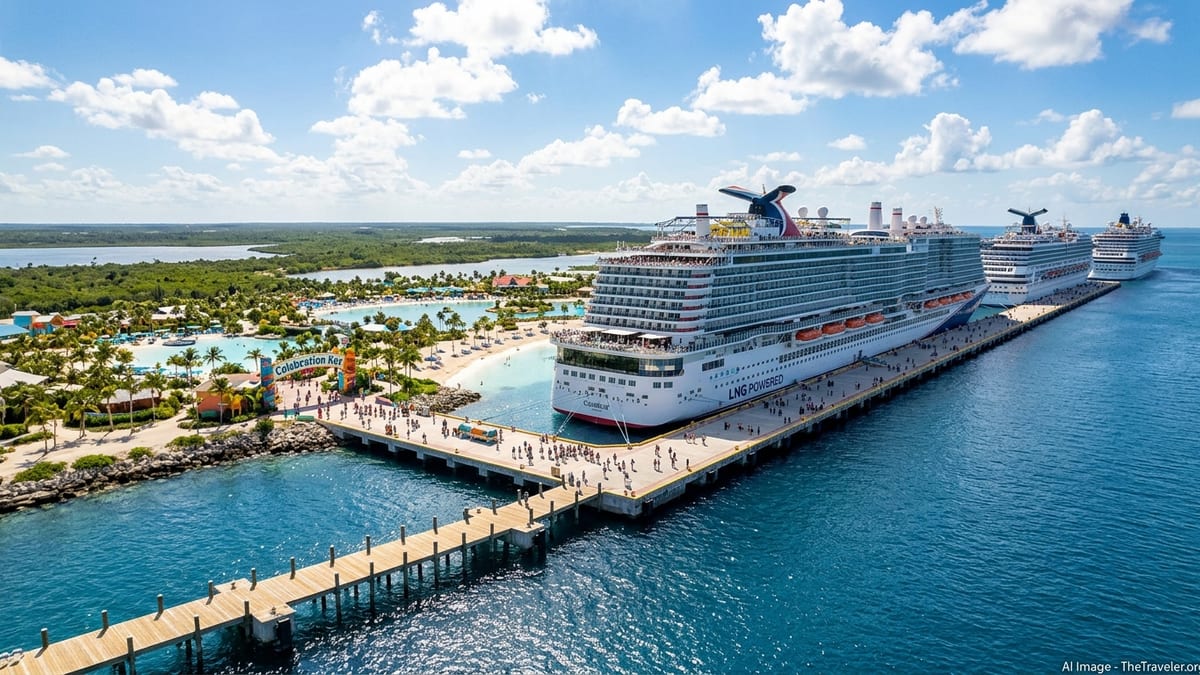
On the destination side, Celebration Key on Grand Bahama opened to cruise guests on July 19, 2025 following what Carnival describes as an initial 600 million dollar investment in the new exclusive port and resort area. The facility launched with a pier configured for two large ships and was designed from the outset to handle the line’s Excel class vessels on short itineraries from multiple U.S. homeports.
In February 2024 Carnival Corporation announced an additional 100 million dollar pier extension at Celebration Key, aimed at doubling berth capacity to four large ships once completed in 2026. The company stated that all four berths were being engineered to accommodate Carnival’s largest Excel class ships. In June 2026 Carnival confirmed that the pier expansion had been completed ahead of schedule, creating four operational berths and effectively doubling the number of ships the destination can receive at once.
By the time Celebration Key marked its first anniversary on July 19, 2026, Carnival reported that the Grand Bahama destination had welcomed about 2.4 million guests since opening, with the expanded pier intended to support growth toward a stated target of up to around 4 million guests annually in the coming years. The ability to moor four large ships simultaneously means the port’s infrastructure is structurally aligned with Carnival’s move toward higher‑capacity LNG vessels, including the newly ordered class.
What the New Ships Could Mean for Bahamas and Caribbean Cruises
Carnival has not confirmed itineraries or homeports for the three new LNG ships, but the combination of their size, fuel type and delivery years, together with the build out at Celebration Key, points to an emphasis on high volume short and medium length cruises in the Bahamas and wider Caribbean. The dedicated four berth pier on Grand Bahama is already configured to handle multiple Excel class ships on the same day and is technically capable of receiving even larger tonnage within similar dimensions.
In public statements about Celebration Key, Carnival has highlighted plans for ships from numerous U.S. homeports to call regularly at the destination. As the new 230,000 gross ton ships enter service at the end of this decade and early in the next, they are positioned to integrate into that network of calls, concentrating more passenger movements per call at ports that have invested in suitable piers and shore infrastructure.
For travelers planning Bahamas and Caribbean cruises, the practical takeaway is that Carnival’s largest ships will increasingly be linked to ports specifically developed or upgraded to receive them, such as Celebration Key. While bookings for the three newly ordered ships are not yet open and deployment plans have not been published, Carnival typically releases ship names, deployment regions and initial sailing programs several years before delivery, so prospective guests should watch for those announcements as the 2029, 2031 and 2033 handover dates approach.