


More news on this day
The China–Laos Railway has carried 300,600 cross-border passenger trips between China and Laos from January 1 to November 16, 2026, marking the first time annual international ridership on the line has surpassed 300,000 and underscoring its rapid shift into a major overland passenger corridor for travel between China and mainland Southeast Asia.
Get the latest news straight to your inbox!
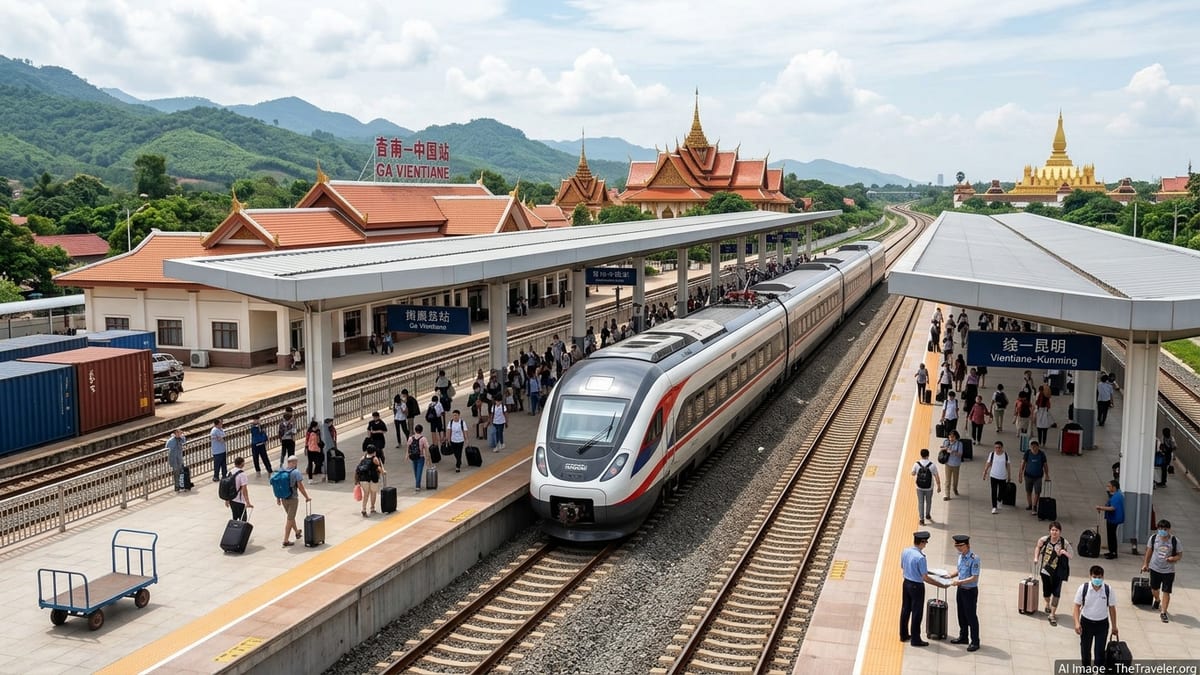
From freight flagship to busy international passenger corridor
The 1,035 kilometer standard gauge China–Laos Railway, linking Kunming in China’s Yunnan province with the Lao capital Vientiane, opened to traffic on December 3, 2021, initially with a heavy emphasis on freight. International passenger services followed later, starting on April 13, 2023, as border restrictions eased and travel demand between China and Southeast Asia began to recover.
According to Laos’ official news agency, citing China Railway Kunming Group, the line handled 300,600 cross-border passenger trips between January 1 and November 16, 2026. This is explicitly counted as international journeys that cross the China–Laos border, not including the much larger number of domestic trips within each country.
Earlier data from Chinese railway authorities show how quickly that international market has grown. By October 15, 2025, cumulative cross-border passengers since the launch of international services had already exceeded 600,000, and by April 2026 the total had passed 800,000, covering travelers from more than 100 countries and regions. Over the same period, total passenger journeys of all kinds on the China–Laos Railway have surpassed 70 million, illustrating how cross-border traffic now sits within a much broader, mature regional network.
Current service pattern: Kunming–Vientiane trains and a tourism-focused link
International passengers today have several daily options on the core Kunming–Vientiane corridor. China Railway Kunming Group reports that four cross-border trains operate each day between Kunming and Vientiane, counting services in both directions. Typical journey time on these through services is around 9 hours 30 minutes from Kunming South to Vientiane, including border procedures at Mohan–Boten.
On top of the main trunk services, an additional international pair connects Xishuangbanna, in southern Yunnan, with Luang Prabang in northern Laos. Both are established tourist destinations, and the dedicated trains between them are scheduled several days per week, excluding some midweek dates, to match holiday peaks and seasonal tourism flows.
Timetables continue to be adjusted periodically, particularly around Chinese and Lao holiday periods and with the rollout of winter and summer schedules. As of late November 2026, no major increase or reduction in Kunming–Vientiane frequency has been announced beyond these incremental adjustments, so travelers should check schedules close to departure rather than assuming a fixed long-term pattern.
What the milestone means for travelers planning overland routes
For travelers, the new ridership milestone confirms that the China–Laos Railway has moved beyond a niche or experimental option and become a mainstream way to travel between China and mainland Southeast Asia. With multiple daily international trains, it is now practical to plan overland itineraries linking Kunming with Vientiane in a single day, and to connect onwards within each country using domestic services on the same standard gauge system.
Tickets for the cross-border trains can generally be bought through China Railway’s 12306 system when originating in China, and via the official Laos–China Railway “LCR Ticket” mobile app or station ticket counters on the Lao side. The LCR app is confirmed by the operator as its official booking platform, though some users report varying requirements around phone numbers and payment methods, so it is sensible to allow extra time to register or seek assistance if booking independently.
Demand on popular dates can be intense. During earlier peak periods, such as Lunar New Year travel in 2025, the line carried tens of thousands of cross-border passengers over just a few weeks, and local reports in both countries have highlighted frequent sell-outs around major holidays. Travelers targeting peak seasons should plan to book as early as allowed by the booking systems and consider building some flexibility into their itineraries if preferred trains are full.
Reaching Thailand and beyond still requires changes of train and gauge
Despite the rapid growth in China–Laos passenger traffic, the current milestone does not mean there is yet a single high-speed train from Kunming to Bangkok or Singapore. South of Vientiane, onward travel into Thailand continues to rely on the separate Laos–Thailand cross-border rail link from Thanaleng or Vientiane area across the Mekong to Nong Khai, and then onto Thailand’s meter-gauge network.
Passengers making the popular Kunming–Laos–Thailand overland route therefore need to plan for at least one change of train and a change of rail system. Timings between services are not yet coordinated as a through high-speed corridor, and tickets must be purchased separately for the China–Laos segment and for Thai domestic trains. High-speed projects within Thailand, including the standard gauge Bangkok–Nong Khai line, remain under development, with no confirmed start date yet for a true through service linking Kunming directly to Bangkok.
For now, the practical impact of the 300,600 cross-border trips reached in mid-November 2026 is clearest on the existing China–Laos section. Travelers can rely on a maturing, relatively frequent international rail service between Kunming and Vientiane, use dedicated trains between hubs such as Xishuangbanna and Luang Prabang, and then piece together onward journeys into Thailand and the wider region using separate links.
What travelers should watch next
Looking ahead into late 2026 and early 2027, the next notable developments for passengers are likely to center on timetable refinements rather than headline-grabbing new routes. Any changes to international frequency, departure times or stopping patterns will be published through China Railway and Laos–China Railway announcements and reflected in the 12306 system and LCR app schedules.
Fare levels for key international segments, such as Kunming–Vientiane or Xishuangbanna–Luang Prabang, are periodically adjusted and can differ between booking channels. Because current official fare tables are not consistently published in English, prospective travelers should verify up-to-date prices directly in the booking systems or via reliable local agents before finalizing budgets.
Longer term, the pace at which Thai standard gauge projects progress will determine when, or if, Kunming–Bangkok through services become possible. Until clear construction milestones and operational dates are confirmed by Thai and Chinese authorities, these remain plans rather than guaranteed timelines. In the meantime, the confirmed 2026 ridership milestone on the China–Laos Railway signals that, even in its current form, the line has already become one of the most significant new rail options for overland travel within mainland Southeast Asia.