


More news on this day
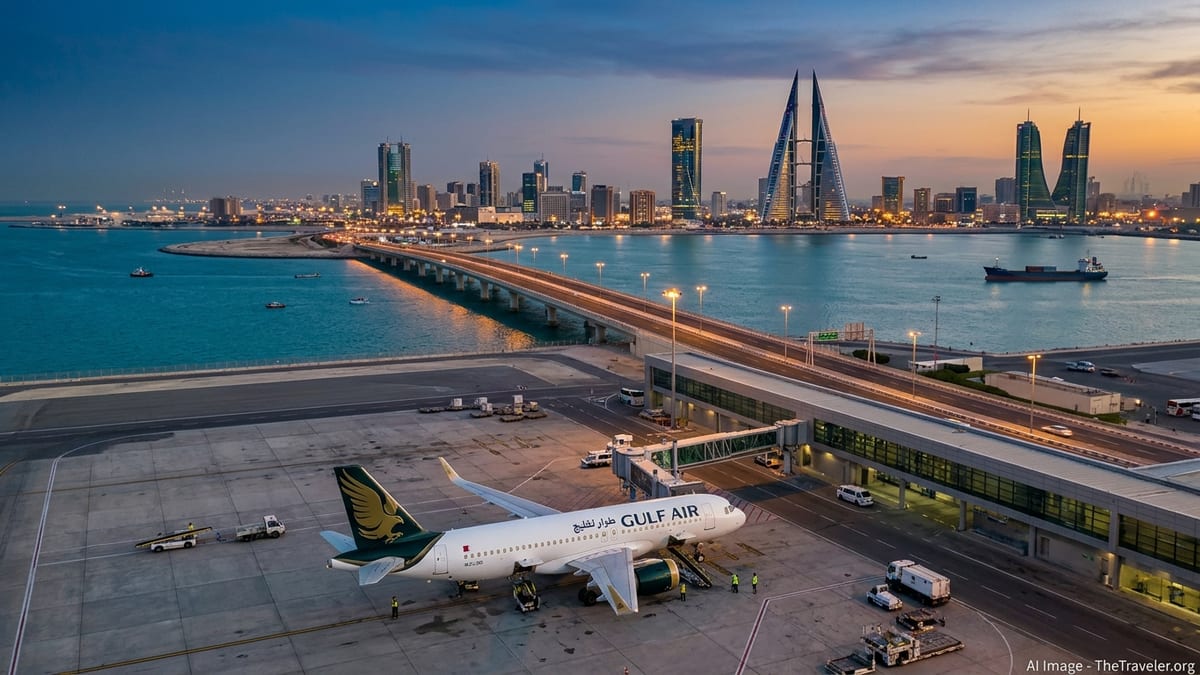
The European Union Aviation Safety Agency has issued a revised conflict-zone bulletin covering Bahrain’s airspace after new Iranian drone strikes on US targets in the kingdom, prompting tactical rerouting and short-notice changes for some itineraries but not a shutdown of Bahrain International Airport.
Get the latest news straight to your inbox!
What the new EASA bulletin actually says
The latest Conflict Zone Information Bulletin, designated CZIB-2026-07R4, was added to EASA’s list of active advisories in mid November and is currently valid until 31 January 2027. In its published text, the agency highlights elevated risks in the Persian Gulf and Gulf of Oman, specifically including the Bahrain flight information region, and urges operators to avoid overwater portions of the Bahrain FIR where possible except for necessary arrivals and departures.
Like other conflict-zone bulletins, CZIB-2026-07R4 is framed as guidance for safety risk management rather than a legal ban. Airlines flying in or through the Bahrain FIR are expected to incorporate the advisory into their internal risk assessments, which can lead to altered routings, additional altitude and routing constraints, or decisions to suspend certain city pairs. The result for passengers is less about outright prohibition and more about a moving target for schedules and routings over the Gulf.
Bahrain airport operations after recent Iranian drone attacks
The tougher tone in EASA’s advisory follows renewed Iranian drone attacks on US radar installations and military sites in Bahrain in mid November, including strikes Iran says were aimed at early-warning systems linked to US forces. Bahraini authorities have reported intercepting several of the incoming drones and issued temporary shelter alerts, but there has been no announcement of a fresh prolonged closure of Bahrain’s civil airspace.
Industry operational summaries and Bahrain Airport Company information indicate that Bahrain International Airport remains open with enhanced monitoring and routing measures rather than a full suspension of traffic. This represents a contrast with earlier phases of the Iran conflict in early 2026, when Bahrain closed its airspace on several occasions and commercial flights were halted before a controlled restart.
From spring shutdowns to managed resumptions
During the most intense phase of hostilities earlier in 2026, Bahrain temporarily closed its airspace, affecting both overflights and local arrivals and departures. According to sector briefings, those restrictions were gradually eased in the first week of April 2026, when Bahrain’s civil aviation authority permitted limited operations to resume under tight security and routing constraints.
Gulf Air, Bahrain’s national carrier, restarted departures from Bahrain International Airport during that April reopening phase, initially with a reduced network and additional operational precautions. Since then, traffic through Bahrain has been rebuilt under what various aviation risk services describe as “enhanced monitoring,” meaning crew, dispatch and air traffic control remain prepared for tactical adjustments in response to changing threat levels.
How US itineraries are exposed through hubs and codeshares
For many US-based travelers, exposure to these changes is indirect. Gulf Air serves as Bahrain’s flag carrier and maintains codeshares with American Airlines and other partners, so US–Bahrain journeys are often ticketed via major Gulf or European hubs such as Dubai, Doha, Abu Dhabi, Riyadh or London rather than as a single nonstop segment. When an airline adjusts routings in the Bahrain FIR or decides to shift capacity between hubs, multi-leg tickets sold in the United States can see knock-on schedule changes.
Current risk and freight operations reports for the Gulf region emphasize that, despite the new EASA bulletin, there are no region-wide bans on commercial overflights in the Bahrain FIR. Instead, airlines are using tactical rerouting, accepting longer track miles over land when feasible, and occasionally holding or diverting aircraft during security incidents. For passengers, this can translate into extended block times, missed onward connections at hub airports, or same-day rebookings even when timetables still show normal operations.
What US travelers should do before flying via Bahrain
Given the combination of an active EASA conflict-zone advisory and recent Iranian attacks on US-linked installations in Bahrain, the main risk to US travelers is itinerary uncertainty rather than an inability to reach the country. Booking engines and static schedules may not fully reflect last-minute routing decisions, and some carriers may quietly trim frequencies or swap aircraft types as security conditions evolve.
Travelers connecting to or through Bahrain over the coming weeks should monitor their booking directly with the operating airline, use carrier apps or SMS alerts for real-time notifications, and check Bahrain International Airport’s official channels on the day of travel for any disruption updates. Until at least 31 January 2027, when the current EASA bulletin is scheduled to expire unless revised, passengers should be prepared for longer routings over the Gulf, occasional holding patterns or diversions, and short-notice schedule adjustments, even though Bahrain’s airport and airspace remain open for commercial traffic.