


Landing at Casablanca Mohammed V International Airport and heading straight to Marrakech is one of the most common travel moves in Morocco. The two cities are only about 240 kilometers apart, and with trains, private drivers, taxis, and rental cars all in play, it is absolutely possible to be sipping mint tea on a riad rooftop in Marrakech just a few hours after you clear immigration in Casablanca. The key is choosing the right transfer option for your arrival time, budget, and energy level.
Get the latest updates straight to your inbox!
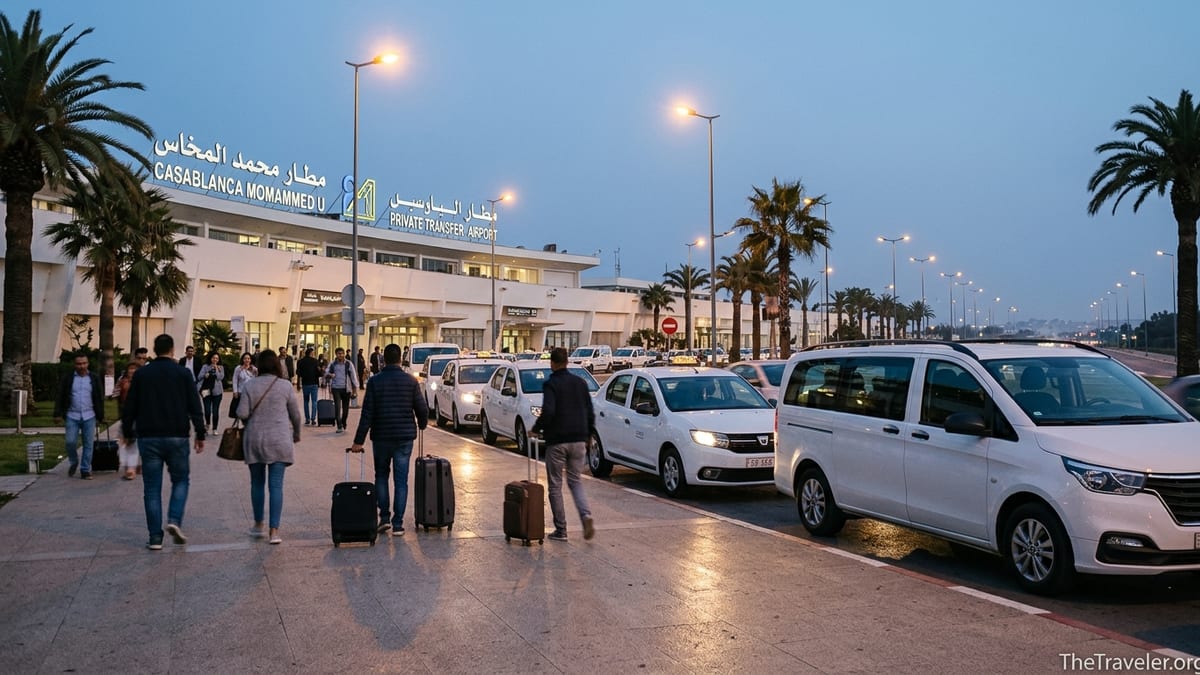
Understanding the Route from Casablanca Airport to Marrakech
Casablanca Mohammed V International Airport sits well south of Casablanca’s city center, roughly halfway to Marrakech in purely geographic terms, but not in travel time. The airport is connected to the national rail network, which means you can ride a dedicated airport train into Casablanca’s main station, Casa Voyageurs, and then connect to a long-distance train down to Marrakech. By rail, the total journey from the airport to Marrakech typically takes around 4.5 to 5 hours, including the connection in Casablanca, depending on how your timings line up.
By road, the drive between Casablanca Airport and Marrakech usually takes around 2.5 to 3 hours in normal traffic. A direct private transfer or taxi that picks you up outside the terminal and drives straight to your riad door in Marrakech will almost always beat the train on pure door to door speed, especially on evenings or weekends when traffic is lighter. The trade-off is cost and, for some travelers, comfort level with night driving on the highway.
Because most long-haul flights from Europe and North America arrive at Casablanca in the late morning or late evening, your actual experience is shaped heavily by timing. A 10:00 arrival with checked luggage and immigration can position you perfectly for a midday train or an early afternoon private transfer, while a 22:30 arrival may push you into a much smaller set of safe and sensible options. Before you lock in a same-day transfer, it is worth looking at how arrivals, train schedules, and daytime driving hours interact on your dates.
Many travelers now plan their Morocco itineraries around flying into Casablanca, switching immediately to Marrakech, and only returning to Casablanca on their final day for a quick visit to the Hassan II Mosque. This pattern works very well in practice, but only if you are realistic about transit times and avoid cutting things too fine on either end of your trip.
Train via Casa Voyageurs: How the Connection Really Works
Casablanca Airport has its own underground station directly beneath the terminals. Airport trains typically run around once per hour throughout the day and evening, with services starting early in the morning and running until roughly late evening. The ride from the airport to Casa Voyageurs usually takes about 45 to 60 minutes, with the train stopping at a handful of suburban stations before reaching the main hub. In practice, travelers often report getting from baggage claim to Casa Voyageurs in about 90 minutes when you factor in ticket purchase, walking to the platform, and average waiting time.
Once at Casa Voyageurs, you connect to an ONCF intercity train to Marrakech. Direct trains on this route generally take around 2.5 to 3 hours and run several times per day. Recent fare tables show second class tickets from Casablanca to Marrakech starting in the ballpark of 90 to 120 dirhams per person and first class at roughly 150 to 180 dirhams, with flexible and promotional fares sometimes cheaper. In real terms, a couple traveling together can usually expect to pay the equivalent of about 20 to 35 US dollars in total for second class, or somewhat more if they choose first class for the extra comfort.
To make this work smoothly, you want at least 1 hour between your airport train arrival and your Marrakech departure, especially if you are new to the station. For example, if your flight lands at 11:00, you clear immigration and collect luggage by 12:00, board the 12:50 airport train, arrive at Casa Voyageurs around 13:40, and comfortably catch a 14:30 or 15:00 train to Marrakech. That puts you in Marrakech around 17:00 to 18:00, early enough to reach your riad and enjoy dinner in the medina without feeling rushed.
First class on this route buys you a reserved seat and a slightly quieter carriage, which many travelers find worth the modest premium after a long flight. However, second class is adequate for most people, with air-conditioned carriages and decent legroom. Tickets can be bought at the airport station or Casa Voyageurs ticket counters, at self-service machines, or online if you are comfortable with the booking system. You do not need months of advance purchase; most travelers buy on the day of travel, but trains in peak holiday periods can be busy, so some forward planning avoids standing for part of the journey.
Private Transfers: Fastest and Most Comfortable Door-to-Door
For many long-haul travelers, especially those arriving in the evening or with significant luggage, a pre-booked private transfer from Casablanca Airport straight to Marrakech is the highest-value option. Reputable Moroccan transfer companies and riad-arranged drivers typically quote around 150 to 200 US dollars for a standard car or minivan carrying two to four passengers on this route. Larger vans for families or small groups understandably cost more, but the per-person price often drops when you fill the seats.
In practice, that means a family of four landing at 21:00 could walk out of customs, meet their named driver holding a sign with their surname, and be on the highway within 20 to 30 minutes. Barring unusual traffic delays, they would be checking in at a riad in central Marrakech between midnight and 00:30. For tired parents with young kids or travelers carrying sports equipment like golf bags or surfboards, this predictable and low-friction transfer can feel like money well spent compared with hauling luggage through train stations close to midnight.
Private transfer vehicles are usually modern sedans, SUVs, or minibuses with air conditioning and seatbelts. Good operators will confirm in writing whether they include highway tolls and late-night surcharges in the quoted price and whether they can drive directly to your riad door inside the medina or only to the nearest vehicle-accessible point. Many Marrakech riads are tucked into car-free alleyways, so it is common for drivers to hand you over to a porter with a luggage cart for the final 5 to 10 minutes on foot.
One point to be realistic about is flexibility. A pre-booked private transfer driver will typically wait a reasonable period for delays in immigration or baggage, and many companies monitor flight numbers. But if you are significantly delayed, you may need to pay an additional waiting fee or, in the worst case, rebook if the driver has another commitment. When comparing quotes, ask clearly about cancellation and delay policies, and keep the company’s WhatsApp number handy so you can update them if your flight time changes at the last minute.
Taxis and Ride-Hailing: When They Make Sense and When They Do Not
Regular grand taxis are widely available at Casablanca Airport, and a direct ride from the airport to Marrakech can be negotiated on the spot. In reality, however, this option is best reserved for seasoned travelers who are comfortable bargaining in French or Moroccan Arabic and who understand local price ranges. Recent traveler reports suggest that a fair negotiated rate for a regular taxi from Casablanca Airport to Marrakech tends to fall roughly in the 400 to 700 dirham range during the day, but unmetered long-distance rides are always subject to negotiation, and drivers may initially quote significantly higher prices, especially at night.
For comparison, some visitors have reported ride-hailing app bids from Casablanca Airport to Marrakech at around 1,100 dirhams, while others have secured trips closer to 400 to 500 dirhams by setting lower offers or negotiating offline. These wide variations underline why travelers on tight budgets or those who dislike haggling often prefer the clarity of a pre-booked transfer price or a train ticket. At the same time, experienced solo travelers who speak the language may view an opportunistic taxi from the airport as a perfectly acceptable solution, especially if they land at an awkward hour when trains are infrequent.
Another factor is comfort and safety on the highway. Many grand taxis are older vehicles that technically seat six passengers plus the driver. For a two- or three-hour intercity drive, that level of crowding is not ideal. If you go this route, insist on a private hire, agree the total price in advance, and clarify that you do not want additional passengers picked up en route. As always, fastening your seatbelt and declining to travel with a driver who appears overly tired or aggressive is consistent with general road safety best practice.
Within Marrakech itself, ride-hailing apps and metered petits taxis are convenient for local journeys between the train station or highway drop-off point and your accommodation. Expect to pay roughly 80 to 120 dirhams for a short taxi ride from Marrakech train station to riads near the main square, depending on time of day and traffic. As at the airport, agree the price before you get in if the meter is not used.
Driving Yourself: Rental Car Pros, Cons, and High-Value Itinerary Ideas
Renting a car at Casablanca Airport and driving yourself to Marrakech can be a good value move for travelers planning a broader loop through Morocco that includes the Atlas Mountains, Essaouira, or smaller towns where public transport thins out. Major international rental brands and reputable local agencies are present at the airport, and compact manual cars are often available for roughly 25 to 50 US dollars per day, depending on season, transmission type, and insurance coverage.
The highway between Casablanca and Marrakech is a modern toll road with clear signage, and the route is generally straightforward. Tolls for this stretch currently sit in the range of several dozen dirhams one way, modest in the context of overall trip costs. The real skill test comes not on the open highway but in navigating urban traffic near the airport exit, Casablanca suburban sprawl, and the crowded streets near Marrakech city limits. Drivers used to European or North American highways usually adapt quickly but may find city driving in Morocco more assertive than they are used to.
A high-value itinerary for a rental car could look like this: arrive in Casablanca, pick up your car, and drive straight to Marrakech on day one, checking into a riad for two or three nights. Use taxis within Marrakech itself, leaving your rental parked securely at your accommodation or in a nearby guarded lot. Then, on day four, drive out for an overnight or two in the High Atlas around Imlil or Ouirgane, or down to the palm groves of Skoura via the Tizi n Tichka pass, continuing later to Fez or back to Casablanca in a wide loop. This pattern maximizes the value of having your own wheels in rural and scenic areas while avoiding unnecessary stress in the dense historic centers.
On the other hand, if your Morocco plan is mostly city-based, with nights concentrated in Marrakech and perhaps Casablanca or Rabat, a rental car can quickly become more hassle than it is worth. Parking fees, navigation in medina-adjacent neighborhoods, and the need to remain within legal blood-alcohol limits if you enjoy a glass of wine at dinner all tilt the equation back toward trains and private transfers. For many first-time visitors, especially on shorter trips, it makes sense to delay any car rental until the day you actually depart Marrakech for the countryside.
Luggage, Late Arrivals, and When a Same-Day Transfer Makes Sense
How much you are carrying and when you land in Casablanca are just as important as how far you are going. A solo backpacker landing at 11:00 with only cabin baggage is in a very different position from a family of five arriving at 23:30 with multiple checked suitcases and a stroller. The physical realities of getting yourself and your bags from the airport platform onto a crowded train and then across Marrakech to a riad with narrow staircases cannot be ignored.
For daytime arrivals between roughly 08:00 and 16:00, a same-day transfer to Marrakech almost always makes sense, either by train via Casa Voyageurs or by road. You have daylight for the highway, multiple backup trains if you miss one connection, and enough margin to absorb moderate delays and still arrive in Marrakech before late evening. For example, a 13:00 landing can comfortably translate into a 15:00 or 16:00 airport train, a late-afternoon connection to Marrakech, and check-in before 21:00 even with minor hiccups.
Late-night arrivals are where judgment is required. If your scheduled landing is around 22:00 or later, you are facing slim margins for catching the last airport train into town. A direct private transfer starts to look more appealing, because you avoid transferring with luggage in a possibly quiet train station environment and can go straight to your accommodation. In practice, many travelers arriving after about 21:30 opt to sleep one night in an airport hotel or a business hotel near Casa Voyageurs, then take a relaxed morning train to Marrakech, arriving fresh in the early afternoon.
Luggage considerations cut both ways. On the train, you keep your bags with you in the carriage, which many travelers appreciate for peace of mind. However, lifting heavy suitcases onto racks or keeping them in the aisle can be awkward when the train is full. In a private transfer, your luggage stays in the trunk, and you do not need to move it again until you reach your riad. For trips involving sports gear, musical instruments, or bulky items, this logistical simplicity is often worth the higher cash cost.
Building a High-Value Morocco Itinerary around a Casablanca Landing
Because long-haul airfares to Casablanca are often cheaper or more plentiful than direct flights to Marrakech, many travelers decide to use Casablanca purely as an entry and exit point while focusing most of their time elsewhere. One common high-value pattern is to land in Casablanca, transfer immediately to Marrakech for several nights, then continue overland to the desert or Fez, only circling back to Casablanca at the end for a brief city stop and flight home.
A sample 8 to 10 day itinerary might look like this. Day one, arrive in Casablanca and transfer directly to Marrakech by train or private transfer. Days two and three, explore Marrakech’s medina, gardens, and museums. Day four, take a day trip or overnight into the High Atlas, perhaps with a guided hike around Imlil. Days five and six, travel via the Tizi n Tichka pass toward Ouarzazate and the desert fringe, spending a night in a desert camp outside Zagora or Merzouga. Days seven and eight, head to Fez by bus or private car, and day nine, take a train from Fez to Casablanca for a final night, visiting the Hassan II Mosque and corniche before your flight on day ten.
In this structure, the initial same-day transfer from Casablanca Airport to Marrakech is a way of front-loading the more logistically simple leg when you are freshest, then building progressively more complex journeys once you have acclimatized. You could also invert the pattern by staying in Casablanca your first night, taking a late afternoon or evening train to Marrakech the next day, and finishing in Marrakech before a direct private transfer back to Casablanca Airport on departure day.
Travelers with shorter trips, such as a five-day break, often find maximum value by limiting themselves to just two bases, such as Casablanca and Marrakech, or Marrakech and Essaouira. In these cases, your same-day transfer decision is even more impactful. If you only have four full days on the ground and want to spend three in Marrakech, it is usually worth investing in the option that gets you there quickly and with minimal stress, even if that means paying for a private transfer instead of a cheaper but slower combination of trains and taxis.
The Takeaway
For most travelers, going from Casablanca Mohammed V Airport to Marrakech on the same day is not only realistic but highly recommended, provided you match your transport choice to your arrival time, budget, and tolerance for complexity. The train via Casa Voyageurs offers excellent value and a straightforward journey in daylight hours, especially for those arriving before mid-afternoon with manageable luggage and a taste for independent travel.
Private transfers provide the smoothest and often fastest door to door experience, particularly for late-night arrivals, families, small groups, or anyone carrying bulky bags. While they cost more upfront, the savings in energy and time can be significant, especially on a short itinerary where every extra waking hour in Marrakech counts.
Taxis and rental cars fill more specific niches, from experienced travelers who are comfortable negotiating fares at the airport, to road-trip enthusiasts planning deep dives into the Atlas Mountains and beyond. For first-time visitors focused on Morocco’s major cities, combining the national rail network with occasional private drivers typically delivers the best balance of comfort, safety, and cost.
Ultimately, the question is not whether a same-day transfer from Casablanca Airport to Marrakech makes sense, but which version of it fits the way you like to travel. With a realistic reading of your arrival time, a clear view of your luggage situation, and a rough itinerary in mind, you can land in Casablanca confident that your path to the Red City is already mapped out.
FAQ
Q1. Is it realistic to go from Casablanca Airport to Marrakech the same day I land?
Yes, for most daytime arrivals it is entirely realistic. Even with immigration and baggage, you can usually reach Marrakech within 4 to 6 hours using either the train via Casa Voyageurs or a direct road transfer, as long as you avoid extremely tight connections and late-night risks.
Q2. How long does the train journey from Casablanca Airport to Marrakech take in total?
From the airport platform to Marrakech station, expect roughly 4.5 to 5 hours. That typically breaks down into about 1 hour on the airport train to Casa Voyageurs, a connection buffer, and then 2.5 to 3 hours on the intercity train to Marrakech, depending on the specific departure you catch.
Q3. How much should I budget for the train from Casablanca to Marrakech?
Recent price ranges show second class tickets between Casablanca and Marrakech starting around the equivalent of 90 to 120 dirhams per person, with first class often in the 150 to 180 dirham range. The airport train into Casa Voyageurs adds a modest extra amount, so overall rail costs remain relatively low compared with private transfers or taxis.
Q4. When is a private transfer from Casablanca Airport to Marrakech worth the extra cost?
A private transfer is especially worthwhile for late-night arrivals, families with children, travelers with heavy or bulky luggage, or anyone beginning a short trip who wants to maximize time in Marrakech. The higher fare buys you simplicity, safety, and a predictable schedule, which many consider excellent value after a long-haul flight.
Q5. Are on-the-spot taxis from Casablanca Airport to Marrakech a good idea?
They can be, but they require confidence with negotiation and local norms. Fares are not fixed and can vary widely, especially at night. If you do choose a taxi, agree the total price before departure, insist on a private hire, and avoid overcrowded cars for a long highway drive.
Q6. Is it safe to arrive in Marrakech late at night after a transfer from Casablanca?
Many travelers safely arrive in Marrakech late at night, particularly when using reputable private transfer companies that deliver you as close as possible to your riad door. However, wandering the medina with luggage after midnight can feel disorienting, so pre-arranging a porter or riad escort and sharing your arrival time is strongly recommended.
Q7. Should I rent a car at Casablanca Airport if I plan to base myself in Marrakech?
Only if you intend to explore rural areas or smaller towns beyond Marrakech. For a trip focused mainly on cities, a rental car in Marrakech often becomes a burden due to parking and traffic. In that case, trains, taxis, and occasional private drivers usually offer better overall value and less stress.
Q8. What if my flight is delayed and I miss the last airport train?
If a delay pushes you past the final convenient train of the night, your realistic options are a direct road transfer, an airport hotel, or a night in Casablanca with a morning train to Marrakech. Having the contact details of a reliable transfer company or a flexible hotel booking in Casablanca as a backup can prevent last-minute panic.
Q9. How much connection time should I allow at Casa Voyageurs between trains?
Allow at least 45 to 60 minutes between your airport train arrival and your Marrakech departure, especially if you need to buy tickets at the station. This buffer provides a margin for minor delays, finding your platform, and settling in, without turning the journey into a race.
Q10. Is it better to spend my first night in Casablanca or go straight to Marrakech?
It depends on your arrival time and personal energy. If you land in the morning or early afternoon, going straight to Marrakech makes sense and buys you more time in the city. If you arrive very late or feel exhausted, spending one night in Casablanca or at an airport hotel and continuing by train the next morning can be a calmer and equally sensible choice.