


Casablanca’s Mohammed V International Airport has long been linked to the city by an hourly train. Since late 2025, however, a dedicated Aerobus shuttle operated by Casabus has added a new, budget-friendly way to get between the terminals and downtown. For many trips, this bright blue bus now quietly outperforms the train on both price and convenience. This guide walks you through exactly how the Aerobus works in 2026, how it compares with the ONCF airport train, and in which real-world situations the shuttle is the smarter choice.
Get the latest updates straight to your inbox!
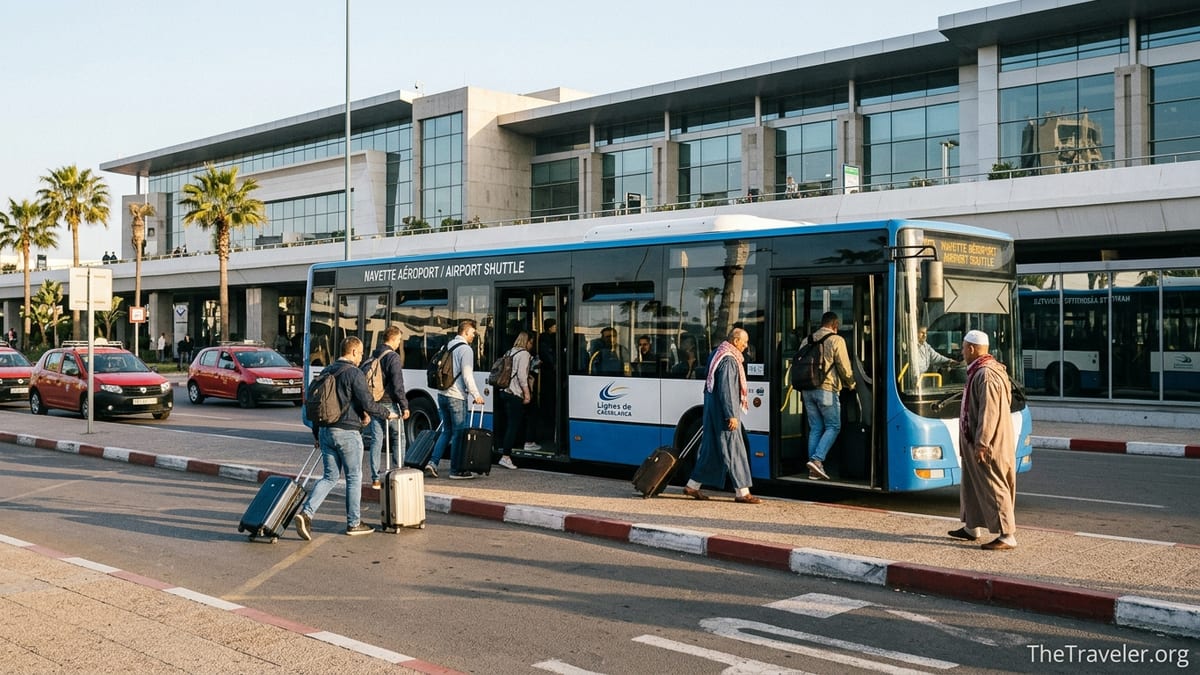
What Exactly Is the Casablanca Aerobus?
The Aerobus is a dedicated airport shuttle bus line connecting Mohammed V International Airport (CMN) with central Casablanca. Operated by Casabus by Alsa under the city transport authority, it runs all day and night between the airport terminals and Casa Port, the downtown rail station near the old medina and port. The service was introduced to give travelers a simpler, lower-cost alternative to taxis and a complement to the existing ONCF airport train.
Unlike regular city buses, the Aerobus uses modern, air-conditioned coaches with luggage space and a flat airport fare. The vehicles are typically branded with “Aerobus” or “Airport” wording and follow a straightforward route along major city arteries. For visitors, that means you do not need to understand the full local bus network; you simply follow airport signage to the Aerobus stop, board the next shuttle, and ride to key downtown points including Casa Port.
In practice, the Aerobus sits between the train and a taxi in both comfort and cost. It is cheaper than a metered or flat-rate airport taxi, yet more comfortable and luggage-friendly than a standard city bus. For solo travelers or couples heading to central neighborhoods like the old medina, the business district near Boulevard d’Anfa, or hotels around United Nations Square, it has rapidly become one of the most attractive options.
Because it is a relatively new service, online coverage is still catching up. Schedules and exact operating hours may adjust with demand, but by mid‑2026 the Aerobus is firmly established as a permanent part of Casablanca’s airport access network alongside the ONCF train and taxi ranks.
Aerobus Route: From CMN to Casa Port and Key City Stops
The Aerobus line runs between Mohammed V International Airport and Casa Port station, with intermediate stops at strategic points in Casablanca’s urban core. From the airport, buses start at Terminal 2 and also serve Terminal 1, so whether you arrive on Royal Air Maroc or a low-cost European carrier, you can follow the Aerobus signs in the arrivals area to reach the stop outside your terminal.
Once it leaves the airport, the bus follows the main highway toward the city before transitioning to large urban boulevards. It then serves a string of high-demand areas: major hotel zones, business districts, and interchange points where you can connect to trams or taxis. Typical reference points along the city section of the route include the area around Arab League Park, major boulevards that cut through central Casablanca, and finally Casa Port station, which is the terminus on the downtown side.
Casa Port is particularly important for travelers because it connects to frequent ONCF trains along the coast, including services to Rabat and Kenitra, plus regional trains to other cities. The station is also a short walk or short taxi ride from popular downtown hotels, the port area, and the medina. If your accommodation is in Gauthier, near United Nations Square, or close to the marina, the Aerobus plus a brief local taxi ride is usually straightforward.
On the return journey, the Aerobus runs from Casa Port back to the airport, mirroring the same main stops in the city before joining the highway to reach Terminals 1 and 2. Many travelers staying downtown simply walk or take a short red taxi to Casa Port, where the shuttle stop is easy to spot near the main station entrance and taxi rank.
Fare, Tickets and Payment: How Much Does the Aerobus Cost?
One of the Aerobus’s main selling points is its flat fare. As of mid‑2026, the official airport shuttle ticket is widely reported at around 50 Moroccan dirhams per person for the full ride between Mohammed V Airport and Casa Port. That is roughly the same order of magnitude as a second-class ticket on the ONCF airport train, but crucially it is fixed for the entire bus route and usually cheaper than an official airport taxi, which often costs in the 250 to 300 dirham range for downtown.
The flat fare model means that once you board the Aerobus, you pay the airport price even if you get off before Casa Port. This is very convenient if you are carrying luggage and want the flexibility to hop off at a downtown stop close to your hotel without worrying about re-calculating the fare. Some locals may ask whether there is a reduced price for shorter segments along the same line, but the airport shuttle is clearly marketed as a premium flat-fare service rather than a typical pay-by-distance city bus.
Payment is generally handled in cash in Moroccan dirhams directly to the driver or a conductor on board. For a smooth arrival, it helps to obtain small notes or coins at an airport ATM or currency exchange before approaching the bus. Contactless or card payments are being rolled out on parts of Casablanca’s bus and tram network, but travelers should not rely on cards working reliably on the Aerobus yet; cash remains the safest assumption.
If you are landing late in the evening and worried about having local currency, a practical approach is to use an airport ATM in the arrivals hall, withdraw a modest amount such as 200 or 300 dirhams, and keep a 50 dirham note set aside for the bus. This is especially helpful if you are connecting onward by train or tram and may need additional small denominations for secondary fares.
Luggage, Comfort and Onboard Experience
The Aerobus is designed with air travelers in mind, so luggage is generally not an issue. Coaches typically have low floors and wide doors, allowing easy boarding with rolling suitcases. You can place large bags in designated luggage spaces near the front or middle of the bus, and keep smaller backpacks or handbags with you in your seat. There is no formal weight limit published for regular passengers, and the standard expectation is that if you can manage your bags yourself, you can bring them on board.
For example, a visiting couple arriving from Paris with two medium checked suitcases and two carry-on backpacks would normally have no trouble getting everything onto the Aerobus in one go. They would wheel their cases from baggage claim to the bus stop outside the terminal, lift them into the luggage area with minimal steps, then take seats nearby. This setup is more forgiving than a local city bus and avoids the stairs and platform gaps you might encounter with the train.
In terms of comfort, the buses are modern and air-conditioned, an important consideration during Casablanca’s hotter months when afternoon temperatures can reach the high 20s or more in degrees Celsius. Seats are basic but adequate for the roughly one-hour journey between the airport and Casa Port, depending on traffic. There are no assigned seats or reserved sections; boarding is first-come, first-served, but even at busy times the buses are structured for airport traffic rather than packed commuter conditions.
Travelers with mobility concerns should still allow extra time and ask staff for assistance if needed. While the buses are low-entry, the airport curb and city curbs can differ in height, and ramps may not always be perfectly aligned. That said, many passengers with strollers or wheeled suitcases use the service daily, and the boarding process is generally straightforward compared with navigating stairs down to the underground airport train station with heavy bags.
Frequency, Operating Hours and Realistic Travel Times
The Aerobus is scheduled to align broadly with flight arrivals and departures, running throughout the day and night. Airport and city sources describe departures roughly every 25 to 40 minutes, which translates to two or more buses per hour at many times of day. Overnight, frequency can thin out slightly, but the goal is continuous coverage so that travelers arriving after midnight still have a public transport option without resorting immediately to taxis.
In practical terms, a traveler landing around 14:00 on a weekday can usually expect to clear immigration and baggage claim in about 45 to 60 minutes and then wait no more than 20 to 30 minutes for the next Aerobus. During peak arrival windows, staff may stage buses to depart when they have filled to a comfortable level rather than strictly on clock times, to keep the flow moving. Timetables can be posted at the airport stop and at Casa Port, but they are best treated as guidelines rather than minute-perfect commitments.
Journey time between the airport and Casa Port is typically about one hour, though this varies with traffic on the motorway and inner-city sections. During late-night or very early-morning trips, when traffic is light, the same route can take closer to 45 minutes. At rush hour, especially near the city center, delays of 10 to 20 minutes are not unusual. Travelers catching long-distance trains from Casa Port or morning flights from CMN should therefore build in a buffer rather than timing their connection to the minute.
By comparison, the ONCF train usually covers the airport to Casa Voyageurs segment in around 30 minutes and continues to Casa Port in roughly 45 minutes total. On pure run time alone, the train is more predictable. The Aerobus’s advantage comes from its city stops and door-to-door convenience for downtown addresses, which can offset a slightly longer transit time when you factor in the need for taxis or walking at each end of a train journey.
When the Aerobus Beats the Train
Although the airport train is an established backbone of Casablanca’s ground transport, there are many scenarios where the Aerobus is the smarter choice. The most obvious is when you are staying near Casa Port, United Nations Square, Arab League Park, or central hotel clusters along main boulevards served directly by the bus. In these cases, the shuttle can drop you much closer to your door than the train, often eliminating the need for an extra taxi ride that would otherwise add both cost and complexity.
Consider a solo traveler arriving from London in the late afternoon and staying at a hotel near United Nations Square. With the train, they would first descend to the airport station, ride to Casa Voyageurs or Casa Port, then take a short but sometimes chaotic taxi ride into the city center, paying about 50 dirhams for the train plus perhaps 20 to 40 dirhams for a taxi depending on negotiation. With the Aerobus, they can ride directly from the terminal to a stop near their hotel for around 50 dirhams total and walk the last few minutes, avoiding the extra transfer.
The Aerobus also shines for late-night arrivals and early-morning departures. The train traditionally operates on an hourly schedule with a window that ends late at night and resumes early in the morning, which can leave passengers with awkward gaps if a flight lands just after the last train or departs before the first. The shuttle’s extended operating hours, including overnight service, give peace of mind to travelers landing after midnight or heading to the airport for 6:00 flights who do not want to pay full taxi fares from downtown.
Finally, for budget-conscious visitors and small groups, the flat fare is hard to beat. A backpacker flying in to start a Morocco tour may prefer to allocate money to accommodation or experiences rather than taxis. For them, paying around 50 dirhams for the shuttle and then perhaps a short local tram or taxi ride, instead of 250 to 300 dirhams for a direct airport taxi, can make a noticeable difference on a tight budget, especially if they are traveling alone.
When You Should Still Choose the Train
The ONCF airport train remains the better option in several important cases. If you are connecting to long-distance trains from Casa Voyageurs, such as high-speed Al Boraq services to Tangier or mainline trains to Marrakech, Fez or Oujda, the train keeps you inside the rail system the entire way. You simply ride from the airport station to Casa Voyageurs, step off, and connect to your onward platform, often with coordinated schedules.
For example, a traveler arriving from Europe at midday who needs to be in Tangier the same evening will be better served by the train. They can catch the airport train at approximately the 50th minute past the hour, ride to Casa Voyageurs in about half an hour, and then transfer to an Al Boraq high-speed train north. Taking the Aerobus to Casa Port and then working back toward Casa Voyageurs by tram or taxi would add unnecessary complexity and risk missing a reserved high-speed departure.
The train is also more attractive if your accommodation is near Casa Voyageurs, Casa Oasis or along the airport line itself. Many mid-range hotels and business properties cluster around Casa Voyageurs because of the rail connectivity, and in that zone the train delivers you effectively to their doorstep. In such cases, combining the Aerobus and a taxi does not produce meaningful savings or convenience.
Finally, if you are particularly sensitive to traffic delays or traveling during known heavy congestion periods on Casablanca’s roads, the train’s fixed right-of-way can provide more reliable timing. For instance, during weekday evening rush hour or when there are major events in the city, the Aerobus may experience slower progress on urban boulevards, while the train schedules, though not immune to delay, generally remain more stable.
Practical Tips: Choosing and Using the Aerobus in 2026
A few simple habits can make the Aerobus experience smoother. First, always check operating information as close as possible to your travel date, as Moroccan public transport providers sometimes adjust timetables seasonally or around Ramadan. Airport information boards, hotel reception desks, and official Casabus information channels can confirm current first and last departures.
Second, carry small denominations of Moroccan dirhams. Upon landing, use an airport ATM to withdraw a modest sum, then break a large note with a coffee or small purchase if necessary so you are not presenting very high-value bills to the bus driver. Having exact or near-exact change speeds boarding for everyone and reduces the risk of misunderstandings over change.
Third, think in terms of your full journey, not just the airport leg. If you are planning to connect from the Aerobus at Casa Port directly onto a train to Rabat or Kenitra, give yourself at least a 30 to 45 minute buffer between the bus’s expected arrival and your train’s departure time to account for traffic or minor delays. Similarly, when heading to the airport for a flight, aim to be at the terminal two to three hours before international departures and work backward to choose an Aerobus departure that comfortably achieves that.
Lastly, keep your valuables close. The Aerobus is widely used and generally safe, but as on any airport shuttle in a big city, pickpocketing can occur. Use common-sense precautions: keep passports and wallets in interior pockets or money belts, keep your daypack in front of you rather than dangling behind, and do not leave bags unattended in the luggage area at intermediate stops. Such simple practices help ensure your experience remains focused on the convenience and savings this new service offers.
FAQ
Q1. How much does the Casablanca Aerobus cost from the airport to Casa Port?
The Aerobus operates on a flat airport fare, which is widely reported at around 50 Moroccan dirhams per person for the full journey between Mohammed V Airport and Casa Port.
Q2. Where do I catch the Aerobus at Mohammed V International Airport?
You can follow the signs for buses or public transport from the arrivals hall of Terminal 1 or Terminal 2. The Aerobus stop is located just outside the terminal buildings, near the main curbside area where other buses and shuttles depart.
Q3. How long does the Aerobus take from the airport to downtown Casablanca?
Typical journey time between Mohammed V Airport and Casa Port is around one hour. At night with light traffic it can be closer to 45 minutes, while at rush hour it may extend to 70 minutes.
Q4. How often does the Aerobus run?
The Aerobus usually runs every 25 to 40 minutes, with service spread over the full day and night to match flight arrivals and departures. Exact intervals can vary slightly by time of day and season.
Q5. Can I pay for the Aerobus with a credit card or contactless payment?
As of 2026, you should assume payment is mainly in cash using Moroccan dirhams, paid directly to the driver or onboard staff. Card or contactless options are expanding in Casablanca but should not be relied upon for the Aerobus.
Q6. Is there space for large luggage on the Aerobus?
Yes. The Aerobus uses modern, low-floor buses with designated luggage areas where you can store large suitcases. Smaller bags and backpacks can be kept with you at your seat.
Q7. When is the Aerobus better than the airport train?
The Aerobus is usually better if you are staying near Casa Port, United Nations Square, Arab League Park or other central stops on the route, if you are arriving very late or leaving very early, or if you are traveling on a tight budget and want to avoid taxi fares.
Q8. When should I still choose the train instead of the Aerobus?
Choose the ONCF train if you are connecting to long-distance services at Casa Voyageurs, heading to cities like Marrakech or Tangier, or staying near stations along the airport train line such as Casa Voyageurs or Casa Oasis.
Q9. Do I need to buy an Aerobus ticket in advance?
No. The Aerobus works on a turn-up-and-go basis. You simply board the next shuttle and pay the driver or onboard staff. There is no advance booking system for individual passengers.
Q10. Is the Aerobus safe to use at night?
The Aerobus is designed to serve late-night and early-morning flights and is generally considered safe, with other travelers and airport staff often on board. As always, keep your valuables secure and stay aware of your surroundings, just as you would on any urban public transport at night.