


More news on this day
France, one of the world’s most visited destinations, is again under a refreshed travel advisory from the United States and other governments, as recent updates highlight persistent security risks, sporadic unrest and tighter border procedures affecting international visitors.
Get the latest news straight to your inbox!
Advisory Level Maintained but Language Tightened
Recent changes to official travel advice for France keep the overall risk classification broadly unchanged while sharpening language on specific safety concerns. Publicly available information from government advisories indicates that France remains in the mid-range of the four-tier scale often used by foreign ministries, where travelers are advised to exercise increased caution rather than avoid travel altogether.
The revised wording points to the country’s long-running vigilance against terrorism, referencing France’s nationwide security posture and the presence of uniformed and plainclothes officers in major transport hubs, public spaces and tourist sites. Advisories emphasize that while large-scale attacks have become less frequent, the risk of isolated violent incidents persists and is treated as a key factor in maintaining the current advisory level.
Published material from several national travel portals notes that the updated advisory does not signal a new emergency, but rather a recalibration based on evolving security assessments, law-enforcement operations and incident trends across European cities. Travelers are being encouraged to stay informed through official bulletins and local news while continuing to visit France’s major urban and resort areas.
Authorities in France have kept their domestic alert framework active in recent years, particularly around major events, religious holidays and high-profile gatherings. This environment, combined with increased visitor numbers during the peak summer season, is reflected in the more detailed guidance now being provided to foreign travelers.
Focus on Protests, Public Gatherings and Urban Safety
The updated advisory places renewed attention on demonstrations and public gatherings, which have become a recurring feature of civic life in France. Recent protest movements over economic policy, labor reforms and social issues have periodically led to large marches and localized clashes in Paris, Marseille, Lyon and other cities, sometimes disrupting traffic and public transport.
Visitors are advised to steer clear of protest routes, avoid confrontations and monitor municipal announcements about planned demonstrations. Reports from European travel-security briefings indicate that most gatherings remain peaceful, but some have seen property damage, fire setting or confrontations with police, particularly after nightfall. The advisory language reflects these patterns by urging travelers to remain alert in central districts where demonstrations are more likely.
Urban crime, including pickpocketing and bag snatching, is also underlined as a continuing concern in tourist-heavy areas. Travel guidance notes that busy rail stations, metro lines, airport connections and attractions such as major museums and monuments are frequent targets for opportunistic theft. Visitors are encouraged to secure passports and valuables, avoid displaying high-value items and be cautious of distractions that may be used as a pretext for theft.
In addition, advisory updates draw attention to scams involving unofficial transportation, counterfeit goods and unlicensed street vendors near attractions. Travelers are urged to use registered taxis or well-known ride services, verify fares where possible and be wary of unsolicited assistance at ticket machines and ATMs.
Border Controls, Entry Rules and Schengen-Wide Changes
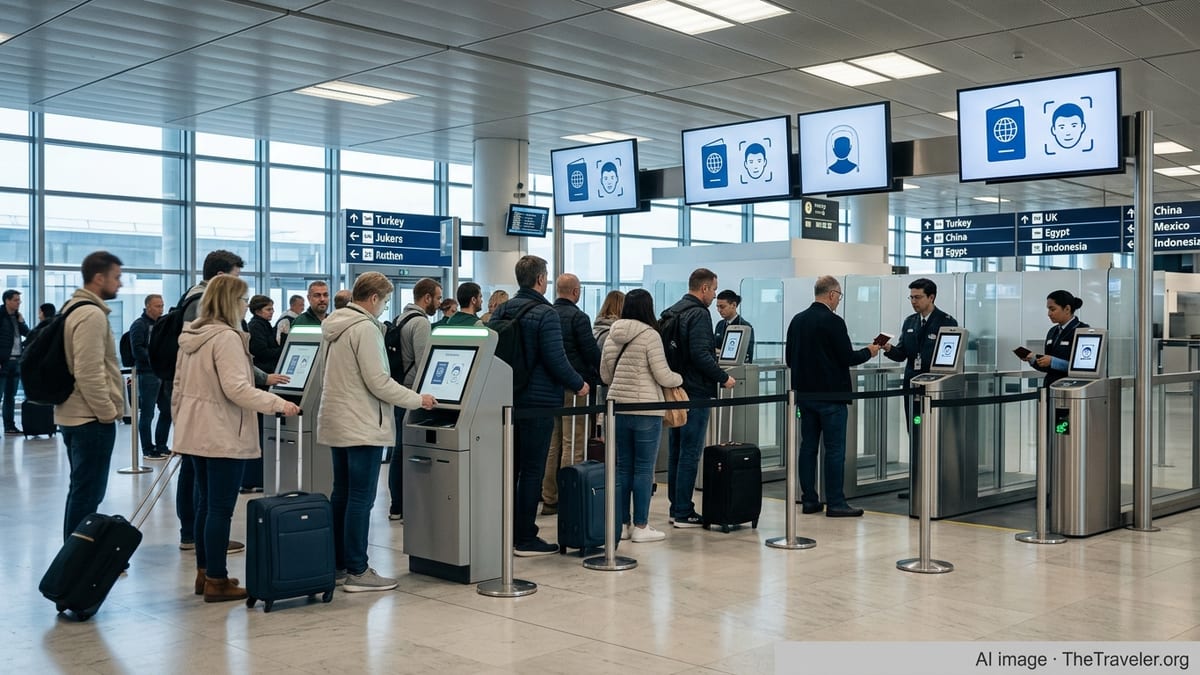
The refreshed guidance for France comes as Europe prepares for new border management tools and continues to adjust internal checks within the Schengen Area. Travel advice now highlights that visitors may face more frequent identity checks at land borders, ports and airports, even when moving between Schengen countries that historically maintained largely open internal frontiers.
Recent European travel updates reference the forthcoming Entry/Exit System and related changes that will increase scrutiny of non-European travelers entering and leaving the Schengen zone. While implementation timelines have shifted in the past, advisories point out that travelers should expect longer processing times and must ensure their passports are valid for the required period beyond their intended stay.
For France specifically, border controls have sometimes been reinforced around major international events, high-profile trials or regional security incidents. Public information from European and national authorities notes that these measures can involve temporary checkpoints on roads and rail routes from neighboring states, as well as more systematic screening at airports serving Paris and other gateway cities.
Travelers are being encouraged to allow extra time for security and immigration checks, carry proof of accommodation and onward travel where applicable, and stay aware that entry decisions remain at the discretion of border officials. Those planning multi-country itineraries across Europe are advised to review the latest entry rules for each stop, as interpretations of shared regulations can differ between states.
Transport Networks, Major Events and Seasonal Pressures
The updated advisory also reflects the cumulative impact of transport disruptions and major events on travel through France. Rail strikes, public transport stoppages and aviation-related actions have periodically affected domestic and international connections in recent years. Travel bulletins emphasize that such disruptions can develop quickly and may lead to cancellations, delays or last-minute schedule changes.
Guidance for travelers recommends monitoring airline notifications, rail operator alerts and local news outlets, particularly during periods of industrial negotiations or large national demonstrations. Flexible itineraries, travel insurance that covers disruption, and backup options for key segments are increasingly presented as prudent measures rather than optional extras.
France’s role as a host of major sporting, cultural and political events also features prominently in security assessments. High-profile tournaments, international summits and large festivals attract significant visitor numbers and can prompt temporary security cordons, road closures and restrictions on vehicle access near stadiums and city centers.
Advisory language notes that while these measures are designed to safeguard participants and spectators, they can also affect routine tourism patterns by rerouting traffic and crowding certain areas. Travelers are encouraged to check event calendars for cities on their route and to plan accommodation and transport well in advance during busy periods.
Practical Advice for Travelers Heading to France
Despite the sharpened wording in the latest advisory, France remains one of the world’s leading tourism destinations, and international arrivals continue at scale. Travel experts and publicly available guidance consistently stress that most visits are trouble-free, provided that visitors approach their trip with preparation and situational awareness.
Standard recommendations include registering travel plans with relevant national consular services where available, ensuring comprehensive health and travel insurance, and keeping both digital and physical copies of key documents. Advisories urge travelers to familiarize themselves with local emergency numbers, basic phrases in French for seeking help, and the locations of their national consulates or embassies.
Visitors are also encouraged to pay attention to local regulations on public conduct, including rules around public intoxication, crowd control around major sites and restrictions on the use of certain public spaces during security operations. Awareness of regional differences within France, from dense urban centers to rural areas and coastal resorts, can help travelers adapt their plans and expectations.
Overall, the updated advisory underscores a balance between caution and continuity. France continues to welcome international visitors, but the latest guidance serves as a reminder that global travelers should pair their itineraries with careful planning, risk awareness and respect for the evolving security context in one of Europe’s most prominent destinations.