


Casablanca’s Mohammed V International Airport (CMN) is the main gateway to Morocco for many travelers, yet arriving passengers are often unsure how to reach the city safely and efficiently. Ridehailing names like Uber and Careem appear in app stores, but their status on the ground can be confusing, especially around the airport where regulations are stricter. This guide sets out what really works in 2026, with a clear look at app availability, where you can be picked up, typical prices into the city, how luggage affects your options, and when a regular taxi or the airport train is the smarter and safer choice.
Get the latest updates straight to your inbox!
Are Uber and Careem actually available at Casablanca Airport?
Travelers arriving at Mohammed V International Airport often open Uber first, only to find there is no official Uber service operating in Casablanca in 2026. You may see the app on your phone if you use it at home, but it will generally show no cars nearby or will only allow you to book intercity services starting from other Moroccan cities where partnerships occasionally exist. In practice, you should not plan on taking a regular Uber from the arrivals curb at CMN.
Careem, which some visitors know from Dubai, Saudi Arabia or Egypt, does appear in Morocco, but its presence is limited and frequently changes. While some travelers report using Careem inside Casablanca’s city districts for local trips, it is not a reliable option for on-demand pickup right outside the airport terminal. Even when the app shows cars, drivers may be reluctant to enter the airport arrival lane because of conflicts with licensed taxis and local enforcement officers. At best, you might arrange a Careem drop-off at CMN when leaving Morocco, but counting on it for an immediate arrival pickup is risky.
The upshot is that Casablanca’s airport still relies on a combination of licensed taxis, prebooked private transfers and the ONCF airport train, rather than the kind of fully legal, widely accepted airport ridehailing scene you may know from cities like London or Istanbul. You can sometimes arrange an app-based ride by walking away from the main terminal area and meeting a driver on a nearby access road, but this is semi-clandestine and not recommended for first-time visitors arriving late at night or with heavy luggage.
For most travelers, the most predictable and safest options are to use the official taxi rank, arrange a private transfer in advance, or go straight to the airport train station in the basement of Terminal 1 and continue to Casa-Voyageurs station in the city before switching to a local taxi or tram.
Understanding licensed taxis at Mohammed V Airport
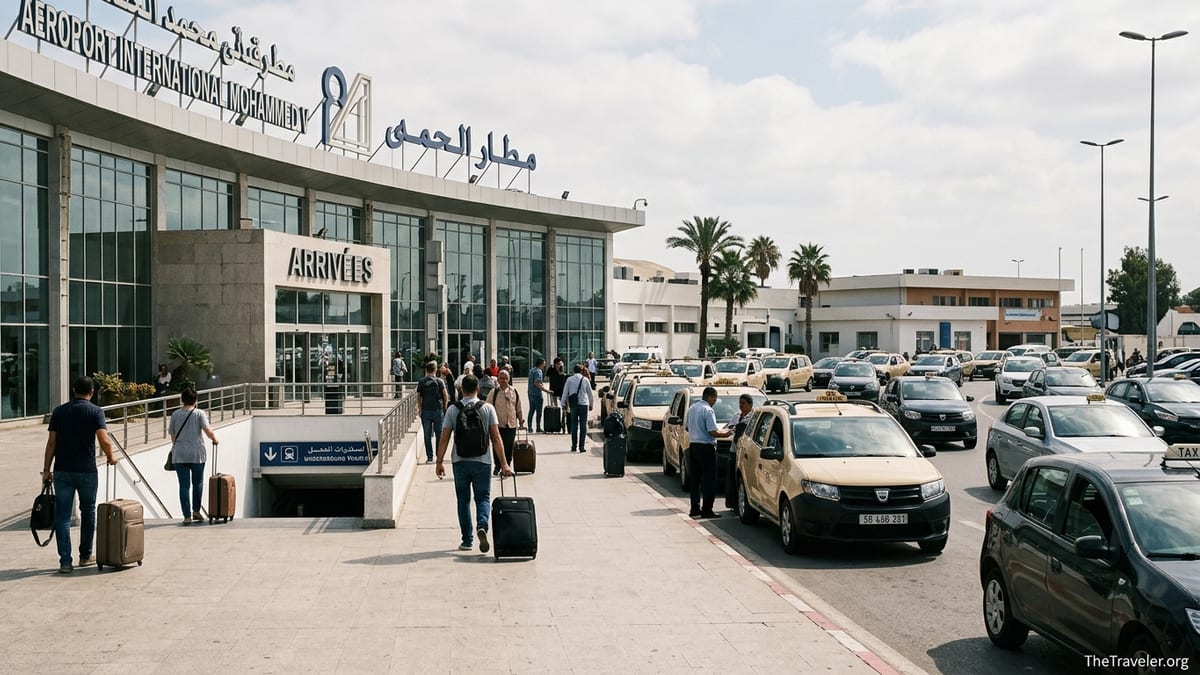
Licensed taxis remain the default way to leave Casablanca’s airport, especially outside the main train operating hours. Official airport taxis wait on the forecourt outside arrivals and are usually beige or white grand taxis rather than the smaller red petit taxis used within the city. As you exit customs into the public arrivals hall, you will see signs pointing towards the taxi rank. Many first-time visitors miss the fact that the airport authority operates a taxi information desk near the arrivals esplanade, with an official tariff board showing typical fixed prices to major destinations such as central Casablanca, Rabat or Marrakech.
Prices from CMN into central Casablanca are usually quoted per vehicle and not per passenger. In 2026, travelers commonly report paying the equivalent of around 250 to 350 Moroccan dirhams for a private taxi from the airport to central districts such as Maarif, Gauthier or the area around Casa-Port and the business center, depending on the hour, traffic and negotiation. This works out to roughly 25 to 35 US dollars for up to three or four passengers sharing one car. Late-night arrivals may pay slightly more. It is a good practice to confirm the price at the taxi desk or agree firmly with the driver before you put your luggage in the trunk.
Within the city itself, you will mostly see red petit taxis, which are supposed to use a meter and are intended for shorter urban journeys. If you arrive at Casa-Voyageurs station by train and need to reach your hotel near the Old Medina or the Twin Center, a metered red taxi ride usually costs the equivalent of a few US dollars. For example, travelers often report paying between 20 and 40 dirhams for a 10 to 15 minute trip during the day from Casa-Voyageurs to central hotel areas, provided the driver uses the meter and there is no extreme congestion.
As with many cities, there is a small risk of unlicensed drivers approaching you in the arrivals hall or just outside offering “cheap taxi” or “private car” rides. These drivers may stand away from the official queue and can be persistent. To stay safer, ignore unsolicited offers, walk directly to the signed taxi rank, and if in doubt ask at the airport information or taxi desk where the official line begins. Licensed taxis should display a number and basic identification, and are more likely to be accountable if a problem arises.
Careem, local apps and practical pickup strategies
Because Uber is not active in Casablanca as it is in many European or North American cities, knowledgeable visitors often look to Careem or to local ridehailing platforms that sometimes operate in partnership with licensed taxis. These services can be useful inside the city, especially for English-speaking travelers who prefer to see an estimated price and track the car in-app. However, at the airport their use is more complicated.
Some Moroccan ride apps connect you with licensed taxis rather than private cars. In theory these could pick you up at Mohammed V Airport’s parking area with less friction than an unlicensed driver, but you still face the same competition with the on-site taxi rank. Many drivers who use these apps simply turn them off when queued at the airport and accept passengers in person instead. In practical terms, you may open an app after clearing customs and see few or no vehicles willing to approach the official curbside lanes.
A more workable strategy, if you strongly prefer app-based rides and feel comfortable navigating the airport exterior, is to collect your luggage, exit the terminal, and walk a short distance to the public parking or to a nearby roundabout or access road outside the immediate arrivals canopy. Some travelers do this to meet a Careem or local app driver who does not want to get into an argument with taxi marshals. For example, a visitor landing on an afternoon Royal Air Maroc flight might walk five to ten minutes to a prearranged point in the parking area and then call a ride within the app. This requires a working local SIM or eSIM, awareness of your surroundings, and a willingness to manage your bags outside the protected terminal zone.
For most first-time visitors carrying large luggage or traveling with children, this workaround is not ideal. The time and effort spent trying to secure an app ride can outweigh any saving compared with the official taxi rank, especially after a long-haul flight. In many cases, prebooking a private transfer with a reputable operator or using the airport train to Casa-Voyageurs and then taking a short city taxi ride turns out to be both cheaper and less stressful than gambling on whether Careem will function at curbside.
Safer alternatives: Airport train, prebooked transfers and when to choose each
One of Casablanca’s major advantages over some regional airports is that Mohammed V Airport has its own ONCF train station directly beneath Terminal 1. From the arrivals level, it usually takes five to ten minutes to walk down to the station in the basement, where you can buy tickets at staffed counters or from machines. Trains typically run about once an hour between early morning and late evening, and the journey to Casa-Voyageurs station in the city takes roughly 35 to 45 minutes.
Ticket prices vary slightly over time, but as of 2026, passengers commonly pay in the region of 40 to 50 dirhams for a one-way second-class ticket from Aéroport Mohammed V to Casa-Voyageurs, which is around 4 to 5 US dollars. This makes the train significantly cheaper than a taxi for solo travelers and budget-conscious visitors. Once you reach Casa-Voyageurs, you can change to onward trains for destinations such as Rabat, Tangier and Marrakech, or take a short taxi or tram ride to your hotel within Casablanca. For example, a traveler staying at a mid-range hotel near the Casa-Port waterfront might take the airport train to Casa-Voyageurs and then a second ONCF service or tram toward Casa-Port, finishing with a brief walk.
Prebooked private transfers are another safer alternative, especially for late arrivals, families or those carrying bulky sports equipment. Many Casablanca hotels, especially higher-end international chains, offer to arrange an airport pickup for a fixed price, often in the range of 350 to 500 dirhams depending on the vehicle type and distance. Independent transfer companies also operate between CMN and popular destinations such as Marrakech or Rabat. While this is more expensive than taking the train, it can be good value if you are a group of three or four sharing the cost, and it avoids the negotiation sometimes needed at the taxi rank.
Choosing between these options depends on your arrival time, budget and comfort level. If you land mid-morning or in the afternoon, and can comfortably manage your bags, the airport train to Casa-Voyageurs followed by a short city taxi is often the best mix of price and predictability. If you land around midnight when trains are not running, are traveling with young children, or do not want to navigate transfers, a prebooked hotel car or an official airport taxi becomes the safer and more straightforward choice, even though you will pay more than using rail.
Pricing expectations from the airport into Casablanca and beyond
Setting realistic expectations about prices helps you recognize fair offers and avoid unnecessary arguments when you are tired from a long flight. From Mohammed V Airport into central Casablanca, an individual traveler using the train and then a local taxi might expect their total cost to land somewhere around 60 to 100 dirhams, depending on distance and traffic within the city. For example, 45 dirhams for the airport train plus 25 dirhams for a red taxi from Casa-Voyageurs to a hotel in Maarif would be typical for a daytime arrival.
By contrast, a direct taxi from the airport to the same hotel might cost five or six times that, but still be reasonable when shared among several people. Three friends arriving together and taking an airport taxi quoted at 300 dirhams to central Casablanca would each pay the equivalent of about 10 US dollars door to door, which many visitors consider acceptable in exchange for convenience. If a driver at the rank demands significantly more than similar figures, you can politely indicate that you will ask at the official desk or consider the train instead. This often encourages a more realistic price.
For longer distances, such as from CMN to Rabat or even Marrakech, you should expect higher figures and consider mixing modes. A common pattern is to take the airport train to Casa-Voyageurs, then transfer to a mainline ONCF or high-speed Al Boraq service. For example, a traveler heading to Tangier might spend roughly 50 dirhams on the airport train plus a higher amount for the Al Boraq ticket from Casa-Voyageurs to Tangier, yet still pay less overall than an all-road private car from the airport. Taxi drivers at CMN will often quote four-figure sums in dirhams for direct runs to those cities, which can make sense for larger groups but not for solo travelers.
With app-based rides inside Casablanca itself, fares from Careem or local platforms, when available, can undercut street-hailed taxis on longer routes because they do not rely on fixed airport tariffs. However, any potential saving is irrelevant if no driver is willing to come to the airport arrivals curb. This is why planning around the train and official taxis, and treating any successful Careem pickup at CMN as a bonus rather than a guarantee, is a more realistic approach.
Luggage, groups and accessibility: Choosing the right option
Your choice of transport from Casablanca’s airport is not only about cost and speed. Luggage volume, group size and mobility needs matter just as much. The ONCF airport train offers generous luggage space at the car entrances and overhead racks, but it is still a regular commuter-style train. If you are arriving with two large checked bags and a carry-on, plus perhaps a suitcase for a child, hauling everything on and off the train, then through Casa-Voyageurs station and into a taxi can be tiring, especially after an overnight flight from North America or Asia.
For groups, a single taxi or minivan transfer can become both easier and better value. Two parents with two teenagers and ski or surf equipment heading to a resort area, for instance, may find that a private prebooked van at around 600 to 800 dirhams from CMN to their Casablanca hotel feels worthwhile. They avoid wrestling several large bags in and out of train carriages and can go straight from the arrivals hall to a parked vehicle with enough room for luggage. Even though the total price is high, the per-person cost becomes more sensible compared with individual train tickets and multiple local taxis to fit both people and gear.
Accessibility is another factor. The airport train station is reachable by escalators and elevators, but moving between platforms, handling steps into the train and transferring at Casa-Voyageurs can still pose challenges for those with limited mobility or who use a wheelchair. In such cases, arranging an accessible taxi or a hotel car that can accommodate mobility equipment is often the safest option. It is advisable to contact your accommodation in advance and ask whether they can book a reliable driver familiar with assisting passengers who have additional needs.
For travelers who insist on using an app-based service like Careem because of language concerns, a compromise is to use it once you are in the city rather than at the airport. Take the train to Casa-Voyageurs, then, from the relative calm of your hotel or a nearby café with Wi-Fi, test whether Careem operates in your area. You may find it useful later in your stay for cross-town journeys, even if it was not practical as a primary airport transfer tool.
Safety tips at pickup points and how to avoid common pitfalls
Regardless of which option you choose, a few basic habits can make your arrival at Casablanca’s airport significantly smoother. First, keep your valuables and key documents in a small bag that stays with you at all times, not in the trunk. When taking a taxi, load large suitcases into the boot, but keep passports, phones and wallets on your person in case you are separated from your luggage in congestion around the terminal or at a hotel drop-off.
Second, agree clearly on the price and destination with any taxi driver before you start moving. If you are going to a specific hotel, show the exact name and neighborhood in writing, ideally in French or Arabic as used locally. For example, if your hotel is near Casa-Port station, mention the area rather than just saying “city center,” as drivers might interpret that broadly. If the taxi is supposed to run on the meter, make sure you see it switched on soon after leaving the airport or Casa-Voyageurs.
Third, be cautious with anyone who approaches you inside the terminal offering transport even before you pass through the sliding doors into the public area. Official drivers generally wait at the rank or hold clearly printed signs with passenger names for prearranged pickups. If a person without identification insists they can give you a “better price than the taxi line,” it is safer to decline. Use well-lit, busy meeting points: the signed taxi rank, the airport train station platforms, or a hotel lobby entrance if you have prebooked a car.
Finally, if something feels off, do not hesitate to step back and choose a different option. It is perfectly acceptable to leave a taxi before departure if the driver suddenly changes the quoted price or if the vehicle appears in poor condition. Similarly, if an app driver wants to pick you up in an uncomfortably isolated area of the car park late at night, consider returning to the terminal and taking a licensed taxi instead. In most cases, any savings from improvising are small compared with the value of a straightforward and safe start to your time in Morocco.
The Takeaway
Casablanca’s Mohammed V International Airport operates differently from hubs where Uber and other global ridehailing brands dominate airport access. In 2026, you cannot rely on opening Uber and getting a legal, on-demand ride from the arrivals curb. Careem and local apps may be useful within the city but are inconsistent at the terminal itself. Instead, think of your choices in three main tiers: the ONCF airport train for value and predictability during operating hours, licensed airport taxis for straightforward door-to-door service, and prebooked private transfers for groups, late arrivals and travelers with extra luggage or accessibility needs.
By arriving with realistic expectations on pricing, understanding where the official taxi rank and train station are located, and being cautious with unsolicited offers, you can avoid the stress and confusion that sometimes greet first-time visitors. Treat any successful Careem pickup at the airport as a bonus rather than the backbone of your plan, and lean on the well-established taxi and train infrastructure instead. With a little preparation, your journey from Mohammed V Airport into Casablanca or onward to other Moroccan cities can be safe, efficient and a smooth introduction to the country.
FAQ
Q1. Is Uber available at Casablanca Mohammed V Airport?
Uber does not operate regular on-demand services from Casablanca’s airport in 2026, so you should not rely on it for pickup at the arrivals curb.
Q2. Can I use Careem to leave Casablanca Airport?
Careem’s availability around CMN is inconsistent, and many drivers avoid the arrivals lanes, so it is safer to plan on taxis, prebooked transfers or the train instead.
Q3. How much does a taxi from the airport to central Casablanca usually cost?
Typical quotes for a licensed airport taxi into central districts fall roughly between 250 and 350 dirhams per vehicle, depending on time of day and negotiation.
Q4. Where do I find the airport train at Mohammed V?
The ONCF airport train station is in the basement of Terminal 1. Follow signs from arrivals down to the station, where you can buy tickets to Casa-Voyageurs.
Q5. How long does the train from the airport to Casa-Voyageurs take?
The journey from Aéroport Mohammed V station to Casa-Voyageurs typically takes about 35 to 45 minutes, with trains running roughly once an hour during the day.
Q6. Is the train cheaper than a taxi for solo travelers?
Yes. A one-way airport train ticket usually costs around 40 to 50 dirhams, which is significantly cheaper than a 250 to 350 dirham taxi for one person.
Q7. Are taxis at Casablanca Airport safe to use?
Licensed taxis waiting at the official rank are generally safe. Use the marked queue, avoid unsolicited drivers inside the terminal, and agree on the fare before departure.
Q8. Can I pay for taxis and train tickets with a credit card?
Some train ticket counters accept cards, but many taxis still expect cash in dirhams. It is wise to withdraw or exchange a modest amount of local currency on arrival.
Q9. What is the best option if my flight arrives late at night?
For late-night arrivals when trains may not run, the safest options are a prebooked hotel transfer or a licensed airport taxi, even if costs are higher than daytime trains.
Q10. Is it safe to meet an app driver in the airport car park?
While some travelers do this, it can involve dark or isolated areas and potential conflicts with taxi marshals, so first-time visitors are usually better off using official taxis or the train.