


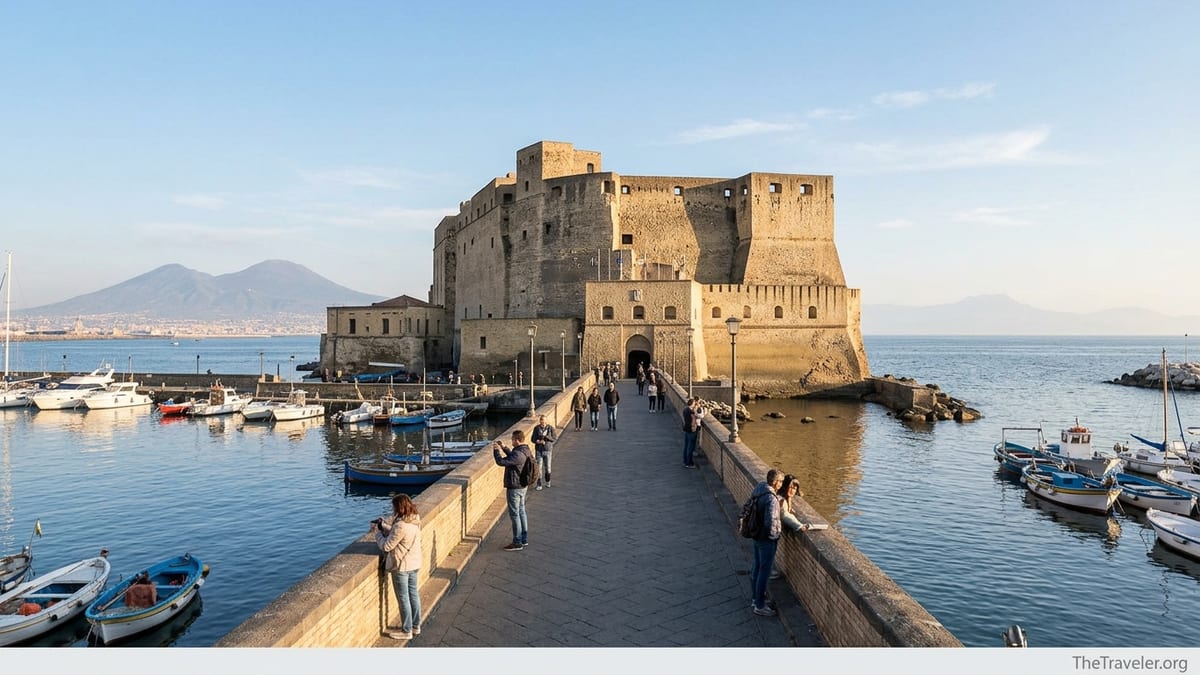
Rising from a rocky outcrop just off the seafront promenade, Castel dell’Ovo is the fortress every visitor to Naples ends up photographing, often before they know its name. Framed by the Bay of Naples and the outline of Mount Vesuvius, this compact castle has guarded, defined and inspired the city for more than a thousand years. Today, it is as much a place for sunset strolls, photo shoots and cultural events as it is a monument to the many civilizations that have called Naples home.
Get the latest updates straight to your inbox!
An Island Fortress That Anchors the Naples Skyline
Castel dell’Ovo sits on the former island of Megaride, now linked to the mainland by a short causeway and surrounded by the marina of Borgo Marinari. This position means that almost every classic Naples postcard view, from Via Partenope or the Lungomare Caracciolo, includes the castle’s angular pale tufa walls in the foreground and Vesuvius beyond. Even first-time visitors find that, once they arrive, the fortress feels instantly familiar: it is the stone landmark they have been glimpsing from their taxi, hotel terrace or ferry all along.
The geography is not just picturesque. From its terraces, visitors can trace the curve of the bay from the working port and historic center to the more residential slopes of Posillipo. On a clear day, you can pick out the islands of Capri and Ischia on the horizon, along with the bobbing masts of sailing boats in the small yacht harbors below. This 360-degree panorama is why many visitors rank a walk around the castle’s ramparts alongside views from Vomero or Posillipo as one of the essential visual experiences of Naples.
Practically, Castel dell’Ovo is also an easy anchor point for understanding the city’s layout. Standing at the main gate with your back to the sea, you are only a 10 to 15 minute walk from Piazza del Plebiscito and the Royal Palace, and a short stroll along the waterfront from grand seafront hotels like the Excelsior and Vesuvio. For travelers plotting an afternoon on foot, it is the natural junction between Naples’ royal quarter, its historic alleys and its modern seaside promenade.
Because of this central, coastal position, the castle has endured in the city’s collective imagination. Cruise ships approaching the port pass in front of it, runners trace routes starting at its bridge, and locals bring visiting friends here for their first sweeping look at Naples. The fortress is not isolated on a hill or behind ticketed gates; it is literally on the daily path of the city.
From Ancient Settlement to Royal Residence
The story of Castel dell’Ovo predates the castle itself. The rocky islet of Megaride was part of early Greek settlement in the Bay of Naples, associated with the origins of Parthenope, the colony that would evolve into modern Naples. Later, in Roman times, the area hosted luxurious seaside villas. Over centuries, the site shifted from retreat to stronghold as different rulers sought to control the bay.
The medieval fortress that travelers see today developed primarily from the 12th century onward, when Norman and then Swabian rulers fortified Megaride. Empress Constance, linked to the Hohenstaufen dynasty, was famously confined here during power struggles for the Kingdom of Sicily, underlining the castle’s role as both prison and prize in Mediterranean politics. Later, under Frederick II, the structure was further strengthened and used to guard royal treasures, reflecting its strategic value at the entrance to one of Italy’s most important ports.
By the 13th and 14th centuries, Castel dell’Ovo had also become a royal residence. Rulers chose the breezy sea-facing location over the denser urban palaces, creating a prototype for the seafront prestige that still defines the area. Walking through the inner courtyards today, it is not difficult to imagine processions entering through the arched gateways or guards stationed along the walls watching for ships from Sicily or Spain.
Later still, under the Aragonese and then Spanish rule, the political and residential focus shifted toward Castel Nuovo, the massive fortress closer to the harbor that many visitors know for its five towers. But Castel dell’Ovo remained a crucial defensive structure, adapted for artillery and redesigned after earthquakes and battles. Eventually its military importance declined, especially after Italian unification in the 19th century, and serious restoration in the 20th century transformed it from a deteriorating stronghold into the public monument and cultural venue it is today.
The Legend of the “Egg” and Naples’ Sense of Fate
Part of what makes Castel dell’Ovo iconic is a legend that is simple, memorable and perfectly suited to a city that thrives on myth. According to a story that took shape in the Middle Ages, the Roman poet Virgil, who medieval Neapolitans recast as a powerful magician, placed a magical egg inside the castle’s foundations. As long as the egg remained intact, the fortress and, by extension, Naples itself would be safe. If it ever broke, disaster would befall the city.
The tale is so ingrained that it explains the castle’s name: Castel dell’Ovo literally means “Egg Castle.” Travelers overhearing local guides on the ramparts will often catch a version of the story, usually introduced with a half-smile that suggests people do not take it literally but love the drama. Some historical sources even mention that in the Angevin period, rulers took the legend seriously enough to reassure the public after structural damage, promising the egg remained unharmed.
For visitors, the legend adds a layer of personality that distinguishes this fortress from many other Italian castles. When you walk up the stone ramp and cross the bridge over the water, you are not just entering a military monument but stepping into a long tradition of Neapolitan storytelling, where the city’s safety is tied to something as fragile and mysterious as an egg hidden in stone. It echoes other local myths, like those surrounding the siren Parthenope, and reinforces Naples’ self-image as a place of destiny on the edge of volcanic forces and the sea.
In practical terms, the legend also shapes visitor experiences. Souvenir stalls and bookshops in Naples often stock children’s books and postcards that play on the egg motif, while some guided tours of the historic center frame their narratives around stories of magic and fate that culminate at Castel dell’Ovo. For families visiting with children, this makes the castle an engaging stop where a simple walk among old walls is transformed into a treasure hunt for the invisible egg that keeps Naples safe.
Free Views and Easy Access in a City of Big Sights
Many of Naples’ headline attractions, from the archaeological treasures of the National Archaeological Museum to the royal apartments of the Palazzo Reale, require paid admission. Castel dell’Ovo is different. At the time of writing, entry to the fortress itself is generally free, with occasional restrictions when parts of the complex host official events or temporary closures for maintenance. This no-cost access makes it especially attractive for travelers managing budgets while still wanting panoramic views of the bay.
Reaching the castle is straightforward. Most visitors approach on foot along Via Partenope, a seafront road that doubles as a broad pedestrian promenade. From popular central areas such as Piazza del Plebiscito, the walk rarely takes more than 15 minutes at an easy pace. The final approach is across a short bridge that separates the castle and Borgo Marinari from the rest of the city, often lined with people pausing to photograph fishing boats and the reflections of the castle walls in the water.
Once inside, there are no elaborate museum displays to navigate. Instead, the experience is about space and views. Gently sloping ramps and wide terraces lead visitors up through the fortress to open platforms where you can look down on the Lungomare, across to Vesuvius or back toward the checkerboard of Naples’ streets. Independent travelers often weave a stop here into a self-guided afternoon wandering from the Spaccanapoli area down to the sea, using the castle as their reward stop for a coffee and rest with a view.
The combination of free entry, sea breezes and uncluttered vistas also makes Castel dell’Ovo popular with locals. On a weekday evening, you are just as likely to see Neapolitan couples leaning against the parapets and office workers taking a break on the walls as you are international visitors adjusting camera settings. This everyday use further cements its status as part of the living city rather than a monument sealed off for tourists.
Where Naples Lives and Dines Around the Castle
Another reason Castel dell’Ovo remains iconic is what surrounds it at water level. At the foot of the fortress lies Borgo Marinari, a compact marina village wrapped around the base of the rock. Here, narrow lanes lined with low pastel buildings host sailing clubs, moored yachts and a cluster of restaurants and bars. In the evening, tables spill out along the quayside, and the castle looms just above as a backdrop of stone. For travelers, this is a classic place to settle in for a plate of seafood spaghetti or grilled fish while watching reflections on the water and the lights of the city beyond.
Along Via Partenope on the mainland side, the scene is more grand but equally tied to the castle. Historic seafront hotels, including long-established luxury properties, face directly onto the promenade. Between them are casual pizzerias and gelaterie where you can order a margherita pizza or a cone of hazelnut gelato to eat while walking toward the castle. Prices vary, but a simple pizza in this area is often in the same range as elsewhere in the city, while drinks and desserts can be a little higher given the waterfront setting and views.
Locals use the space slightly differently from visitors. On weekend mornings, families push strollers along the Lungomare, pausing at the low sea walls to look at the fishing boats clustered near the castle. Joggers trace routes from the Villa Comunale park to the fortress bridge and back, timing their runs by the length of the waterfront. In recent years, sections of Via Partenope have been closed to through traffic or calmed, reinforcing its role as a pedestrian-friendly strip where the castle functions as the natural end point to a seaside stroll.
For travelers, this mix of daily life and scenic setting means that Castel dell’Ovo is not just something to see but somewhere to linger. Whether over an espresso in a simple bar at Borgo Marinari, or on a public bench along the Lungomare with a takeaway sfogliatella, the castle’s presence shapes how people use the waterfront. It is the stone constant in countless casual experiences, from children feeding pigeons on the square at its entrance to wedding parties posing on the bridge.
A Cultural Stage: Exhibitions, Events and Weddings
While Castel dell’Ovo has no permanent blockbuster museum exhibitions, the interior spaces are far from empty. The city of Naples uses the halls and courtyards for rotating art shows, photography exhibitions, conferences and occasional concerts. These events change throughout the year and can range from contemporary art to historical displays, giving repeat visitors fresh reasons to step inside.
Several of the vaulted rooms and open-air terraces are also available for conferences and private events. Corporate meetings, academic symposia and cultural festivals have all taken place within the walls. Travelers occasionally encounter signs indicating that a particular hall is reserved for a congress or installation, a small reminder that the fortress remains an active civic space rather than a static relic.
Perhaps most memorably for many visitors, Castel dell’Ovo serves as a sought-after setting for weddings. On most spring and autumn weekends, it is common to see bridal parties and photographers using the bridge, ramparts and courtyards as backdrops. For couples from Naples and beyond, hosting a ceremony or reception within the castle folds their personal story into the city’s much older one. For onlookers, the sight of a bride in white against ancient stone walls and a blue bay crystallizes why this particular landmark has such symbolic power.
Because event schedules can affect which areas are open, it is worth checking at the entrance or with local tourist information if you are planning a photo session or a longer visit inside. Even when parts of the interior are reserved, the exterior walkways, main approach and nearby promenade almost always remain accessible, so the quintessential views of the castle against the water are rarely off-limits.
Planning Your Visit: When to Go and What to Combine It With
Timing shapes the experience at Castel dell’Ovo as much as location. Early morning visits reward those willing to wake up with soft light over the bay, fishermen arranging their nets at Borgo Marinari and relatively few crowds on the ramparts. The castle opens in the morning and generally closes around sunset, with exact hours varying slightly by season and local administration decisions, so midday and late afternoon are the busiest times.
Many travelers plan their visit to coincide with golden hour, when the low sun warms the tufa walls and Vesuvius turns a deeper shade across the water. This is also when the Lungomare fills with strollers and street performers. Photographers often head up to the highest accessible terrace to capture the city’s lights coming on while the sky is still bright, then linger as the castle itself is illuminated and reflected in the bay.
Because of its position, Castel dell’Ovo fits easily into broader walking itineraries. A popular route is to start in the historic center near Via Toledo or Piazza del Gesù, work down through the Spanish Quarter or the royal quarter to Piazza del Plebiscito, then continue along Via Chiaia toward the seafront. From there, visitors can follow the waterfront to the castle for an afternoon of sea air and views, and finish with dinner in Borgo Marinari or on Via Partenope. Others might combine a morning at Castel dell’Ovo with an afternoon at Castel Sant’Elmo in the Vomero district, creating a “two castles” day that showcases Naples from sea level and hilltop.
Travelers with limited time, such as cruise passengers docking for a single day, often prioritize the castle because it provides a rapid, visually rich introduction to Naples without requiring long transfers. From the port area, a taxi or even a brisk walk can bring you to the castle quickly, and within an hour you can have taken in the iconic panorama, explored the courtyards and had a coffee overlooking the bay before moving on to other sights.
The Takeaway
Castel dell’Ovo remains one of Naples’ most iconic landmarks because it is more than a fortress on a rock. It is an everyday reference point for locals, a myth-tinged symbol of destiny, a free vantage point over one of the world’s most beautiful bays and a stage for modern life, from art exhibitions to weddings. Its compact size and easy access mean it rarely overwhelms, yet the views from its terraces are among the city’s grandest.
For travelers, including Castel dell’Ovo in a Naples itinerary is less about ticking off a monument and more about understanding how sea, stone and city interact here. Standing on its ramparts, with Vesuvius on the horizon and the jumble of Naples at your back, you feel why this particular castle, rooted in ancient rock and wrapped in legend, continues to define the image of the city both for those who live here and those who arrive for the first time with a camera in hand.
FAQ
Q1. Is Castel dell’Ovo free to visit?
Access to Castel dell’Ovo has typically been free, though specific exhibitions or events hosted inside may occasionally charge or restrict access to certain rooms.
Q2. How much time should I plan for a visit?
Most visitors spend about 45 minutes to 1.5 hours exploring the castle, walking the ramparts and taking photos, especially if combined with a stroll along the Lungomare.
Q3. What is the best time of day to go to Castel dell’Ovo?
Early morning offers quieter views and softer light, while late afternoon and sunset provide dramatic colors over the bay and excellent photo opportunities.
Q4. Can I visit Castel dell’Ovo with children or a stroller?
The approach and lower areas are stroller friendly, but some upper terraces are reached via ramps and stairs, so very young children and those with mobility needs may require extra time.
Q5. Are there guided tours available at Castel dell’Ovo?
Occasionally, cultural associations and private guides offer tours that include the castle within wider walking itineraries; otherwise, most visitors explore independently.
Q6. Is Castel dell’Ovo open every day?
The castle is usually open daily except for certain holidays or temporary closures for maintenance or events, so it is wise to verify current opening hours once in Naples.
Q7. Can I see Vesuvius and Capri from the castle?
Yes, on clear days the terraces provide wide views of the Bay of Naples, including Mount Vesuvius and, in the distance, islands such as Capri and Ischia.
Q8. Are there restaurants or cafes inside the castle?
There are no full-service restaurants inside the fortress itself, but the surrounding Borgo Marinari and Via Partenope offer many cafes, pizzerias and seafood restaurants.
Q9. Is Castel dell’Ovo a good place to watch the sunset?
Castel dell’Ovo is one of the most popular sunset spots in Naples, with terraces and nearby promenade areas offering open views across the water.
Q10. Can I host a wedding or event at Castel dell’Ovo?
Certain spaces within the castle can be booked for weddings and events through local authorities or event planners, subject to availability and city regulations.