


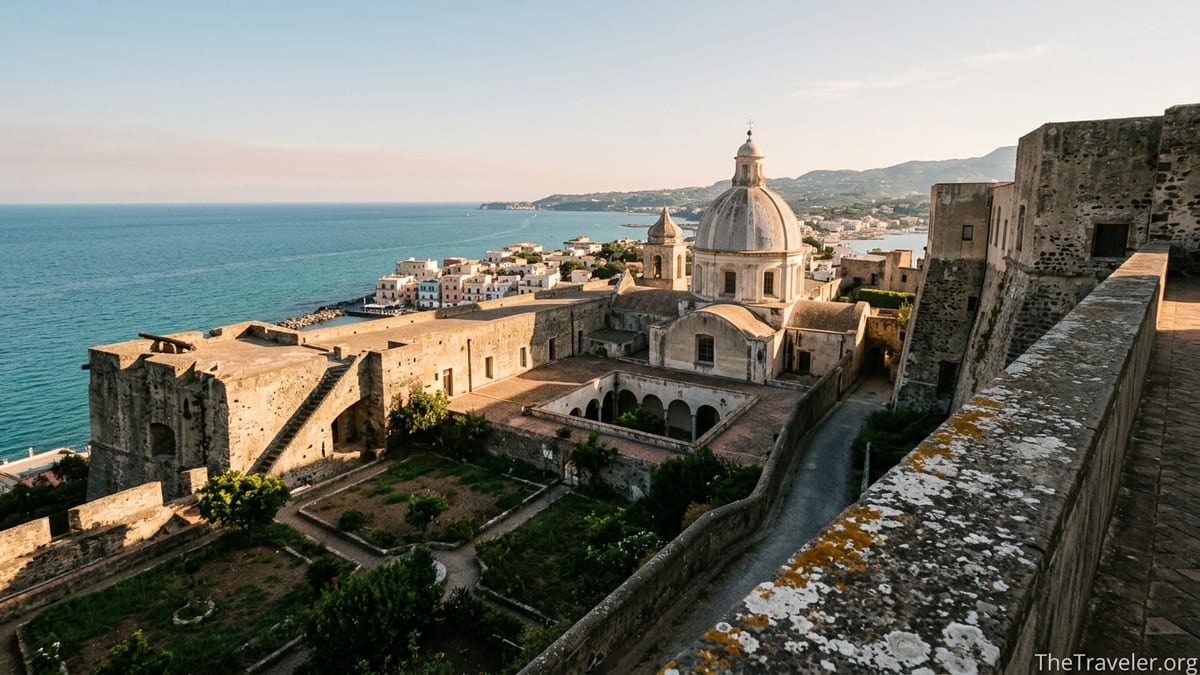
From the causeway at Ischia Ponte, Castello Aragonese looks like pure postcard material: a storybook fortress floating above the Tyrrhenian Sea. Yet beyond the sweeping views and sunlit terraces lies a second, quieter castle, made up of details most visitors walk straight past. Look closely, and this fortified island reveals traces of vanished churches, cloistered nuns, bomb scars, secret gardens and even modern art tucked into medieval stone.
Get the latest updates straight to your inbox!
The First Clues Begin on the Bridge and in the Tunnel
Most people stride across the 220-meter stone bridge with their eyes fixed on the summit, but the first hidden details begin before you even reach the ticket desk. Built in the 15th century under Alfonso V of Aragon on the site of an earlier wooden causeway, the bridge was once a strategic lifeline rather than a scenic promenade. If you pause halfway and look down to the rock base and sea walls, you can still make out the angled bastions that allowed cannons to defend the strait without exposing the garrison to return fire. On calm days, the regular joints of the lower masonry are visible just below the tide line, revealing how precisely the blocks were laid to deal with storm swells and currents.
Once inside, visitors enter the rock through a long tunnel carved in the mid-1400s directly into the trachytic cliff. Today it is softly lit and dotted with information panels, so it can feel like a simple passageway. Look more closely at the side chapels cut into the rock, especially the small altar dedicated to San Giovanni Giuseppe della Croce, Ischia’s patron saint. The roughly smoothed walls, low ceiling and modest stucco frame recall the original function of the tunnel as a bombproof refuge for hundreds of villagers during pirate raids. Slight irregularities in the tunnel’s curve hint at how workers followed natural fault lines in the rock rather than a perfectly straight course.
About two thirds of the way up, lean briefly on the stone parapets of the ramps that spiral out into daylight. The views back toward Ischia Ponte are spectacular, but the notable detail is the difference in the stonework: older sections bear deep chisel marks and patches of salt efflorescence from centuries of marine air, while smoother, slightly lighter replacement blocks show where bomb damage and erosion have been quietly repaired over the last century of restoration.
Reading the Churches: Minimalist Baroque and a Shattered Cathedral
At the top of the first ramp, many visitors step into the Church of the Immacolata, glance up at the dome and quickly move on, underwhelmed by the relative plainness of the interior. That “emptiness” is itself a hidden detail. Built from 1737 for the adjacent Clarisse nuns, the church was conceived in a late Baroque style but never fully decorated when funds ran short, leaving unusually bare walls and a restrained stucco program. If you stand near the entrance and look at the pilasters along the nave, you can see small unfinished details, such as capitals with only partially carved volutes and plaster surfaces that were never covered with marble or elaborate frescoes, a rare snapshot of a Baroque project frozen mid-ambition.
Around the corner, the ruined Cattedrale dell’Assunta tells a different, more violent story. Many visitors note the open sky and romantic ruins, but not the specific war scars. Walk toward the surviving side chapels and inspect the jagged breaks high on the walls. These are not the result of slow decay but of British cannon fire during the 1809 siege, when the castle, held by French troops, was bombarded from ships off the coast. In some niches, you can see where marble revetments and commemorative slabs were ripped off in the 19th century when the site was state-owned, leaving rectangular “ghosts” of lighter stone on the walls where plaques and tombs once sat.
Beneath the cathedral lies a small crypt that many day-trippers skip altogether. On its low vaulted surfaces are the faint remains of late medieval frescoes, influenced by Giotto’s narrative style, now badly damaged yet still legible in places. If you let your eyes adjust to the dim light, traces of blue robes, ochre halos and fragmentary faces emerge from the plaster. The contrast between the almost effaced paint and the heavy stone suggests how the castle’s role as a living town, war fortress and later neglected ruin repeatedly overprinted the sacred with the practical.
The Clarisse Convent and the Chilling Cemetery of the Nuns
One of the castle’s most quietly unsettling spaces is the former Convent of the Clarisse, which in the 16th and 17th centuries housed enclosed Poor Clare nuns. Today, visitors stroll through what looks like a simple cloister with island views, but the most extraordinary detail lies underneath. In the underground level is the convent cemetery, a narrow vaulted chamber that once contained “seats” where the bodies of deceased nuns were placed upright to decompose, their fluids draining away before the bones were collected. This type of funerary chamber, known in Italian as a putridarium, is usually discussed in academic studies or shown in remote monasteries, yet here it hides in plain sight beneath one of Ischia’s busiest attractions.
Most tour groups do not dwell on the practicalities, but if you look at the stone forms carved into the floor and lower walls you can imagine how the system worked. The seats are now empty, and the chamber is clean and dry, but the relationship between the serene convent above and this starkly functional space below captures the medieval attitude toward death as a daily, almost matter-of-fact presence. It is a powerful counterpoint to the castle’s sunny terraces and Instagram-ready viewpoints.
Back up in the cloister, another overlooked detail speaks to the nuns’ cloistered life. Peer carefully at some of the low, grilled openings along the peripheral walls. These once allowed the sisters to see out toward the sea and village without being seen themselves, preserving both enclosure and a sense of connection to the outside world. Even today, if you stand at certain angles, you can recreate that hidden line of sight: the bustling waterfront below framed by a narrow, shadowed slit of stone and iron.
War Scars, Private Houses and Traces of Everyday Life
By the 18th century, nearly 2,000 people lived on this rock, complete with a bishop, five parishes, ten churches, convents and a full military garrison. Most visitors, however, register only a sequence of “ruins” without realizing they are walking a former town’s main street. Look for the simple stone doorways and low windows cut into the outer sides of walls facing the paths. Many of these belonged to private houses, workshops and storerooms. Soot marks above certain door lintels hint at kitchens or bakeries, while hooks embedded in exterior stonework once held pulleys for hauling goods up from boats below.
The outer bastions, especially those on the seaward side, still bear subtle signs of the 1809 bombardment. At first glance the walls appear seamlessly restored, but if you run your fingers lightly along some sections, you can feel where original stones are pitted and cracked compared with the sharper edges of later infills. On a bright afternoon, the difference in patina becomes clearer: centuries-old blocks have a warmer, mottled tone, while 20th-century restorations are cooler and more uniform. This patchwork is the visual record of the moment the castle ceased to be a serious military stronghold and slowly became an abandoned relic.
Another detail that escapes casual notice is the continued presence of a private residence within the complex. In 1912, after decades of neglect, a local lawyer purchased the crumbling castle from the state for a price that would be modest even by today’s standards and began a long restoration. His descendants still live in a reserved section closed to visitors. As you follow the signed route, you may spot discreetly maintained doors, potted plants and shuttered windows that look a little too lived-in to be part of the museum circuit. These quiet signs of domestic life underline that Castello Aragonese is not just an open-air monument but also a home.
Hidden Gardens, Terraces and Contemporary Art
One of the castle’s greatest pleasures lies in its elevated gardens and belvederes, though many people treat them as simple photo stops. Take a closer look at the plantings and layouts, especially on terraces where the paths narrow between dry-stone retaining walls. Here you will find Mediterranean macchia species carefully interwoven with old-fashioned kitchen herbs and fruit trees, echoing the original mixed use of the island’s slopes as defensive ramparts, food gardens and medicinal plots. The thick stone planters and cistern mouths disguised as low wells reveal how precious fresh water was on this volcanic rock, collected painstakingly from rain rather than springs.
More recently, the castle has quietly established itself as a stage for contemporary art exhibitions, which can be easy to miss if you associate the site purely with history. In recent seasons, installations and photography shows have been set up inside former magazines, cisterns and minor chapels, sometimes without large banners or signage visible from a distance. A visitor might step into what appears to be an empty vaulted chamber and only belatedly realize that a subtle light piece or sculptural work has been integrated into the architecture. These shows typically run through the summer and early autumn, so if you are visiting between late June and September, keep an eye out for small wall texts near less-frequented rooms.
Terraces facing Capri and Procida also hide quieter corners where you can still sense the castle’s earlier, more isolated character. On busy afternoons, most people flock to the central viewpoints, leaving secondary paths nearly empty. Follow these side routes and you may come across weathered stone benches with barely legible carved initials from the early 20th century, when the first wave of Italian vacationers and writers rediscovered Ischia as a retreat. These modest graffiti, softened by lichen and time, bridge the gap between the medieval world and the beginnings of modern tourism.
Practical Details Visitors Rarely Read Closely
Even the practical information surrounding a visit to Castello Aragonese contains details that shape how you experience the site, yet many travelers glance over them. The castle is open daily from 9 a.m. until sunset, with the last ticket issued roughly 90 minutes before closing. Because closing time shifts with the season, arriving in late afternoon on a short winter day can leave you rushing through the upper sections. For travelers who want to linger in the crypts, convent spaces and side terraces, a mid-morning or early-afternoon arrival is more forgiving and less crowded.
As of mid-2026, a full adult ticket costs around 15 euros, with reductions for teenagers, seniors over 70 and local residents, and free entry for children under 10. While many visitors treat the price as covering a quick photo stop, it is more helpful to think of it as admission to a self-guided museum laid out as a 2- to 3-hour walk. There is no additional fee to visit the crypt, convent, gardens or most temporary art shows. Audio guides and printed maps are available, but even without them, thoughtfully reading the small bilingual panels near lesser-known sites, such as the Clarisse cemetery or minor chapels, reveals layers of information that standard guidebooks compress into a single line.
One further detail often missed: the family that owns and manages the castle has deliberately avoided over-commercializing the experience. Apart from a cafe, a small bookshop and the boutique hotel in part of the convent, there is relatively little retail space. For visitors used to heavily branded heritage sites, the understated infrastructure explains some of the castle’s atmosphere of authenticity, but it also means you should bring water, sunscreen and suitable footwear rather than expecting a mall-like range of services at the summit.
How to Spot the Castle’s Subtler Stories on Your Visit
With so much to see, it is easy to be swept up in the big views and headline monuments. To notice the hidden details, slow your pace and approach the castle with a few specific mini-missions. For example, in each major area, look for at least one trace of a different historical phase: Greek or Roman reuse in the bedrock foundations, late medieval fresco remnants in sacred spaces, Renaissance or Baroque additions in church architecture, 18th-century domestic details such as balcony corbels or window frames, 19th-century war scars in the bastions, and 20th-century restoration choices in mortar color or stone textures.
Another tactic is to consciously shift your gaze between far and near. When you emerge onto a terrace with a panoramic vista, enjoy the scenery, then immediately focus on something within arm’s reach: an iron ring set into a wall, the way a step has been worn into a shallow dip, a blocked doorway bricked up with different stone. Each of these small features hints at stories the main narrative panels do not have space to tell, such as where horses were once tethered, how processions moved through the complex, or which paths were closed in more recent times when private and public areas were separated.
If your schedule and budget allow, consider pairing the castle visit with a stroll through Ischia Ponte before or afterward. Looking back at the fortress from the waterfront or small fishing harbor helps you understand why, in late antiquity and the Middle Ages, the rock served as both refuge and watchtower. From ground level, the height of the defensive walls and the location of gun ports become more apparent, reinforcing details you will later see from within the complex.
The Takeaway
Castello Aragonese can be enjoyed in an hour as a beautiful backdrop to Ischia’s turquoise waters and pastel harbor, but it rewards a slower, more attentive gaze. Beneath the obvious charms of sea views and ruined chapels lie clues to a crowded hilltop town, a cloistered convent, a battered fortress and a 20th-century restoration that quietly turned a near-ruin into one of southern Italy’s most evocative historic sites. By looking beyond the postcard moments to crypt frescoes, unfinished stucco, putridarium seats, patched bastions and discreet signs of present-day domestic life, you experience the castle not as a static monument but as a living palimpsest.
For travelers willing to linger on side paths, duck into half-lit chapels and run a hand along weathered stone, Castello Aragonese becomes more than a must-see attraction. It turns into a conversation across centuries, where the smallest details tell the deepest stories, and where the boundary between fortress, village, convent, ruin and contemporary cultural space is far less clear-cut than it first appears.
FAQ
Q1. How long should I plan to spend visiting Castello Aragonese in Ischia?
Most visitors spend about two hours, but if you want to explore the crypts, convent, gardens and art spaces at a relaxed pace, plan for at least three.
Q2. What are the current opening hours and ticket prices?
The castle generally opens daily from 9 a.m. until sunset, with last entry about 90 minutes before closing. Full adult tickets are around 15 euros, with discounts for youths, seniors and residents.
Q3. Is the Clarisse nuns’ cemetery open to the public, and is it very disturbing?
Yes, the former cemetery beneath the convent is part of the visitor route. The space is clean and empty today, but its history as a putridarium can feel quite intense for some visitors.
Q4. Are guided tours available, or is it mainly self-guided?
Most people visit on a self-guided basis using the signposted route and panels. At certain times, small-group tours or audio guides may be available; check locally when you buy your ticket.
Q5. Can I see original frescoes or artworks inside the castle?
Yes. Faint medieval fresco fragments survive in the crypt beneath the former cathedral, and some chapels and rooms host rotating contemporary art exhibitions, especially in the warmer months.
Q6. Is Castello Aragonese suitable for children and older travelers?
The castle is family-friendly, but there are many slopes, steps and uneven surfaces. Children often enjoy the tunnels and terraces, while older visitors may appreciate taking the climb slowly and using rest stops.
Q7. What should I wear and bring for a comfortable visit?
Wear sturdy walking shoes, bring water, sunscreen and a hat, and consider a light layer for the cooler, shaded interiors. The paths can be hot and exposed in summer.
Q8. Are there cafes or restaurants inside the castle?
There is at least one cafe and a small bookshop within the complex, and a hotel with its own restaurant. For a wider choice, you can eat before or after in nearby Ischia Ponte.
Q9. Can I stay overnight on the castle grounds?
Yes. A portion of the former convent has been converted into a small hotel, allowing guests to experience the castle in the quiet early morning and evening hours when day visitors have left.
Q10. Is photography allowed, especially in the more sensitive areas like the crypt and cemetery?
Photography for personal use is generally allowed in most outdoor and many indoor areas, but flash or tripods may be restricted. In sensitive spaces such as the crypt, it is courteous to keep photos discreet and avoid using flash.