


More news on this day
Cathay Pacific has become the first major Asian airline to partner with Google on large-scale tests of artificial intelligence tools designed to predict and avoid heat-trapping aircraft contrails, in a move positioned as a cost-effective way to shrink aviation’s climate footprint using existing fleets and routes.
Get the latest news straight to your inbox!
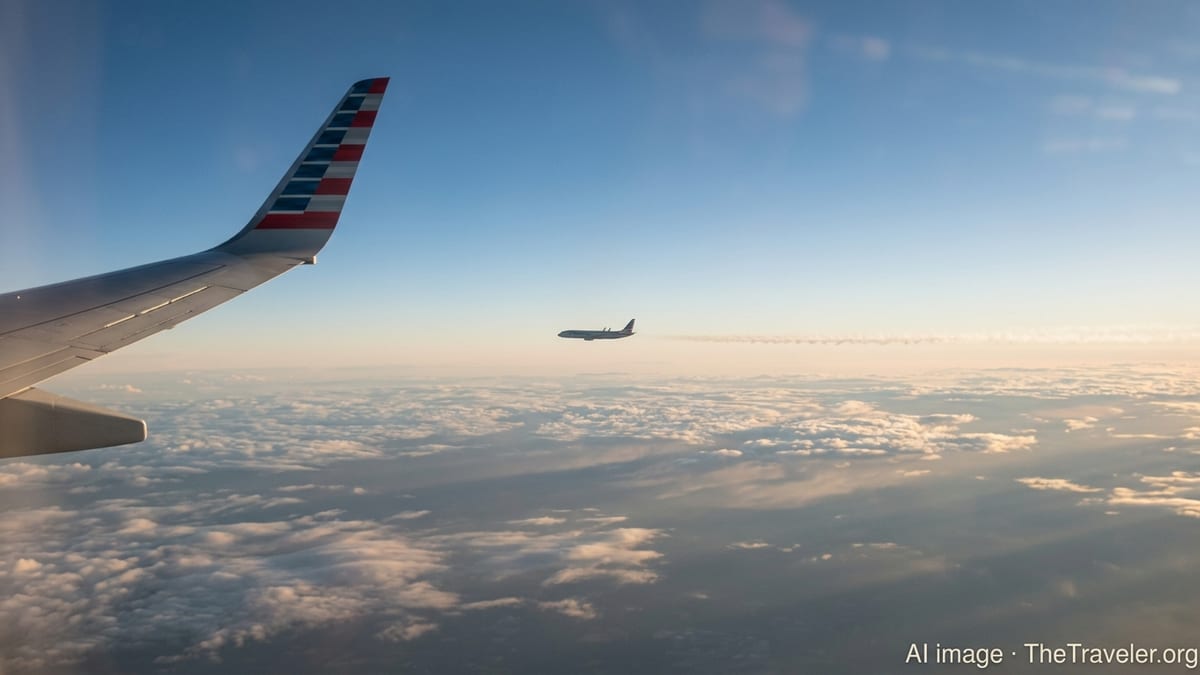
New AI Partnership Targets Aviation’s ‘Hidden’ Warming
Contrails, the thin white trails that sometimes spread into high ice clouds, are estimated in published research to account for roughly one third of aviation’s total climate impact by trapping outgoing heat in the upper atmosphere. While they are less visible in climate policy than carbon dioxide emissions, studies over the past several years have highlighted contrail formation as one of the fastest levers available to curb aviation’s warming effect without waiting for new aircraft or fuels to arrive at scale.
According to a new Google Research update published on September 7, 2026, the company is now partnering with Cathay Pacific to bring its AI-powered contrail prediction and avoidance system into day-to-day operations on selected flights in the Asia-Pacific region. The carrier is Google’s first large commercial airline partner in Asia to trial the technology, adding a new geography to earlier tests conducted with American Airlines and other industry partners in North America and Europe.
The collaboration uses machine learning models trained on large satellite imagery datasets and atmospheric reanalysis to forecast locations and altitudes where persistent contrails are likely to form along a planned flight path. Dispatchers and pilots can then make modest adjustments to cruising altitude on certain segments so aircraft pass above or below high-risk layers, reducing the chance that exhaust plumes will evolve into long-lived contrail cirrus.
Initial trial results published by Google indicate that these adjustments can be made within standard safety and air traffic control constraints, and that they often require only small changes in flight level rather than wholesale route redesign. That operational detail has been seen by analysts as crucial to making contrail management a realistic tool for busy long-haul networks such as Cathay Pacific’s.
Trial Data Shows Around 40 Percent Cut in Contrail Warming
Google’s latest technical summary reports that an initial operational trial with Cathay Pacific targeted more than 100 flights across the airline’s global network, focusing heavily on ultra-long-haul and selected regional sectors in contrail-prone airspace. More than 80 of these flights ultimately followed contrail-avoidance routes generated by Google’s AI forecasting system and integrated into Cathay’s internal flight planning tools.
Post-flight analysis using satellite imagery and automated contrail-detection algorithms suggests that the modified routes achieved an estimated 40 percent reduction in the warming impact of contrails, compared with a modeled control scenario. This aligns with earlier research trials led by Google with American Airlines and partners, where randomized controlled experiments found a statistically significant drop in observed contrails on flights that followed AI-guided altitude changes versus those that did not.
In the Cathay Pacific collaboration, flights on the busy Hong Kong–Singapore corridor were highlighted as particularly important, with Google’s blog noting that interventions on this single route accounted for more than half of the trial’s total estimated climate benefit. The airspace between southern China and Southeast Asia frequently exhibits atmospheric conditions conducive to persistent contrail formation, making it an early test bed for whether AI-based mitigation can scale in the world’s fastest-growing aviation market.
Underlying academic work published in 2024 and 2025 reinforces the feasibility of per-flight contrail avoidance, finding that relatively small altitude shifts can cut contrail-related climate forcing while adding only fractions of a percent to fuel burn in many cases. These studies are increasingly cited in policy and industry discussions as evidence that contrail management could complement long-term efforts around sustainable aviation fuels and new aircraft technologies.
How AI Forecasts Reach the Cockpit
The Cathay Pacific deployment builds on Google’s Project Contrails, which combines physics-based weather models, machine learning and satellite observations to map where contrails are likely to form at different flight levels. Publicly available documentation describes a pipeline in which large volumes of geostationary satellite imagery are processed by neural networks to detect existing contrails and then used to train forecast models that predict future high-risk regions.
For the airline trial, Google’s contrail forecasts are converted into route-specific guidance that can be ingested by Cathay’s dispatch systems and made available to pilots via in-flight connectivity. Google’s blog explains that these insights appear alongside standard operational data in the carrier’s proprietary Electronic Flight Folder, allowing crews to see recommended altitude adjustments on certain legs without changing established cockpit workflows.
During a flight, pilots remain responsible for all safety decisions and must coordinate any altitude changes with air traffic control, as with other operational requests such as avoiding turbulence. Reports on the project stress that contrail mitigation is only attempted when consistent with safety margins and airspace constraints, and that flights may revert to standard levels if operational conditions do not support the AI-recommended profile.
To verify whether avoidance maneuvers are working, Google cross-checks flight tracks against satellite imagery using its Contrails Explorer tools and detection models. Contrails observed in post-flight imagery are compared with those expected from a baseline routing, enabling researchers to estimate the reduction in contrail coverage and its associated climate impact over the test region.
Asia-Pacific Becomes a Test Bed for Climate-Optimized Routing
The Cathay Pacific partnership marks the first major application of Google’s contrail-avoidance AI on ultra-long-haul flights originating in Asia, a region where air travel demand is projected to continue growing over the coming decades. Public information from Project Contrails highlights plans to extend the underlying satellite-based models to additional geostationary platforms over East Asia and Western Australia, enabling more continuous coverage of key trunk routes that connect Hong Kong to Europe, North America and the rest of Asia-Pacific.
Analysts note that deploying contrail mitigation in this region will require careful coordination with air navigation service providers and regulators, especially on transpacific and polar routes that traverse congested or weather-sensitive airspace. However, Google’s involvement in other large-scale trials, including a recently announced partnership with the UK government to test contrail-avoidance procedures in British-controlled skies, suggests a broader push to evaluate how AI-driven routing can be integrated into existing traffic management frameworks.
For Cathay Pacific, the trial arrives as airlines worldwide face mounting scrutiny of non-CO2 climate effects and new reporting requirements emerging from European climate legislation. While Hong Kong-based carriers are outside some of these mandates, industry observers point out that global alliances and corporate travel buyers are increasingly tracking full climate impacts of flying, including contrails, when assessing the environmental performance of routes and partners.
By contributing Asia-Pacific data to the growing pool of contrail research, the airline is expected to help refine models that remain relatively new and still subject to scientific uncertainty, particularly across tropical and subtropical flight corridors. The expanded trial phase is intended to test how reliably contrail forecasts hold up across different seasons, jet-stream patterns and airspace conditions encountered on Cathay’s long-haul operations.
From Niche Experiment to Emerging Climate Tool
Only a few years ago, contrail avoidance was largely a theoretical concept explored in simulations. Since 2023, Google and partners such as American Airlines, Breakthrough Energy and European air traffic organizations have published a series of studies and trial results that move the idea from models toward operational practice, including evidence that navigational avoidance can be both scientifically robust and economically competitive with other climate measures.
Google’s own environmental reporting has framed contrail management as a relatively low-cost intervention, with internal analyses estimating that avoiding the most climate-intensive contrails could be achieved at costs measured in a few tens of dollars per tonne of carbon dioxide equivalent. This compares favorably with many emerging decarbonization technologies and can be implemented using today’s aircraft, which is a key consideration for airlines facing tight fleet-renewal timelines.
At the same time, technical publications emphasize remaining challenges, including forecast uncertainty, the need for standardized contrail metrics, and potential trade-offs between added fuel burn and reduced non-CO2 warming. Recent work on forecast stability and scalable airline-led contrail avoidance suggests that continued improvements in weather models and AI architectures could further reduce these uncertainties and increase confidence in operational deployments.
For travelers, the shift may be largely invisible. Project Contrails materials note that flights avoiding contrails may feel nearly identical to conventional services, since altitude changes are similar to those already made to avoid turbulence. Yet if trials such as Cathay Pacific’s Asia-Pacific program continue to validate earlier findings, AI-guided routing decisions made behind the scenes could become a growing part of how airlines and technology firms respond to aviation’s climate challenge.
Google blog: Trialing AI-powered contrail mitigation technology
Google Research: Project Contrails overview
Communications Engineering: Feasibility test of per-flight contrail avoidance in commercial aviation