


More news on this day
Cebu Pacific is sharpening enforcement of its cabin baggage rules and introducing higher gate baggage fees across its network, as the Philippine low-cost carrier seeks to protect on-time performance by cutting boarding bottlenecks linked to oversized and overweight bags.
Get the latest news straight to your inbox!
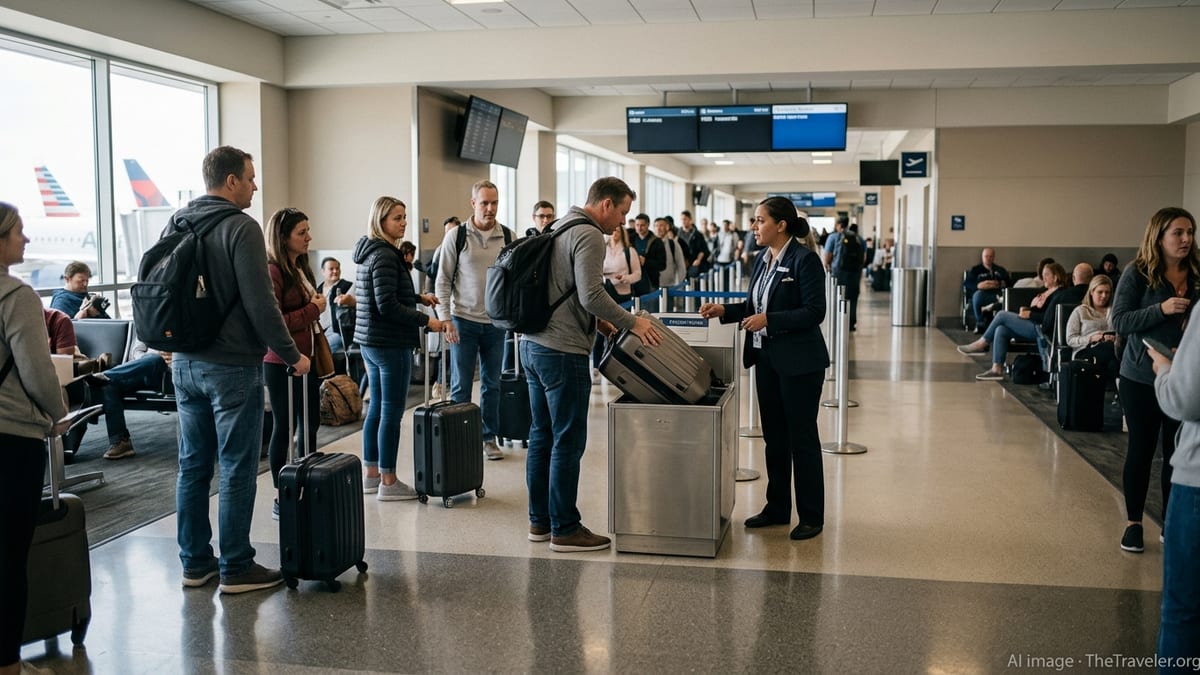
Stricter gate checks aim to keep departures on schedule
Recent advisories and published guidance indicate that Cebu Pacific, often branded as CEB, is leaning more heavily on pre-boarding baggage checks to keep flights running on time. The airline’s domestic travel guide notes that hand-carry bags may be assessed at the pre-departure entrance or before boarding, giving staff more opportunity to intercept overweight or non-compliant cabin items before passengers reach the aircraft door.
This tighter gate screening is designed to reduce last-minute repacking at the aircraft steps and to avoid situations where overhead bins fill up early, forcing crew to gate-check multiple bags and delaying pushback. Industry practice shows that when cabin baggage exceeds available space, boarding can slow significantly as crew search for room or remove trolley bags to be stowed in the hold.
Publicly available information from the airline also highlights the use of self-service kiosks and automated bag-drop counters, which are meant to push more passengers to check bags earlier in the airport journey. By moving larger or heavier pieces into the hold before security screening, Cebu Pacific reduces the risk of congestion at boarding gates that can cascade into departure delays.
Travel forums and passenger accounts over the past year further suggest a more consistent weighing of cabin trolleys at security entrances and boarding areas, particularly on busy routes and during peak travel periods. While enforcement may still vary by airport, these reports align with Cebu Pacific’s broader objective of ensuring that carry-on allowances are observed to safeguard turnaround times.
Standard 7 kg cabin allowance under closer scrutiny
Cebu Pacific’s core hand-carry policy remains centered on a combined 7 kilogram allowance for cabin baggage. The airline’s baggage guidelines state that passengers may bring up to two pieces on board, such as a small trolley bag and a personal item, provided the total weight does not exceed 7 kg and dimensions fall within specified limits.
Advisory content and third-party explainer sites note that one primary bag that fits in the overhead bin is generally allowed, together with a smaller item that can be placed under the seat. However, the combined weight remains capped at 7 kg, and passengers with bulky backpacks or multiple shopping bags may be asked to consolidate or check some items. These parameters are not new, but stricter gate-level checks mean travelers who previously relied on lenient enforcement could now be asked to pay additional fees.
Enhanced baggage guidance also lists certain exemptions, such as mobility aids, infant-care items, or goods bought inside the airport, which may be carried in addition to the standard allowance under specific conditions. Even so, Cebu Pacific stresses through its help pages that all carry-on items must fit safely in the cabin and that anything of excessive size or weight can be refused and redirected to the aircraft hold.
The airline’s general conditions of carriage specify that carry-on baggage must be capable of being stored in overhead compartments or under the seat in front. Items that cannot be accommodated within those spaces, or that raise safety concerns, must travel as checked baggage. This legal framework supports more assertive enforcement at the gate when staff determine that a bag exceeds the published limits.
Gate baggage fees and upgraded checked options
In parallel with more rigorous checks, Cebu Pacific has formalized a gate baggage fee for items that are discovered to be non-compliant at boarding. A tariff bulletin referenced in a publicly available advisory shows that, effective December 12, 2024, specific charges apply when cabin bags are reclassified at the gate and moved to the hold. The fee structure is designed both to recover handling costs and to nudge passengers into purchasing checked baggage in advance at lower rates.
Travel information portals that track Cebu Pacific’s policies note that once a bag is tagged at the gate, passengers can face higher charges than if they had pre-purchased a checked allowance during booking or via the airline’s manage-booking tools. The presence of a clearly defined gate baggage fee also creates a financial deterrent for travelers who might otherwise risk bringing multiple heavy cabin bags in the hope of avoiding standard checked baggage costs.
Cebu Pacific has, at the same time, expanded its paid checked baggage options. Company reports and published product descriptions describe an upgraded structure in which travelers can buy 20 kg checked bags and then increase the allowance in 4 kg, 8 kg, or 12 kg increments, up to 32 kg per piece. Certain fare bundles, such as those marketed with added flexibility, include at least one 20 kg checked bag by default.
These add-ons give passengers a more predictable alternative to potential gate fees, particularly on longer trips where the 7 kg cabin limit is difficult to meet. By encouraging pre-purchase of hold luggage, the airline can better balance cabin loads, while travelers gain greater clarity on costs before arriving at the airport.
Operational pressures from crowded cabins and peak travel
The push for tighter baggage compliance comes against a backdrop of strong demand on Cebu Pacific’s domestic and regional network. Annual and sustainability reports from the airline emphasize high load factors and rapid traffic recovery, elements that can intensify competition for overhead bin space and expose any inconsistencies in baggage enforcement.
Across the Philippines, peak holiday and long-weekend travel routinely strain airport facilities, from check-in counters to security screening and boarding gates. Public advisories and travel tips from the carrier repeatedly urge passengers to arrive at terminals several hours before departure and to confirm baggage rules ahead of time, signaling a continued focus on reducing congestion points that contribute to delays.
At Manila’s Ninoy Aquino International Airport, past disruptions to baggage-handling systems have highlighted the sensitivity of departure times to ground operations. While those issues focused on checked luggage systems, they underscored how small bottlenecks can ripple into wider schedule impacts. With cabin baggage, Cebu Pacific appears to be seeking a more controllable part of the process, using clear rules and monetary incentives to keep volumes within manageable limits.
Travel discussion boards also describe a shift away from the perception that hand-carry allowances are loosely enforced on certain routes. Reports of more frequent weighing of carry-on luggage and stricter counting of personal items suggest an attempt to standardize practice across airports, aligning day-to-day operations with the policy descriptions on the airline’s official help pages.
What Cebu Pacific passengers can expect at the airport
For travelers, the main impact of Cebu Pacific’s tightened baggage regime will be felt at security checkpoints and boarding gates. Passengers carrying wheeled cabin trolleys or visibly large backpacks are increasingly likely to be asked to place their bags on a scale before accessing the departure area, particularly in busy terminals such as Manila and Cebu.
Those whose bags exceed 7 kg, or whose combined cabin items go beyond the allowable number and size, may be required to check some pieces and pay the applicable gate baggage fee. To avoid unexpected costs, the airline’s published materials and independent travel advisories consistently recommend purchasing checked baggage in advance and packing valuables and essentials in a small cabin bag that clearly meets the dimensions and weight threshold.
Self-service kiosks and online check-in options play a supporting role in this strategy. By completing check-in formalities before arriving at the counter and by pre-allocating baggage allowances, passengers can move more quickly through the terminal and minimize the risk of last-minute disputes over bag size and weight at the gate, which are among the most common causes of boarding delays.
While individual experiences will continue to vary, the direction of travel across Cebu Pacific’s official documents, tariff notices, and customer-facing guides points to firmer and more uniform baggage enforcement. For the airline, the goal is to protect schedule reliability and cabin safety. For passengers, the emerging message is clear: respecting the 7 kg hand-carry limit and considering prepaid checked baggage are increasingly integral parts of flying with Cebu Pacific.
Cebu Pacific baggage guidelines
Cebu Pacific domestic travel guide