


More news on this day
Asia’s aviation network is facing another punishing disruption event after regional trackers logged 4,504 delayed flights and 278 cancellations in a single day, with Delhi, Shanghai, and Jakarta among the airports reporting the heaviest operational strain.
Get the latest news straight to your inbox!
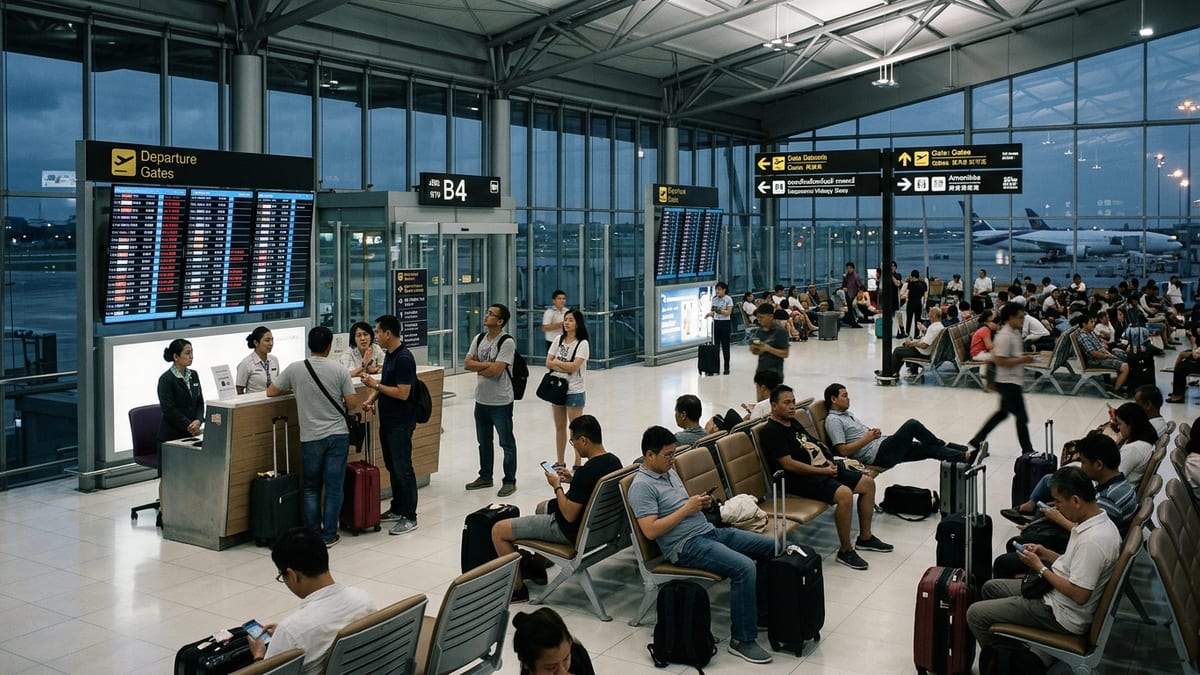
Severe Disruption Concentrated at Key Asian Hubs
Published tallies compiled from real time aviation data show that thousands of passengers across Asia have been affected by the latest wave of schedule upheaval. The snapshot, drawn from regional disruption dashboards for a 24 hour period on 4 September 2026, indicates that 4,504 flights were delayed and 278 were cancelled across the continent, with a clear concentration at major connecting hubs.
New Delhi’s Indira Gandhi International Airport, Shanghai’s Pudong hub and Jakarta’s Soekarno Hatta International Airport stand out in the figures. Reports indicate that Delhi recorded 494 delayed departures and 13 cancellations, the highest delay volume attributed to any single airport in the dataset. Jakarta logged 205 delays and 25 cancellations, the largest cancellation count among the hubs cited, while Shanghai’s dual airport system added to a wider pattern of congestion within China’s domestic and international network.
Additional disruption was reported at other large Asian gateways, including airports serving Beijing, Guangzhou, Shenzhen, Chengdu, Chongqing, Xiamen and Wuhan. Coverage drawing on airport performance tables and disruption maps highlights that many of these facilities were operating in elevated disruption bands, where increased delay minutes and cancellation totals push performance beyond normal conditions.
Combined, these hotspots produced the headline figures that have drawn attention from travelers and industry observers alike. While the numbers represent a single high impact day, they sit within a broader period of volatility for Asian air travel as carriers and airports contend with weather, capacity limits and regional airspace challenges.
Delhi’s Weather Turmoil Adds to Delay Pressures
The disruption in Delhi coincided with intense rainfall and a short lived squall that swept across the Indian capital on 4 September. Publicly available reports describe heavy showers and strong winds around the city’s main airport, with the India Meteorological Department recording a squall at Palam and issuing warnings for further thunderstorms in the afternoon and evening.
News coverage from the city notes that rainwater accumulated on sections of the airport precinct and nearby access roads, while several arriving flights were diverted to other Indian cities during the peak of the storm. Parallel reporting indicates that around 11 flights were diverted and hundreds of services experienced knock on delays as ground handling and runway operations adjusted to the sudden deterioration in conditions.
The latest delay and cancellation counts place Delhi among the most affected hubs in Asia’s current disruption wave. Data collated by travel industry outlets shows that the airport’s 494 delayed departures and double digit cancellations contributed significantly to the regional total of 4,504 delays and 278 cancellations across the same 24 hour period.
Delhi’s role as one of Asia’s busiest airports means that local weather events can quickly ripple across domestic and international networks. Figures maintained by international airport rankings list Indira Gandhi International among the top three busiest facilities in Asia by passenger volume, underscoring how operational shocks in the capital can have outsized effects on schedules across the subcontinent and beyond.
Shanghai and Jakarta Highlight China and Indonesia’s Network Strains
In China, the disruption snapshot reflects broader operational pressures across the country’s dense aviation system. Coverage based on compiled delay statistics points to extensive disruption at airports serving Beijing, Shanghai, Guangzhou, Shenzhen, Chengdu, Chongqing, Xiamen and Wuhan, among others. Given the high frequency of flights on China’s main domestic corridors, even modest increases in average delay can generate large totals when aggregated over a full day.
Shanghai, which functions as a major international and domestic gateway through its Pudong and Hongqiao airports, features prominently in the breakdown. Although individual airport level figures vary across sources, the city’s hubs appear repeatedly in disruption tables tracking late departures and arrivals. These facilities handle a mix of long haul international routes and some of the busiest short haul sectors in the world, leaving limited flexibility when weather, airspace constraints or operational bottlenecks emerge.
Indonesia’s capital Jakarta rounds out the trio of hardest hit hubs. Data cited by travel and tourism media shows that Soekarno Hatta International Airport registered 205 delays and 25 cancellations within the same 24 hour window, the highest number of cancellations among all airports listed in one widely referenced dataset. With the airport serving as the primary gateway for domestic routes across the Indonesian archipelago and key regional connections in Southeast Asia, each disruption has the potential to trigger secondary delays at smaller destinations.
These figures arrive on top of earlier September statistics illustrating how Jakarta and New Delhi have featured repeatedly in regional disruption summaries. Separate coverage of a previous event, compiled on 1 September, recorded more than 3,600 delays and 470 cancellations across 39 Asian airports, again highlighting Jakarta and Delhi as prominent nodes in the pattern.
Part of a Broader Pattern of Seasonal and Structural Stress
The latest numbers are not an isolated spike but rather part of an ongoing series of disruption days across Asia during late August and early September. Aviation focused outlets have documented multiple dates in recent weeks when regional delay counts exceeded 4,000 services in a 24 hour period, with cancellations frequently reaching or surpassing the high hundreds.
Weather remains a central factor. Monsoon systems over the Indian subcontinent, thunderstorms affecting Southeast Asian hubs and localized heavy rain events at major airports such as Delhi have repeatedly disrupted operations. At the same time, seasonal haze from forest fires and convection driven storms have affected visibility and airspace capacity in parts of Indonesia and neighboring countries, further constraining already busy approach and departure corridors.
Structural pressures also play a role. Published analyses note that many Asian airports are operating near or above their designed capacity, particularly during peak travel periods. This leaves little margin to absorb irregular operations, so a cluster of diversions or temporary runway closures can quickly cascade into extensive delays and cancellations. In parallel, airlines continue to adjust schedules and fleet deployment in response to earlier global shocks, which has sometimes left tight turnaround times and limited backup aircraft.
Travel industry observers frame these events as an illustration of how interconnected Asia’s aviation system has become. With major hubs such as Delhi, Shanghai and Jakarta serving as transfer points for domestic and international itineraries, disruption at one node can generate missed connections and aircraft rotations that propagate throughout the region.
What Travelers Can Expect in the Coming Days
While the specific tally of 4,504 delays and 278 cancellations describes a single day, recent patterns suggest that conditions may remain fluid at least in the short term. Weather agencies in India and other parts of Asia have signaled the potential for further storms and heavy rain as monsoon influences persist, raising the possibility of renewed disruption at already stressed airports.
Flight tracking platforms and disruption maps indicate that many Asian hubs continue to operate with elevated delay indices, although conditions can improve or deteriorate quickly depending on local weather and airspace constraints. For travelers, this translates into a need for greater schedule flexibility, with publicly available guidance frequently emphasizing the importance of checking flight status close to departure, allowing extra time for airport formalities and considering rebooking options where itineraries include tight connections through Delhi, Shanghai or Jakarta.
Airlines and airports across the region have been working through reaccommodation backlogs created by the latest disruption wave. According to comparative articles reviewing recent events, previous episodes with similar scale have required several operational cycles to fully clear displaced passengers and restore on time performance to normal levels, particularly where aircraft and crews have been left out of position.
For Asia’s aviation sector, the episode underscores the continuing challenge of managing rapid growth in demand alongside weather volatility and evolving regional geopolitics that can affect airspace availability. Observers note that investments in capacity, air traffic management and resilience measures are likely to remain central themes as airports and carriers seek to limit the impact of future disruption days of this magnitude.
TheTraveler.org: Asia Flight Chaos 4,504 Delays and 278 Cancellations in a Day
NomadLawyer: Asia Flight Disruptions Jakarta Delhi Shanghai September 2026