


More news on this day
European air travel has entered a new phase of disruption as 2,141 flight delays and 113 cancellations were recorded across 12 major airports on 3 September 2026, creating ripple effects across the continent’s already stretched aviation network.
Get the latest news straight to your inbox!
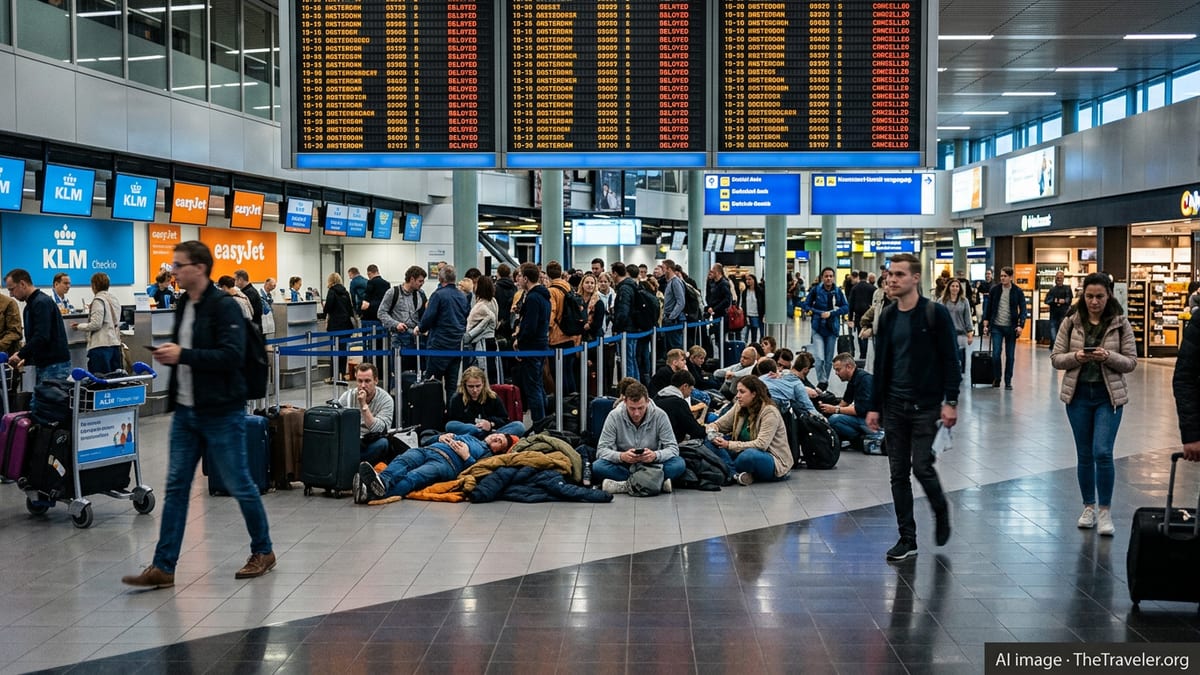
Fresh disruption hits 12 of Europe’s busiest airports
Publicly available disruption data compiled for 3 September 2026 indicates that 2,141 flights were delayed and 113 cancelled across 12 key European hubs, including Rome Fiumicino, Amsterdam Schiphol, London Heathrow, London Gatwick, Berlin Brandenburg, Frankfurt, Brussels, Madrid Barajas, Barcelona El Prat, Dublin, Oslo and Paris Charles de Gaulle. Reports describe the day as one of the most operationally challenging of the late summer period, with delays spilling into evening departure banks and overnight rotations.
Coverage from travel-rights and aviation-tracking platforms points to Rome Fiumicino recording some of the highest raw delay numbers, while Berlin Brandenburg stood out for its elevated cancellation rate. Amsterdam Schiphol and London’s main airports again featured prominently in delay tallies, continuing a pattern of recurring congestion that has marked the 2026 high season.
The disruption came just days after another widely reported spike in irregular operations, when Europe logged nearly 3,000 disrupted flights across London and 15 additional airports on 30 August 2026. That sequence of events has prompted some analysts to characterise early September as an escalation rather than a tail-end easing of the summer’s aviation pressures.
Operational data and airport status dashboards suggested that, on several routes, departure punctuality fell well below historical norms, with some carriers forced into rapid schedule reshuffles to keep aircraft and crews in position for the following day.
Operational bottlenecks and airspace constraints converge
Reports on the 3 September disruption highlight a mix of contributing factors rather than a single trigger. Eurocontrol’s network updates for the 2026 season underline how en route air traffic management regulations, sector capacity caps and weather-related flow restrictions have repeatedly pushed congestion into already busy terminal areas. Those structural constraints were again visible in the pattern of delays, particularly on north-south flows linking Italy, Spain and the Benelux countries.
Industry analyses of recent summers note that Europe’s air traffic management system continues to operate close to its capacity ceiling on peak days, so comparatively modest weather issues or local incidents can quickly ripple into long delays and missed connections across the wider network. Airspace complexity over central Europe, combined with military restrictions linked to ongoing geopolitical tensions, has further limited the number of routings available to absorb traffic spikes.
Ground operations also played a role. Airports such as Amsterdam, London Gatwick and Barcelona have been operating with tight ground-handling and security staffing margins, according to previous seasonal briefings. When paired with late-arriving aircraft from earlier disrupted rotations, even small setbacks at check-in, baggage or boarding can lengthen turnarounds and push departure banks beyond their assigned slots.
Analysts tracking punctuality trends add that the Entry/Exit System for Schengen border checks, now in full operation across much of the European Union, has introduced extra processing time at some external border points during peak hours. Airport and airline groups have previously warned that prolonged queues at passport control can delay boarding and force last-minute offloading of passengers or bags, adding further strain on schedules.
Passenger experience: missed connections, overnight stays and compensation questions
The scale of the 2,141 delays and 113 cancellations translated into missed onward connections, extended waiting times and, in some cases, overnight stays for passengers at key hubs. Travel-rights platforms reported elevated use of online compensation calculators and disruption guides in the days following 3 September, echoing patterns seen after earlier waves of European flight chaos this year.
Under European Union Regulation EC 261 and the United Kingdom’s equivalent rules, many passengers on EU- or UK-operated flights may be eligible for fixed-sum compensation when cancellations or long delays are not caused by extraordinary circumstances such as severe weather, security incidents or restrictive air traffic control orders. Publicly available commentary from consumer advocates stresses that travellers often under-claim these rights or accept vouchers instead of cash, particularly during multi-day disruption.
Guidance published by passenger-advocacy and legal-aid sites encourages affected travellers to keep boarding passes, booking confirmations and written evidence of delay durations, and to submit claims directly to airlines rather than relying solely on intermediaries. For those stranded overnight, hotel and meal entitlements typically apply regardless of the root cause, provided the disrupted journey departs from the EU or is operated by an EU or UK carrier.
Online travel resources also emphasise that passengers facing same-day cancellations should first attempt to rebook via airline apps or websites to secure limited seat availability, then approach airport service desks only if digital channels do not offer workable alternatives. That approach proved critical on 3 September, when long queues reportedly formed at rebooking counters at several major hubs.
Why late summer 2026 is proving especially fragile
Context from Eurocontrol’s latest network operations reports shows that overall European traffic in mid to late 2026 has approached or surpassed pre-pandemic levels on many peak days, while average delay per flight remains elevated compared with targets. Previous summer assessments pointed to a system that has improved since the worst of 2022 and 2023, but still lacks resilience when multiple stressors combine.
Staffing imbalances are a recurring thread. Airlines and ground-handling companies rebuilt capacity through 2025 and early 2026, but some operational roles remain hard to fully staff, particularly at high-cost hubs and in specialised technical functions. When crew are out of position because of earlier delays or duty-time limits, aircraft can be ready at the gate yet unable to depart, feeding visible passenger frustration.
Weather has also contributed to 2026’s turbulent summer. Severe thunderstorms over central and western Europe, as documented in late-August disruption coverage, have forced temporary airport closures and runway capacity reductions at major hubs. Even when storms clear quickly, residual congestion from holding patterns, diversions and missed slots can take hours to unwind, especially at airports running tightly sequenced departure and arrival waves.
In parallel, infrastructure works at large airports, including runway maintenance and taxiway repairs scheduled through the 2026 summer timetable, have occasionally constrained capacity during certain periods of the day. While most works are planned well in advance, unexpected overruns or concurrent projects at multiple hubs can narrow the system’s margin for error just as seasonal demand peaks.
How travellers can navigate an unsettled European aviation landscape
With early September disruption following closely on the heels of late-August turmoil, travel advisories increasingly recommend that passengers crossing Europe build additional buffers into itineraries, particularly when cruise departures, tours or long-distance rail connections depend on on-time arrivals. Bookings that combine separate tickets on different airlines are considered especially vulnerable to missed connections because protection rules typically apply only within a single booking reference.
Experts who monitor flight performance data often advise selecting early-morning departures where possible, as these are less affected by knock-on delays from earlier rotations. On heavily trafficked intra-European routes, choosing services with multiple daily frequencies can also provide more rebooking options if a flight is cancelled or heavily delayed.
For day-of-travel monitoring, live flight-tracking platforms and official airport or airline apps remain the primary tools to track gate changes, estimated departure times and baggage information. Features that allow push notifications can help travellers respond quickly when a boarding time moves forward or when an earlier disruption opens up an alternative routing.
As Europe’s aviation sector works to digest the lessons of this latest wave of disruption, industry planning documents suggest that long-term fixes will depend on a combination of enhanced air traffic management capacity, further recruitment in critical ground and flight roles, and careful coordination of border-control technology such as the Entry/Exit System. Until those elements align, days like 3 September 2026 are likely to remain a recurring risk in the European travel calendar.
https://nomadlawyer.org/europe-flight-disruptions-delays-cancellations-rome-amsterdam-london-2026
https://www.eurocontrol.int/publication/network-operations-report-july-2026