


Landing at Chiang Mai International Airport can feel surprisingly relaxed compared with Bangkok, but the first decision you will face is how to get from the terminal to the Old City. The distance is short, traffic patterns change through the day, and you will see everything from metered taxis and Grab cars to red songthaews waiting at the exit. Choosing the right option can save you money, time, and a lot of confusion at the curb.
Get the latest updates straight to your inbox!
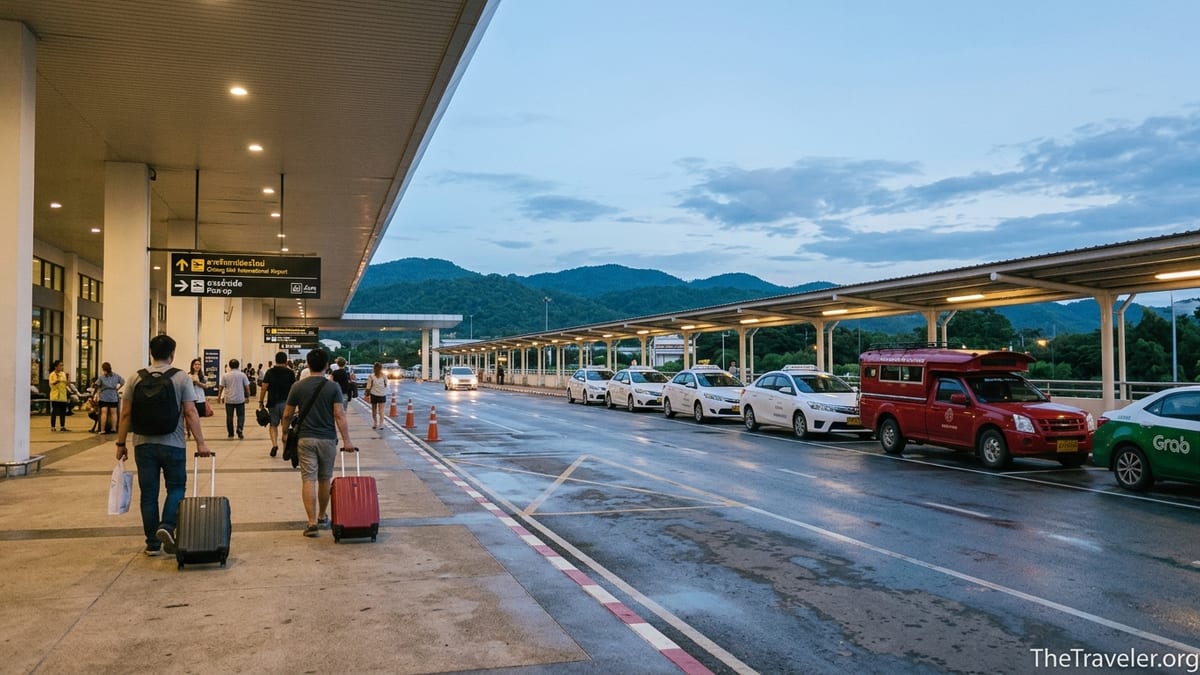
Chiang Mai Airport and the Old City: What to Expect on Arrival
Chiang Mai International Airport (CNX) sits only about 4 kilometers southwest of the Old City moat, so transfers are generally fast and inexpensive compared with other major Asian cities. In normal daytime traffic, most journeys from arrivals to central areas such as Tha Phae Gate, Chiang Mai Gate, or Wat Phra Singh take around 10 to 20 minutes. The short distance means the main factors in choosing transport are not journey length but your arrival time, luggage, budget, and hotel location.
Most international flights now arrive into a compact terminal where immigration, baggage claim, money exchange, SIM card desks, and ATMs are within a short walk. After customs, you step almost directly into the ground transportation zone. Signage leads you toward an official taxi counter and exit doors where other options such as Grab pick-up points, red songthaews, and pre-booked transfer representatives wait. You will not need to navigate a huge transport hall or shuttle train; everything is within a few minutes on foot.
Because the airport closes overnight for most commercial flights, late-night arrivals are usually around midnight rather than 3 a.m. Still, schedules can shift, and charter flights or delays sometimes push people into the small hours. Very early morning and late-night transfers can feel completely different from mid-afternoon, when domestic flights and tour buses create short peaks in demand. Keeping your arrival time in mind is crucial when comparing options like Grab, fixed-fare airport taxis, and public songthaews.
For most visitors, the Old City means the square moat area that contains key landmarks such as Tha Phae Gate, Wat Chedi Luang, and the Sunday Walking Street on Ratchadamnoen Road. Many guesthouses cluster along lanes like Moon Muang Road, Ratchamanka Road, and near Chiang Mai Gate. These are all standard destinations for drivers who shuttle back and forth from the airport all day, so you rarely need to give detailed directions beyond the hotel name and nearest gate.
Official Airport Taxi: Easiest All-Round Option
The official airport taxi is the simplest and most predictable way to reach the Old City, particularly after a long flight or if it is your first time in Chiang Mai. After exiting the baggage hall, you will see signs directing you to a taxi counter near the arrivals doors. Staff at the desk will ask for your hotel name or the nearest city gate, take payment, and hand you a slip to give to the driver waiting at the taxi rank a few steps outside.
Fares for official taxis are generally flat-rate for central Chiang Mai, including the Old City. In recent years most visitors have reported around 150 to 200 baht for a car into the main city area, which matches guidance published by local transport guides and airport information. This usually covers up to three passengers with standard luggage. For example, a couple heading to a guesthouse near Tha Phae Gate might pay 150 baht and be dropped at the small lane leading directly to their lobby within 15 minutes.
One advantage of the airport taxi is that you do not need mobile data, a local SIM, or a ride-hailing app. You pay in cash at the counter, so there is also less room for on-the-spot negotiation or confusion. Drivers are used to carrying large suitcases, backpacks, and occasionally awkward items like folded baby strollers or flat-packed bicycles, and most sedans can comfortably handle two large checked bags and two carry-ons. If you are traveling as a family with multiple big suitcases, you can ask the counter staff to assign a larger vehicle, though you may pay a bit more.
The main downside of the official taxi is that you pay a slight premium compared with the cheapest ride-hail fares. During quiet times, a Grab or Bolt car may be noticeably cheaper than the flat airport rate. On the other hand, during heavy rain or rush hours when ride-hail apps surge in price, the airport taxi can be the better value. In general, if you land between about 7 a.m. and 11 p.m. and want a smooth transfer with zero hassle, the airport taxi desk is the most reliable choice.
Grab and Other Ride-Hailing Apps: Flexible and Often Cheaper
Grab is widely used in Chiang Mai, and several competing apps such as Bolt and Maxim also operate in the city. For travelers who already have a Thai SIM card or roaming data and like seeing the fare estimate and driver rating before committing, ride-hailing can be a very attractive option. From the arrivals area, many people order a car after collecting luggage, then follow in-app instructions to walk to the designated pick-up zone just outside the terminal.
Prices from Chiang Mai Airport to the Old City via GrabCar or similar services typically fall in the range of roughly 120 to 200 baht for a standard car, depending on time of day, demand, and whether it is raining. For example, a solo traveler arriving at 2 p.m. and heading to a hostel near Chiang Mai Gate might see estimates of 130 to 150 baht on Grab, compared with the 150 baht flat rate on the official taxi counter. During quiet mid-morning periods, fares can occasionally dip close to 100 baht for short hops to the western moat or Nimman area.
Where ride-hailing really shines is hotel drop-off at smaller lanes and guesthouses that might confuse some drivers. Because the app includes a map location and GPS navigation, it is easier to get dropped directly at a hidden café-style guesthouse down a one-way soi behind Wat Phra Singh, for instance. You also see the total fare upfront and can pay by card or linked wallet, which some visitors prefer to carrying extra cash fresh from the currency exchange.
However, ride-hailing has two key limitations. First, at peak times such as Friday evenings in high season or during major festivals like Loy Krathong and Songkran, surge pricing can raise Grab fares well above standard taxi rates. A ride that normally costs 150 baht might jump to over 250 baht when rain and heavy traffic combine. Second, very late at night or around dawn, fewer drivers may be online near the airport, meaning longer waits or occasional unavailability. In those windows, the official airport taxi or a pre-booked transfer is often the safer bet.
Songthaews and Local Buses: Cheapest if You Travel Light
Red songthaews, the shared pickup trucks with bench seats in the back, are an iconic part of Chiang Mai’s transport system. While they traditionally serve as flexible shared taxis within the city, a number of them wait near the airport exit looking for passengers into town. These are usually not the cheapest songthaews you will find in Chiang Mai, but they can still be good value for backpackers or anyone with very light luggage.
From the airport, drivers often prefer to operate as private hires rather than shared public vehicles. Typical quotes to the Old City range from around 150 to 200 baht for the whole back of the truck, similar to or slightly more than the flat-rate airport taxi. For instance, a group of three friends with only hand luggage heading to a guesthouse near Tha Phae Gate might negotiate 180 baht total, which breaks down to 60 baht each. That is still cheap compared with many cities, but it is not the ultra-budget 30 baht songthaew fare you might pay for a short hop along the moat once you are already in town.
Public city buses serving the airport have been inconsistent over the past few years, with some routes suspended and others relaunched. When operating, airport-connected lines typically charge around 20 to 30 baht per person and follow set routes that loop through parts of the Old City and Nimman area. They are a good option if you are carrying a small backpack and staying near a main road like Suthep Road or the eastern moat. However, frequencies can be irregular and service hours may not match early-morning or late-night flights, so it is risky to rely on buses if you are on a tight schedule.
Both songthaews and buses are less comfortable with large suitcases. You may need to lift your luggage up into the back of a pickup truck and hold it steady as the vehicle weaves through traffic. On a lightly loaded songthaew, this is manageable, but if several passengers pile in or the driver makes multiple stops, your big suitcase can become an obstacle. For that reason, these ultra-budget options are best for short stays, minimal luggage, and travelers who are already somewhat familiar with Chiang Mai’s layout.
Private Transfers and Hotel Pickups: Best for Late Nights and Families
For travelers who value a smooth, pre-arranged experience, private transfers booked in advance are an appealing choice. These are typically arranged through hotel reception, local tour operators, or booking platforms that specialize in airport transport. You share your flight number and accommodation details, and a driver meets you in the arrivals hall holding a sign with your name, then escorts you to a waiting car or van just outside.
Prices for private transfers from Chiang Mai Airport to the Old City are higher than taxis but still moderate by international standards. A standard sedan for up to three passengers often falls in the range of 250 to 400 baht, while a comfortable van suitable for a family of five with several suitcases might cost around 500 to 700 baht. For example, a family arriving from Europe on a connecting flight that lands close to midnight might reserve a van at 600 baht to a hotel near Wat Phra Singh, ensuring a smooth and predictable arrival with space for strollers and large luggage.
The main advantage of a pre-booked transfer is certainty. Your driver tracks your flight and waits even if immigration is slow or your baggage takes longer than expected. This removes the need to stand in a taxi queue or open a ride-hailing app while tired and jet-lagged. It is particularly useful if you arrive during busy periods like Chinese New Year, university graduation season, or the March to April burning season when visibility drops and many visitors are arriving at once.
Some upscale hotels and boutique properties around the Old City also offer their own direct transfers, occasionally included in room packages or at a slight premium. While these can cost more than arranging a car yourself, they have the advantage of drivers who know the property well and can navigate tricky one-way streets and parking rules directly to the hotel gate. If you are staying inside a narrow lane near Ratchamanka Road or in a heritage building with limited street access, a hotel-organized driver can save time circling the moat looking for the correct entrance.
Choosing the Best Option by Time of Day and Travel Style
Because the airport is so close to central Chiang Mai, there is no single “right” transfer method for every traveler. Instead, the best option depends heavily on your arrival time, luggage, and comfort level. During daylight hours from mid-morning to early evening, the combination of official airport taxi and Grab gives you plenty of flexibility. For example, a digital nomad landing at 11 a.m. with a laptop backpack and one small suitcase may simply compare the Grab price with the taxi flat rate and choose whichever is cheaper at that moment.
In the evening and late at night, reliability becomes more important than shaving 20 or 30 baht off the fare. If you are landing after 10 p.m., especially on a weekday low season flight, a pre-booked private transfer or the official airport taxi counter is usually a safer choice than relying solely on ride-hail. You may still find Grab drivers, but you do not want to spend 30 minutes waiting on the curb after immigration closes. For a solo traveler arriving at 1 a.m. due to a delay, paying 250 or 300 baht for a guaranteed car to a guesthouse near Chiang Mai Gate feels like money well spent.
Travel style also matters. Backpackers who are used to overland buses and informal transport often enjoy hopping on a songthaew and chatting with other passengers, even if the fare from the airport is not the absolute rock-bottom price they might pay elsewhere. In contrast, a couple on a short honeymoon trip to a boutique hotel near Wat Phra Singh may not mind paying a little extra for a private car with air-conditioning and help with luggage. Families with young children often prioritize having enough seat belts and space for child seats, which can tilt the balance toward private vans or ride-hail vehicles with larger interiors.
Another subtle factor is your hotel’s exact location relative to the city gates. Properties on main roads like Chang Klan Road near the Night Bazaar or just outside Tha Phae Gate are straightforward for any driver, including songthaews. But if you are staying deep inside the maze of alleys between Ratchamanka Road and the moat, a driver using GPS navigation via Grab or a hotel-arranged transfer will typically find the door more easily than a songthaew driver who relies on landmarks and general directions.
Luggage, Group Size, and Hotel Access: Practical Considerations
Luggage is often the deciding factor between cheap shared options and more comfortable door-to-door transfers. A single traveler with only a carry-on backpack can comfortably hop into almost any vehicle, including a shared songthaew whose driver is heading toward the Old City anyway. In contrast, two people each with a 20-kilogram suitcase and additional hand luggage may find it awkward to climb into the back of a pickup truck and balance bags through a bumpy ride. For them, a regular sedan taxi or GrabCar becomes the more practical and not much more expensive option.
Group size also plays a major role. For a solo traveler, paying 150 baht for an airport taxi might feel a little high compared with city songthaew fares, but for a group of four sharing a vehicle, that same fare equates to less than 40 baht per person. In fact, a small group can sometimes charter a songthaew from the airport at a negotiated fare similar to the taxi price, but with more space in the back for backpacks and surfboard-sized luggage. For example, four friends arriving from Bangkok for a weekend might agree on 200 baht total in a red truck to their hostel near Chiang Mai Gate, making it a social and cost-effective ride.
Hotel access is especially important within the Old City, where many streets are one-way and some lanes are too narrow for vans. If your accommodation is inside the pedestrianized area near the Sunday Walking Street, drivers might drop you just outside a police box or one of the main gates, leaving a short walk to your door. A hotel that knows these constraints might advise you in advance to tell the driver to stop at Tha Phae Gate or Chang Phuak Gate rather than insisting on the tiny side lane where parking is impossible. It is worth checking your booking confirmation for suggested drop-off points.
Seasonal conditions can also affect comfort. During the March to April burning season, when air quality can be poor, many travelers prefer sealed, air-conditioned cars to reduce exposure to smoke in open-sided songthaews. In the rainy season, intense but short downpours can soak anyone sitting near the back opening of a pickup truck. Under these conditions, taxis, ride-hail cars, and private transfers gain another advantage beyond simple convenience and price.
The Takeaway
Transferring from Chiang Mai International Airport to the Old City is one of the simpler airport journeys in Southeast Asia. The distance is short, prices are low by international standards, and a range of options means every type of traveler can find a good fit. The official airport taxi counter offers a straightforward flat-rate ride that works for almost everyone, especially first-time visitors and those arriving at conventional hours. Grab and other ride-hailing apps are excellent for travelers with data access who want transparent fares and precise hotel drop-off, particularly in the middle of the day and early evening.
Budget-conscious visitors with light luggage can experiment with red songthaews or local buses when they are running, though it is wise to treat these as flexible options rather than something to rely on when your schedule is tight. At the other end of the spectrum, pre-booked private transfers and hotel-organized pickups are worth the extra cost if you are landing late at night, traveling with children, or carrying bulky luggage that makes squeezing into a shared vehicle uncomfortable.
In practice, your best strategy is to decide on a default option before you land. For many travelers, that means planning to use the airport taxi counter, then checking a ride-hailing app while waiting for luggage. If the app shows a significantly cheaper fare with a short wait time, you can walk to the ride-hail pick-up zone. If the price is similar or surge pricing is in effect, you simply follow the signs to the taxi desk. With a little preparation and a realistic sense of prices, you can be checked in at your Old City hotel and walking along the moat or toward Tha Phae Gate far sooner than you might expect.
FAQ
Q1. How much does a taxi from Chiang Mai Airport to the Old City cost?
The official airport taxi to most Old City hotels usually costs in the region of 150 to 200 baht per car, fixed at the counter rather than by negotiation.
Q2. Is Grab cheaper than the airport taxi in Chiang Mai?
Grab and similar apps are sometimes slightly cheaper, especially in off-peak hours, but during busy times or surge pricing, the official flat-rate airport taxi can be equal or better value.
Q3. Can I use Grab or Bolt directly from the airport?
Yes, Grab and other ride-hailing apps operate from Chiang Mai Airport; you order through the app after landing and meet your driver at the designated pick-up zone outside arrivals.
Q4. Are songthaews from the airport a good budget option?
Songthaews at the airport often charge private-hire rates similar to taxis, so they are not always the absolute cheapest, but they can be cost-effective for small groups with light luggage.
Q5. Is there a shuttle bus from Chiang Mai Airport to the Old City?
Airport-linked city bus routes have operated on and off, usually charging around 20 to 30 baht, but schedules and availability change, so do not rely on them if your timing is tight.
Q6. What is the best option if my flight arrives very late at night?
For arrivals after about 10 p.m., a pre-booked private transfer or the official airport taxi counter is generally the safest and most reliable choice.
Q7. How long does the journey from the airport to the Old City take?
In normal traffic the trip takes about 10 to 20 minutes, though heavy rain, rush-hour congestion, or festival closures around the moat can add some extra time.
Q8. Which option is best if I have a lot of luggage?
If you have multiple large suitcases or bulky items, a regular taxi, GrabCar, or pre-booked private van is more comfortable and practical than a songthaew or crowded bus.
Q9. Will my driver know small guesthouses inside the Old City?
Most drivers know the main gates and roads; if your guesthouse is in a small lane, it helps to have the Thai address or map ready, especially when using taxis or songthaews.
Q10. Do I need to tip taxi drivers from the airport?
Tipping is not mandatory, but many travelers round up the fare by 10 to 20 baht for good service, help with bags, or late-night rides; small notes are appreciated rather than expected.