


Chicago O’Hare is one of the busiest airports in the United States, and that makes getting an Uber or Lyft after you land feel confusing, especially if you are jet-lagged or arriving in bad weather. Pickup rules have changed several times in recent years, signage is not always clear, and international travelers at Terminal 5 in particular can be caught off guard by where they actually need to go. This guide walks you step by step through where to meet your rideshare by terminal, how long the walk usually takes, what to expect on pricing, and when a traditional taxi or train into the city might be the smarter move.
Get the latest updates straight to your inbox!
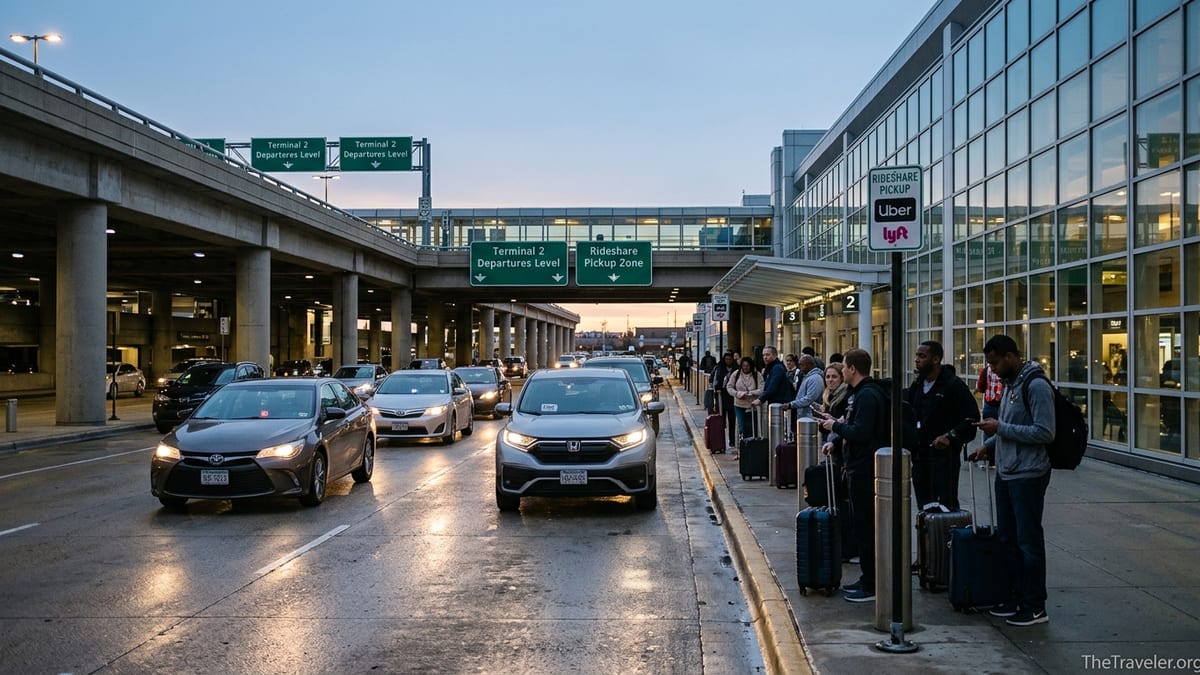
How Rideshare Works at O’Hare Today
Uber and Lyft are both allowed to operate at Chicago O’Hare, but the airport and the City of Chicago tightly control where drivers can pick you up. The official term for these companies locally is “TNP,” short for Transportation Network Provider, and rules distinguish between regular rideshare such as UberX or Lyft and premium services such as Uber Black or Lyft Lux. All the mainstream app-based options are available 24/7, but the specific curb where they can stop is limited to marked rideshare zones near the terminals.
For most domestic arrivals at Terminals 1, 2, and 3, regular Uber and Lyft pickups now happen on the upper-level departures roadway outside the terminal buildings in clearly marked rideshare areas. Signs might say “Ride App Pickup,” “TNP,” or “Rideshare,” and the apps will usually nudge your pin to one of these zones automatically when you enter your terminal. Premium services such as Uber Black often have a bit more flexibility and may be able to meet you closer to the baggage claim level by arrangement, but the app will still direct you to an approved curb.
Terminal 5, which handles most international flights and some domestic services, is where many visitors are surprised. At times, regular rideshare pickups have been moved away from the terminal to ease congestion, requiring passengers to ride the Airport Transit System train to Terminal 2 or another shared pickup area. Because O’Hare is in the middle of a long-term terminal expansion, construction can temporarily shift curb use. As a result, the safest approach is to follow the live instructions in your Uber or Lyft app and be prepared for a short walk or quick train ride if directed.
In practice, that means you should not rely on blog posts or even prior personal experience alone. A traveler who last passed through O’Hare two years ago, for example, may remember walking outside Terminal 5 and calling an Uber there, only to discover on a 2026 trip that the app insists on sending them to a signed rideshare zone at Terminal 2 instead. Think of the information in this guide as a framework and use your app as the final word once you land.
Terminal 1, 2 & 3: Domestic Rideshare Pickup Explained
Terminals 1, 2, and 3 sit along the same main horseshoe roadway and together handle the bulk of domestic traffic, including United at Terminal 1, a mix of airlines at Terminal 2, and American at Terminal 3. If you arrive at any of these terminals and request a standard UberX or Lyft, you can expect your app to direct you to the upper-level roadway near your terminal rather than the baggage claim level below. The logic is simple: arrivals is often jammed with private cars and buses, while the departures level has more space for quick rideshare stops.
A typical United passenger landing at Terminal 1 would collect bags at the lower level, then follow signs for “Departures” or “Ticketing” back upstairs. Once outside on the upper level, they would look for the section marked for rideshare or TNP pickups. The app will usually specify a door or vestibule number, such as “Door 1C,” and may show a letter code similar to 1B or 2D. Walking from baggage claim to these curbs usually takes 5 to 10 minutes, including time on escalators or elevators.
At Terminals 2 and 3, the pattern is similar but signage can vary slightly. An American Airlines passenger at Terminal 3 might see instructions in Lyft that say “Go to Departures, doors 3H–3K, rideshare pickup.” Once upstairs, they will notice that one stretch of curb has clusters of passengers looking at phones, with drivers slowly pulling in, showing app logos on their windshield. That is the correct lane. In busy periods, there can be separate zones for different app brands, though in practice many Chicago drivers work for both Uber and Lyft and will display both stickers.
If you arrive into Terminal 3 but your app only offers Terminal 2 as a pickup choice, do not panic. The distance between Terminals 2 and 3 on the upper level is walkable in roughly 5 minutes with rolling luggage, and many locals regularly stroll between them when traffic clogs one side of the horseshoe. Just stay on the sidewalk outside departures, follow the signs and terminal numbers overhead, and you will quickly see the marked rideshare area appear.
Terminal 5: International Arrivals and Getting to Rideshare
Terminal 5 is O’Hare’s main international terminal and the first touchpoint for many visitors arriving from Europe, Asia, or South America. After you clear immigration and customs and exit into the public arrivals hall, your instinct may be to walk directly outside and try to call an Uber or Lyft from the curb. Depending on current airport rules, however, the apps may not allow a standard pickup directly at Terminal 5’s arrivals roadway and will redirect you to a designated rideshare zone elsewhere, often by Terminal 2 on the departures level.
Here is how that looks in real life. A traveler landing from London around 6 pm opens Uber while standing at baggage claim in Terminal 5. Instead of letting them drop the pin out front, the app shows a blue dot at Terminal 2 upstairs and a note that says “Pickup: Rideshare zone, Terminal 2 departures.” The traveler is instructed to take the Airport Transit System automated train, which runs in a loop connecting Terminals 1, 2, 3, 5, and the Multi-Modal Facility where rental cars and some shuttles are based. The ride from Terminal 5 to Terminal 2 usually takes around 5 minutes, and trains run frequently throughout the day and evening.
To follow those instructions, the traveler would stay inside Terminal 5, follow signs for “Airport Transit System / ATS,” take the escalator or elevator up to the train platform, and board the next train toward Terminals 1, 2, and 3. At Terminal 2, they exit, follow signs back into the terminal, and then head toward the departures level curb where the app has pinned their pickup. The whole process from collecting luggage at Terminal 5 to reaching the rideshare zone at Terminal 2 often takes 15 to 25 minutes, especially if customs lines are long or if they are learning the layout for the first time.
Travelers who prefer to avoid that extra leg often choose the straightforward option of a taxi directly outside Terminal 5 instead. The official taxi stand on the arrivals level is usually a short walk from the exit doors, and cabs queue 24/7 when international banks of flights arrive. For a solo traveler heading to downtown Chicago, a metered ride from Terminal 5 to the Loop might cost roughly 45 to 70 dollars before tip, depending on traffic and time of day. At the same time, a surge-priced UberX from the Terminal 2 rideshare zone could easily climb into a similar range, which is why many frequent international flyers simply follow the taxi signs instead of adding a train ride and curbside wait.
Walking Directions and Wayfinding Tips Inside the Terminals
The most confusing part of using rideshare at O’Hare is often not the price or the wait time but simply figuring out how to reach the right curb. The key is to think in levels and numbers. Arrivals and baggage claim are generally on the lower level. Departures, ticketing, and most rideshare zones are on the upper level. Each set of doors on the curb is labeled with both a terminal number and a letter, such as 2A, 2B, or 3G. Your Uber or Lyft app will usually quote one of those combinations as a meeting point.
From baggage claim at Terminal 1, 2, or 3, look first for overhead signs indicating “Ticketing” or “Departures.” These signs lead to either an escalator bank or an elevator. Once you reach the ticketing level, continue following signs that mention “Ground Transport” or “Rideshare.” At many doors, small blue or white plaques show the door number, which should match the range noted in your app. If you are unsure, step outside, look for curbside signage mentioning Rideshare or TNP, and then walk along the sidewalk until you reach the section where most passengers are waiting with luggage and phones in hand.
If you are connecting between terminals, such as walking from Terminal 3 to a rideshare pickup at Terminal 2, stay inside the secure core if possible until you reach the food court and hallway connecting the domestic terminals, then follow overhead signs for “Baggage Claim / Ground Transport.” Once in the public area, choose the escalator or elevator up to departures and follow the rideshare signs. Walking between Terminals 2 and 3 indoors typically takes about 5 to 10 minutes, and then moving from the ticketing hall out to the rideshare curb adds only a couple more minutes.
At Terminal 5, wayfinding hinges on the Airport Transit System. After customs, follow the crowd until you see large signs for “Airport Transit System / Parking / Rental Cars.” The ATS station is directly connected to the terminal via walkways and elevators. For riders asked to go to Terminal 2 or the Multi-Modal Facility for pickup, listen for the train announcements and watch the digital displays above the doors that show which station is next. The train ride is short, but if you are carrying heavy luggage or traveling with small children, allow extra time so you do not feel rushed.
What to Expect on Price, Wait Times, and Surge
Fares from O’Hare into Chicago vary widely. In light traffic and with no surge, a typical UberX or Lyft trip from the airport to a hotel in the Loop or River North might fall somewhere in the 35 to 55 dollar range before tip and tolls. Premium options such as Uber Black or Lyft Lux will generally cost at least double that, often 90 to 150 dollars depending on time of day and demand. Higher-capacity vehicles like UberXL usually sit between the two, commonly in the 60 to 90 dollar bracket for the same route.
Surge pricing is the big swing factor. After a storm delays flights on a Sunday evening, for example, hundreds of passengers may land within a tight window, all opening the apps at once. In that scenario, a ride that usually costs 40 dollars might spike to 80 dollars or more, and estimated wait times can jump from 3 to 5 minutes to 20 to 30 minutes. Travelers arriving between roughly 1 am and 5 am may also see elevated prices or longer waits simply because fewer drivers are on the road, even though the airport is quieter.
For comparison, a metered taxi from O’Hare to downtown often comes out in the 45 to 70 dollar range before tip, varying based on traffic on the Kennedy Expressway. Flat-rate suburban taxi companies serving specific suburbs might quote set prices, such as around 45 to 60 dollars to nearby suburbs like Park Ridge or Des Plaines and 70 dollars or more for farther-flung suburbs, though these numbers can shift with fuel costs. In heavy surge conditions, that means a traditional taxi from the arrivals-level stand can occasionally be cheaper than a rideshare from the designated pickup curb, particularly for solo travelers heading straight downtown.
One practical strategy that some locals use is to open both Uber and Lyft at the same time while standing in baggage claim and compare the quoted prices and estimated wait times. If UberX is surging to 90 dollars with a 25-minute wait but Lyft shows a more moderate 50 dollars with a 10-minute wait, they will choose Lyft. Conversely, if both apps are surging and showing long waits, hopping into the taxi line near baggage claim can be the least stressful option.
Taxi, Train, and Other Alternatives to Uber and Lyft
While Uber and Lyft are convenient, they are not the only way into Chicago. For many travelers, especially those headed downtown and comfortable with transit, the CTA Blue Line train from O’Hare is both predictable and cost-effective. The station is attached to the domestic terminals and accessible from Terminal 5 via the Airport Transit System. A single-ride fare into the city is typically just a few dollars, and trains run 24/7, though less often late at night. Even during rush hour, the train is unaffected by expressway traffic, making the roughly 45-minute ride into the Loop a reliable choice.
Traditional taxis are another strong alternative. Official city-licensed cabs queue on the lower-level arrivals curb outside each terminal. For a couple arriving with heavy luggage or small children late at night, walking straight out of baggage claim into the taxi line can be much easier than hauling bags upstairs or onto the train to reach a rideshare zone. Payment by credit card is widely accepted, and the drivers are accustomed to running downtown or to common suburbs. Because taxi fares are metered, travelers should insist that the meter is turned on at the start of the ride and avoid anyone who approaches them inside the terminal offering an unmetered ride.
Pre-booked car services and hotel shuttles also play a role. Many downtown hotels and convention properties around Rosemont and near the Allstate Arena recommend specific livery companies, which often use the parking areas or livery-designated curbs across from the terminals instead of the public rideshare zones. For a family traveling with multiple car seats or a business traveler who needs guaranteed pickup after a long international flight, pre-booking a sedan or SUV with a known rate can be reassuring, even if it costs more than a same-day UberX.
Finally, frequent visitors sometimes use the rental car center and the nearby “Kiss and Fly” lot as meeting points. In practice, a traveler might ride the Airport Transit System to the Multi-Modal Facility, meet a friend or family member who has driven in from the suburbs, and then exit together without ever touching the congested terminal roadways. While this approach is not necessary for most visitors, it illustrates how many options exist at O’Hare beyond the main rideshare curbs.
Real-World Scenarios and Local Tips
Consider a common scenario: a solo business traveler landing from New York at Terminal 1 on a Tuesday at 4 pm, with only a carry-on bag and a meeting downtown at 6 pm. In normal traffic, both taxi and rideshare can reach the Loop in 45 to 60 minutes, but traffic on the Kennedy Expressway frequently stretches that to 75 minutes or more at peak rush hour. This traveler might open Uber and see a quote of around 45 dollars for UberX with a 6-minute wait, then check Lyft and see something similar. Unless there is heavy congestion or a major incident, calling an UberX to the departures-level rideshare zone makes sense, especially if they want to answer emails in the backseat.
Now imagine a family of four arriving from Tokyo into Terminal 5 at 7 pm on a Saturday, with two exhausted children and three large checked bags. After clearing customs, they open Lyft and are told to go to Terminal 2 for pickup, with an estimated 20-minute wait and an 85-dollar fare to their hotel in River North. Stepping outside Terminal 5, they see a steady stream of taxis at the official stand. In this situation, many families choose the taxi: there is no need to board the Airport Transit System train, and the total cost to downtown may not differ much from a high-demand rideshare quote once surge pricing and tips are considered.
A third scenario involves a budget traveler landing late at night. A student arriving from Denver at Terminal 3 at 11:30 pm may open Uber and see a 55-dollar UberX estimate with a 10-minute wait, while the CTA Blue Line is still running through the airport station. If they are comfortable with public transit, they could follow signs from the terminal to the Blue Line station, tap in, and be downtown in about 45 minutes for just a few dollars. Many locals in Logan Square, Wicker Park, and the West Loop rely on this train daily because it is immune to the expressway traffic that can slow cars to a crawl.
Local riders often mention two other practical tips. First, they recommend updating your pickup location inside the app only after you have actually reached the rideshare zone. Moving the pin while still inside the terminal can cause confusion and lead to drivers circling without spotting you. Second, they suggest paying attention to the vehicle make, model, color, and license plate listed in the app. On busy evenings when several black SUVs pull up in a row, matching the plate number is the simplest way to ensure you are boarding the correct car.
The Takeaway
Chicago O’Hare’s size and ongoing construction projects mean that rideshare pickup rules are more complicated than at smaller airports. Yet once you understand the basic pattern, the process becomes predictable. Standard Uber and Lyft pickups tend to favor the upper-level departures roadway near Terminals 1, 2, and 3, while international arrivals at Terminal 5 often involve either a short Airport Transit System ride to a designated rideshare zone or a simple walk out to the taxi stand.
For travelers, the smartest strategy is to use this guide as orientation, then trust the real-time instructions inside your Uber or Lyft app once you land. Factor in the time to walk or ride the train between terminals, check surge pricing against taxi estimates, and choose the option that best balances cost, convenience, and your level of fatigue. Whether you roll away in an UberX, settle into the back seat of a metered cab, or hop on the Blue Line, a little planning at O’Hare goes a long way toward a smoother start to your stay in Chicago.
FAQ
Q1. Where do Uber and Lyft pick up at O’Hare for most domestic flights?
For most domestic arrivals at Terminals 1, 2, and 3, regular Uber and Lyft pickups happen on the upper-level departures roadway in clearly marked rideshare or TNP zones. Your app will specify the exact terminal doors, such as 2A–2F or 3G–3K.
Q2. I’m landing at Terminal 5. Can I get an Uber or Lyft right outside arrivals?
Sometimes, but not always. Depending on current airport rules, the apps may direct you to a designated rideshare zone at another terminal, often Terminal 2, which you reach by taking the Airport Transit System train and then walking to the departures-level curb.
Q3. How long does it take to get from Terminal 5 to the main rideshare pickup area?
From customs at Terminal 5 to the Terminal 2 rideshare curb, allow roughly 15 to 25 minutes. That includes walking to the Airport Transit System station, waiting for the next train, riding to Terminal 2, then walking to the departures-level pickup area.
Q4. Is a taxi ever cheaper than Uber or Lyft from O’Hare?
Yes. In normal conditions, UberX and Lyft are often comparable to or slightly cheaper than a metered taxi into downtown. But during heavy surge periods or late-night driver shortages, rideshare prices can rise sharply, making a metered cab from the arrivals-level taxi stand as cheap or cheaper for the same trip.
Q5. How much should I expect to pay for an UberX from O’Hare to downtown Chicago?
In light to moderate traffic with no surge, many travelers see UberX or similar rides around the 35 to 55 dollar range to the Loop or River North, before tip and tolls. Prices can climb higher when demand is strong.
Q6. Are Uber Black and other premium services allowed to pick up at different locations?
Premium services such as Uber Black or Lyft Lux often have a bit more flexibility and may use livery-designated curbs or parking areas. However, they still must follow airport rules, and your app will show the precise meeting point, which may be closer to baggage claim or at a specific livery zone.
Q7. How do I know which door or vestibule to wait at for my rideshare?
Each curbside door at O’Hare is labeled with a terminal number and letter, such as 1C or 3H. After you request a ride, your app will display a specific door or a door range. Follow terminal signs to departures, step outside, and walk along the sidewalk until you find the matching door label.
Q8. What should I do if my driver cannot find me at the pickup zone?
Stay in the marked rideshare area, double-check that your pin is correctly placed, and use the in-app call or message feature to describe your exact location, including door number and any visible signs. Avoid moving far from the pinned spot unless you and your driver agree on a new landmark.
Q9. Is it safe to accept offers of rides from people inside the terminal?
No. For your safety and to comply with airport rules, you should only use official taxis from the designated stands or rides arranged through licensed apps and car services. Avoid anyone inside the terminal who approaches you offering a ride for cash or without a clear meter or app record.
Q10. Are there good alternatives to rideshare if I’m on a tight budget?
Yes. The CTA Blue Line train connects O’Hare directly with downtown Chicago for a low fixed fare and runs 24 hours a day, with more frequent service during daytime and evening hours. For many budget-conscious travelers, especially solo riders, the train is the most economical and predictable option into the city.