


Chicago O’Hare International Airport handles tens of millions of passengers a year, and many of them head straight for a rental car. Yet O’Hare does things a bit differently: instead of scattered lots and competing shuttles, the airport has a single consolidated hub for rental cars and ground transport. Understanding how this Multi-Modal Facility works, how to reach it, what to expect with tolls, insurance and deposits, and whether you even need a car in Chicago can save you time, money and frustration.
Get the latest updates straight to your inbox!
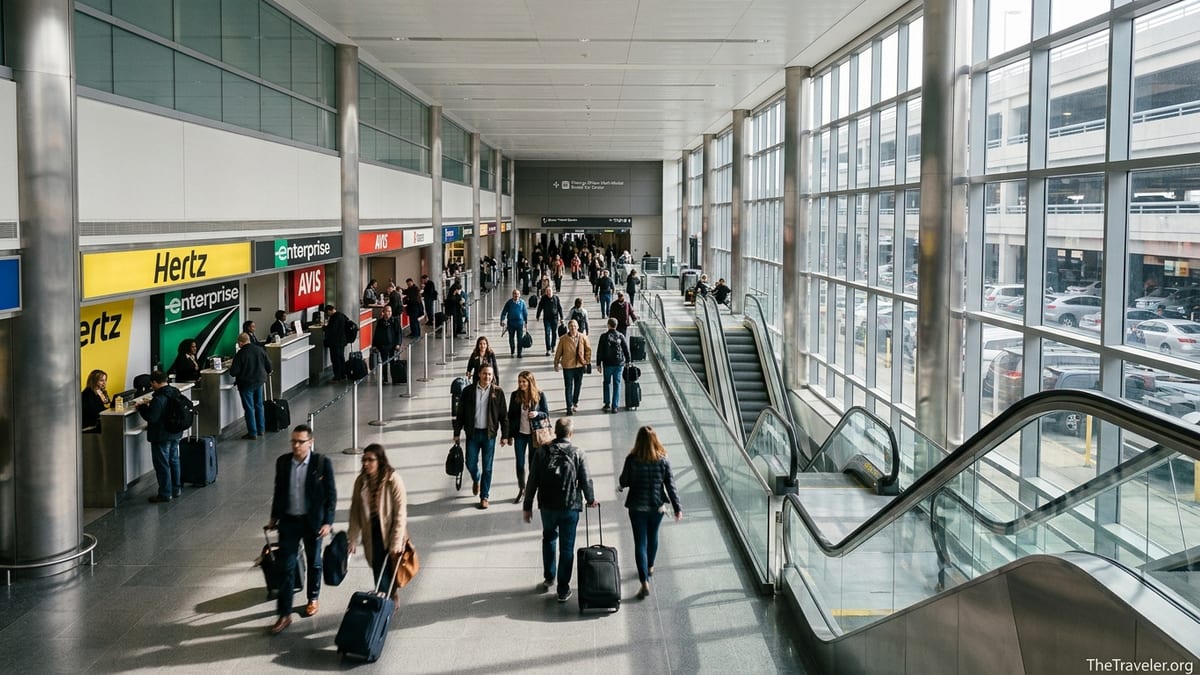
Understanding O’Hare’s Multi-Modal Facility
All on-airport rental car companies at Chicago O’Hare now operate out of the airport’s Multi-Modal Facility, often shortened to MMF. It is a large, multi-level complex on the northeast side of the airfield that acts as a one-stop hub for rental cars, Economy Parking Lot F, the Kiss ’n’ Fly drop-off area, Pace suburban buses and access to the nearby Metra O’Hare Transfer rail station. In practice, this means every major brand you recognize at O’Hare, such as Alamo, Avis, Budget, Dollar, Enterprise, Fox, Hertz, National, Payless, Sixt and Thrifty, is clustered in one building instead of scattered across airport frontage roads.
The MMF is designed around a central customer lobby with service counters for each rental brand and adjacent multi-level “ready/return” garages where vehicles are parked. Travelers move from the lobby to their car via clearly marked escalators or elevators, then follow color-coded signage out to the appropriate floor and row. The idea is to streamline what used to be a patchwork of separate shuttles and lots into a single, predictable experience: no matter which on-airport company you choose, you’ll always start and end at the same facility.
Most visitors will never drive directly to the MMF. Instead, you reach it from the terminals using the airport’s Airport Transit System, or ATS, the free people-mover that stops at all terminals, parking and the MMF. However, the MMF does have a street address on the east side of the airport, which matters if you are a local renter picking up a car without a flight, or if you’re returning a vehicle via GPS directions rather than following airport signs.
The consolidated setup has knock-on benefits: it cuts down on terminal curb traffic, reduces shuttle congestion, and makes it easier to compare prices among brands. For you, the traveler, it translates into a more consistent layout and fewer surprises when you land, particularly if you’ve rented at O’Hare before and are returning to the same familiar building.
Getting to the Rental Cars: ATS and Ground Access
The key to reaching your rental car at O’Hare is the Airport Transit System. The ATS is an automated people mover that runs 24 hours a day, connecting Terminals 1, 2, 3 and 5 with parking garages, the MMF and ground transport connections. Trains typically arrive every few minutes during the day and evening. Importantly, the ATS is free, so there is no fare to pay and no ticket required. You simply follow the signs to “Airport Transit System” in your arrival terminal, ride to the station labeled for the Multi-Modal Facility, and exit there.
If you land at one of the domestic terminals (1, 2 or 3), look for ATS signage near the baggage claim level. You will usually take an escalator or elevator up to the ATS platform, where trains operate in a loop. From Terminal 5, which handles most international flights, ATS access works the same way, though walking distances can be longer, especially from the far gates. Plan on about 10 to 20 minutes from gate arrival to the MMF if everything goes smoothly, including walking, waiting a few minutes for a train, and the ride itself.
Once you arrive at the MMF station, you will exit the train and follow clearly marked signs into the Multi-Modal Facility building. Inside the main lobby you’ll see counter banks for the different rental companies, along with large digital displays indicating directions to specific brands and garage sections. If you are an elite member with a company like Hertz, National or Avis, you may be able to bypass the counter and go directly to your assigned vehicle area, but it is still worth following the posted instructions, as procedures can vary by brand.
Travelers who are not arriving by air can also reach the MMF by car, taxi, rideshare or Metra commuter rail. If you are being dropped off, your driver can follow signs for “Rental Cars” and “Multi-Modal Facility” around the airport perimeter roads to the MMF entrance. Metra’s O’Hare Transfer station sits just east of the facility, connected by a short walkway and shuttle connections, offering a rail link from northwest suburban communities. This multi-modal design means your rental car pickup can tie seamlessly into Chicago’s broader transit network.
Step-by-Step: How the Pickup and Return Process Works
The pickup sequence at O’Hare’s rental car hub is fairly standard once you understand the flow. After leaving your arrival terminal, ride the ATS to the Multi-Modal Facility and enter the main lobby. If you have a standard reservation and no special status, your first stop will typically be your rental company’s counter. Here you will present your driver’s license and credit card, confirm the rate and duration, decide on add-ons like additional drivers or toll packages, and sign the rental agreement. Lines can form in the late afternoon and evening, especially on Sundays and Mondays, so allow extra time if you are traveling at those peaks.
Once your paperwork is processed, the agent will direct you to the appropriate floor and row in the attached garage where your vehicle is staged. For example, you might be instructed to take an elevator to Level 3, follow signs for “Hertz Gold” or “Alamo Compact & Midsize,” and then select any car in a designated aisle. Larger vehicles like SUVs and minivans often have their own clearly marked sections. Before leaving the garage, take a few minutes to inspect the car for existing damage and photograph any visible scratches or dents. In Chicago’s winter months, also check that the windshield washer fluid is topped off and that the tires look appropriate for cold-weather driving.
Returning the car follows a reverse pattern. As you approach the airport, follow roadside signs for “Rental Car Return” rather than trying to navigate by terminal name. These signs will direct you back to the MMF rather than to the terminal curbs. Within the facility, overhead boards and painted arrows guide you to your specific company’s return lanes. A staff member will usually scan the vehicle, note the fuel level and mileage, and provide a receipt. From there, you follow indoor signage back to the ATS platform to return to your departure terminal.
If you have a tight connection or early-morning flight, build in additional buffer time for both ATS travel and possible traffic near the airport. Morning rush hours on weekdays around the Kennedy Expressway can slow down access to O’Hare. As a practical rule, plan to be pulling into the MMF at least 45 to 60 minutes before your airline’s recommended terminal arrival time, especially if you need to check bags or clear security during busy periods.
Navigating Chicago’s Tolls with a Rental Car
Chicago’s highway network includes several toll facilities, notably stretches of I-294 (the Tri-State Tollway), I-90 northwest of the city, I-355 and the Chicago Skyway. Illinois uses an electronic toll system branded I-PASS, which is fully compatible with E-ZPass. On some expressways, toll plazas have fully transitioned to cashless collection, with overhead gantries scanning license plates instead of offering staffed booths. This matters for renters, because any tolls run through a rental plate can generate administrative fees from the rental company if you do nothing.
Rental companies at O’Hare typically offer their own toll programs. For instance, a brand might provide a transponder or toll waiver device that activates automatically when you pass under a toll gantry and charges a daily service fee on top of the tolls incurred. These fees can be modest for one or two days, but add up quickly on longer trips. A family renting a minivan for a five-day suburban stay, driving the Tri-State Tollway daily, could easily spend more on the rental company’s service fee than on the tolls themselves.
Many travelers prefer to manage tolls directly to avoid these markups. One common strategy is to use the state’s online pay-by-plate system after the trip. You register the rental car’s plate number and rental dates with the Illinois Tollway website and pay the accumulated tolls at the posted rates, which can be lower than the invoice you might receive via the rental company’s toll administrator. Another approach, especially for people who visit Illinois or other I-PASS states regularly, is to bring a personal I-PASS or compatible E-ZPass transponder and temporarily add the rental car’s plate to the account for the rental period.
If you prefer to avoid tolls altogether, you can plan your routes on non-toll alternatives such as surface streets or free portions of the interstates. However, in some corridors, like the route between O’Hare and many western or southern suburbs, the tollway system can be significantly faster, especially during peak traffic. Before deciding, compare approximate drive times using an up-to-date navigation app. Also be aware that certain airport exits, such as specific ramps connecting the tollway directly to the O’Hare area, may have their own toll gantries, making it difficult to visit the airport without incurring at least one toll when arriving via those routes.
Insurance, Fees and Deposits: What to Expect
At O’Hare’s rental counters, insurance and deposit policies broadly mirror those at other major U.S. airports, but Chicago’s dense urban traffic and winter weather can make coverage decisions feel more consequential. Most rental companies will place a temporary hold on your credit card at pickup, often in the range of a few hundred dollars above the estimated cost of the rental. This hold is released when you return the vehicle in good condition and settle the final bill. Debit card rentals are often more restricted; companies may require proof of return travel, perform a credit check, or impose lower vehicle class limits when you use a debit card instead of a credit card.
In terms of coverage, you will be offered a collision damage waiver (also called loss damage waiver), supplemental liability, and sometimes personal accident or personal effects protection. If you hold a major credit card issued in the United States, there is a good chance it includes some form of rental car coverage, especially for collision damage, as long as you pay for the rental with that card and decline the rental company’s equivalent coverage. However, these benefits vary and often exclude certain vehicle types, so it is wise to confirm with your card issuer before your trip.
Given Chicago’s mix of tight parking garages, parallel street parking in dense neighborhoods and occasionally slick roads in winter, many travelers choose to either rely on robust credit card coverage or purchase the rental company’s waiver to reduce their financial exposure. A modest daily fee for a collision waiver can feel worthwhile if you expect to be squeezing into downtown parking structures or navigating unfamiliar residential streets at night. As a middle path, some renters stick with their own auto insurance for liability coverage and use a credit card benefit for collision, declining the other extras at the counter.
Beyond insurance, pay attention to surcharges common at major airports. Concession recovery, facility fees that help pay for the MMF, local taxes and per-day charges for additional drivers or child seats can significantly increase the cost above the headline daily rate you saw online. Reviewing an itemized cost breakdown before you sign will help you catch any optional extras you do not truly need, such as prepaid fuel options that may not make sense for a short stay focused in the city.
Do You Really Need a Car in Chicago?
Whether a rental car at O’Hare is worth it depends heavily on your itinerary. For visitors staying in or near downtown Chicago, especially in the Loop, River North, Streeterville or West Loop, a car can be more hassle than help. Downtown hotels frequently charge overnight parking fees that can run into the dozens of dollars per night, and public garages in central neighborhoods often post daily maximums that rival or exceed the typical cost of a rideshare ride from O’Hare to the city center. On top of that, Chicago’s CTA “L” trains and buses provide extensive coverage, and the Blue Line offers a direct link from O’Hare to downtown.
Consider a long weekend where you plan to stay near Millennium Park, visit the Art Institute, explore the Riverwalk and dine in nearby neighborhoods like West Loop and Wicker Park. In this scenario, you could easily rely on the Blue Line from O’Hare, walk between many sights, and supplement with the occasional rideshare or taxi. The total cost would likely be significantly lower than renting a car for three days, paying for hotel parking, and dealing with traffic and parking each time you go out.
On the other hand, if your plans focus on suburban destinations, a rental car quickly becomes more compelling. Visitors attending a wedding in Naperville, a youth sports tournament in Schaumburg, or a family reunion spread across northwest suburbs will find that suburban public transit is patchy and rideshare fares can add up quickly over multiple days. In those cases, picking up a midsize sedan at the MMF may be both more convenient and more economical, even when accounting for tolls and fuel.
Season and time of day also play a role. In deep winter, slogging luggage through snow and slush to reach train platforms or bus stops may tilt the calculation toward a car for families with children or anyone with mobility constraints. Conversely, in summer, using the train from O’Hare and then enjoying Chicago’s walkable lakefront, bike-share system and outdoor patios can make a car feel unnecessary. When in doubt, sketch out your specific plans, estimate transit and rideshare costs, and compare that with a realistic rental quote including parking and tolls.
Practical Driving and Parking Tips Around O’Hare and the City
If you do decide to rent, a bit of local awareness goes a long way. Leaving the airport, your navigation system will likely route you onto I-190, which connects directly to I-90 (the Kennedy Expressway) or to the Tri-State Tollway. Traffic into downtown via I-90 can be heavy during weekday rush hours and on Sunday evenings. Giving yourself extra time and staying aware of real-time traffic conditions is essential, particularly if you have timed tickets for attractions or dinner reservations.
Parking practices differ markedly between downtown and the neighborhoods. In the core business districts, multi-level garages and surface lots dominate. Many now accept mobile payments and display digital signs with current prices at the entrance. In residential areas, you will encounter more street parking, often with permit requirements or time limits. Before renting, it is worth checking whether your hotel or accommodation includes parking or has a partnership with a nearby garage that offers overnight rates. Navigating these details in advance helps avoid circling blocks late at night hoping to find an open space.
Chicago is also a city of distinct seasons. In winter, be ready for snow, slush and lower visibility. Rental cars at O’Hare will generally come with all-season tires, but traction can still be a concern on untreated side streets. Drive cautiously, allow extra stopping distance, and avoid aggressive lane changes on elevated expressway ramps. In summer, construction zones are commonplace, and lane closures on major arteries like the Kennedy or the Dan Ryan can cause sudden slowdowns. Patience and defensive driving are your friends in both extremes.
Finally, if your itinerary includes both downtown and outlying areas, one strategy is to split your rental. For example, you might arrive at O’Hare, use the Blue Line and rideshares for two car-free days in the city, then return to O’Hare by train, pick up a car at the MMF for a one- or two-day suburban excursion, and return it directly before your departure flight. This hybrid approach can minimize parking headaches while still giving you the freedom to explore beyond the city core.
The Takeaway
Renting a car at Chicago O’Hare is built around a modern, centralized Multi-Modal Facility that gathers all the major rental brands, parking and ground transport connections into one place. Once you understand how to reach it on the free Airport Transit System, the process of picking up and returning a vehicle is straightforward, with clear signage and standardized layouts across companies.
The bigger questions for most travelers are less about logistics and more about value. Chicago’s toll roads, dense downtown traffic, parking costs and robust transit network mean that not every trip justifies a car. For purely urban itineraries, especially in and around the Loop and nearby neighborhoods, you may be better off relying on trains, buses and rideshares. For suburban-heavy plans or multi-stop regional travel, an O’Hare rental can be a practical, cost-effective tool.
By thinking through your route, estimating toll and parking costs, and choosing insurance and deposit options that match your risk tolerance, you can make O’Hare’s rental car system work for you rather than against you. Whether you step onto the ATS with car keys in hand or swipe onto the Blue Line with a transit pass, going in with a clear plan will make your arrival in Chicago smoother and your stay more enjoyable.
FAQ
Q1. Where exactly are the rental cars located at Chicago O’Hare?
The on-airport rental car companies are all housed in the Multi-Modal Facility, a single complex connected to the terminals by the free Airport Transit System train.
Q2. How do I get from my arrival gate to the rental car facility?
Follow signs for the Airport Transit System after baggage claim, ride the train to the Multi-Modal Facility stop, then walk into the main lobby to find your rental company.
Q3. How long does it take to reach the Multi-Modal Facility from the terminals?
In normal conditions, plan on about 10 to 20 minutes from your gate to the MMF, including walking, a short wait for the ATS and the train ride itself.
Q4. Can I rent a car at O’Hare even if I am not flying that day?
Yes. Local renters can drive or be dropped off at the Multi-Modal Facility, where all the rental counters and garages are located, and pick up vehicles there.
Q5. Do I need an I-PASS or E-ZPass to use Chicago’s toll roads with a rental car?
No, but having a transponder or using the state’s pay-by-plate system can save money compared with relying on the rental company’s toll program and fees.
Q6. Is a rental car recommended if I am staying in downtown Chicago?
Often it is not. Between high hotel parking costs, heavy traffic and strong transit options, many downtown visitors find it cheaper and easier to go car-free.
Q7. When does renting a car from O’Hare make the most sense?
Renting is most useful if your plans focus on suburbs, regional day trips or multiple distant locations that would be difficult or expensive to reach by transit or rideshare.
Q8. What kind of deposit or hold should I expect on my credit card?
Most rental companies place a temporary hold that can be a few hundred dollars above the estimated rental cost, released when the car is returned in good condition.
Q9. Are there off-airport rental companies near O’Hare?
Yes, some smaller or discount brands operate off-airport locations and may provide shuttles from the Multi-Modal Facility, but you should confirm details when booking.
Q10. How early should I return my rental car before a departing flight?
Aim to arrive at the Multi-Modal Facility at least 45 to 60 minutes before the time you want to be at your terminal, allowing for return processing and an ATS ride.