


When you book a flight to Chicago, the booking screen often gives you a choice that can shape your whole trip: O’Hare International Airport (ORD) or Midway International Airport (MDW). Both are major airports with direct train links into the city, but they feel very different on the ground. The right choice depends on where you are coming from, where you are staying, your airline loyalty, and even the time of day you plan to land.
Get the latest updates straight to your inbox!
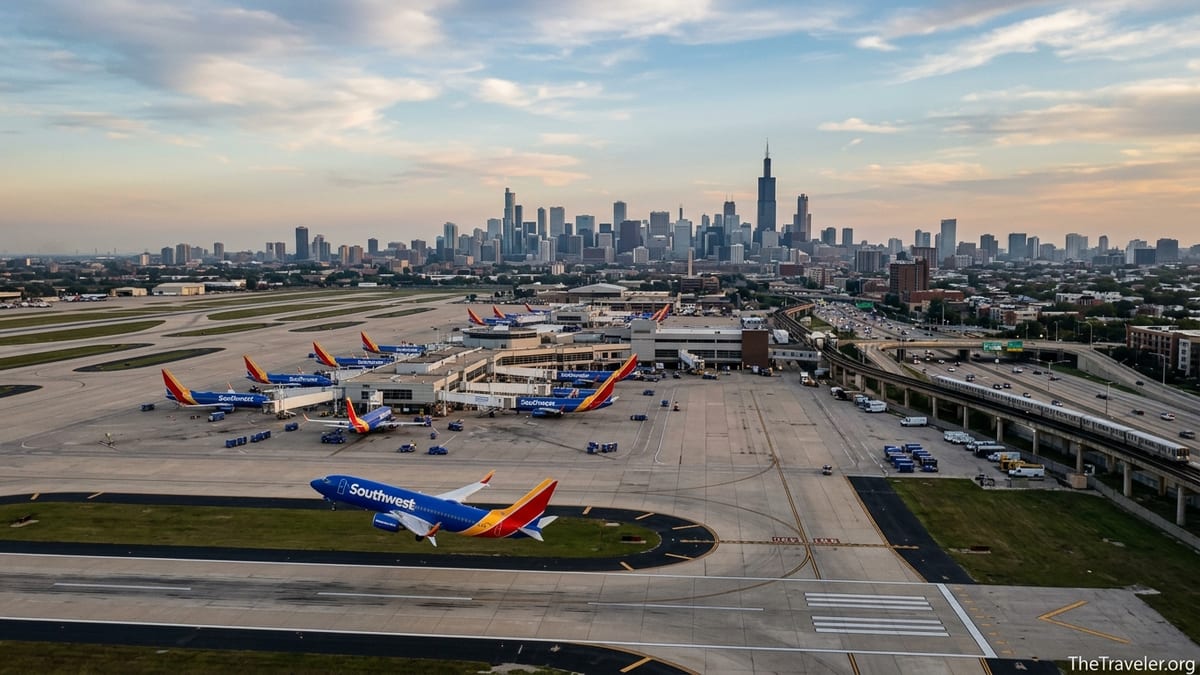
Big Picture: How ORD and MDW Fit Into Chicago Travel
Chicago is one of the few U.S. cities with two sizeable commercial airports, each serving a distinct role. O’Hare, on the northwest edge of the city, is the global gateway. It is a major hub for United and American, with hundreds of daily departures and nonstop flights all over North America, Europe, Asia, the Middle East and beyond. It is the airport you choose when you need a direct flight from places like London, Tokyo, Frankfurt or Sao Paulo, or when you are connecting across a big domestic network on a legacy carrier.
Midway, southwest of downtown, is Chicago’s domestic workhorse and one of Southwest Airlines’ strongest bases, with dozens of routes across the United States. If you are flying from cities such as Denver, Nashville, Dallas Love Field or Phoenix and you see an attractive Southwest fare, there is a good chance it will bring you into Midway. For many domestic travelers, especially those already loyal to Southwest, Midway feels like the “home airport” for Chicago.
In practical terms, that means O’Hare usually offers more choice and better connections, especially for international or complex itineraries, while Midway often wins on simplicity: fewer terminals, shorter walks, quicker security lines and a faster ride into the Loop. Understanding those broad roles is the first step toward choosing the airport that fits your trip instead of fighting against it.
Imagine two friends visiting Chicago in October. One is coming from Paris and staying near the Magnificent Mile. The other is flying in from Kansas City for a weekend in a West Loop hotel. The Paris traveler really has to use O’Hare to get a nonstop overnight flight, while the Kansas City visitor may find that Southwest into Midway is cheaper, non-stop and much easier to navigate.
Flight Options, Airlines and Routes
If your priority is route choice, O’Hare almost always comes out ahead. As of 2024 and 2025 schedules, O’Hare offers nonstop service to well over 200 destinations across the Americas, Europe, Asia, the Middle East and parts of Africa. That includes long-haul routes like Chicago to London Heathrow, Frankfurt, Tokyo Haneda, Delhi and Doha, often with multiple daily frequencies. On the domestic side, United and American link O’Hare to major hubs such as Los Angeles, New York, Houston, Phoenix, Miami and Seattle with numerous flights each day, making it easier to adjust your timing or recover from disruptions.
By contrast, Midway focuses almost entirely on domestic and near‑international service, dominated by Southwest. You will find frequent flights to places like Denver, Las Vegas, Orlando, Atlanta and Phoenix, along with smaller cities such as Omaha, Indianapolis or Raleigh–Durham, depending on the season. For many travelers, that is a plus: the networks are straightforward, and a single airline often operates multiple daily departures on popular routes. If you live in a Southwest city, you might easily piece together a two‑segment itinerary such as Albuquerque to Chicago via Denver, and stay entirely within one carrier’s system.
There are trade‑offs. A family flying from London will not find nonstop options into Midway and will almost certainly fly into O’Hare on an airline like British Airways or American. On the other hand, a couple from Nashville planning a Chicago weekend might see a nonstop Southwest flight into Midway that lets them depart after work on Friday and return Sunday night at a competitive fare compared with legacy carriers into O’Hare. For domestic point‑to‑point trips inside the United States, Midway often matches or beats O’Hare for pure convenience.
Connections matter too. Frequent flyers with status on United or American usually lean toward O’Hare, where they can connect onward to dozens of smaller markets in the Midwest and Great Plains. Travelers embedded in Southwest’s ecosystem will find that Midway offers an unusually dense web of routes, with many early‑morning and late‑evening options designed for business trips and short breaks.
Getting Downtown: Time, Cost and Realistic Commute Scenarios
From a map view, Midway is clearly closer to downtown Chicago than O’Hare, and that plays out in real travel time. The Chicago Transit Authority’s Orange Line train runs from Midway to the Loop in about 20 to 25 minutes under normal conditions. By comparison, the Blue Line from O’Hare to downtown takes roughly 40 minutes. Both lines run frequently, and the Blue Line operates 24 hours a day, which is a crucial detail for late‑night or early‑morning arrivals.
On price, the two are similar but not identical. As of mid‑2026, a single CTA train ride from either airport into the city typically costs just a few dollars, but the fare leaving O’Hare on a single‑ride ticket carries a small airport surcharge that makes it slightly more expensive than a standard city trip. For a solo traveler landing at O’Hare around 4 p.m., taking the Blue Line can save a significant amount compared with a taxi or ride‑share that may cost several times more and sit in Kennedy Expressway traffic for an hour.
In real life, roadway traffic often exaggerates the difference between the airports. A rideshare trip from Midway to a Loop hotel on a weekday morning might take 20 to 30 minutes and cost in the ballpark of 25 to 40 dollars, depending on surge pricing. The same rideshare from O’Hare during a busy afternoon could easily exceed 45 minutes and climb into the 60 to 80 dollar range once tolls and congestion are factored in. Some travelers landing at O’Hare around rush hour intentionally head to the Blue Line instead of the taxi stand simply to avoid rolling the dice on Expressway gridlock.
Consider a business traveler staying at a hotel in the Loop near the Harold Washington Library station. If she lands at Midway at 8:30 a.m. on a weekday and travels with only a carry‑on, she can be on the Orange Line within 15 minutes and in the Loop about 25 minutes later, arriving downtown before 9:30 a.m. The same traveler landing at O’Hare at 8:30 a.m. has a longer ride ahead, whether by Blue Line or car, and is less likely to make a 10 a.m. meeting comfortably.
Fares, Fees and Typical Price Differences
Airfare pricing shifts constantly, but general patterns show up over time. Because O’Hare is a competitive hub for several large airlines and handles more international traffic, it often offers greater price variation: sometimes it is significantly cheaper, other times more expensive. For example, on a random midweek in October, a Chicago to Los Angeles roundtrip might price around 250 to 350 dollars from O’Hare on United or American, with basic economy options dipping lower during sales. The same route on Southwest from Midway may show a similar or slightly higher base fare, but includes two checked bags and more flexible change policies, which can make it a better value for some travelers.
On purely domestic city pairs where Southwest has a strong presence, such as Chicago to Denver or Nashville, Midway flights may undercut O’Hare by a noticeable margin during off‑peak periods. A weekend getaway from Chicago to Nashville in February might cost around 150 to 220 dollars roundtrip from Midway on Southwest if booked early, while O’Hare‑based options on legacy carriers could price higher, especially once baggage fees are added. Conversely, a transatlantic flight such as Chicago to Dublin or London will almost always depart from O’Hare, and competition between multiple carriers can lead to attractive economy fares during shoulder seasons.
There are also practical cost differences tied to the airports themselves. Parking at either airport can add up quickly, but long‑term parking near O’Hare is often slightly more expensive than similar off‑site lots near Midway, reflecting O’Hare’s busier profile and longer distances. For an extended trip, that difference might run to 30 or 50 dollars over a week. Transit costs into the city are modest from both airports, but if you are a family of four arriving at O’Hare late at night, paying for a large rideshare vehicle at peak pricing can erase any airfare you saved by flying into the bigger hub.
One useful tactic is to price both airports side by side when you start planning. Look at your total door‑to‑door cost instead of just the base fare. A 40 dollar cheaper ticket into O’Hare does not help if you then spend 60 dollars more on an airport transfer compared with a straightforward Orange Line ride from Midway.
Delays, Reliability and When Each Airport Struggles
No Chicago airport is immune to delays, especially in winter when snow and low visibility affect the entire region. However, the two airports behave a bit differently. O’Hare handles a much larger volume of flights, and that heavy traffic means that small disruptions can ripple through the schedule more easily. Federal aviation data from recent years has consistently placed O’Hare among the busier U.S. hubs for delay counts. Midway, with fewer runways and a compact footprint, can also see significant disruptions during storms, but its overall delay totals are generally lower than O’Hare’s simply because it runs fewer flights.
Seasonal weather matters. In January and February, both airports are vulnerable to snowstorms that can shut down runways or require extensive de‑icing, adding taxi time and causing missed connections. In practice, the traveler’s experience often depends more on airline operations than the specific airport. United and American run complex hub‑and‑spoke banks at O’Hare, so a thunderstorm line sweeping through the Midwest on a summer afternoon can knock out significant chunks of their networks and lead to rolling delays. Southwest at Midway may also be hit, but with fewer international connections and a more point‑to‑point structure, some passengers see a slightly smoother recovery.
For a time‑sensitive trip such as a same‑day client meeting, it is worth looking at the time of day as well as the airport. Analysis of on‑time performance in Chicago has shown that very early morning departures, especially before 8 a.m., tend to leave closer to schedule from both O’Hare and Midway, before weather patterns and air traffic congestion build up. So whether you are flying O’Hare to New York on American or Midway to Dallas on Southwest, the 6:30 a.m. departure is more likely to run on time than a 5:30 p.m. flight at the height of evening rush.
If you are connecting through Chicago in winter, O’Hare’s larger network cuts both ways. It provides more back‑up options and rebooking possibilities, but it also exposes you to congestion if storms ripple across multiple hubs. Midway has fewer total flights but can sometimes be easier to navigate during disruptions because there are fewer terminals, shorter distances between gates and a single dominant carrier handling most operations.
Terminal Experience, Comfort and Convenience on the Ground
O’Hare’s size is both its strength and its drawback. With multiple terminals, extensive international facilities and long concourses, it can feel like a small city. If you are flying business class to London or Tokyo, you may appreciate O’Hare’s premium lounges, wider restaurant selection and duty‑free shopping. Families connecting on United or American also benefit from the number of food outlets, from national chains to local Chicago names, and from ample seating areas, though crowding at peak times is common.
That scale also means longer walks. It can take 15 to 20 minutes to walk from some gates to the Blue Line station, and security lines in the morning bank at Terminal 1 or 3 may feel daunting. First‑time visitors have been known to underestimate just how long it takes to reach a far‑flung gate after clearing security. On tight domestic connections, even a short delay on arrival can leave you hustling through long corridors or taking the intra‑terminal train to make your onward flight.
Midway, in contrast, is compact and easier to read at a glance. Most gates feed into a central concourse with shops and dining clustered along a few main hallways. Security lines can still back up during busy periods, but once you are airside, moving between gates is generally quicker than at O’Hare. Travelers often remark that Midway feels more human‑scale, and that is a real advantage if you are shepherding younger children or older relatives through the airport.
Imagine arriving at Midway with kids in tow for a spring break trip to Orlando. You clear security, pick up a snack from a recognizable chain, find your gate just a few minutes’ walk away and let the kids watch aircraft on the ramp through big windows. The same trip through O’Hare might involve a longer trek and more wayfinding, but a richer variety of food options and, for some passengers, access to airline lounges to break up the wait.
Which Airport Works Best for Different Types of Trips
Once you understand the characteristics of O’Hare and Midway, the choice becomes clearer for different scenarios. For international travel, especially if you want nonstop flights or are using miles on a global alliance, O’Hare is almost always the answer. A traveler from London booking a Chicago city break will find multiple nonstops into O’Hare on major carriers, and then a straightforward 40‑minute Blue Line ride into downtown, even if the flight lands late in the evening.
For domestic weekend getaways focused squarely on downtown, Midway is often the more relaxed option. A couple from Dallas Love Field flying on Southwest can land at Midway on a Friday afternoon, ride the Orange Line into the Loop in under half an hour and check into a hotel near Millennium Park with minimal hassle. Their return flight on Sunday afternoon departs from the same compact terminal, reducing the amount of time spent navigating long concourses.
Business travelers with meetings in the northern or northwestern suburbs, such as Schaumburg, Rosemont or Deerfield, frequently prefer O’Hare because it sits closer to those corridors and offers easier access to rental cars and suburban hotels. In contrast, someone visiting friends in neighborhoods on the Southwest Side or near the Orange Line corridor, such as Bridgeport or Brighton Park, may find that Midway plus a short bus or rideshare trip is the most sensible choice.
Another group to consider is budget‑conscious solo travelers and students. For them, the decisive factors tend to be airfare plus transit costs. A student flying home from Boston for winter break might choose a low‑fare carrier into O’Hare if the price is right and then rely on the Blue Line to reach a dorm near the Red Line. Another student coming from Kansas City may find that Southwest into Midway, followed by an Orange Line ride and a connecting bus, delivers the best combination of price and convenience.
The Takeaway
There is no single “best” Chicago airport, only the one that works better for your specific trip. O’Hare is the heavyweight hub with global reach, deep domestic networks and a 24‑hour train connection into the city. It is the sensible choice for most international travel, for passengers tied to United or American frequent flyer programs, and for visitors headed to the northern suburbs. Its drawbacks are longer travel times to downtown, bigger crowds and a greater likelihood of feeling overwhelmed if you are not used to large hubs.
Midway, by comparison, is the nimble specialist. Closer to downtown, heavily served by Southwest and easier to navigate, it shines for domestic point‑to‑point trips, quick weekends and travelers who value a simple, compact terminal. It does not offer the same breadth of long‑haul or international routes, and late‑night public transit options are more limited than O’Hare’s, but for many visitors whose plans center on the Loop or West Loop, it can deliver a noticeably smoother arrival and departure.
When you are faced with the O’Hare versus Midway choice on a booking screen, zoom out and think about the entire journey. Factor in where you are staying, how you plan to get into the city, what time you land, and whether you care more about route flexibility or an easy airport experience. For a jet‑lagged arrival from Europe, O’Hare’s nonstop options and around‑the‑clock Blue Line might win. For a Friday evening hop from Nashville or Denver, Midway’s shorter commute to downtown could be the difference between catching sunset over the Chicago River and spending it in traffic.
In short, let your itinerary lead the decision. Both airports work well when you match them to the right kind of trip. Use O’Hare when you need reach and redundancy, and choose Midway when you want speed and simplicity into the heart of Chicago.
FAQ
Q1. Which Chicago airport is closer to downtown?
Midway is closer by both distance and typical travel time. The CTA Orange Line usually reaches the Loop in about 20 to 25 minutes, while the Blue Line from O’Hare takes around 40 minutes in normal conditions.
Q2. Which airport is better for international flights?
O’Hare is far better for international travel, with nonstop routes to major hubs in Europe, Asia, the Middle East and Latin America. Midway’s network is focused mainly on domestic and limited near‑international destinations.
Q3. Is O’Hare or Midway cheaper to fly into?
It depends on your route, airline and dates. O’Hare can be cheaper on some competitive domestic and transatlantic routes, while Midway, especially on Southwest, often offers good value for U.S. point‑to‑point flights. Always compare both for your specific dates.
Q4. Which airport has better public transportation?
Both offer excellent train links. O’Hare has the 24‑hour Blue Line, which is a major advantage for very late or very early flights. Midway’s Orange Line is faster to the Loop but does not run overnight in the same way. For daytime arrivals, Midway usually wins on overall travel time.
Q5. Is Midway really easier to navigate than O’Hare?
Yes, most travelers find Midway noticeably simpler. It is more compact, with shorter walks between security, gates and the train station. O’Hare is much larger and can require long walks and more wayfinding, especially for connections.
Q6. Which airport should I choose for a downtown weekend trip?
If you are flying domestically and have a reasonable fare option, Midway often makes more sense for a Loop or West Loop weekend because it is closer and less hectic. If your best fares or routes are into O’Hare, the Blue Line still provides a straightforward link to downtown.
Q7. Which airport is better in winter weather?
Both can suffer delays during Chicago’s snow and ice seasons. O’Hare handles more traffic and can see larger ripple effects, but it also provides more options for rebooking. Midway runs fewer flights and is simpler to navigate during disruptions, which some travelers prefer.
Q8. Where should I fly if I am staying in the suburbs?
If you are headed to the northern or northwestern suburbs, O’Hare is usually more convenient. For southwest or south‑side suburbs, Midway may be closer. Check your hotel’s address and map out the drive or transit from each airport before deciding.
Q9. Does Southwest fly from both O’Hare and Midway?
Southwest’s primary Chicago base is Midway, with by far the most routes and frequencies. At various times it has operated a smaller set of flights from O’Hare, but most travelers using Southwest to or from Chicago will be flying through Midway.
Q10. If prices are the same, which airport should I pick?
For domestic trips where fares are similar, choose based on where you are staying and when you land. Downtown hotels and daytime arrivals usually favor Midway. International itineraries, late‑night flights and complex connections usually favor O’Hare.