


For many visitors, the first glimpse of Chicago beyond the airport is from the windows of the Blue Line train. The CTA’s Blue Line connects O’Hare International Airport directly to downtown Chicago, running 24 hours a day and offering one of the fastest and cheapest ways into the city. This guide walks you through every step of the journey, from finding the station at O’Hare to choosing the right downtown stop, understanding tickets and passes, staying safe with luggage, and avoiding common mistakes first-time riders often make.
Get the latest updates straight to your inbox!
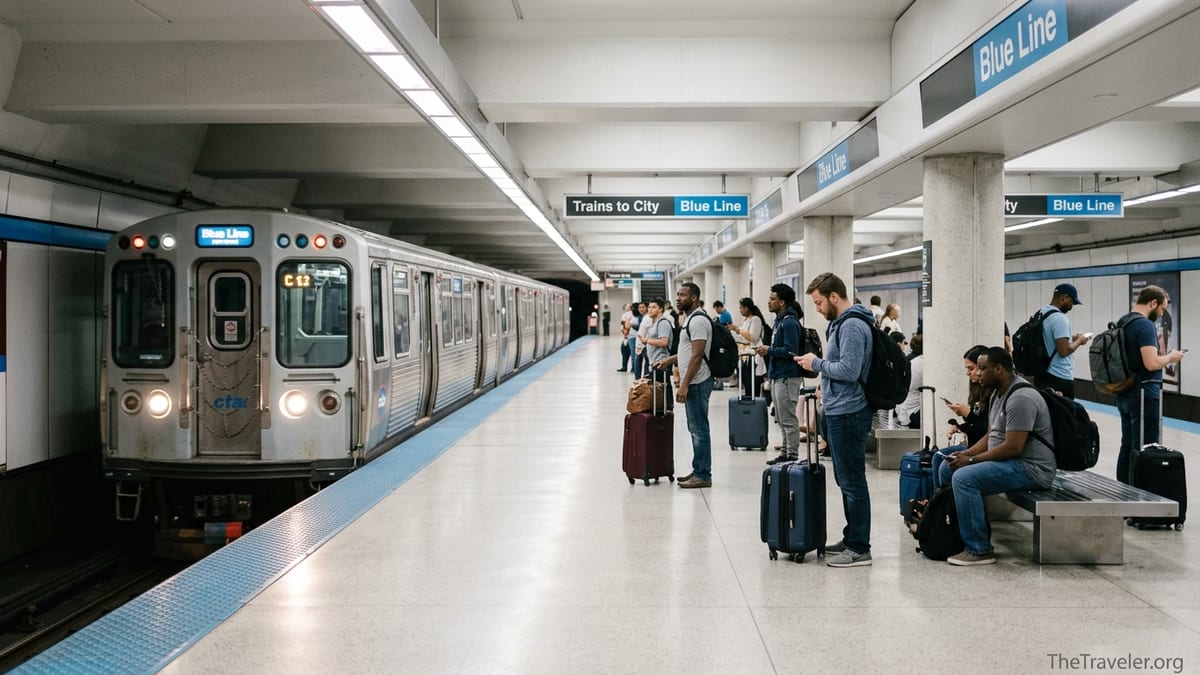
How the Blue Line Connects O’Hare and Downtown
The CTA Blue Line runs from O’Hare International Airport on the far northwest edge of Chicago all the way to Forest Park, passing straight through downtown via the Milwaukee–Dearborn subway. Trains operate 24 hours a day, which makes the Blue Line one of the few big-city airport rail links that you can count on even for very early morning or late-night flights. During busy daytime hours, trains usually run every few minutes; late at night you may wait 10 to 15 minutes.
From O’Hare to the heart of the Loop, plan on roughly 45 to 50 minutes of ride time. The schedule lists about 40 minutes to downtown in ideal conditions, but it is wise to build in a bit of extra time for minor delays, crowded trains, and the walk from your downtown station to your hotel. For example, a traveler landing around 3:00 p.m. often reaches Clark/Lake around 4:15 p.m. after walking from baggage claim, buying a ticket, and boarding the next train.
The O’Hare branch of the Blue Line largely runs in the median of the expressway between the airport and the city, then dives underground as it approaches downtown. Once in the Loop, the line serves a series of central stations that make it easy to walk to most major hotels, offices, and tourist sights. If your destination is somewhere like Millennium Park, the Riverwalk, or the Theater District, you will likely ride the Blue Line at least as far as Washington, Monroe, or Jackson.
Because the Blue Line is part of the broader CTA rail network, you can also transfer to other train lines and buses at no additional cost within two hours on most tickets and passes. That means you can ride from O’Hare to Clark/Lake, switch to the Brown or Orange Line to reach a specific neighborhood, and still only pay a single fare or one unlimited-ride pass for the entire journey.
Finding the Blue Line Station at O’Hare
At O’Hare, the Blue Line station is located in the main airport transit center, attached to Terminals 1, 2, and 3 by an underground pedestrian walkway. If you land on United, American, or most domestic carriers, follow the overhead signs for “Trains to City” after baggage claim. These signs are sometimes easy to miss when you are jet-lagged and juggling luggage, so slow down and look for the blue train icon as you walk toward the main corridor that connects the terminals.
From Terminals 1, 2, or 3, the walk to the station usually takes about 8 to 12 minutes at a normal pace. You will follow the underground corridor past moving walkways, airport services, and food outlets before reaching the CTA entrance. If you arrive at Terminal 5 on many international flights, you will first take the free Airport Transit System train to the main terminals, then follow the same “Trains to City” signs. Build in at least 20 to 25 minutes from clearing customs at Terminal 5 to reaching the Blue Line platform, especially during busy periods.
Once you reach the transit center, you will see the CTA Blue Line station entrance marked with large blue signs. Just inside are rows of Ventra ticket vending machines, customer information posters showing the full system map, and fare gates leading down to the platform. Unlike some airports where the rail link is far from the terminals, O’Hare’s setup keeps you indoors the entire way, which is especially helpful in winter when temperatures can be below freezing or during summer thunderstorms.
If you are unsure whether you are headed the right way, look for airport staff or other travelers wheeling suitcases toward the same corridor. It is common to see flight crews using the Blue Line to get into the city for layovers, and following them is often a reliable sign you are on the correct path. If you get turned around, asking specifically for “the CTA train to downtown” rather than just “a train” will help staff direct you quickly.
Tickets, Passes and What It Really Costs
Fares for the Blue Line are handled through the CTA’s Ventra system, which supports both reusable Ventra cards and disposable tickets. A standard single ride from any station in the system normally costs about two and a half dollars, but tickets purchased at the O’Hare Blue Line station carry a higher airport fare, which is currently around five dollars for a ride into the city. That higher price often includes the value of a transfer to another CTA train or bus within a set time window, so you do not pay a second full fare if you need to connect.
At the station, Ventra vending machines accept major credit and debit cards, as well as cash in U.S. dollars. For a short visit, most travelers buy either a single-ride ticket or a 1-day unlimited ride pass. The 1-day pass typically costs only a little more than a round-trip ride from O’Hare to the Loop and is a good value if you plan to ride the L or buses multiple times in the same 24-hour period. Longer 7-day and 30-day passes are aimed more at locals and business travelers staying for an extended period, but can still make sense if you are in town for a week and expect to use transit daily.
As an example, imagine a couple visiting for a long weekend. If they each buy a single-ride ticket from O’Hare to their downtown hotel and another back to the airport, they might spend close to ten dollars per person just on those two trips. By contrast, a 1-day unlimited pass for about six dollars could cover the airport trip plus a full day of rides between downtown, the lakefront, and neighborhoods like Wicker Park or Pilsen. For a two- or three-day stay packed with sightseeing, combining a 1-day pass on the busiest day with individual fares on lighter days often minimizes costs.
Frequent visitors and locals often use a Ventra card linked to their bank card or a mobile wallet instead of buying separate tickets each time. If you expect to return to Chicago regularly, consider purchasing a plastic Ventra card at O’Hare, loading some transit value or a pass onto it, and keeping it for future trips. Just remember that the base fare may change over time, and airport surcharges may be adjusted, so it is wise to check current prices on the Ventra machines or posted fare charts before you buy.
Key Downtown Stops and Choosing the Right One
The Blue Line serves several important stops in and around downtown Chicago, and choosing the right one can save you a lot of walking with luggage. For many visitors, Clark/Lake is the most versatile downtown stop. It sits in the northwestern part of the Loop, close to the Riverwalk, major office towers, and several hotels. It is also a major transfer point to the Brown, Green, Orange, Pink, and Purple Lines via the elevated tracks above, making it a convenient jumping-off point for exploring other parts of the city.
Washington and Monroe are located deeper in the Loop under Dearborn Street, offering excellent access to the Theater District, Daley Plaza, and many city and county offices. If your hotel is around State Street, Millennium Park, or the east side of the Loop, you might ride to Washington or Monroe and then walk east for 5 to 10 minutes. For example, visitors staying near Millennium Park often ride the Blue Line to Washington, exit on Dearborn Street, and walk past State Street shops to reach Michigan Avenue.
Jackson is another core downtown station where the Blue Line intersects directly with the Red Line via an underground pedestrian tunnel. This can be particularly useful if you are headed to North Side neighborhoods like Lincoln Park or Wrigleyville on the Red Line after dropping bags at a central hotel. From the Jackson Blue Line platform, signs clearly mark the walkway to the Red Line; the transfer usually takes about five minutes underground and keeps you out of the weather.
South and west of the Loop, stations like UIC–Halsted, Illinois Medical District and Racine serve major campuses and hospitals. These are less relevant for most tourists, but crucial if you are visiting friends at the University of Illinois at Chicago, attending a conference near the medical district, or staying in nearby West Loop hotels and guesthouses. In those cases, you may still ride from O’Hare into downtown, then continue a few more stops depending on exactly where you need to go.
Travel Time, Frequency and When to Allow Extra Cushion
Under normal circumstances, the scheduled travel time from O’Hare to downtown Loop stations is about 40 minutes. In real life, most visitors should plan on 45 to 60 minutes from stepping onto the platform at O’Hare to stepping off the train at their chosen downtown stop. This extra time accounts for minor slow zones, dwell times at busy stations, and the possibility that you just miss a train and have to wait for the next one.
Service is most frequent on weekday mornings and late afternoons, when trains can arrive every few minutes, making the ride feel almost like a metro in European capitals. Midday, evenings, and weekends see somewhat longer gaps between trains, but the O’Hare branch still tends to be one of the more reliably frequent lines, since it serves both commuters and airport travelers. Late at night, especially after midnight, be prepared to wait 10 to 15 minutes for a train and expect more fellow travelers carrying luggage or airport employees heading home from overnight shifts.
For an early morning flight home, many Chicago residents routinely take the Blue Line from stations like Logan Square, Damen, or Clark/Lake to O’Hare at 4:00 or 5:00 a.m. and report that trains are quiet but not deserted. If your international flight leaves around 8:00 a.m., for example, you might leave a downtown hotel around 5:30 a.m., board a Blue Line train by 5:45 a.m., arrive at O’Hare a little after 6:30 a.m., and have ample time to clear security.
Occasionally, track maintenance or incidents can cause longer-than-usual delays or require trains to be rerouted around particular stations, especially downtown. The CTA typically posts alerts on digital signs at stations and makes onboard announcements when this happens. If you see a notice about a reroute between downtown stops or a temporary station closure, you may need to get off one stop earlier or later than planned and walk an extra few blocks. This is rarely a major problem downtown, where the street grid is straightforward and there are usually plenty of people around to ask for directions.
Safety, Etiquette and Riding With Luggage
Like most big-city transit systems, the Blue Line is generally safe for ordinary travelers who use common sense, but it can occasionally feel rough around the edges. The O’Hare branch in particular is used heavily by airport workers, airline crews, and everyday commuters, which means you are rarely the only person with a suitcase or backpack. Incidents of serious crime on trains are relatively rare compared with the huge number of rides each day, but riders do sometimes encounter people who are unhoused, visibly intoxicated, or behaving erratically.
To stay comfortable, sit or stand near other regular riders rather than in an empty rail car, especially late at night. Many locals recommend boarding a middle or front car and avoiding the very last car after midnight, primarily because it tends to feel more isolated. Keep your bags either in front of your knees or in your lap instead of blocking aisles or doors. If you are traveling with a large suitcase, look for the open space near the doors or at the articulated center section between cars where you can stand with your luggage without crowding seats.
Basic etiquette on the Blue Line mirrors that of other major city metros. Do not place luggage on seats when the train is even moderately full, and offer priority seating to elderly riders, people with disabilities, or anyone visibly pregnant. Keep your voice to a normal conversation level, and avoid playing audio from your phone without headphones. Local riders sometimes become frustrated when airport passengers treat the train as a private shuttle and spread out with multiple bags, so being considerate about space goes a long way.
If someone on the train makes you uncomfortable, you have several options. First, you can quietly move to another part of the car at the next stop. If the behavior feels threatening, consider changing cars or exiting at a busy station like Jefferson Park or Logan Square and waiting for the next train. Uniformed transit security staff and Chicago police officers are periodically present at larger stations, and there are emergency intercoms in each car to contact the train operator if you need assistance. Trust your instincts; it is always acceptable to prioritize your comfort and safety, even if it means arriving a few minutes later.
Common Tourist Mistakes to Avoid
One of the most common mistakes visitors make is underestimating how long the overall journey from plane door to hotel lobby takes. While the Blue Line ride itself may be about 45 minutes, it is easy to forget the time needed for taxiing, disembarking, immigration, baggage claim, walking to the CTA station, buying tickets, and walking from your downtown station to your hotel. For evening events like theater performances or dinner reservations, give yourself generous buffer time so a delayed flight or slow baggage delivery does not cause unnecessary stress.
Another frequent error is getting off at the wrong downtown stop and then facing a longer walk with heavy bags than expected. For instance, travelers headed to hotels along Michigan Avenue sometimes exit at Clark/Lake and then discover that the walk to the east side of the Loop is longer than they anticipated, especially in winter weather. Checking your hotel’s address on a map in relation to the Blue Line stops before boarding at O’Hare can save time and energy. In many cases, Washington, Monroe, or Jackson may be more convenient for central Loop and Millennium Park addresses.
Some visitors also try to ride the train without purchasing a valid ticket or misunderstand how unlimited passes work. Ventra gates will not open unless you tap a properly loaded card or ticket, and on-train inspections occasionally occur. For example, a family might mistakenly assume that a 1-day pass counts calendar days rather than a 24-hour period from first use, leading them to tap a ticket that has already expired when trying to ride back to the airport. To avoid this, check the activation time printed on the back of the disposable ticket or displayed in the Ventra app so you know exactly when your 24-hour period ends.
Finally, tourists sometimes disregard basic street smarts because they are tired from a long flight. It is not unusual to see visitors standing near train doors with open backpacks, wallets in outer pockets, or phones left on top of suitcases. While pickpocketing is not rampant, big city transit calls for basic awareness. Keep valuables zipped inside your bag, hold your phone securely when using it to check maps, and avoid leaving laptops or passports unattended on seats while you adjust luggage or step briefly into the aisle.
When the Blue Line Makes Sense vs Taxis and Rideshare
The Blue Line is almost always the cheapest way to travel between O’Hare and downtown, particularly for solo travelers or couples. A single airport fare in the neighborhood of five dollars compares very favorably with typical taxi or rideshare costs, which can run anywhere from thirty-five to sixty dollars or more depending on traffic and surge pricing. For a solo visitor arriving at 4:00 p.m. on a weekday, the Blue Line ride may even be faster door to door than a rideshare stuck in Kennedy Expressway congestion.
For families or small groups with heavy luggage, the equation can be more nuanced. A group of four adults each paying the airport fare may only save a modest amount compared with splitting an Uber or taxi, especially late at night when road traffic is light. In those cases, it often comes down to your tolerance for hauling bags through stations and potentially standing on a busy train versus the convenience of being dropped at your hotel door.
Layover time is another key factor. If you have a six-hour daytime layover at O’Hare and want a quick taste of downtown, the Blue Line is usually the most predictable option. An example itinerary might include boarding the train around noon, arriving at Washington station by 12:45 p.m., walking to Millennium Park and the Cloud Gate sculpture, grabbing lunch near State Street, and then riding back to O’Hare around 3:00 p.m. to comfortably clear security again by 4:30 p.m. for an early evening flight.
Travelers with mobility challenges or very young children should weigh station layouts and walking distances. While stations like Clark/Lake and Jackson have elevators, not every downtown station is equally convenient for wheelchairs or strollers at all times, especially if an elevator is temporarily out of service. In those situations, a taxi or accessible rideshare directly from the terminal may be worth the added cost, particularly in winter weather or late at night.
The Takeaway
The Blue Line is one of Chicago’s most useful tools for visitors: it is relatively fast, runs all day and night, and costs a fraction of a taxi or rideshare. With a bit of planning around fares, station choice, and travel time, most travelers find it to be a straightforward, reliable way to get between O’Hare and the city center. Knowing in advance how long the walk from your gate to the station will take, which downtown stop is closest to your hotel, and how unlimited passes work can turn what might feel intimidating into an easy, routine part of your trip.
By following local norms around luggage and space, staying aware of your surroundings, and giving yourself a comfortable buffer in your schedule, you can make the most of Chicago’s 24-hour airport rail link. Whether you are in town for a conference in the Loop, a weekend of museums and restaurants, or just a few hours on a layover, the Blue Line offers a direct and affordable route to the heart of the city.
FAQ
Q1. How much does it cost to take the Blue Line from O’Hare to downtown?
The airport fare from O’Hare to downtown is typically around five dollars for a single ride purchased at the station, which is significantly cheaper than a taxi or rideshare.
Q2. How long does the Blue Line ride from O’Hare to the Loop actually take?
Scheduled time is about 40 minutes, but most travelers should plan for 45 to 50 minutes of train time, plus extra for walking, buying tickets, and getting to their final destination.
Q3. Is the Blue Line safe to ride early in the morning or late at night?
The O’Hare branch is generally considered reasonably safe at all hours, especially if you sit near other riders, stay aware of your surroundings, and move cars or wait for the next train if someone makes you uncomfortable.
Q4. Which downtown Blue Line stop should I use for hotels near Millennium Park?
For Millennium Park and nearby hotels, Washington or Monroe stations are usually more convenient than Clark/Lake, followed by a short walk east toward Michigan Avenue.
Q5. Can I use an unlimited 1-day pass for my trip from O’Hare and then ride around the city?
Yes. A 1-day unlimited pass is valid for 24 hours from first use, so you can use it to ride from O’Hare, explore the city on buses and trains, and return to your hotel within that time window.
Q6. Is there space for large suitcases on the Blue Line trains?
Yes, but space is shared. Stand near the doors or in open floor areas and keep larger suitcases out of the aisles and off the seats, especially when the train is crowded.
Q7. How do I transfer from the Blue Line to other CTA lines downtown?
You can transfer at stations like Clark/Lake for multiple elevated lines or at Jackson for the Red Line, usually by following clearly marked signs and walking through underground or in-station corridors.
Q8. What if the Blue Line is delayed or a downtown station is closed?
The CTA posts service alerts on digital signs and makes on-board announcements. In most cases you can exit one station earlier or later and walk a few extra blocks downtown with minimal disruption.
Q9. Should families with small children use the Blue Line or a taxi from O’Hare?
For budget-conscious families comfortable managing luggage on trains, the Blue Line is very economical. Those prioritizing door-to-door convenience or traveling late at night may prefer a taxi or rideshare despite higher costs.
Q10. Do I need a Ventra card, or can I just buy a paper ticket at O’Hare?
You do not need a reusable Ventra card for a short visit. Ventra machines at O’Hare sell disposable tickets and passes, though frequent visitors may find it convenient to buy and keep a plastic Ventra card for future trips.