


More news on this day
Spain’s Commission for the Investigation of Railway Accidents is signaling that its inquiry into the deadly Adamuz rail crash will not conclude quickly, with publicly available information indicating that the technical investigation is expected to extend for several more months.
Get the latest news straight to your inbox!
Complex inquiry into a high‑speed rail disaster
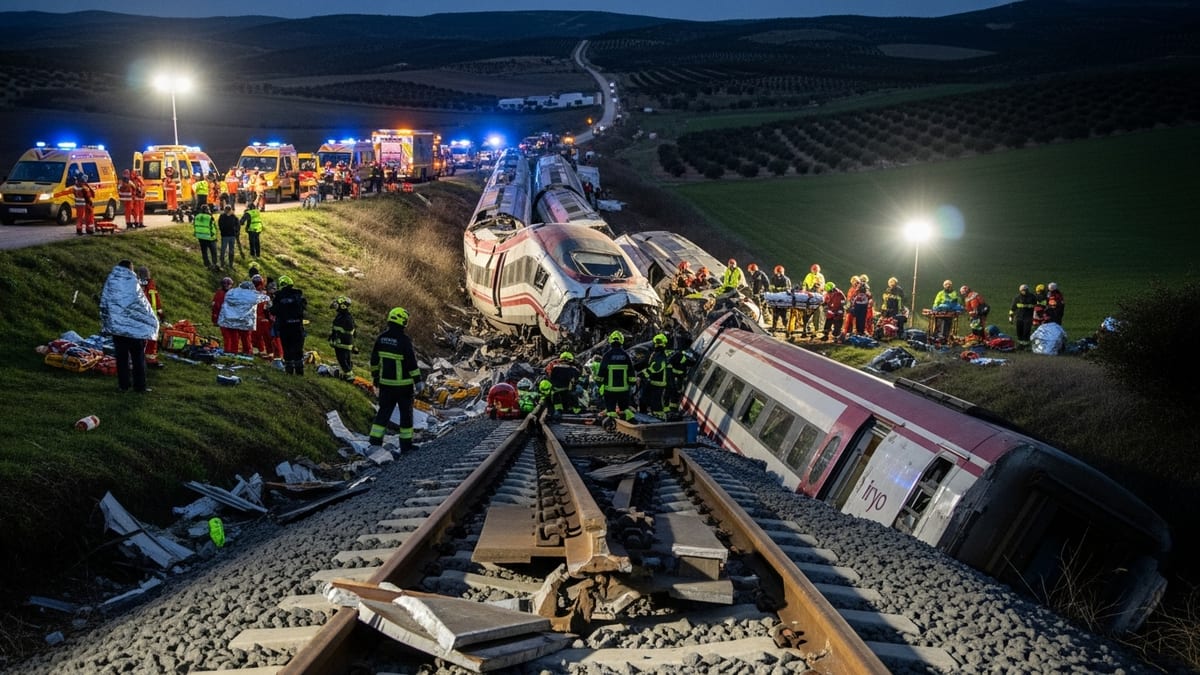
The Adamuz crash on 18 January 2026 involved a high speed Iryo service on the Madrid Seville corridor and a Renfe train on the parallel conventional line near the town of Adamuz in Córdoba province. The rear cars of the Iryo train derailed and collided with the oncoming service, resulting in dozens of fatalities and many more injuries, according to early official tallies reported in national and international media.
Publicly available coverage of the technical work points to the Commission for the Investigation of Railway Accidents, known by its Spanish initials CIAF, as the lead body for the independent safety investigation. While a judicial inquiry in Córdoba is examining potential liabilities, CIAF’s mandate is to determine causes and issue safety recommendations to prevent similar events.
Preliminary documentation and media summaries indicate that investigators rapidly focused on the state of the infrastructure at the time of the derailment. Attention centered on a fractured rail in the high speed track, as well as on the performance of track monitoring systems and maintenance regimes on a section that had been refurbished relatively recently.
In the months since the crash, CIAF has gathered data from the trains’ recorders, trackside equipment, maintenance records and inspection logs. However, recent Spanish press reporting indicates that this work is far from complete and that the final findings will not be ready in the short term.
Rail fracture remains central hypothesis
From the first week after the disaster, a break in the rail on the high speed line has been described in open sources as the most likely immediate trigger for the derailment. A preliminary CIAF note, summarized by public broadcasters and major newspapers, pointed to a section of rail with a significant fracture as the focal point of the analysis.
According to these accounts, investigators are working on the hypothesis that the rail was already cracked before the Iryo train passed, and that the defect propagated to full failure under load, causing the last cars of the train to leave the track. Reports also indicate that investigators are studying whether a defect in a weld or joint may have contributed to the break, and whether any component of the rolling stock could have struck the rail in the moments before the collapse.
Further questions being explored in parliamentary documents and media coverage include how the rail condition related to the broader configuration of the line. Coverage from Spanish outlets has highlighted the presence of both a high speed and a conventional track in close proximity at the accident site, prompting technical discussion about whether detection systems, inspection intervals and maintenance standards for each line were sufficient to identify a developing fracture.
Specialist rail media and national newspapers report that CIAF plans to conduct detailed metallurgical examinations of recovered rail sections and other components in laboratory conditions. Those tests are expected to be time consuming, contributing to the projection that the investigation will continue for several months more.
Staffing pressures slow progress
In mid July, six months after the crash, Spanish radio and press outlets published details of a letter from the director of the Adamuz investigation to the head of Spain’s overarching technical accident investigation authority. According to those reports, the investigator warned that a shortage of staff and resources within CIAF was compromising the progress and depth of the inquiry.
The correspondence, as described in this coverage, characterizes the situation as serious and cautions that, without additional personnel, the commission will struggle to complete the Adamuz case with the rigor and within the timeframe that such a major disaster demands. The letter has drawn renewed attention to long running concerns about resourcing levels for Spain’s rail safety investigations.
Media reports on this exchange indicate that CIAF is juggling multiple open cases while also responding to the heightened public and political interest generated by the Adamuz crash. The board’s limited pool of specialized engineers and analysts must share time between field inspections, laboratory coordination, data analysis and drafting of interim and final reports.
These constraints help explain why observers now expect the Adamuz report to remain in preparation for several months. Commentators in transport and legal circles note that complex railway accident investigations routinely extend beyond a year, especially where laboratory tests, component reconstructions and validation exercises are required.
Judicial and political scrutiny alongside technical work
The CIAF inquiry is only one strand of the wider response to the Adamuz disaster. According to press summaries of judicial proceedings, a court in the Córdoba area opened a criminal investigation shortly after the crash to determine possible responsibilities. That process is proceeding in parallel with the technical work, drawing on some of the same evidence but pursuing different objectives.
Parliamentary activity in Madrid and in the Spanish Senate has intensified the focus on how the Adamuz line was maintained and supervised. Written questions submitted by opposition lawmakers, published on the Senate’s official platform, request detailed explanations about the configuration of the affected section, the timetable and results of recent inspections, and any prior warnings from train drivers or maintenance crews.
Public documents and media reporting indicate that lawmakers are also asking whether the Ministry of Transport has requested interim updates from CIAF, infrastructure manager Adif or operators involved in the crash. These questions reflect a broader concern about oversight of high speed and conventional rail lines and the mechanisms in place to identify weaknesses before they lead to accidents.
The combination of court proceedings, parliamentary inquiries and the CIAF investigation ensures that Adamuz will remain prominent in Spain’s public debate. Analysts suggest that the eventual technical conclusions are likely to inform not only potential legal outcomes but also any reforms to rail safety policy.
Implications for rail safety and future travel
The expectation that CIAF’s Adamuz investigation will take several more months underscores the complexity of modern rail safety work. For travelers, publicly available information indicates that services on the Madrid Seville route have already resumed, following infrastructure repairs and testing carried out in the weeks after the crash. However, the definitive assessment of what went wrong and how similar events can be prevented lies in the still unfinished technical report.
Experts quoted in Spanish media emphasize that such reports typically go beyond identifying a single cause. They analyze organizational practices, maintenance planning, training, communication protocols and the performance of safety systems. The Adamuz case is expected to follow this pattern, with recommendations potentially touching infrastructure monitoring technology, inspection intervals and the coordination between infrastructure managers and train operators.
For the wider travel industry, the ongoing investigation is a reminder that major accidents can have long term effects on public confidence and on regulatory frameworks. Operators and infrastructure managers across Europe are likely to watch the outcome closely, particularly if CIAF identifies systemic vulnerabilities in the way rail fractures are detected and managed on busy mixed traffic corridors.
Until the final report is published, international travelers heading to or through Spain will see few visible signs of the work under way beyond normal rail operations. Yet behind the scenes, the Adamuz case is shaping months of intensive analysis and debate, with the CIAF investigation now clearly set to extend well beyond the first anniversary of the crash.