


More news on this day
Low clouds and shifting winds over San Francisco International Airport on Friday led to extensive air traffic disruptions, as ground delay programs rippled through the national network and affected hundreds of arriving and departing flights.
Get the latest news straight to your inbox!
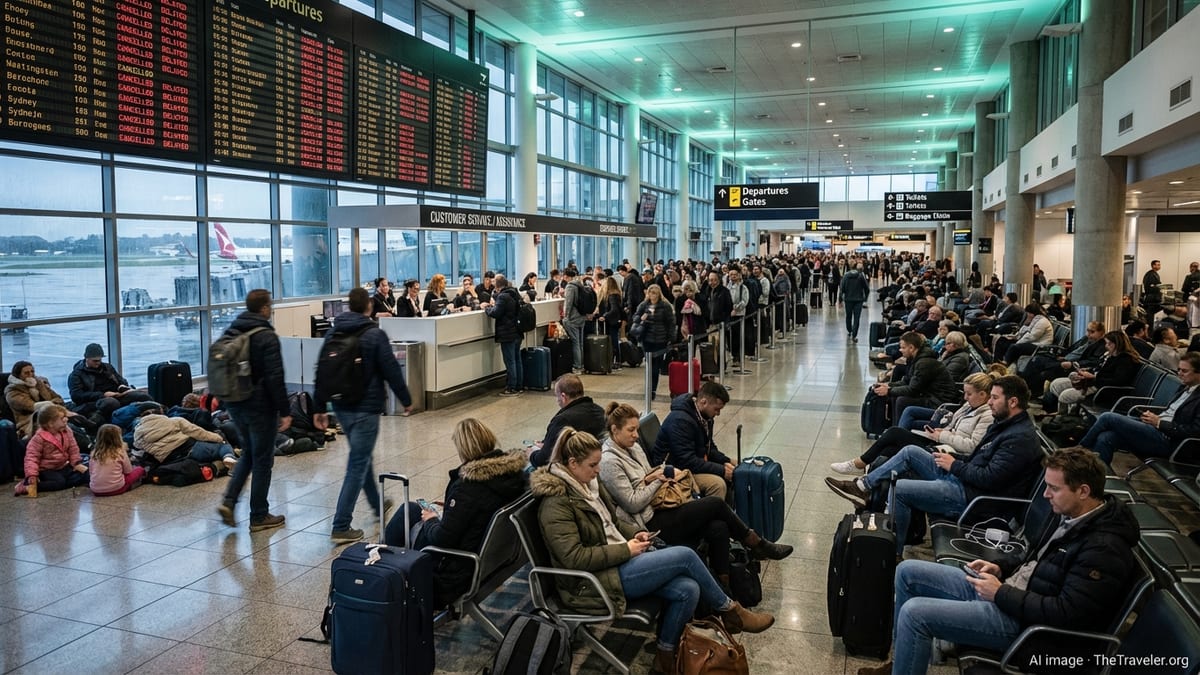
Ground Delay Programs Slow Traffic Into the Bay Area
Publicly available data from the Federal Aviation Administration shows that San Francisco International Airport has been operating under ground delay measures as a bank of coastal clouds and reduced ceilings moved across the Peninsula. These programs limit the number of aircraft allowed to arrive per hour, forcing airlines to hold departures at origin airports and to pad flight times into SFO.
FAA national airspace status boards for Thursday and Friday indicate that SFO was placed into at least one formal ground delay period, with average arrival delays near an hour during peak windows as traffic was metered into the airport. Recent FAA briefings and industry bulletins describe similar SFO initiatives through May, frequently citing low ceilings, fog and “other” weather-related capacity constraints as the cause.
Arrivals data from aviation tracking services for Thursday evening and early Friday show long strings of flights into SFO with delays of 30 minutes or more, alongside a smaller number of cancellations. The pattern reflects a common West Coast scenario where seemingly benign low clouds off the ocean reduce visibility and force controllers to space aircraft further apart on final approach.
Local coverage from Bay Area outlets also points to shifting winds across San Francisco Bay, which can complicate runway use and contribute to flow restrictions. With runway capacity temporarily constrained, any additional bottlenecks elsewhere in the system quickly translate into missed connections and rolling delays for SFO-bound travelers.
Hundreds of Flights Affected Across Domestic and International Routes
While precise systemwide totals fluctuate by the hour, schedules and tracker snapshots on Friday morning and midday suggested that several hundred flights connected to SFO were impacted in some way, from modest departure holds to outright cancellations. The effect extended beyond the Bay Area as aircraft bound for SFO were slowed or held at hubs in the Rocky Mountains, the Pacific Northwest and along the West Coast.
Earlier in May, transportation analytics briefings had already flagged SFO as a recurring source of delay, highlighting multi-hour ground delay programs and average waits of about an hour when low clouds rolled in. Friday’s disruption followed a familiar pattern, reinforcing SFO’s reputation among frequent flyers as an airport where marine layer conditions can quickly cascade through the schedule.
Because SFO is a major gateway for transpacific and cross-country services, the knock-on effects reached far beyond California. Flight-status boards for long-haul routes showed a mix of delayed departures and retimed arrivals, in some cases pushing late-night inbound services into the early hours. Regional feeders to and from Northern California and the Pacific Northwest also showed clusters of late operations as aircraft waited for landing slots to open.
Travel forums devoted to San Francisco and airline operations have, in recent weeks, described ground delay programs at SFO as an almost daily feature of the spring schedule. Contributors point to a combination of high traffic volumes, complex approach procedures and weather-sensitive runway alignments that leave the airport particularly vulnerable when ceilings drop.
Why Low Clouds Cause Outsized Disruption at SFO
Although Friday’s delays were linked to a relatively routine marine cloud deck, SFO’s geography and runway layout magnify the operational impact. The airport’s two main landing runways sit close together, and aviation studies note that low ceilings and reduced visibility can prevent the use of simultaneous side-by-side approaches. When that happens, controllers must stagger arrivals, sharply cutting the number of aircraft that can land each hour.
Historical research on SFO’s approach zone shows that from late spring into early autumn, shallow marine layers often produce low cloud ceilings along the Peninsula and over San Francisco Bay. Even when surface conditions seem only mildly gray to airport visitors, those cloud layers can sit right in the path of arriving aircraft, forcing more conservative spacing and routing. The result is that a modest reduction in visibility sometimes leads to a disproportionately large reduction in capacity.
Recent FAA and airport-related documents have also referenced construction and other structural constraints that temporarily limit runway configurations and further reduce flexibility during marginal weather. When capacity is already tight, the addition of a ground delay program means that delays can build quickly through successive departure banks at distant hubs feeding SFO.
Industry briefings this month compared SFO’s low-cloud disruptions with similar challenges at major East Coast airports when low ceilings move in. In each case, planners have little choice but to meter traffic, trading on-time performance for a more orderly and predictable flow of arrivals under constrained conditions.
Traveler Experience: Longer Lines, Missed Connections and Rebookings
For passengers, Friday’s weather-driven slowdown translated into longer waits at gates and check-in counters, as well as crowding around rebooking desks when connection windows disappeared. With arrival slots at SFO rationed by ground delay programs, even flights that departed roughly on time from other cities often found themselves circling or queued on approaches, ultimately reaching gates well behind schedule.
Airline mobile apps and online trackers showed rolling estimates for SFO-bound flights throughout the day, with some departure times repeatedly pushed back in 15- or 30-minute increments as updated flow-control data came in. Travelers with tight connections through SFO, particularly those heading to regional destinations in California and the Pacific Northwest, faced elevated risks of misconnecting and being re-accommodated on later departures.
Social media posts and discussion threads on Friday morning described packed gate areas at SFO terminals, with passengers waiting for delayed inbound aircraft to arrive from other parts of the country. Some travelers reported that crew duty-time limits added another layer of complexity, leading to aircraft waiting on replacement crews even after weather-related restrictions began to ease.
Consumer advocates regularly advise passengers flying through SFO during low-cloud and fog season to build longer connection buffers into their itineraries and to monitor flight-status tools closely in the 24 hours before departure. The pattern observed on Friday aligned with that guidance, as those with flexible schedules and backup options appeared to navigate the disruption more smoothly.
Outlook for the Weekend and Summer Travel Season
Forecast discussions for the Bay Area indicate that marine clouds are likely to remain a feature of the region’s weather in the days ahead, although the exact impact on SFO operations will depend on how low ceilings descend and how winds line up with the runways. Time-of-day effects are also critical, with early-morning and late-evening arrival banks typically the most sensitive to cloud height and visibility.
Recent SFO planning documents and bond disclosures have acknowledged that, through at least early autumn, a combination of runway work and evolving air-traffic procedures could keep the airport’s effective capacity below historical norms during certain weather regimes. If that pattern persists into the peak summer travel season, ground delay programs during cloudy periods may remain relatively common.
Industry observers note that airlines have some tools to adapt, including adjusting schedules, adding extra time into block schedules for SFO turns and proactively issuing travel waivers when multi-hour flow restrictions are forecast. However, the experience of this week’s cloudy-day disruption underscores that even modest weather systems can have outsize effects at one of the West Coast’s busiest international gateways.
For travelers with upcoming trips through San Francisco, the latest round of delays serves as a reminder to plan for contingencies, keep a close eye on evolving conditions and allow additional time whenever the marine layer is in the forecast.