


More news on this day
Colorado Springs Airport remained strikingly calm on the day before Thanksgiving, with short security lines and mostly on-time departures, even as AAA forecast tens of millions of Americans on the move nationwide for the 2026 holiday period.
Get the latest news straight to your inbox!
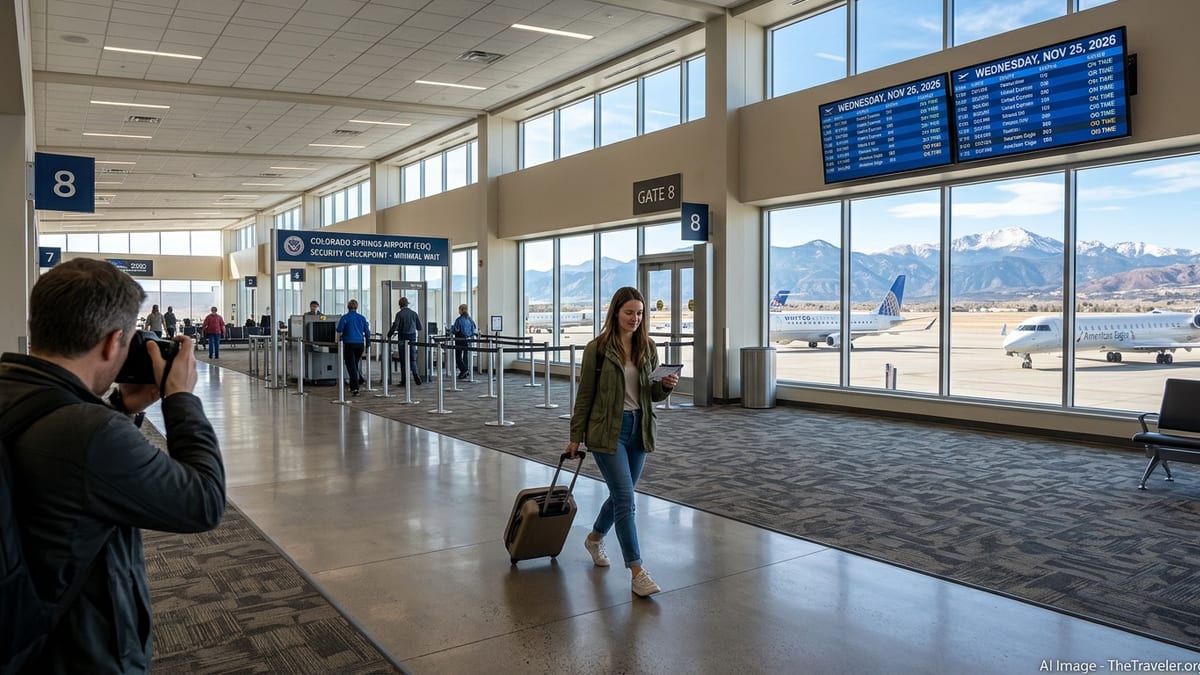
A quiet airport on one of the year’s busiest travel days
On Wednesday, November 25, the day before Thanksgiving in 2026, Colorado Springs Airport reported smooth operations, with passengers moving quickly through security and only minor schedule disruptions. Local broadcaster KRDO, which visited the terminal that afternoon, found sparse queues at Transportation Security Administration (TSA) checkpoints, easy bag drop-offs and only a handful of departures delayed by about 10 minutes, a picture consistent with live departure boards for the airport that showed no major disruptions.
The scene in Colorado Springs contrasted with images from many larger U.S. hubs, where airlines and federal officials had been preparing for one of the busiest travel days of the year. Nationally, flight-tracking and federal screening data pointed to heavy airport traffic, but at Colorado Springs, a smaller regional facility that typically handles about 1.3 million departing passengers a year, passenger volumes appeared manageable and the atmosphere subdued compared with peak-holiday crowds at major hubs.
The calm at Colorado Springs does not indicate a collapse in local demand so much as the airport’s smaller scale, a limited number of daily departures and a holiday travel pattern that is spread over several days. Airport traffic data and regional forecasts ahead of Thanksgiving indicated that the facility expected a busy week overall, but with passenger volumes comparable to last year and without a single overwhelming surge on the Wednesday before the holiday.
National forecast: Slight dip in Thanksgiving travel, cars still dominate
The relatively relaxed conditions in Colorado Springs came against the backdrop of a broad national travel forecast from AAA that pointed to a modest pullback in Thanksgiving trips for 2026. The motor club projected that about 81.5 million Americans would travel at least 50 miles from home during the Thanksgiving period, defined as the six days from Tuesday through the Monday after the holiday. That represents a decline of roughly 0.1 percent from the estimated 81.6 million travelers in 2025, ending a three-year streak of record Thanksgiving travel that began in 2023.
Cars remained the dominant way Americans moved over the holiday. AAA’s breakdown indicated that about 72.9 million people were expected to travel by automobile, accounting for nearly 90 percent of all Thanksgiving trips. By comparison, nearly 6 million travelers were forecast to fly on domestic routes during the holiday period, with another 2.6 million using buses, trains or cruise ships. These projections suggested that while airports would be busy, most congestion and delays were likely to be felt on highways and at roadside services rather than at security checkpoints.
AAA’s national outlook also highlighted that, despite the slight dip in total travelers, congestion remained a concern for drivers, particularly on the Tuesday and Wednesday before Thanksgiving and on the Sunday return. Traffic data providers working with the motor club identified midafternoon into early evening as the most congested window on many metropolitan routes, as commuter traffic merged with long-distance holiday trips. For motorists in Colorado and elsewhere, the advice was to travel early in the day or outside peak periods where possible.
Colorado Springs traffic expectations and how COS fits into Colorado’s network
Within Colorado, Colorado Springs Airport plays a secondary but important role alongside Denver International Airport, the state’s major hub. FAA data for 2024 showed that Colorado Springs handled about 1.25 million commercial passenger boardings that year, classifying it as a small-hub primary airport and placing its annual volumes far below Denver’s, which exceeded 82 million total passengers in 2025. More recent modeled data through October 2026 indicated that Colorado Springs screened roughly 1.3 million departing passengers in the preceding 12 months, a decline of about 1.4 percent compared with the prior year, suggesting broadly stable but not rapidly growing demand.
Local reporting ahead of the 2026 Thanksgiving period indicated that airport officials in Colorado Springs were preparing for a busy week similar to last year’s holiday pattern, without expecting record numbers. The airport typically processes about 2.4 million passengers annually, counting both arrivals and departures, a scale that allows it to operate without the prolonged security lines and gate-area crowding seen at larger hubs during national travel peaks. For Thanksgiving week specifically, local forecasts pointed to traffic remaining fairly even across most days, with a noticeable dip on Thanksgiving Day itself and the heaviest loads concentrated on the Sunday return.
Regional coverage also noted that, across Colorado, more travelers have been turning to bus and rail options for holiday journeys, although these shifts are from a relatively small base and do not drastically alter airport volumes. For Colorado Springs Airport, the main practical implication is that it can plan for consistent, moderate passenger flows through the week rather than a single overwhelming wave, helping to keep wait times shorter even during a national travel rush.
Why Colorado Springs can feel calm when other airports feel chaotic
Several structural factors help explain why passengers at Colorado Springs often describe the airport as “oddly” or “eerily” calm at times when national travel headlines focus on packed terminals elsewhere. The first is scale. With only a fraction of the passenger throughput of major hub airports, Colorado Springs has fewer flights and more space per traveler in its concourses and public areas. This tends to keep queues shorter, especially outside the busiest departure banks in the early morning and late afternoon.
Second, Colorado Springs primarily serves origin and destination traffic rather than connecting passengers. That means the airport is less vulnerable to cascading disruptions when weather or technology problems affect distant parts of the national network. While Denver International and other hub airports can quickly accumulate long lines and stranded travelers as missed connections ripple through their schedules, Colorado Springs typically sees impacts in the form of individual delays or cancellations on specific routes rather than wholesale crowding across the terminal.
Finally, Colorado Springs sits within driving distance of Denver, and many price-sensitive travelers in the region opt to begin their trips at Denver International when fares there are markedly lower or nonstop options more plentiful. This dynamic shifts a portion of potential peak-holiday demand away from Colorado Springs, leaving the municipal airport serving a smaller, often more local customer base. Anecdotal accounts from frequent flyers in the area, stretching back over several Thanksgiving seasons, describe the Colorado Springs terminal as generally uncrowded and security screening as rarely exceeding 10 to 20 minutes, conditions that appeared to hold on the day before Thanksgiving in 2026.
Implications for travelers and what to watch for through the holiday weekend
For travelers using Colorado Springs Airport over Thanksgiving, the 2026 experience so far suggests that arriving at the terminal the standard 90 minutes to two hours before domestic departure should remain sufficient in most cases, even during the peak days. On the Wednesday before Thanksgiving, passengers reported breezing through security and check-in processes and in some cases finding themselves at the gate much earlier than needed. However, while conditions were calm locally, airlines still recommended that passengers follow their standard guidance on arrival times and allow extra margin if traveling with checked baggage, young children or passengers who require assistance.
Looking ahead to the remainder of the holiday period, national patterns indicate that the Sunday after Thanksgiving is likely to be the single busiest day for U.S. air travel, including at smaller airports like Colorado Springs. Travelers booked on Sunday flights should pay close attention to their airline’s notifications and to weather forecasts along their route, since storms in other parts of the country can disrupt aircraft rotations and crew schedules even if skies are clear over Colorado. As of Thanksgiving eve, Colorado Springs departures were largely running on time, but this situation can change quickly during a systemwide travel surge.
On the roads, AAA’s projections underscore that most congestion and delays will occur on highways rather than at airports, with 72.9 million Americans expected to drive for Thanksgiving 2026. In Colorado, motorists were advised to build in extra time for interstate routes and popular mountain corridors, to check state transportation advisories for weather-related restrictions and to ensure vehicles are road-ready. AAA also emphasized that many roadside assistance calls during the holiday period involve avoidable issues, such as drivers locking their keys in their cars, a reminder that slowing down and double-checking before departure can prevent delays that have nothing to do with traffic or weather.
For anyone still planning travel over the Thanksgiving weekend, the overarching message from both national and local data is to verify conditions close to departure. That includes checking live flight status through airline apps or airport websites, monitoring TSA and local security advisories, and reviewing route-specific driving forecasts. While Colorado Springs Airport began the holiday rush in an unusually calm state, travelers should continue to prepare for typical peak-season uncertainties and build flexible time into their plans through the Monday after Thanksgiving.