


More news on this day
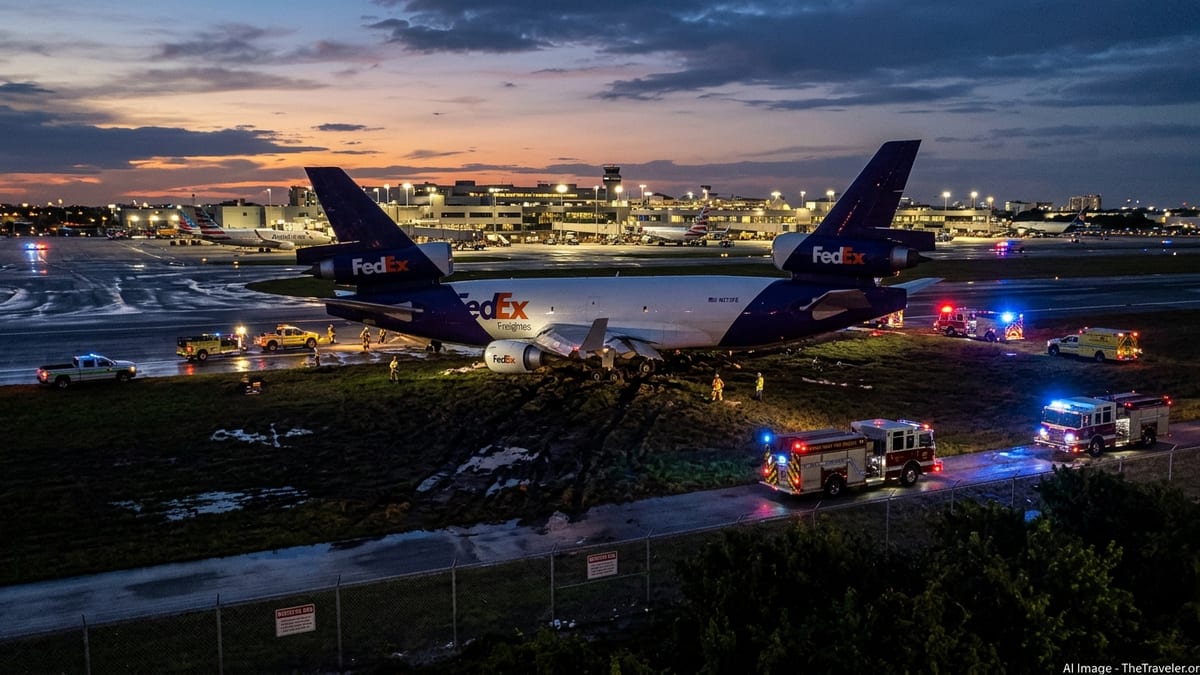
A FedEx Express MD-11 freighter arriving from Memphis overran a runway at Miami International Airport on the evening of November 25, 2026, forcing the temporary closure of all but one runway, triggering a ground stop for inbound flights and causing widespread delays for passengers traveling on one of the busiest nights of the Thanksgiving period, according to airport officials and federal regulators.
Get the latest news straight to your inbox!
What happened to FedEx Flight 910 at Miami
According to the Federal Aviation Administration, the incident involved FedEx Flight 910, a McDonnell Douglas MD-11 freighter arriving from FedEx’s main hub at Frederick W. Smith International Airport in Memphis, Tennessee. The aircraft landed on Runway 26R at Miami International Airport at around 8:40 p.m. local time on Wednesday, November 25, when it failed to stop within the paved surface and overran the end of the runway.
Images and video from the scene, as well as descriptions from local media, show the aircraft coming to rest beyond the runway safety area near the airport perimeter. The Miami-Dade Aviation Department confirmed that the jet left the runway after landing and that airport fire-rescue units and other emergency services responded. Authorities reported no injuries to the flight crew or people on the ground, and there was no immediate indication of fire.
FedEx confirmed the incident and said the crew exited the aircraft safely. In a brief written statement, the cargo carrier said the aircraft “experienced an issue upon landing” at Miami and that it was cooperating with authorities. The company did not provide additional details about any structural damage to the plane, which remained disabled at the airport into the night while recovery planning was underway.
Runway closures, ground stop and how operations were affected
The disabled freighter blocked critical infrastructure at Miami International, prompting air traffic control to sharply reduce the airport’s capacity at a peak holiday travel period. An FAA advisory from the Air Traffic Control System Command Center placed a ground stop on flights bound for Miami beginning at 8:16 p.m., meaning departures from other airports headed to MIA were temporarily held at their origin rather than allowed to take off and join arrival flows.
During the response, airport officials said all but one runway were taken out of service. Runway 26R, where the FedEx jet overran, was closed while emergency crews secured the scene and engineers evaluated pavement and lighting. Other nearby taxiways were also restricted, further constraining operations. One remaining runway continued to handle a limited number of takeoffs and landings, but at a significantly reduced rate compared with normal evening schedules at the busy international hub.
Flight tracking and FAA planning data for Wednesday night show that the disruption quickly translated into extensive delays. Advisories cited the disabled aircraft, runway and taxiway conditions and weather in the region as primary causes. Estimates from federal traffic management documents and airport communications indicate that more than a thousand flights in and out of Miami experienced some level of delay, with average delays in the 40 to 50 minute range at the height of the disruption and the longest exceeding one to two hours for some departures and arrivals.
Impact on travelers during the Thanksgiving rush
The incident occurred on the eve of Thanksgiving, one of the busiest air travel days of the year in the United States, when Miami International was already handling heavy passenger volumes. The timing magnified the effect of the runway closure on commercial travelers even though the incident involved a cargo aircraft with no passengers on board.
Miami International Airport urged anyone scheduled to travel on Wednesday night to check directly with their airline before coming to the terminal. Local broadcasters showed crowded gate areas and long lines at departure counters as airlines worked to re-time flights around the reduced arrival and departure capacity. Some flights diverted to alternate South Florida airports during the ground stop window, while others held at origin or experienced extended taxi-out times as carriers sequenced departures into available slots.
By later in the evening, officials said operations were gradually recovering as the ground stop ended and the remaining runway handled an increased number of movements. However, knock-on effects were expected to persist into the late-night and early Thursday morning periods, as aircraft and crews remained out of position and airlines adjusted their schedules. Travelers booked through Miami around the time of the incident were advised that even once the ground stop lifted, residual delays and occasional cancellations could continue while the airport worked back toward normal throughput.
Safety investigation and relation to earlier Miami cargo overrun
The National Transportation Safety Board opened an investigation into the runway excursion, standard practice for a significant incident involving a large transport-category aircraft at a major U.S. airport. Investigators are expected to review flight data and cockpit voice recordings, examine the aircraft’s braking and landing systems and analyze weather, runway surface conditions and air traffic control instructions at the time of landing.
Early local reports noted that the greater Miami area had been under heavy rain and a flood watch on Wednesday, with wet runway conditions possible at the time of the landing. As of the latest official updates, neither the FAA nor the NTSB has identified a specific cause or contributing factor, and authorities have not released a detailed account of crew actions on final approach and rollout. Any information about the condition of the braking system, touchdown point or use of reverse thrust will likely appear later in preliminary findings, typically issued days to weeks after an event.
Airport and industry observers also pointed out that this is the second serious cargo runway excursion at Miami International in less than three months. On September 6, 2026, 21 Air Flight 7598, a Boeing 767-300 operating on behalf of Amazon’s Prime Air, overran Runway 30 after landing, coming to rest beyond the airport boundary and causing fatalities and significant damage. In that earlier case, preliminary NTSB documents have highlighted factors including tailwind conditions and runway state. The FedEx MD-11, however, landed on Runway 26R rather than Runway 30, and investigators have not suggested that the two events share a common cause. For now, regulators are treating them as separate accidents at the same airport pending further analysis.
What travelers should do now and what to expect next
By Thursday morning, Miami International Airport and the FAA reported that operations were stabilizing, with the ground stop lifted and airlines resuming regular departures and arrivals using available runways. Nevertheless, the presence of the disabled FedEx aircraft and ongoing inspections meant that some parts of the airfield remained restricted, and the airport cautioned that delays could continue as airlines worked through backlogs and repositioned aircraft and crews.
Passengers traveling through Miami in the hours and days after the incident should not assume schedules have fully normalized. Because the overrun occurred amid broader pre-Thanksgiving congestion and unsettled weather across parts of the United States, it may take time for carriers to restore their normal rotations. Travelers connecting through MIA are advised to monitor airline apps, text alerts and departure boards closely, allow extra time for security and check-in and be prepared for gate or timing changes, particularly on evening and early morning flights when recovery operations are often concentrated.
For now, the key facts for travelers are that no injuries resulted from the FedEx runway excursion, the immediate safety risk to passengers at the airport has been contained, and the remaining runway infrastructure is supporting ongoing operations at reduced but improving capacity. As the NTSB’s investigation progresses, regulators may issue safety recommendations related to approach procedures, runway condition reporting or airfield design. Any such changes would be implemented over time and are not expected to have an immediate visible impact on the experience of most travelers passing through Miami, beyond the temporary disruption already felt on the night of November 25.