


More news on this day
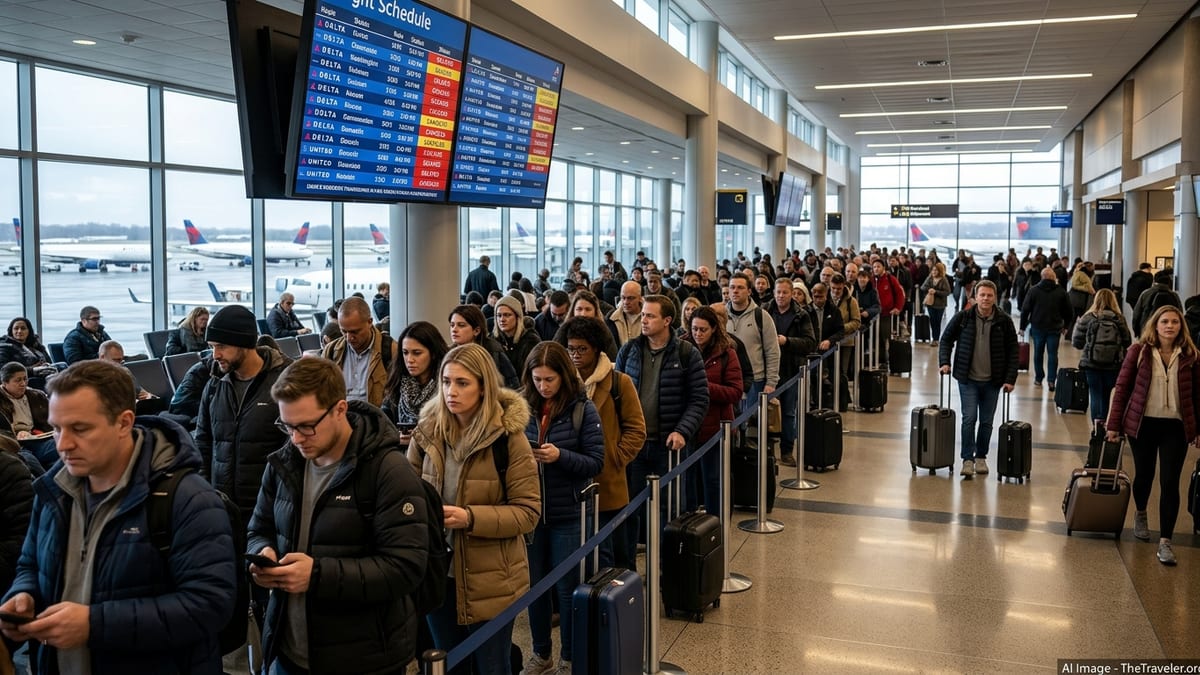
As millions of Americans fly for Thanksgiving 2026 amid stormy weather, lingering technology glitches and recent nationwide disruptions, travel experts and regulators are stressing that what passengers do in the first minutes of a delay or cancellation can determine whether they make it home for the holiday or spend it in an airport. Knowing how to rebook quickly and when U.S. rules require a refund or other help is particularly important this year, as airlines brace for one of the busiest and most disruption‑prone travel periods since the pandemic.
Get the latest news straight to your inbox!
Why Thanksgiving 2026 air travel is especially fragile
Thanksgiving week is always one of the busiest travel periods in the United States, but several developments in November 2026 have made this year’s operations more fragile. A historic nationwide ground stop earlier in the month triggered widespread cancellations and knock-on delays just days before the holiday. Separate automation and technology issues at major airlines, including Delta and United, then added further disruption as carriers worked to reset their schedules ahead of the peak travel window.
At the same time, forecasters and transportation officials have warned that unsettled weather could disrupt operations at multiple points in the system. Storms and coastal flooding risks have been highlighted for parts of the Northeast and Pacific Northwest in the days around Thanksgiving, alongside snow and rain in sections of the Midwest. These conditions increase the chances of air-traffic flow restrictions, ground delays and weather-related cancellations that generally do not trigger compensation for hotels or meals from airlines, even as they leave aircraft and crews out of position for subsequent flights.
By Wednesday 25 November, one of the busiest getaway days, flight-tracking services were already reporting thousands of delays across the domestic network and a smaller number of cancellations, with officials warning that the heaviest strain could come on the Saturday and Sunday return rush. Against that backdrop, travel commentator Katy Nastro, who appears regularly on ABC News to discuss disruptions, has been emphasizing practical steps passengers can take in real time when their Thanksgiving flights run into trouble, and how to use existing U.S. Department of Transportation rules to secure refunds in some situations.
First steps when your flight is delayed or canceled
When a Thanksgiving flight is canceled or faces a substantial delay, speed is crucial because alternative seats can disappear within minutes on peak days. U.S. travel experts consistently recommend pursuing several channels at once: using the airline’s mobile app or website to look for self-service rebooking options, standing in line at the airport service desk if you are already airside, and calling the carrier’s reservation number, which may connect you to an agent able to access different inventory. Passengers traveling in groups are often advised to designate one person to queue in person while others work phones and apps.
On particularly busy days such as the Wednesday before Thanksgiving or the Sunday after, it can be worth asking agents to look at nearby airports as well as alternative routings. A traveler booked into a congested hub may sometimes be rebooked via a secondary airport if there are seats and crews available. Some airlines will also transfer passengers to another carrier in the case of disruptions they consider controllable, but this is a matter of policy rather than a legal requirement and varies by airline and situation.
If a delay extends for several hours, or if a cancellation means an unexpected overnight, passengers should find out immediately whether the disruption is considered within the airline’s control, such as crew or mechanical issues, or whether it is attributed to weather or broader air-traffic system constraints. That distinction often determines whether the carrier offers hotel vouchers, meal credits or other assistance on a voluntary basis. While there is no U.S. law that compels airlines to provide such amenities for domestic flights, many have published customer service commitments that go beyond the minimum legal standard and can be checked in real time.
What U.S. travelers are legally entitled to receive
In the United States, the clearest legal protection for airline passengers facing disruption is the right to a refund when a flight is canceled or significantly changed and the traveler chooses not to fly. Under U.S. Department of Transportation rules and enforcement guidance, if an airline cancels a flight for any reason, or makes a schedule change or delay that is considered significant, passengers who decide not to travel are generally entitled to have the full cost of the unused transportation returned to the original form of payment. That includes the fare, taxes and many paid extras such as seat selection or checked baggage fees tied to the canceled segment.
The exact threshold for what counts as a significant schedule change or delay is defined in DOT regulations and enforcement policy rather than by each airline. For domestic routes, authorities have pointed to delays of several hours as a benchmark, although the precise treatment can depend on the circumstances and how the change is characterized by the airline. Importantly, accepting a travel credit, future voucher or frequent flyer miles instead of a cash refund is usually optional; travelers who prefer money back can insist on a refund if they qualify under the applicable rules.
Separate from refund rights, DOT has created a public Airline Cancellation and Delay Dashboard that summarizes what major U.S. airlines have committed to provide voluntarily during controllable disruptions. For example, many large carriers pledge to offer meal vouchers after specific delay thresholds caused by issues such as maintenance or crew shortages, and hotel accommodation if a passenger is stranded overnight for reasons within the airline’s control. These commitments do not generally apply to weather-related disruptions, air-traffic control initiatives or other events categorized as outside the carrier’s control, and the dashboard is designed as a comparison and accountability tool rather than a new legal regime.
When storms and system outages limit compensation options
Thanksgiving 2026 travelers are confronting not only routine winter weather but also the after-effects of system outages that rippled through airline networks in the days before the holiday. Ground stops and automation failures have contributed to crews and aircraft being out of position, which in turn can cause cancellations and rolling delays even after the original technical issue has been resolved. In practice, that can leave passengers affected by a tangle of causes that are not always easy to separate.
From a passenger rights perspective, however, the cause matters a great deal. U.S. carriers typically classify weather, air-traffic control constraints and certain infrastructure failures as outside their control, and in those cases they often limit assistance to reaccommodation on the next available flight. Hotels and meals in such scenarios are usually at the traveler’s own expense, although some passengers may recoup costs through third-party travel insurance or credit cards that include trip delay and interruption coverage as a benefit. Policy documents for those products typically spell out minimum delay thresholds and covered events, and experts suggest checking them before incurring large expenses.
By contrast, when disruptions are attributed to purely internal issues such as crew scheduling, mechanical problems or certain technology failures confined to the airline’s own systems, more generous support may be available under published customer service plans. In the wake of several high-profile meltdowns in recent years, DOT has pressured airlines to expand these commitments and has brought enforcement actions where carriers failed to issue refunds or provide promised amenities. For passengers, that means carefully documenting the airline’s explanation for a disruption, saving receipts for out-of-pocket expenses, and, if necessary, filing a complaint with DOT if they believe a carrier has not honored its own policies or federal refund rules.
Practical strategies to reduce disruption risk this holiday week
While individual travelers cannot control weather systems or nationwide technology outages, certain booking and day-of-travel decisions can materially reduce the chance of spending Thanksgiving stranded. Federal guidance notes that early-morning departures are statistically less likely to be delayed than later flights, partly because they are less exposed to the cumulative knock-on effects of earlier disruptions. Nonstop flights remove one potential point of failure compared with connections, and choosing larger hubs with multiple daily frequencies can give travelers more options if something does go wrong.
Experts also highlight the value of monitoring flight status and airport conditions in real time during Thanksgiving week. Several services aggregate Federal Aviation Administration ground stop and delay program information by airport, giving passengers an early signal that operations are deteriorating at a particular hub. Keeping an eye on storms along the route, not just at the departure and arrival airports, can also indicate whether flow-control measures may be introduced. That information can help flyers decide whether to move to an earlier departure, adjust their routing or, in some cases, switch to driving on shorter routes if seats become scarce.
For those who still have flexibility, certain travel days may offer marginally lower risk. Historical data and recent analyses suggest that the day of Thanksgiving itself often sees fewer cancellations and a slightly lower share of delayed flights than the Wednesday before or the Sunday after, when volumes peak and small disruptions can quickly cascade. However, choosing to fly on Thanksgiving Day is not a guarantee of a smooth trip, especially in years with active weather patterns, and travelers should still build in extra time for check-in, security and potential gate changes.
What travelers should watch for after Thanksgiving Day
The biggest remaining pinch points for Thanksgiving 2026 air travel are expected from Friday 27 November through Monday 30 November, when millions of passengers return home or head out for the remainder of the holiday weekend. Airlines and regulators will be watching closely for how quickly carriers can recover from any weather-related or technical disruptions earlier in the week, and whether staffing and crew positioning are sufficient to handle the surge. Historically, the Saturday and Sunday after Thanksgiving have produced some of the highest cancellation percentages of the period, and that pattern could repeat if storms or other operational constraints overlap with peak demand.
Travelers with flights in those windows are advised to reconfirm their itineraries a day or two before departure, monitor for schedule changes pushed by email or app notifications, and consider proactive moves such as moving to earlier departures on the same day if severe weather or airport delays appear likely. Several airlines have already issued flexible travel policies or waivers around specific storm systems and regions, allowing passengers to change flights without standard change fees or fare differences in defined date and routing ranges, although the exact details vary by carrier and are subject to update as forecasts evolve.
Looking beyond the Thanksgiving period, federal officials are implementing new reporting rules and refining enforcement tools intended to clarify the causes of delays and cancellations and strengthen refund practices across the industry. Some of those measures, including adjusted definitions for delay categories, are scheduled to take full effect in 2027. For the immediate holiday, however, the most effective protections remain those already on the books: understanding when you can insist on a refund, using the DOT dashboard to compare airlines’ customer service commitments, closely tracking real-time conditions, and reacting quickly when disruption strikes.