


More news on this day
Miami International Airport is handling a heavy Thanksgiving travel surge with mostly manageable disruptions, as weather issues and an overnight runway incident contributed to moderate delays but relatively few cancellations for passengers moving through one of the United States’ busiest holiday gateways.
Get the latest news straight to your inbox!
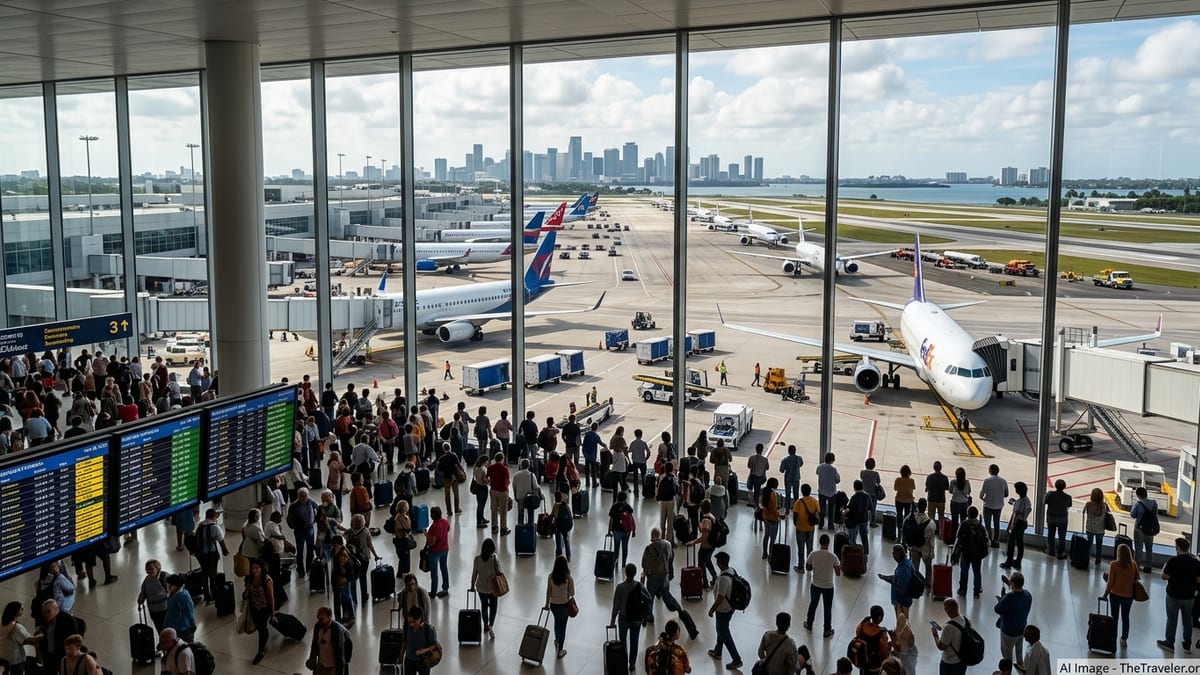
Heavy holiday traffic, but operations continue
Thanksgiving Day on November 26, 2026, finds Miami International Airport operating under strain but not breakdown, as a national holiday travel surge combines with localized factors to slow some journeys without shutting down the hub. Aviation data services tracking the Thanksgiving peak report that Miami is experiencing a significant number of late departures and arrivals, yet the vast majority of scheduled flights are still operating, giving travelers a reasonable chance of reaching South Florida or connecting through it on the holiday itself.
Figures compiled from flight-tracking platforms on Wednesday, November 25, indicate that Miami entered the holiday with an elevated but not extreme level of disruption. Around early afternoon on Thanksgiving Eve, one widely used tracker showed roughly 269 delayed flights and three cancellations at Miami International, compared with more than 200 delays and four cancellations at nearby Fort Lauderdale–Hollywood International Airport. Those numbers pointed to a pattern of congestion and schedule slippage in South Florida, but not a wholesale collapse of service.
The Transportation Security Administration and airport officials had warned earlier in the week that this year’s Thanksgiving period would be one of the busiest in more than a decade, with national forecasts suggesting over 80 million Americans traveling at least 50 miles from home. Miami’s role as both an international gateway and a domestic connection point made it particularly exposed to ripple effects when weather or technical issues disrupted the broader network, but advance planning and staffing appear to have kept most operations moving, if slower than timetables advertised.
Runway overrun, weather and national system strains
Miami’s ability to limit cancellations is notable given a series of stress tests on the air travel system in the days leading up to Thanksgiving. On the night of Wednesday, November 25, a FedEx cargo aircraft arriving from Memphis overran a runway at Miami International. The incident prompted the temporary closure of all but one runway at the airport while emergency services and investigators responded, constraining arrival and departure capacity at a time when airline schedules were already dense for the holiday.
While no widespread ground stop at Miami was ordered purely because of the local incident, the combination of that runway closure with existing congestion led to knock-on delays for some late-evening and overnight flights. FAA planning data also show that Miami was included in a set of airports affected by broader traffic management initiatives this week, including at least one short-lived ground stop period routed through multiple air traffic control centers. These measures were intended to regulate the flow of aircraft into already crowded hubs so that runways, taxiways and gates did not become gridlocked.
Weather has added another layer of complexity. Forecasts for South Florida on Thanksgiving week highlighted the risk of strong winds, heavy rain and even isolated tornadoes on some days, conditions that can slow departures and arrivals or require rerouting of aircraft. Nationally, low cloud ceilings around San Francisco and deteriorating weather in several regions led to delays at other major airports, further tightening flight connections into and out of Miami. Although Miami itself avoided the worst of the country’s storms during the core Thursday holiday period, the interconnected nature of the network meant that upstream delays elsewhere sometimes cascaded into later Miami departures.
Historic context and expectations for the long weekend
For travelers familiar with past Thanksgiving disruptions, this year’s picture at Miami appears mixed but not unprecedented. Over the five Thanksgiving travel periods from 2021 to 2025, historical schedule data analyzed by independent services indicate that just over 7 percent of Miami departures were significantly disrupted, defined as being at least an hour late, canceled or diverted. That rate was modestly higher than the roughly 6.9 percent average in the surrounding non-holiday weeks, reflecting how peak-season crowding tends to magnify any operational problem, even when weather is benign.
Local coverage from recent years suggests Miami has seen both relatively smooth and heavily delayed Thanksgiving travel days. On Thanksgiving in 2025, for example, morning operations were reported to be running with minimal lines and only a few dozen delays. By contrast, post-holiday weekends have sometimes been far more difficult, with more than 200 delays and several dozen cancellations recorded on the Saturday and Sunday as returning travelers converged on a smaller number of departure windows.
National forecasts for 2026 point toward a similar pattern for the days after Thanksgiving. Airlines have loaded dense Sunday and Monday schedules, and industry and government projections indicate that those two days will likely be the busiest for passenger volumes and security screening. Travelers leaving Miami after Thursday’s main holiday should therefore anticipate that even a modest amount of weather or a minor outage in another part of the system could generate quickly worsening delays. While there is no confirmed plan for significant schedule reductions or targeted waivers at Miami beyond the usual weather-related policies, airlines could still adjust operations if conditions deteriorate over the weekend.
How Miami prepared for the Thanksgiving surge
Miami-Dade County and airport management spent much of November signaling that they expected a heavy but manageable holiday season at Miami International. On November 23, county leaders joined airport officials to highlight progress in a long-term, multi-billion-dollar modernization program that includes expanded gates, upgraded security screening lanes and improved passenger circulation. Although these projects are still unfolding over a period of several years, measures already in place are intended to help accommodate peak flows like Thanksgiving with fewer pinch points than in the past.
In media briefings ahead of the holiday, Miami International’s director advised passengers to arrive at least three hours before departure for domestic flights, and even earlier for international journeys. The guidance reflects not only security screening times but also the need to allow for baggage check, potential traffic congestion around the terminals and occasional gate changes as airlines respond to delays. Airport officials have also pointed to investments in new self-service kiosks, upgraded signage and additional customer service staff as tools to help keep long lines moving and reduce confusion when departure boards begin to fill with revised times.
Customs and Border Protection, which manages international arrivals in the federal inspection areas, has its own holiday-season staffing plans. While detailed operational schedules are not published in real time, a recent notice on cargo operations at Miami highlights how federal offices adjust hours around major holidays such as Thanksgiving and the day after. For arriving international passengers, these shifts can translate into varying processing times depending on the time of day and the mix of inbound flights, although there were no reports of widespread immigration bottlenecks on Thanksgiving Day itself in 2026.
What travelers through Miami should watch next
With the core Thanksgiving holiday now under way, travelers using Miami International over the long weekend face a different set of questions than those boarding flights earlier in the week. The first is how quickly airlines recover from the Wednesday night runway incident and any associated backlog. Because Thursday’s schedules are slightly lighter than those on the surrounding peak days, carriers have an opportunity to re-time some flights, reposition aircraft and restore normal gate patterns before Friday and Sunday’s heavier loads. Passengers whose flights were delayed or missed on Wednesday evening should monitor their airline’s rebooking channels closely, as open seats may be limited on the busiest return days.
Another consideration is the possibility of new weather systems emerging during the rest of the holiday period. Forecasts can change rapidly, and even storms well outside Florida can affect Miami-bound flights if they develop along major trunk routes or at key hubs. Travelers with tight connections through Miami to Latin America, the Caribbean or domestic destinations should pay particular attention to their initial departure city, as a delay of an hour or two at the start of the journey may be enough to miss onward flights in South Florida. When schedules begin to slide, airlines may loosen same-day change rules or offer limited travel waivers, but these are typically announced market by market and tied to specific dates.
Finally, passengers still planning to travel through Miami this Thanksgiving weekend can reduce the risk of serious disruption by methodically checking a few key details. It remains essential to confirm flight status on airline websites or apps before leaving for the airport, as departure times may be updated several times over the course of a day. Allowing extra time to transit security, particularly during the morning and late afternoon peaks, can help preserve options if a flight is re-timed. Travelers who experience a cancellation or a delay of several hours should also familiarize themselves with U.S. Department of Transportation refund rules, as in many cases a significant schedule change entitles them to a refund rather than only a voucher if they decide not to travel. Taken together, these steps can help passengers navigate a Miami Thanksgiving that, while far from disruption-free, remains more an exercise in patience than a wholesale breakdown of holiday air travel.