


More news on this day
Heavy storms on both coasts, scattered technology outages and long security lines are complicating one of the busiest U.S. travel periods of the year, as airports and highways handle an expected 81.5 million Thanksgiving travelers between Tuesday, November 24 and Monday, November 30, 2026.
Get the latest news straight to your inbox!
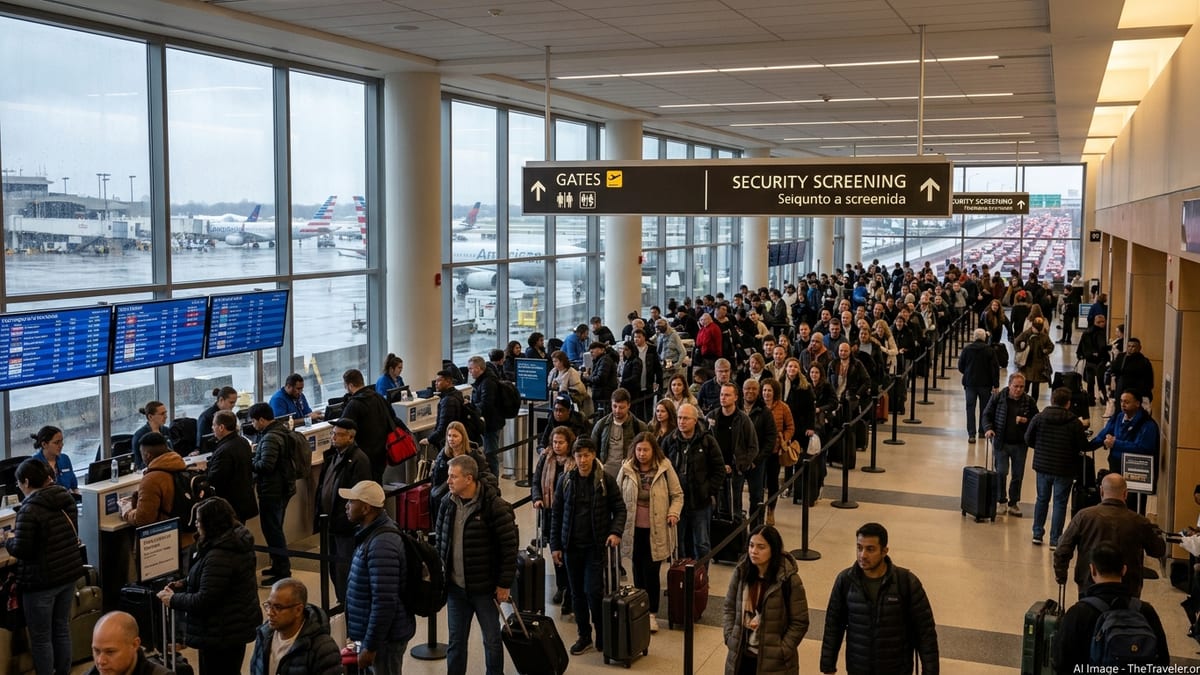
Near-record Thanksgiving crowds despite slight dip in forecast travel
The American Automobile Association projects that 81.5 million people will travel at least 50 miles from home during the seven-day Thanksgiving period running from Tuesday, November 24 through Monday, November 30. The forecast is marginally below last year’s record estimate of 81.6 million travelers, ending a three-year stretch of new highs but still leaving overall volumes close to peak holiday levels.
AAA’s breakdown anticipates that nearly 73 million people will travel by car, just under 6 million will fly and about 2.6 million will use other modes such as intercity buses, passenger rail or cruises. Those projections are based on booking and economic data compiled with transportation analytics firm S&P Global Market Intelligence and were published on November 16, giving travelers and operators an early indication of where the biggest bottlenecks might emerge.
The slight decline in total travelers has not translated into noticeably easier conditions at major hubs so far this week. Airports reported full parking facilities, congested ticketing halls and steady security queues by midweek, while highway agencies warned of extended rush-hour-style congestion on thoroughfares including Interstate 95 along the East Coast and Interstate 5 on the West Coast.
Security lines lengthen as TSA screens millions of passengers
The Transportation Security Administration expected to screen about 17.6 million passengers from Tuesday through Monday, according to data provided to the Associated Press and republished by multiple outlets on November 25. That total covers travelers passing through federal airport checkpoints over the six main travel days surrounding the holiday and positions the current week among the busiest periods since the start of the pandemic.
Wait times on the Wednesday before Thanksgiving varied sharply by airport and time of day. At Miami International Airport, morning security lines at times exceeded an hour, with the TSA reporting a peak standard-lane wait of around 80 minutes. Newark Liberty International and Portland International in Oregon each recorded roughly 40‑minute waits during the morning rush. At Fort Lauderdale–Hollywood International, some travelers described nearly one-hour lines to clear security before boarding intra-Florida flights.
Conditions were less severe at other large airports. At Ronald Reagan Washington National Airport outside Washington, D.C., some passengers reported moving from the curb through check-in and security in under 10 minutes early Wednesday, reflecting how differences in terminal layout, local staffing levels and passenger arrival patterns can produce very different experiences on the same travel day. TSA officials have continued to advise passengers to arrive at least two hours before domestic flights and three hours before international departures, particularly at peak morning and evening periods.
Coastal storm and interior snow create multi-state weather disruptions
The most immediate threat to smooth Thanksgiving travel is a sprawling storm system organizing along the Eastern Seaboard. National Weather Service outlooks issued on Wednesday, November 25 warn that the developing coastal low is expected to bring heavy rain, strong onshore winds, coastal flooding and isolated power outages to parts of the Carolinas on Wednesday before shifting its focus to the northern Mid-Atlantic and New England on Thanksgiving Day.
Along the Interstate 95 corridor from northern Georgia through the Carolinas, Virginia and into the Northeast, forecasters have posted wind advisories and, in some locations, high wind warnings. Gusts along exposed coastal and urban locations could reach or exceed 50 miles per hour, raising the risk of tree damage, scattered power interruptions and hazardous crosswinds for high-profile vehicles. The combination of heavy rain and high astronomical tides associated with this week’s full moon has prompted coastal flood warnings and advisories from coastal Georgia through New Jersey and into parts of southern New England.
Further inland, the same storm system is interacting with colder air to produce winter weather hazards. The National Weather Service has issued winter storm watches and warnings for portions of Missouri and Illinois, including the St. Louis metropolitan area, where forecasters have indicated that up to about 9 inches of snow is possible in some locations. Snow accumulations of that magnitude would cause difficult or impossible driving conditions during peak travel periods and could lead to de-icing delays and runway clearing operations at affected airports.
Heavy rain, king tides and West Coast surf add to travel complications
While much of the national attention is focused on the East Coast storm, travelers in other regions are also contending with disruptive weather. Periods of heavy rain have been reported across parts of Florida, the Carolinas, Mississippi and western Washington state as separate frontal systems move through. In the Pacific Northwest, the National Weather Service in Seattle has warned of a wet and windy Thanksgiving period, with gusts of 25 to 35 miles per hour in the metropolitan area and stronger winds along the coast and in northern Puget Sound, where localized power outages are possible.
On the West Coast, a combination of strong Pacific storms and seasonal king tides is driving dangerous coastal conditions from Southern California through the San Francisco Bay Area and northward to Oregon and Washington. Forecasts call for large breaking waves and coastal flooding in vulnerable low-lying communities, and National Weather Service offices have issued coastal flood statements and high surf warnings accordingly. In the San Francisco region, forecasters this week noted exceptionally high tidal levels, with records for November water heights challenged or exceeded at some tide gauges.
These coastal impacts are largely confined to shorefront neighborhoods, beach roads and harbor facilities, but they can affect travel indirectly when waves reach or overtop coastal highways or when local authorities close seaside routes as a precaution. Port and ferry operators in several West Coast cities have advised travelers to monitor service alerts throughout the holiday period, particularly for smaller or exposed routes where sailings are more vulnerable to wind and wave conditions.
Delays, cancellations and lingering concern over aviation technology
Flight data provider FlightAware reported relatively modest national disruption numbers on Wednesday morning, with around 30 U.S. flights canceled and more than 1,100 delayed by mid-morning local time. Those figures represent only a small fraction of the thousands of scheduled daily departures and arrivals, but they are subject to change quickly as weather conditions deteriorate through Thanksgiving Day, particularly at busy East Coast hubs such as New York, Boston, Philadelphia and Washington.
Travelers’ concerns this week are shaped not only by weather but also by recent technology problems affecting the aviation system. Earlier in November, a malfunction within a Federal Aviation Administration network triggered the most extensive nationwide ground stop in roughly a quarter-century, temporarily halting departures across the United States and affecting tens of thousands of passengers. In the days that followed, separate IT outages at United Airlines and Delta Air Lines disrupted operations at those carriers, leading to multiple hundreds of flight delays and cancellations combined.
Federal officials have said they are reviewing the root causes of the FAA outage and have stressed that there is no indication of a cybersecurity incident. Airlines, for their part, have updated internal procedures for switching to manual processes when automated systems fail and have urged passengers to use carriers’ mobile apps and text alerts to receive real-time updates on gate changes and rebooking options. While there is no specific indication that technology failures will recur during the Thanksgiving period, the recent incidents have kept contingency planning and communication protocols in sharp focus for both regulators and airlines.
What travelers should check as the holiday storm and crowds evolve
With the coastal storm still evolving and peak return travel days yet to come, conditions for air and road travel remain subject to rapid change through the end of the Thanksgiving period on Monday, November 30. Weather agencies recommend that travelers monitor updated National Weather Service forecasts for both departure and arrival locations, paying close attention to wind advisories, coastal flood statements and winter weather alerts along their planned routes.
Passengers flying into or out of major East Coast airports on Thanksgiving Day and into Friday morning should be prepared for potential delays stemming from low clouds, heavy rain, gusty winds and required spacing between aircraft in turbulent conditions. Those driving through the central United States, especially in areas under winter storm watches or warnings, may need to adjust departure times, carry winter emergency supplies and consider alternate routing around the heaviest snow bands. Coastal travelers on both coasts should verify whether high tides or wave runup are affecting specific stretches of shoreline highways or access roads to beach communities.
Given the forecast passenger volumes and the possibility of weather-related disruption, transportation agencies and travel providers continue to emphasize early planning and real-time information. Travelers are advised to allow additional time for airport check-in and security screening, confirm reservation details before leaving home and enroll in airline and rail alert systems that provide gate, platform and schedule changes. For those yet to depart, checking conditions again on Sunday and Monday will be essential, as the same storm system and its trailing disturbances may continue to influence return journeys even after Thanksgiving Day itself.