


If you regularly hop between Expedia, Hotels.com, Vrbo, Orbitz or Travelocity looking for the “best deal,” you are not alone. What many travelers do not realize is that these brands all sit under the same corporate umbrella, Expedia Group, and often pull from the same underlying inventory. Yet they are not identical, and small differences in pricing, policies, rewards and fine print can cost you money or complicate your trip. Understanding how these platforms truly compare in 2026 helps you avoid common traps and book with eyes wide open.
Get the latest updates straight to your inbox!
Confusing Different Brand Names With Different Deals
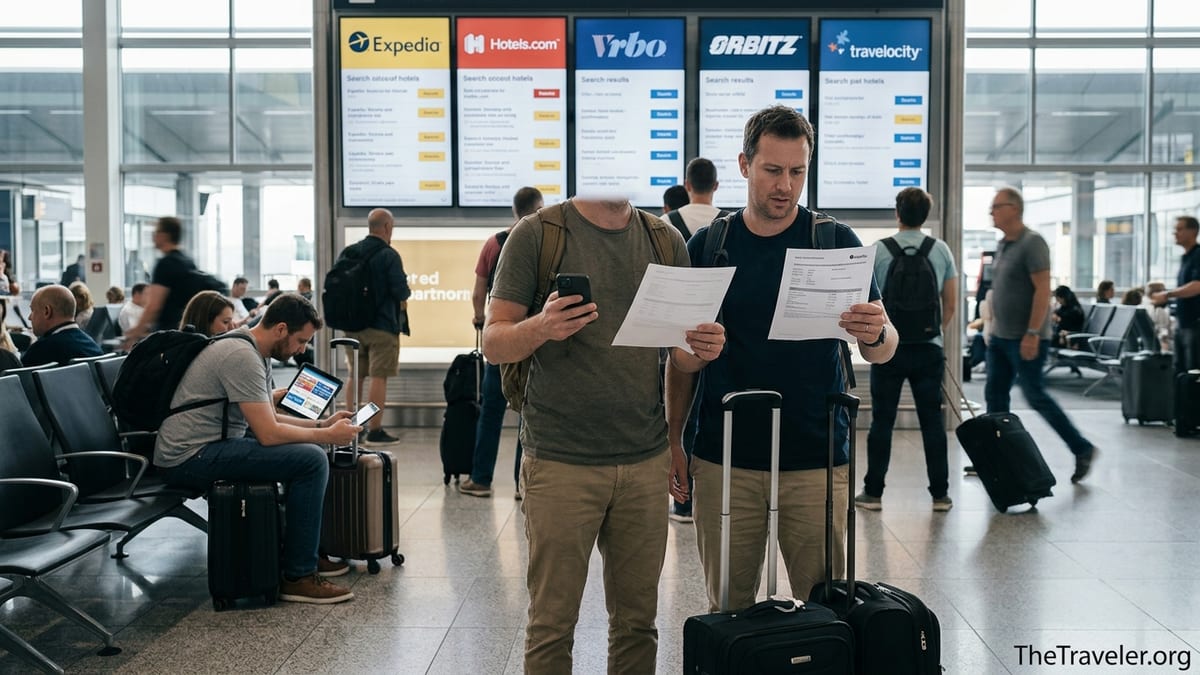
One of the most common mistakes is assuming separate brand names always mean separate, competing offers. Expedia, Hotels.com, Vrbo, Orbitz, Travelocity, Hotwire and several other well known booking sites are all owned by Expedia Group. For a typical chain hotel in Chicago or Paris, the base rate you see on Expedia is often identical to the rate on Hotels.com or Orbitz for the same room and dates. Travelers who spend an hour bouncing between these Expedia Group brands often end up right back where they started, with no real savings to show for the effort.
Consider a mid range business hotel near Seattle Tacoma International Airport on a random August weekend. You might see a king room at about 189 dollars per night on Expedia. Pull up Hotels.com or Orbitz, choose the same room type and cancellation policy, and you are likely to see 189 dollars again, sometimes differing by only a few cents due to rounding or currency conversion. The underlying contract between the hotel and Expedia Group is the same, so the base price is too. Any difference usually comes from a coupon code, a temporary promotion, or a slightly different way of displaying taxes and fees.
The practical problem is that travelers interpret tiny differences as evidence that one platform is “always cheaper” and start to swear off other brands. In reality, the better question to ask is not “Which Expedia Group site is cheapest in general?” but “Which one is giving me the best total value for this specific booking when I factor in rewards, coupons and flexibility?” That shift in thinking helps you compare more intelligently across related brands instead of chasing phantom patterns.
Ignoring How One Key Loyalty Works Across Brands
Another big source of confusion is loyalty. For years, Hotels.com had its own punch card style program where every tenth night was effectively free. Expedia had Expedia Rewards, and Vrbo operated separately again. That changed when Expedia Group rolled out One Key, a unified rewards program that now covers Expedia, Hotels.com and Vrbo in the United States and has been expanding internationally. Under One Key, you earn a small percentage of what you spend as OneKeyCash and can then spend that credit across participating brands.
A common mistake is clinging to old assumptions about loyalty that are no longer true. Travelers who still believe Hotels.com offers a “stay 10 nights, get 1 free” deal are often disappointed when they realize it has been replaced by the shared One Key structure. On the flip side, some travelers do not realize they can earn OneKeyCash on a Vrbo vacation rental at the beach in Florida and then use that credit toward a city hotel booked on Expedia for a business trip a few months later. Failing to connect these pieces can mean missing out on rewards you have technically already earned.
There is also confusion about status and benefits. A traveler might reach Silver or Gold status by booking multiple stays through Hotels.com, then book a flight plus hotel package on Expedia without logging in, or by using a guest checkout. They effectively throw away the chance to earn more OneKeyCash and possibly receive perks like price tracking or priority customer service. If you are going to use more than one Expedia Group platform, it is crucial to use the same One Key account and stay logged in so that your activity, perks and balances carry over wherever possible.
Comparing Prices Without Matching Policies and Fees
Travelers also routinely miscompare prices across Expedia Group sites by looking only at the headline rate, not the details behind it. One platform might show a hotel at 160 dollars per night while another displays 150 dollars, and it is tempting to assume the latter is cheaper. However, the 150 dollar rate may be non refundable, while the 160 dollar rate includes free cancellation until the day before arrival. Or one site may hide a mandatory resort fee until the final booking page, while another bakes that fee into the nightly total from the start.
Real world booking examples illustrate how misleading this can be. On a three night stay in Las Vegas, you might see a resort listed at around 120 dollars per night on Expedia and 115 dollars on Travelocity. Once you click through on Travelocity, a daily resort fee of more than 40 dollars plus tax appears only on the payment screen, while Expedia’s version may have shown a higher “total for three nights” earlier in the process. Many travelers screenshot the lower nightly rate and never realize that the final bill on both sites ends up within a few dollars of each other.
The same issue appears with Vrbo, where service fees and cleaning fees play a huge role in the final cost. Two nearly identical condos in the same Florida beach town might start at 230 and 250 dollars per night respectively. After a 180 dollar cleaning fee and high platform service fee, the “cheaper” option can easily become more expensive over a six night stay. When you compare Expedia Group platforms, you need to push each option all the way to the final confirmation page and compare the total, including every fee, for the same dates, room or property type, and cancellation rules.
Overlooking Bundles, Coupons and Time Sensitive Deals
Many travelers compare Expedia Group platforms in a static way, assuming that what they see on a random weekday afternoon is representative of pricing at all times. In reality, these sites lean heavily on dynamic promotions. Expedia is especially aggressive with package deals and sometimes offers substantial discounts if you book your flight and hotel together. In one 2026 comparison, a round trip from Los Angeles to Honolulu plus four nights at a beachfront hotel priced out at about 480 dollars when booked separately, but bundled through Expedia the total dropped to around 389 dollars, a meaningful savings for a family.
By contrast, Hotels.com may not emphasize flight and hotel bundles in the same way but can surface different “members only” prices once you log in. You might see a business hotel in Berlin labeled as 10 percent off for One Key members on Hotels.com but not highlighted on Orbitz, even though the underlying base rate is the same. A traveler who checks only one platform, or who fails to sign in before searching, will never see those targeted discounts. That leads to the impression that one brand is randomly more expensive when the reality is that the traveler is not triggering all the available offers.
Coupon codes are another source of comparison errors. Some brands under the Expedia Group umbrella run periodic discount codes on their homepages or through email newsletters. A hotel that appears identical at 220 dollars per night across all brands becomes more attractive on Orbitz if you can apply a 10 percent off code there and not on Expedia. The underlying nightly rate did not change; instead, the promotional layer on top did. When comparing these platforms, do not stop at what the search results page shows. Factor in any loyalty discounts, promotional codes and bundling options you are realistically willing to use.
Forgetting About Direct Booking and Hotel Loyalty Programs
Perhaps the most expensive mistake is comparing only Expedia Group platforms with one another and never checking the hotel’s own website. Many major chains and even some independent properties quietly guarantee that if you find a lower public rate elsewhere, they will match it and sometimes add a small extra discount or bonus. Studies of pricing across online travel agencies and direct channels in recent years have found that booking directly with the hotel comes out cheaper or equal surprisingly often once you consider loyalty points, elite night credits and flexible cancellation policies.
For example, a traveler planning four nights at a large branded hotel in New York might see rates around 280 dollars per night on Expedia and Hotels.com. A quick check on the hotel’s own site could show a “members rate” of 270 dollars, plus full points in the hotel’s loyalty program worth perhaps another 10 to 15 dollars per night in future stays. Over a four night trip, that can amount to well over 50 dollars in additional value. Yet many travelers never run that last comparison, assuming that an Expedia Group platform must already reflect the market’s best price.
There is also the question of how problems get resolved. When you book through an intermediary like Expedia or Vrbo, the hotel or property owner may refer you back to the platform for billing disputes or reservation issues. Some travelers have reported situations where a hotel claimed not to work with a particular platform or could not find a reservation in its system, leading to stressful calls between the hotel and the online agency. Booking directly does not guarantee perfection, but it does mean there is only one party to deal with if something goes wrong, and your elite status with the hotel chain may give you extra leverage that an intermediary booking cannot match.
Misunderstanding Who Handles Customer Service and Risk
Another frequent misunderstanding is assuming that all Expedia Group platforms offer identical customer service experiences and protections. In practice, support can feel different depending on whether you book a standard chain hotel through Expedia, a boutique property through Hotels.com, or a vacation rental through Vrbo. Policies around cancellations, overbookings and refunds can vary widely by property, and Expedia Group often positions itself as a go between rather than the ultimate decision maker. Travelers who believe “Expedia will take care of me no matter what” sometimes face frustration when a hotel or host refuses to budge.
Real stories from recent years reflect this pattern. Some travelers describe fully refundable hotel bookings on an Expedia Group site that, when canceled, turned into long waits for refunds or disputes between the platform and the property about who actually held the money. Others have reported vacation rentals on Vrbo where a host canceled last minute or where the property did not match the photos, only to find that resolution required multiple phone calls and documentation. These experiences are not unique to Expedia Group, but they matter when you are comparing platforms that many people assume are interchangeable.
Risk also looks different across Expedia Group brands. Booking a conventional hotel room through Expedia or Hotels.com generally means your accommodation is subject to standard hotel regulations, local safety codes and 24 hour staffing. Booking a standalone vacation rental through Vrbo might offer more space and privacy but also depends heavily on the individual host’s reliability. Travelers who treat those two product types as comparable simply because they appear on sites owned by the same company may underestimate the extra due diligence required for vacation rentals, such as reading reviews carefully and verifying cancellation and damage policies.
Focusing Only on Headline Savings Instead of Trip Strategy
A final mistake is treating platforms like Expedia, Hotels.com, Vrbo, Orbitz and Travelocity as if the main goal is always to shave a few dollars off a single booking, instead of thinking about your broader travel patterns. A traveler who takes one big leisure trip each summer and otherwise travels rarely may care more about simple, flexible cancellation terms and responsive customer service than about squeezing out every possible reward dollar. That person might reasonably decide to consolidate on one platform for convenience and peace of mind.
By contrast, a frequent traveler who books dozens of nights per year and several flights may be better off using Expedia Group platforms strategically as a secondary tool, while concentrating most hotel stays with one or two major chains to maximize elite benefits and points. That could mean using Expedia to bundle a complex multi city itinerary or to book independent hotels where your preferred chain does not operate, then going direct to Hilton, Marriott, IHG or another brand whenever chain hotels are available. Understanding where Expedia Group platforms fit into your personal travel strategy is more important than deciding whether Expedia or Hotels.com is “better” in the abstract.
Even within the Expedia family, you might choose different brands for different purposes. Some travelers prefer Travelocity’s interface for simple flight searches, while others find Hotels.com’s filtering tools more intuitive for multi night stays. Vrbo can excel for family trips where you need a kitchen and multiple bedrooms, but a midweek solo work trip might be easier and safer in a traditional hotel booked through Expedia. The key is to compare not just prices, but how each platform’s strengths align with your needs on a given trip.
The Takeaway
When you zoom out, the core mistake travelers make is assuming that Expedia, Hotels.com, Vrbo, Orbitz and other Expedia Group brands are fundamentally different competitors. In reality, they are siblings sharing much of the same inventory, with differences that mostly show up in loyalty structures, promotions, presentation and customer experience. Failing to recognize that connection leads to wasted time chasing tiny price discrepancies and overlooking more important factors like cancellation rules, hidden fees and who will actually help you if something goes wrong.
The most effective way to compare Expedia Group platforms is to be systematic. Always sign in to your One Key account before searching so you see member rates and earn rewards. Push any promising option to the final booking screen on at least two platforms to compare the true total cost with identical policies. Then cross check the hotel’s own website or the vacation rental’s direct channel when available, especially if you value elite status and direct support. Finally, think in terms of your long term travel habits: use Expedia Group where it adds genuine value, and do not hesitate to book directly when that serves you better.
FAQ
Q1. Are Expedia, Hotels.com, Orbitz and Travelocity really the same company?
Yes. All of these brands belong to Expedia Group, which owns a portfolio of travel sites that includes Expedia, Hotels.com, Vrbo, Orbitz, Travelocity, Hotwire and several others. They often share the same underlying hotel and flight inventory, even though the interfaces and promotions can differ.
Q2. If the same company owns these platforms, why do prices sometimes look different?
Base rates for the same hotel and room type are usually very close or identical, but each brand may run different member discounts, coupon codes or bundles. Taxes and mandatory fees can also be displayed at different stages of the booking process, which makes the headline nightly rate look different even when the final totals are similar.
Q3. What is One Key and how does it affect my bookings?
One Key is Expedia Group’s unified loyalty program that covers Expedia, Hotels.com and Vrbo in many markets. You earn OneKeyCash on eligible bookings and can spend it across participating brands. The key is to log in with the same account on each platform so your rewards and status levels accumulate in one place.
Q4. Is Hotels.com’s “stay 10 nights, get 1 free” offer still available?
No. That legacy Hotels.com punch card style program has been retired and replaced by the shared One Key system. Instead of earning a free night after a fixed number of stays, you now earn a percentage of what you spend as OneKeyCash, which you can later apply to eligible bookings across participating brands.
Q5. Which Expedia Group site is best for booking hotels?
There is no single best choice for everyone. Expedia, Hotels.com, Orbitz and Travelocity often show similar hotel prices, so the right option depends on which interface you prefer, what promotions you can access and how you value One Key rewards. Some travelers pick one brand and stick with it for simplicity, while others check two or three before committing.
Q6. When should I use Vrbo instead of a hotel booking on Expedia or Hotels.com?
Vrbo is generally better for longer stays, family trips or group travel where you want multiple bedrooms, a kitchen and more space. Expedia and Hotels.com typically work better for short stays, business trips and situations where you prefer hotel like services such as daily housekeeping, a staffed front desk and predictable loyalty benefits.
Q7. Do I lose hotel loyalty points if I book through an Expedia Group site?
Often, yes. Many major hotel chains either do not award full points and elite night credits on third party bookings or exclude them entirely. If you care about status with a chain like Marriott, Hilton or IHG, it is worth checking the direct rate and loyalty benefits before booking the same hotel through an Expedia Group platform.
Q8. How can I fairly compare prices across Expedia, Hotels.com and the hotel’s own site?
Use the same dates, room type and cancellation policy, then click through to the final booking page on each platform. Compare the total cost including taxes and mandatory fees, and factor in the value of any rewards you will earn, such as OneKeyCash or hotel loyalty points. Only then can you see which option truly offers the best value.
Q9. What should I do if my Expedia or Vrbo booking is not honored by the hotel or host?
Contact the platform’s customer service immediately and document everything, including confirmation numbers, emails and any messages from the property. In many cases the platform will try to find alternative accommodation or issue a refund, but the process can take time. This is one reason some travelers prefer direct bookings for critical stays.
Q10. Is it worth checking multiple Expedia Group brands before booking, or is that overkill?
If you are booking an expensive trip, a long stay or travel during a busy period, checking at least two Expedia Group brands plus the property’s own website can be worthwhile. For a simple one night airport hotel, the potential savings may be small, so choosing the platform you know best and ensuring you are logged into One Key is usually sufficient.