


Stepping into Vatican City for the first time, I expected more of Rome: more Baroque stone, more crowds, more gelato stands and souvenir kiosks. Technically, that is what I got. The traffic still rumbled along Via della Conciliazione behind me, tour groups hoisted the same colored flags, and the summer heat bounced off the paving stones. Yet the moment I crossed the discreet security perimeter and entered St Peter’s Square, it felt as if I had walked into a different country in every sense, not only on paper. The contrast between chaotic, sensual Rome and tightly choreographed Vatican City was far sharper than I had imagined, and it changed the way I planned the rest of my time in both places.
Get the latest updates straight to your inbox!
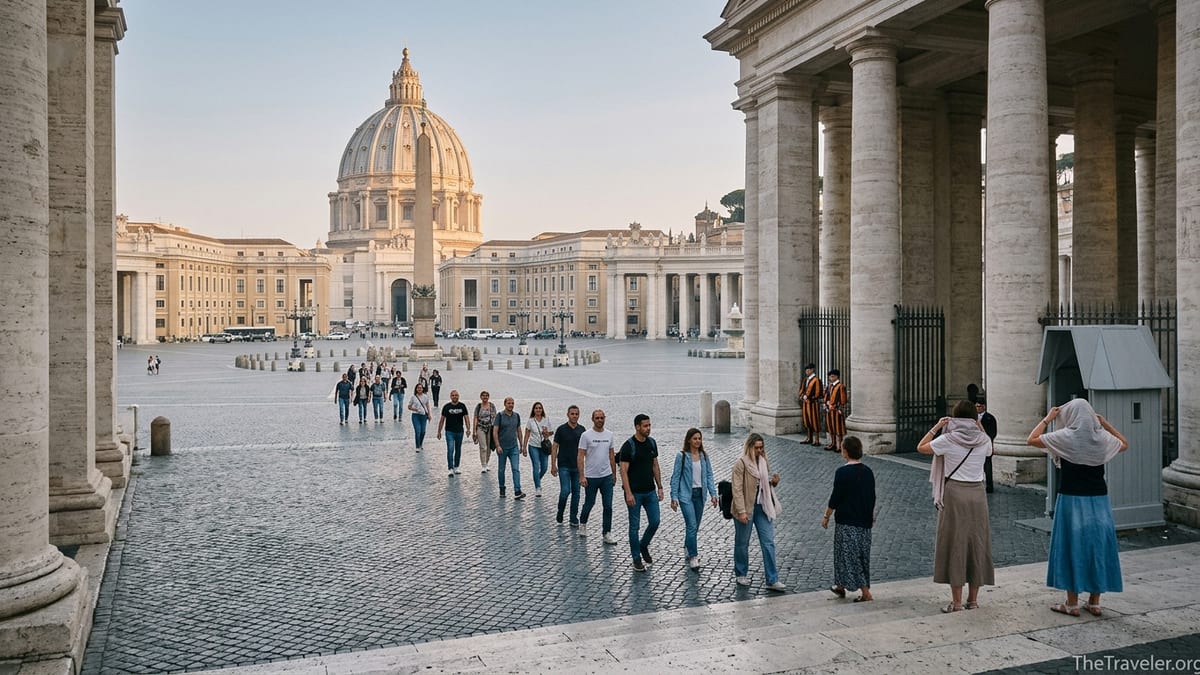
A Border You Hardly Notice Until You Feel It
On a map, Vatican City is a sovereign microstate nestled inside Rome. In person, the border is so understated that many first time visitors walk past the small metal bollards and police booths on Via della Conciliazione without realizing they have technically left Italy. There are no passport checks and no customs line. What you notice instead is a shift in atmosphere. The political slogans and union posters that blanket walls elsewhere in Rome disappear. The noise of car horns fades, replaced by the low murmur of tour guides explaining papal history in half a dozen languages.
In Rome, even major sites like the Colosseum or Piazza Navona bleed into the surrounding neighborhoods, with buses, bars, and apartment balconies pressed right up against the monuments. Vatican City feels more sealed. The curve of Bernini’s colonnade acts like a set of stone arms closing around you, filtering out the city beyond. Street vendors still appear, but you sense that everything beyond the colonnade obeys a different set of rules, from the Swiss Guards in their striped uniforms to the discrete Vatican gendarmes watching the lines for security issues rather than touts.
That invisible frontier is reinforced in small, practical ways. When you pass into St Peter’s Square early in the morning, you see workers quietly washing the travertine paving, setting out rows of chairs for a papal audience, and checking barriers. The same morning in Trastevere or near Termini, café owners are dragging chairs onto sidewalks while scooters weave around parked delivery vans. Both are cities waking up, but the Vatican’s routine has the feeling of a ritual, calibrated to liturgies and audiences rather than the rhythms of commuters and school runs.
This sense of separation only intensifies when you leave the square and walk along the outside of the Vatican walls toward the Museums entrance. On one side, buses wheeze up the hill and residents duck into supermarkets. On the other, the high fortifications of the papal state rise in plain brick, with only the occasional doorway for staff. You are still in Rome on the sidewalk, but one turn of a corner and a security check later you are inside another country’s carefully managed front door.
Dress Codes and Decorum vs Roman Nonchalance
Rome is a city where fashion rules the streets. In the summer you will see locals in tailored linen and tourists in shorts and sandals sharing the same café terrace. At the Pantheon or the Trevi Fountain, posted dress codes exist but are loosely applied. Women in sleeveless dresses slip in and out of churches after tossing a scarf over their shoulders, and nobody measures hemlines with a ruler. The Vatican, by contrast, left me with no doubt that the rules are real. Shoulders and knees must be covered for entry to St Peter’s Basilica, the Vatican Museums, and the Sistine Chapel, and those guidelines are actively enforced at the security gates rather than left to personal interpretation.
I watched a couple ahead of me in the basilica line turned away because the man’s shorts brushed only mid thigh and the woman’s top left her shoulders bare. Their faces dropped when the guard pointed to the illustrated dress code board. There were no paper shawls handed out for free. Instead, they had to circle back to the souvenir stalls just off the square, where lightweight scarves and sarongs were selling for about 5 to 15 euros, clearly displayed on racks labeled “Vatican dress code solutions.” When they rejoined the queue nearly an hour later, the mid morning heat had already intensified, and the cost of underestimating the rules was obvious.
Inside the Museums the same standard applies, although the enforcement point is the security scan at the entrance rather than each gallery door. You can walk around the galleries in comfortable sandals and casual clothes, but anything that reads as beachwear, overly revealing, or deliberately provocative is likely to draw a quiet intervention from staff. This stands in stark contrast to, say, a summer evening around Campo de’ Fiori, where tank tops and crop tops are the norm and nobody pays attention beyond fashion opinions.
The dress code also affects what you pack for your Roman days. In most of the city, you can leave your hotel in shorts and a T shirt and flex your schedule. If you decide to step into a church like Santa Maria sopra Minerva, you might be politely asked to cover your shoulders, but you can simply choose another stop instead. For a Vatican day, you need to plan the outfit before breakfast, especially in July and August when temperatures hover around 30 degrees Celsius or higher. Lightweight linen trousers, a cotton midi dress with short sleeves, and a packable scarf become practical gear, as essential as your water bottle. The cultural difference is unmistakable: Rome is lived in, spontaneous, and sometimes chaotic; the Vatican is curated and expects you to adapt to its code of conduct.
Crowd Choreography: Pilgrims vs Tourists
Rome’s crowds are restless and scattered. At the Colosseum and Roman Forum, people line up for timed entries, but once inside, they disperse: some sit in the shade scrolling on their phones, others listen intently to guides, still others pose for endless photos on the tiers of the amphitheater. In Trastevere or Monti, the sidewalks are a constant shuffle of locals, service staff, students, and travelers. By contrast, Vatican City shapes its visitors into distinctly organized flows, and a significant portion of those flows are pilgrims rather than casual tourists.
Nowhere is this more evident than on a Wednesday morning when the Pope holds a general audience. From as early as 7:30 a.m., groups in matching T shirts or with parish banners begin to queue at the security checkpoints leading into St Peter’s Square. Unlike the fragmented queues at the Colosseum, these lines are imbued with a sense of shared purpose: groups recite rosaries aloud in their own languages, choirs warm up soft hymns, and priests move through the crowd greeting their parishioners. By 9:30 a.m. the square is segmented into neat blocks of chairs, each filled by arches of color coded groups, while late arriving solo travelers find seats at the back or along the colonnades.
The Vatican Museums, too, orchestrate movement differently from Roman sites. Standard tickets bought on the official portal cost around 25 euros with the online booking fee included and are dated and timed, an attempt to smooth the arrival peaks that come with roughly several million visitors per year. Many days in high season, entry slots sell out in advance, and you will see disappointed travelers outside asking staff if extra tickets might be released. Those who booked a guided tour or “skip the line” package through agencies often pay considerably more, sometimes 70 to 90 euros per person when all fees are added, but in return they are collected at designated meeting points, walked directly to the Museums entrance, and shepherded through security as a unit.
Inside, the flow continues: taped arrows on the floor and attentive guards keep visitors moving in a single general direction toward the Sistine Chapel. In heavily trafficked galleries such as the Gallery of Maps, staff remind people to keep to the right and to avoid stopping for too long in bottleneck spots. The effect can feel closer to a pilgrimage procession than a leisurely museum visit. In Rome’s Capitoline Museums or the Galleria Doria Pamphilj, by comparison, there is room to double back, linger in front of a painting, and wander largely as you please. The Vatican expects you to follow its set path and pace, which can be disconcerting if your mental picture of Rome is one of relaxed, meandering exploration.
Architecture and Scale: From Grand City to Sacred Stage
Rome is defined by layers: ancient ruins beside Renaissance palaces, apartment buildings perched over medieval arches, laundry strung across Baroque courtyards. Its beauty comes as much from the accidents and overlaps as from the grand monuments. Vatican City, in the part open to the public, feels like a carefully arranged stage where each element serves a clear liturgical or symbolic purpose. The scale is monumental but also tight, concentrated within a handful of key spaces rather than spread across neighborhoods.
St Peter’s Square is the first shock. Standing in the center, you are dwarfed by the curved colonnades and the basilica’s facade, but instead of blending into an urban vista, the view is almost entirely self contained. In Rome, even standing by the Vittoriano or Piazza del Popolo, your eye travels outward to side streets, shop signs, and rooftop terraces. In the Vatican, your focus is drawn back to the obelisk, the papal apartments, and the balcony from which the “Urbi et Orbi” blessing is given. The square is both civic space and open air sanctuary, and the lack of ordinary city clutter reinforces its sense of otherness.
Inside St Peter’s Basilica, the difference from Roman churches is one of scale and hierarchy. Even if you have visited imposing basilicas like San Giovanni in Laterano or Santa Maria Maggiore in the city, St Peter’s still overwhelms. The polished marble floors, Bernini’s bronze baldachin over the papal altar, and the sweeping side chapels are all meticulously maintained, with roped off areas and uniformed staff guiding visitors. In many Roman churches, you can slip into a side pew, quietly admire a Caravaggio, and leave without ever seeing a guard. In St Peter’s, every move feels subtly observed, from the way you navigate around ongoing Masses to where you are allowed to stand for photos.
The Vatican Museums compound the sense of curated space. While museums in Rome often occupy palaces that once housed families and still feel like domestic spaces adapted for public use, the Vatican collection is presented as an encyclopedic archive of faith and power. Long galleries like the Pio Clementino and the Raphael Rooms are lit and labeled to guide you through a narrative that culminates in the Sistine Chapel. There is little of the loose, lived in feel you find in places like the Galleria Borghese, where statues share space with windows that open onto gardens. In the Vatican, the narrative is controlled, and by the time you stand shoulder to shoulder under Michelangelo’s ceiling, you are keenly aware that this is not another Roman museum but the heart of a sovereign church.
Security, Logistics, and the Pace of a Visit
In Rome, security checks at major monuments tend to be quick and functional. At the Colosseum or the Roman Forum, you pass through airport style scanners, but the atmosphere is relaxed, and the process feels like a necessary chore rather than a defining feature. In Vatican City, security is part of the identity of the place. Metal detectors and bag scanners guard every public entry point, from the basilica and Museums to papal audiences. You may see Italian police on the perimeter, Vatican gendarmes inside the state, and plainclothes officers mingling with the crowds, all working together in a choreography that feels different from the looser oversight at a typical Roman attraction.
This heightened security affects how you move through your day. Backpacks and medium sized daypacks are generally permitted, but anything oversized or containing sharp objects is likely to be refused at the scanners, and cloakroom services can be limited, especially around the basilica. Water bottles are allowed, though you may be asked to sip from them, and umbrellas usually must be collapsed and carried. Clearing security for St Peter’s can take anywhere from 15 minutes on a quiet winter morning to more than an hour at peak midday in June, even before you step over the basilica threshold. For the Museums, queues wrap around the high walls in summer, and the advantage of a timed ticket becomes clear as you bypass an otherwise daunting line.
Transport logistics also highlight the contrast. In wider Rome you can rely on the metro, bus, or tram network to hop between neighborhoods. A single public transport ticket costs around 1.50 euros and is valid for 100 minutes, or you can purchase a weekly pass for roughly the cost of a few cappuccinos per day if you plan to ride often. To reach the Vatican, many visitors simply take metro line A to Ottaviano or Cipro and walk 10 to 15 minutes, joining a tide of people heading in the same direction. Yet once you step onto St Peter’s Square, there are no buses, no taxis, and no bike lanes inside the state. Movement becomes entirely on foot, slower and more deliberate, often dictated by religious schedules rather than commuter timetables.
The pace of a Vatican visit surprised me most in the small pauses. After exiting the Museums, there is an almost ceremonial funneling of visitors toward the gift shops and cafeterias before they spill back into Rome. At the basilica, climbing the dome involves buying a separate ticket, deciding between the elevator plus stairs or all stairs option, and navigating a narrow, one way spiral staircase where everyone moves methodically, pausing in alcoves to let others pass. None of this is accidental. Vatican City is built to receive enormous numbers of people, but it insists they adapt to its measured tempo, while Rome allows, and sometimes forces, you to adapt to its frantic heartbeat instead.
Money, Souvenirs, and Subtle Cultural Cues
Rome’s commercial life is exuberant. Souvenir kiosks crowd the streets around the Trevi Fountain, restaurants competing for attention line the alleys of the historic center, and street vendors strike up easy conversations to sell everything from leather bags to selfie sticks. Vatican City participates in this economy, but in a noticeably different key. The transition begins on the streets ringing the Vatican walls, where shop windows display rosaries, holy water bottles, and crucifixes alongside the usual magnets and postcards, signaling that you are nearing a religious marketplace as much as a tourist one.
Inside the Vatican Museums, the commercial offer is curated. Gift shops sell high quality art books, reproductions of frescoes, Vatican coins, and papal themed items whose tone skews more devotional than kitsch. Prices reflect both the location and the controlled environment: a slim paperback on the Sistine Chapel might cost just under 20 euros, while glossy coffee table volumes climb much higher. Food options are similarly practical rather than particularly atmospheric. Self service cafeterias offer pizza slices, pasta, salads, and drinks at prices slightly above an average Roman bar but below the more touristic restaurants around Piazza Navona. There are no terrace cafés with street performers, no wine bars spilling onto cobblestones, only functional seating designed to refuel you before you rejoin the galleries.
St Peter’s Square and the surrounding streets, on the other hand, show how Vatican and Roman cultures intersect. Vendors outside the colonnade sell rosaries advertised as “blessed” after papal audiences, plastic bottles shaped like Madonna statues ready to be filled at nearby holy water fonts, and framed papal blessings that can be personalized for weddings or baptisms. Prices vary widely: a simple rosary might cost a few euros, while sterling silver versions or official blessings purchased through Vatican offices cost substantially more. Haggling is less common here than at open air markets in Rome; the interaction is quieter and more reverent, even when clearly commercial.
These small economic details underscore a broader cultural divide. In Rome you often feel like a spectator or participant in a living city that happens to contain ancient wonders. In Vatican City you are, for a few hours, a guest in a spiritual and political institution that welcomes visitors but does not primarily exist for them. Tipping customs blur somewhat, too: in Roman trattorias you might leave a few coins or a small percentage on top of the bill, while in Vatican related settings such as licensed guides for papal audiences or official Museums tours, suggested tips sometimes follow international norms closer to what North American travelers expect. Paying attention to these cues helps you navigate each microculture with respect.
The Takeaway
Before my trip, I thought of Vatican City as an especially grand stop on a Rome itinerary, an obligatory check box alongside the Colosseum and the Spanish Steps. What I found instead was a place that functions on its own terms, with rhythms, rules, and expectations that quietly but firmly distinguish it from the city that surrounds it. The border may be invisible in a passport sense, but you feel it in the dress codes, the crowd choreography, the security presence, and the way time itself seems to move differently once you step under the colonnades of St Peter’s.
Recognizing this difference is not just an interesting travel observation; it has practical consequences. Planning a Vatican day means booking key tickets in advance where possible, dressing with modesty and heat in mind, allowing extra time for security checks, and mentally shifting from the improvisational style that works elsewhere in Rome to a more patient, structured approach. It also opens space to appreciate why so many visitors arrive not simply as tourists but as pilgrims, carrying intentions and prayers that give the place its particular energy.
If you treat Vatican City as merely another Roman neighborhood, you risk frustration and missed opportunities. Embrace it as the distinct city state it is, with its own character and pace, and you will not only navigate it more smoothly but also deepen your understanding of Rome itself. The Eternal City suddenly makes more sense when you see that at its heart lies another city, smaller yet symbolically vast, shaping the skyline and stories of Rome while quietly following a different set of rules.
FAQ
Q1. Do I need my passport to enter Vatican City from Rome?
In practice, no passport control is required when walking into Vatican City from Rome, but you should still carry photo ID as you would anywhere in the city.
Q2. How strict is the Vatican dress code compared with churches in Rome?
The Vatican is noticeably stricter: shoulders and knees must be covered for St Peter’s Basilica, the Vatican Museums, and the Sistine Chapel, and security staff actively turn away visitors who do not comply.
Q3. Are Vatican Museums tickets more expensive than other major sites in Rome?
Standard Vatican Museums tickets bought through the official system cost slightly more than entry to many Roman museums, and guided or “skip the line” packages can be significantly pricier.
Q4. Can I just show up and buy Vatican Museums tickets at the door?
Same day tickets are sometimes available, but in busy months time slots often sell out in advance, so it is safer to book ahead rather than rely on walk up sales.
Q5. Is Vatican City safe to visit compared with the rest of Rome?
Vatican City has a visible security presence and feels very safe, but you should still watch your belongings in crowded areas, just as you would around other major Roman attractions.
Q6. Do the public transport tickets I use in Rome work inside Vatican City?
Public buses and the metro run only in Rome up to the Vatican’s edge; once inside the state you move on foot, so your transport tickets are used only to reach and leave the area.
Q7. Can I wear shorts if I only plan to stay in St Peter’s Square?
Yes, the dress code is enforced at entrances to the basilica and Museums, not in the open square itself, so modest shorts are generally fine if you are not entering religious buildings.
Q8. Is food inside the Vatican Museums very expensive?
Museum cafeterias are a bit pricier than an average Roman bar but still within a moderate range, offering simple dishes and drinks aimed at convenience rather than gourmet dining.
Q9. How much time should I plan for a Vatican visit compared with other sights in Rome?
A combined visit to the Vatican Museums, Sistine Chapel, and St Peter’s Basilica usually takes most of a day once you include security, queues, and time inside, longer than many single sites elsewhere in Rome.
Q10. Is a visit to Vatican City suitable for children?
Yes, but the long lines, security checks, and dense crowds can be tiring, so families should plan breaks, bring snacks, and consider focusing on either the Museums or the basilica rather than trying to do everything.