


Coney Island is one of New York City’s most nostalgic summer playgrounds, where historic wooden coasters, neon-lit boardwalk games, and the Atlantic surf all collide in a few packed blocks. For visitors, it can also be confusing: there is no single gate, the beach is free, different parks use different ride systems, and hours shift with the weather. This guide breaks down how Coney Island’s main theme park areas work today, what the key rides are really like, how to choose between wristbands and pay-per-ride, and what to expect once you step off the subway and onto the boardwalk.
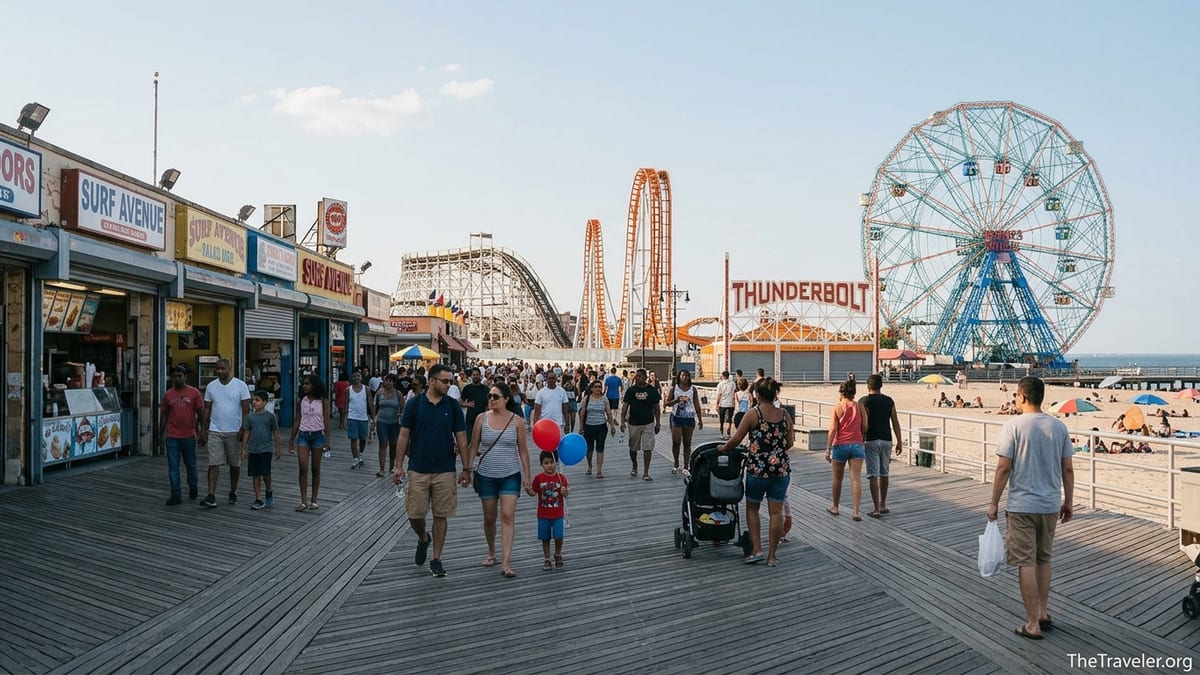
Understanding Coney Island’s Theme Park Layout
Unlike a self-contained park such as Disneyland or Universal, Coney Island is a loose cluster of attractions spread along Surf Avenue and the Riegelmann Boardwalk in southern Brooklyn. The two main ride operators are Luna Park in Coney Island and Deno’s Wonder Wheel Amusement Park, each with its own ticketing system and signature attractions. Around them you will find the New York Aquarium, independent arcades, classic boardwalk food stands, and beach access managed by New York City Parks. There is no single admission fee to enter the amusement district or the beach; you simply walk in from the street like you would in any New York neighborhood.
Luna Park currently operates most of the modern thrill rides, including the Cyclone wooden coaster and the steel Thunderbolt, and spreads across several zones between Surf Avenue and the boardwalk. It is cashless at the rides, so you will use a Luna Card or a time-based wristband to access attractions. A short walk away, centered around the towering Wonder Wheel, Deno’s Wonder Wheel Amusement Park runs as a traditional pay-per-ride park; entry is free, and you buy paper or digital ride tickets at booths scattered through the park. This split layout means you can mix and match: perhaps ride high-intensity coasters at Luna Park, then stroll over to Deno’s for gentler family rides and the historic Ferris wheel.
The beach and boardwalk create a third layer to the experience. Even on days when some rides are closed because of wind or light rain, you can still walk the boardwalk, watch pickup volleyball games in the sand, or sample a hot dog at the original Nathan’s Famous on Surf Avenue across from the subway. Many locals treat the amusement parks almost as background scenery for a beach day, dropping in for one or two rides instead of committing to a full amusement-park-style itinerary.
Because all of this is stitched into a living, sometimes chaotic neighborhood, the vibe can change from block to block and hour to hour. Midday on a sunny Saturday in July is all families, beach coolers, and stroller traffic; a breezy Tuesday evening in May might feel quiet and almost old-fashioned, with twinkling lights, scattered visitors, and just the hiss of the surf behind the rides.
Getting There, Seasons, and When to Go
Coney Island sits at the southwestern tip of Brooklyn, roughly an hour from Midtown Manhattan by subway if trains are running smoothly. Four subway lines terminate at Coney Island – Stillwell Avenue: the D, F, N, and Q. This is a large, ground-level station with a high canopy and clear signage; when you step outside, Surf Avenue and the entrance to Luna Park are directly in front of you, and the boardwalk and beach are two short blocks south. A secondary station, West 8 Street – NY Aquarium, is slightly closer to the aquarium and eastern end of the boardwalk, but Stillwell is the main arrival point for theme park visitors.
The amusement season is heavily weather dependent. The beach itself is public and open year-round, but lifeguards and official swimming season typically run from late May to early September. Luna Park and Deno’s Wonder Wheel generally open weekends in spring, expand to daily or near-daily operation in late June through August, then scale back to weekends and holidays in September and October. On a cool or rainy April Sunday, you may find only a subset of rides operating with short hours; during a heatwave in July, evening hours often extend late as long as demand and weather hold.
If you can, target a fair-weather weekday between late June and late August. On a Tuesday or Wednesday afternoon, queues for headline attractions like the Cyclone and Thunderbolt are usually far shorter than on Saturdays, and you will have an easier time finding space on the beach and in restaurants. A concrete example: a family arriving at 11 a.m. on a July Wednesday might wait 15 to 25 minutes for the Cyclone and walk straight onto several flat rides, while the same visit on a Saturday afternoon could see waits over 45 minutes for the most popular coasters.
For shoulder seasons, think about temperature and daylight. In May or early October, it can be breezy enough by the water that a light jacket feels essential, especially in the evening. Extreme wind or thunderstorms can shut down exposed rides temporarily, even on otherwise warm days. If your main goal is to ride coasters, check park social channels the morning of your visit and be ready to pivot: on cooler days some visitors resign themselves to just one or two must-do rides, then spend more time at the aquarium, in the Coney Island Museum, or strolling the boardwalk.
Key Rides at Luna Park and Deno’s Wonder Wheel
For theme park fans, the Cyclone is non-negotiable. Opened in 1927 and still clattering along its swooping wooden track above Surf Avenue, this historic coaster is both a New York City Landmark and a National Historic Landmark. The ride is short but intense, with strong lateral forces, abrupt drops, and the kind of wooden rumble you will feel in your shoulders afterward. Many experienced riders recommend the front for smoother airtime and better views, while those chasing maximum force will choose the back. Note that the Cyclone has a separate ticket booth at its entrance and often runs a dedicated pay-per-ride price, even when you are using a Luna Park wristband or credits.
Thunderbolt, by contrast, is a modern steel coaster with a vertical lift, beyond-vertical first drop, and inverting elements that loop above the boardwalk skyline. Its bright orange track and compact, twisted layout make it one of the most visible structures on the Coney Island horizon. The ride is shoulder-harness intensive and can feel rough to some visitors, particularly if you have a sensitive neck; hold your head against the headrest and keep your body braced as you crest the lift. For many thrill-seekers, a one-and-done ride on Thunderbolt and a repeat on the Cyclone make the ideal Luna Park combo.
Elsewhere in Luna Park you will find a mix of family coasters, spinning rides, flat rides, and children’s attractions. Zamperla-built coasters such as Soarin’ Eagle offer flying-style experiences where you ride prone, while rides like Coney Clipper, Electro Spin, and the Air Race variations deliver spin-and-swing sensations. For families with younger children, the park’s “Kiddie Zone” areas along the boardwalk include mini coasters, gentle carousels, and small spinning rides that allow parents to ride together with kids under a certain height, often around 36 to 42 inches.
Next door, Deno’s Wonder Wheel Amusement Park centers on the iconic Wonder Wheel, a 1920 Ferris wheel whose swinging cars slide along tracks as the wheel turns, creating a slow but surprisingly thrilling motion. Riders choose between stationary and swinging cars at the loading platform. The park also operates a mix of family attractions that feel more old-school than Luna Park’s: a classic haunted dark ride, bumper cars, kiddie boats, and small coasters like the Phoenix, a family-friendly steel coaster added as part of the Wonder Wheel’s centennial expansion. Because Deno’s uses simple paper or digital tickets that you buy in small or large bundles, it is easy to pop in just for one spin on the Wonder Wheel at sunset before continuing your boardwalk stroll.
Tickets, Wristbands, and Typical Costs
Planning how to pay for rides is where many first-time visitors get tripped up. The most important point: there is no admission fee to enter Luna Park or Deno’s Wonder Wheel Amusement Park. You walk in from the street and pay only if you choose to ride. At Luna Park, you will either buy a time-limited unlimited rides wristband that covers most attractions, or purchase Luna Credits loaded onto a Luna Card, which you tap at each ride. At Deno’s, you buy ride tickets that are physically or digitally presented at each attraction.
Luna Park’s pricing changes regularly, but in recent seasons four-hour unlimited ride wristbands have often been advertised in the ballpark of several dozen dollars per person, with more expensive options that include a bundle of “Extreme Thrill” rides such as the Cyclone and Thunderbolt. As an example, a promotional package might pair a four-hour wristband with a small arcade game card in the roughly 50 to 70 dollar range per guest. Individual marquee coasters like Cyclone and Thunderbolt tend to cost a higher number of Luna Credits or a special ticket, with some visitors reporting paying around ten dollars per ride in recent years when purchased à la carte.
For Deno’s Wonder Wheel, admission to the park is explicitly free, and you can buy individual ride tickets at windows throughout the property. Ticket books often provide a modest discount compared with buying single rides. A realistic scenario: a couple might purchase a mid-size ticket package, ride the Wonder Wheel once, try the haunted house and bumper cars, and still have a few tickets left for a kiddie ride if they are traveling with a child. Because the Wonder Wheel itself is such a highlight and only takes one ticket per person, Deno’s can be a very good value if your goal is just one or two nostalgic rides rather than a full day of intense coasters.
How should you choose between wristbands and pay-per-ride? For children who are tall enough to ride a good mix of Luna Park’s attractions, a four-hour wristband can pay off quickly if they plan to ride continuously. A teenager who does the Cyclone twice, Thunderbolt once, and half a dozen flat rides could easily reach the breakeven point compared with paying per ride. On the other hand, if you are a casual visitor who mainly wants to experience the Cyclone once and then spend most of the day on the beach or at the aquarium, a simple pay-per-ride approach is usually more economical. It is common for locals to load a modest amount of credits on a Luna Card, ride one headliner, then keep whatever small balance remains for a future visit later in the summer.
Practical Tips: Lines, Lockers, and Safety
Because Coney Island is woven into the city rather than fenced off, the crowd pattern follows the weather and the subway schedule. On the busiest summer Saturdays, lines for the Cyclone, Thunderbolt, and Wonder Wheel often spike mid-afternoon and early evening, when beachgoers drift back toward the rides. If you want to minimize waits, arrive close to opening and go straight to your must-do attractions before stopping for food or a boardwalk stroll. Alternatively, consider a later evening visit on a clear weekday: the after-dusk lighting makes the boardwalk feel magical, and families with small children tend to leave earlier, easing lines on some mid-level thrill rides.
On-ride storage matters more here than in many city attractions. Many Luna Park rides require you to leave loose items behind at the platform and will not allow backpacks or large bags on board. Some attractions provide simple open cubbies on the loading side of the ride, where you place your belongings before boarding and retrieve them afterward, while others suggest paid lockers located in central zones of the park for longer-term storage. In practice, locals often travel light, bringing only a small crossbody bag or fanny pack that can be secured in front or left with a non-riding friend. If you are combining a beach visit with ride time, consider leaving your main beach bag on the sand only if someone in your group is staying with it; theft is not rampant but unattended bags in any large city beach area are a tempting target.
Ride safety standards are broadly consistent with other modern amusement parks in the United States. Coasters and flat rides have clearly posted height requirements and safety warnings, and operators will check restraints before dispatch. If you are riding with a smaller child who is just at the minimum height, prepare them for firm restraint checks and possibly a walk-back if the operator deems them too small. For guests with back, neck, or heart conditions, or who are pregnant, the usual cautions apply; wooden coasters like the Cyclone are thrilling but undeniably jarring compared with newer family coasters such as Phoenix at Deno’s.
General city safety follows the same common sense guidance as the rest of New York. The amusement area and boardwalk are busy and heavily trafficked during peak season, especially from late morning through sunset. After dark, especially outside high summer, the atmosphere can change as day-trippers leave and a more local crowd remains. Solo travelers who feel uneasy in crowded nightlife scenes may prefer to head back on the subway by 10 or 11 p.m., while groups often stay later to enjoy late-night rides and boardwalk bars. Keep valuables out of sight, remain aware of your surroundings, and, as on any big-city subway, avoid empty train cars late at night if a more populated car is available.
Food, Drinks, and What Else to Do
Eating is as central to the Coney Island experience as riding coasters. The most famous stop is Nathan’s Famous at the corner of Surf and Stillwell, where lines for hot dogs, crinkle-cut fries, and lemonade wrap around the historic neon façade on sunny weekends. Many visitors make this their first or last stop, grabbing a classic chili dog after arriving on the subway or before heading back into Manhattan. On the boardwalk itself, another Nathan’s outlet serves beachgoers who prefer to stay close to the sand.
If you are looking for a sit-down meal or a drink with a view, the boardwalk has several long-running establishments with outdoor seating. Ruby’s Bar & Grill, family-operated since the 1970s in various forms, serves burgers, fried seafood, and cold beer at picnic tables that spill directly onto the boardwalk, making it a natural place to linger at sunset. Nearby, you will find ice cream stands, funnel cake counters, and modern fast-casual chains mixed in with independent vendors. Prices are in line with other New York tourist areas; a simple lunch of a hot dog, fries, and a drink can easily come to 15 to 20 dollars per person once tax is included.
Beyond rides and snacks, Coney Island offers several side attractions that can help you round out the day or provide a break from the sun. The New York Aquarium, just east of the amusement parks, has been heavily reinvested in over the past decade, with shark exhibits and immersive tanks that appeal to families. The Coney Island Museum and Coney Island USA’s sideshow performances present the area’s history and its quirky, carnival roots. On certain summer evenings, minor league baseball games at Maimonides Park and concerts at the amphitheater draw both locals and visitors, turning the entire shoreline into a festival atmosphere.
Many New Yorkers pair Coney Island with neighboring Brighton Beach, a short walk east along the boardwalk. There, the atmosphere shifts from theme park energy to a more residential seaside community with Eastern European bakeries, grocery stores, and restaurants tucked under the elevated subway tracks. A common local routine is to spend the late morning and early afternoon on the quieter sands near Brighton Beach, have an early dinner at a neighborhood restaurant, then stroll back along the boardwalk to Coney Island for an hour or two of rides as the lights come on.
Weather, What to Wear, and Accessibility
Coney Island sits directly on the Atlantic, so conditions can feel dramatically different from Midtown Manhattan on the same day. In July and August, expect strong sun reflected off the sand and water, with temperatures on the boardwalk often feeling hotter than in shaded neighborhoods inland. A hat, high-SPF sunscreen, and a refillable water bottle are essential if you will be out for more than an hour or two. On the flip side, in May, early June, or late September, the wind off the water can make a 68-degree day feel cool, especially if clouds roll in. Packing a light layer that can go over a T-shirt is wise even in high summer if you plan to stay past sunset.
Footwear matters more than many visitors expect. Surf Avenue, the boardwalk planks, and the sand itself create changing surfaces over the course of a day. Closed-toe shoes or sturdy sandals with a back strap are ideal if you plan to do multiple rides; several attractions do not allow loose flip-flops and may require you to remove or secure them. If you are heading straight to the beach first, you can wear lighter footwear and then change into more supportive shoes stored in a small backpack or beach bag before moving into the ride areas.
Accessibility varies by attraction. The beach and boardwalk are managed by New York City Parks, which maintains accessible ramps onto the boardwalk and seasonal beach mats that help visitors with mobility devices reach closer to the sand on busy sections. The Stillwell Avenue subway station has elevators and ramps, though as always in New York, it is worth checking current elevator status before your trip. Within Luna Park and Deno’s, pathways are generally level, but individual rides have their own boarding procedures and restrictions, and some classic attractions require climbing steps to reach elevated platforms. If accessibility is a priority, consider stopping by guest services early in your visit to request information on which attractions are best suited to your needs.
Weather also affects operations. High winds can temporarily shut down tall rides like the Wonder Wheel or the topmost coasters at Luna Park, even when the rest of the park is functioning normally. In the event of thunderstorms, outdoor attractions pause operations until conditions improve. This is another argument for avoiding tightly packed schedules: rather than racing from ride to ride with fixed times, it is better to build in flexibility, knowing that a mid-afternoon thunderstorm might send you into the aquarium, a museum, or a boardwalk bar for an hour before the skies clear.
The Takeaway
Coney Island is less a single attraction than a layered seaside district where beach culture, historic rides, and big-city energy overlap. Understanding how its two main amusement parks operate, when crowds are likeliest to spike, and how ticketing works will help you avoid the most common frustrations, like overpaying for rides you never reach or arriving on a spring weekday before the full park is open. Whether you are a coaster enthusiast chasing the legendary wooden drops of the Cyclone, a family looking for gentle rides and sandcastles, or a traveler who simply wants to walk a classic American boardwalk with a hot dog in hand, it is possible to customize the experience to your pace and budget.
Plan your visit around the weather, aim for a weekday when possible, and think through your ride strategy before you tap your first Luna Card or buy your first ticket book. If you stay flexible and give yourself time to wander, Coney Island’s small joys reveal themselves in the details: the clatter of trains pulling into Stillwell Avenue, the creak of the Wonder Wheel at sunset, the smell of sunscreen and salt air, and the neon glow of Surf Avenue lights flickering on as the sky darkens over the Atlantic.
FAQ
Q1. Do I have to pay to enter Coney Island’s theme parks?
Entry to the amusement area, including Luna Park and Deno’s Wonder Wheel Amusement Park, is free. You only pay if you choose to ride attractions, either via wristbands, ride credits, or individual tickets.
Q2. How much time do I need for Luna Park and Deno’s Wonder Wheel?
If you want to ride several major attractions at Luna Park and add a spin on the Wonder Wheel, plan at least four to six hours. Visitors combining a beach day, aquarium visit, and a few rides often spend a full day from late morning through evening.
Q3. Is the Cyclone included with Luna Park wristbands?
The Cyclone is operated by Luna Park but often has its own pricing and can require a separate ticket or a higher number of ride credits. Wristband inclusion depends on current offers, so check the latest details at the park or on official materials before you buy.
Q4. What is the best way to get to Coney Island from Manhattan?
The most convenient option for most visitors is the subway. Take the D, F, N, or Q train to Coney Island – Stillwell Avenue, which drops you a short walk from Luna Park, Nathan’s Famous, and the boardwalk.
Q5. Are the rides suitable for young children?
Yes. Both Luna Park and Deno’s have dedicated kiddie areas with gentle rides and small coasters designed for younger guests. Height requirements vary by attraction, so parents should check signs at each ride and be prepared for operators to measure children who are near the cutoff.
Q6. When is Coney Island most crowded?
Crowds peak on sunny weekends from late June through August, especially from midday to early evening. Holiday weekends, such as the Fourth of July, can feel extremely busy on both the beach and the rides. Weekdays and shoulder-season days with less ideal weather are noticeably quieter.
Q7. Can I visit Coney Island in the off-season?
You can visit the neighborhood, beach, and boardwalk year-round, but many rides operate only seasonally and may be closed entirely in winter. In the off-season you can still walk the boardwalk, see the ocean, and explore local restaurants, even if the amusement parks are largely inactive.
Q8. Is Coney Island safe at night?
The main amusement and boardwalk areas are usually busy and feel comfortable during summer evenings when rides and bars are open. As the night wears on and crowds thin, conditions can feel less polished, so solo travelers may prefer to head back on the subway by late evening and follow typical big-city precautions.
Q9. What should I wear for a day at the parks and beach?
Wear breathable clothing for hot weather, bring a light layer for cool evenings, and choose supportive footwear suitable for walking and rides. If you plan to swim, pack a swimsuit and a change of clothes, and keep in mind that some rides restrict loose footwear and unsecured bags.
Q10. Do the rides operate in bad weather?
Operations are weather dependent. Light rain may only affect some attractions, but high winds or thunderstorms can temporarily close tall rides or pause operations entirely. If the forecast looks unstable, check same-day updates and be prepared to shift to indoor activities like the aquarium or local museums.