


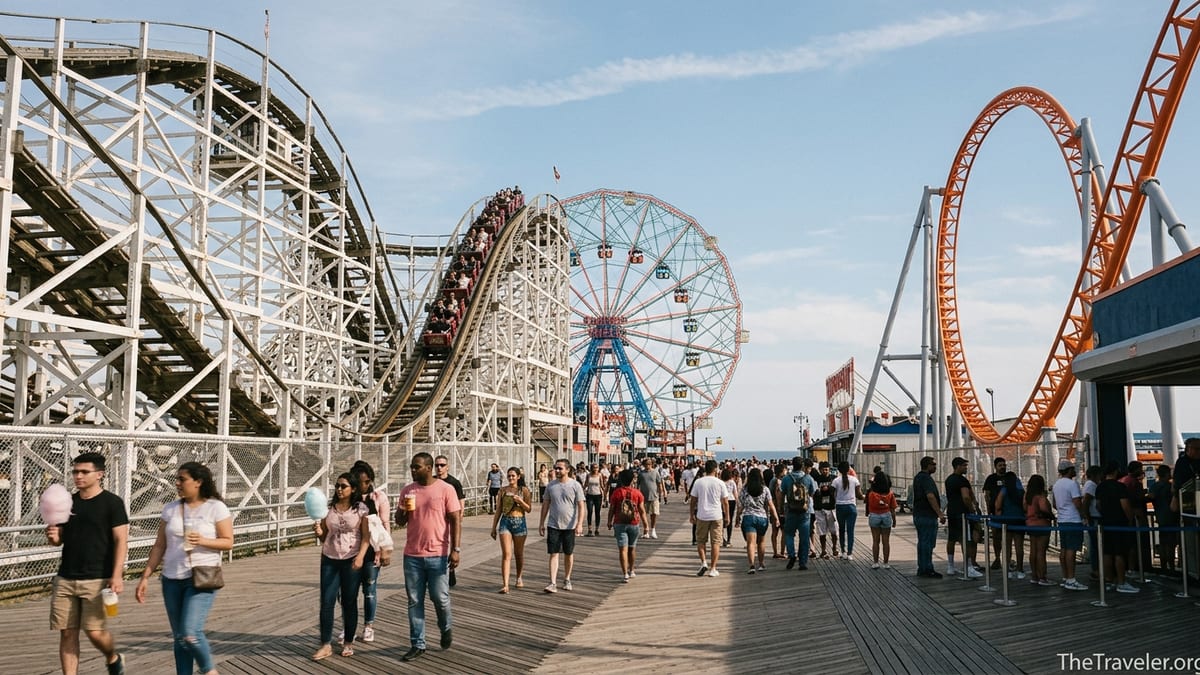
Coney Island is less a single theme park and more an entire seaside amusement district. For first-time visitors, that can be both thrilling and confusing. Rides are scattered between Luna Park, Deno’s Wonder Wheel Amusement Park, and a handful of independent attractions, all threaded along the famous Brooklyn boardwalk. With dozens of options and a limited amount of time, knowing which rides truly define the Coney Island experience can make the difference between an ordinary beach day and a classic New York memory.
How Coney Island’s Ride Scene Works Today
First-time visitors are often surprised to learn that Coney Island is not one enclosed theme park with a single gate. Instead, it is a historic amusement zone in Brooklyn that currently centers on two main operators: Luna Park and Deno’s Wonder Wheel Amusement Park, plus several standalone rides and games spread along Surf Avenue and the boardwalk. Both parks typically open for the season around late March or early April, ramp up to daily operations in summer, and then scale back to weekends in early fall, though exact dates vary by year and weather conditions.
Luna Park, operated by Italian ride manufacturer Zamperla, runs more than 30 attractions ranging from intense launch coasters to gentle family rides and kiddie areas. Deno’s Wonder Wheel Amusement Park, a family-run operation just a short walk away, focuses on a smaller collection of classic and family-friendly rides anchored by the landmark Wonder Wheel ferris wheel, in continuous operation for more than a century. Tickets are sold differently depending on whether you choose pay-per-ride credits or wristbands that bundle multiple attractions.
If you plan to concentrate on the major signature rides such as the Coney Island Cyclone, Thunderbolt, Phoenix, and the Wonder Wheel, budget for a mix of approaches. Luna Park frequently offers timed wristbands that cover a wide slate of rides but may exclude certain extreme attractions, while independent icons sometimes require separate payment per ride. On a peak summer Saturday, a typical first-time visitor might easily spend the equivalent of several individual ride tickets just to experience the handful of classics that appear in most guidebooks.
Because of Coney Island’s coastal location, operations can be affected by strong winds, thunderstorms, or chilly early-spring temperatures. Local news outlets regularly report on pre-season inspections and note that some attractions, especially those using hydraulics or complex coaster systems, may need warm-up periods before opening for the day. To get the most from a first visit, plan to arrive by late morning, check which key rides are operating, and tackle the biggest coasters before queues and afternoon sea breezes build.
Coney Island Cyclone: The Essential Wooden Coaster
If you ride only one attraction at Coney Island, make it the Coney Island Cyclone at Luna Park. This wooden roller coaster, dating back to the 1920s, is one of the most famous coasters in the world and a designated New York City landmark. Its out-and-back layout, clattering wood structure, and tight, abrupt turns deliver a style of airtime and lateral forces that feels very different from smooth modern steel coasters. Many coaster enthusiasts consider a front-seat ride on the Cyclone a rite of passage, describing it as rough in places but still remarkably powerful for its age.
For a first-timer, the experience starts even before the lift hill. The station sits close to Surf Avenue, so you can hear the rumble and screams as trains dive toward the street. Restraints are simple lap bars, and the loading crew is famously efficient, often dispatching trains at a brisk pace. Once the chain pulls you up the 85-foot lift hill, you get a quick, sweeping view of the Atlantic Ocean, the boardwalk, and the patchwork of rides below. Then the first drop and ensuing series of small hills and quick turns deliver a rapid-fire sequence that lasts roughly a minute and a half but feels longer because of the intensity.
In recent years, the Cyclone’s maintenance has included track work and safety upgrades, and like any aging wooden coaster it sometimes closes for inspections or repairs. For example, mechanical issues discovered during routine checks have occasionally paused operations for part of a season while parts are replaced or reconditioned. First-time visitors should check on-the-day signage or the park’s official channels to confirm that the ride is open, particularly early or late in the season. If you have flexibility, riding earlier in the day tends to mean shorter waits, as lines can stretch down the midway on sunny summer afternoons.
Because the Cyclone is more intense and jarring than most modern family coasters, it is best suited to guests who are already comfortable with traditional roller coasters. If you are nervous, consider starting in the middle of the train rather than the very back, where the drops and laterals feel sharpest. Many locals recommend holding onto the lap bar with one hand, bracing with your feet, and relaxing your shoulders rather than tensing up. With these simple techniques, even cautious riders often walk away saying the Cyclone was a highlight of their New York trip rather than something to endure.
Thunderbolt and Phoenix: Modern Thrills on the Boardwalk
While the Cyclone represents Coney Island’s past, Thunderbolt at Luna Park and Phoenix at Deno’s Wonder Wheel Amusement Park showcase its modern thrill ride side. Thunderbolt is a steel coaster that towers over the boardwalk with a vertical lift and a beyond-vertical first drop. Its bright support structure and boxy track profile are visible from the subway platforms as you arrive. Riders are secured with soft over-the-shoulder vest restraints, then ascend a narrow vertical tower before plunging into a twisting sequence of inversions and dive loops that many visitors compare to compact European-style thrill coasters.
Reviews from coaster fans are mixed but generally agree that Thunderbolt delivers strong elements and memorable views of the ocean. Some riders find the shoulder restraints can produce head or neck bumps if they brace too rigidly or ride in the very back row, so first-timers who are sensitive to roughness may prefer a seat closer to the front. On a busy Saturday, individual-ride prices for Thunderbolt are typically on the higher end of Luna Park’s pricing tier, comparable to the Cyclone. If you are purchasing a time-limited wristband, confirm whether Thunderbolt is included or requires extra payment, since policies can shift from season to season.
Across the midway at Deno’s Wonder Wheel Amusement Park, Phoenix is a suspended family coaster that opened in the early 2020s and has quickly become a favorite among locals. Built by Dutch manufacturer Vekoma, it sends riders in seat-mounted trains hanging below the track through swooping turns and banked curves without going upside down. The track rises above the surrounding midway, weaving near the Wonder Wheel and other attractions, so you get dynamic perspectives of the park and boardwalk as you fly past.
Phoenix is an excellent pick for first-time visitors who want something more intense than a kiddie coaster but less intimidating than Thunderbolt. The ride is generally praised for its smoothness and lack of harsh jolts, which makes it approachable for tweens and adults who might skip the biggest coasters. Because it is relatively new and has broad appeal, queues can form quickly on warm afternoons. If you are splitting your day between Luna Park and Deno’s, consider doing Thunderbolt and Cyclone first, then crossing to Phoenix by early afternoon before the family crowds concentrate there.
The Wonder Wheel: Classic Views and Eccentric Cars
No list of the best Coney Island rides would be complete without the Wonder Wheel, the 150-foot ferris wheel that anchors Deno’s Wonder Wheel Amusement Park and has operated in some form since the early 1920s. Unlike a standard ferris wheel with only fixed gondolas, the Wonder Wheel offers a choice between stationary cars and “swinging” cars that slide along internal tracks as the wheel turns. From the ground, you can see those inner cars gliding inward and outward, which creates a surprising swoop partway through each rotation.
For a first-time visitor who wants iconic Coney Island photographs, the Wonder Wheel is essential. The slow ride cycle, typically several minutes per rotation, gives you time to frame shots of the beach, the boardwalk, the Cyclone’s wooden lattice, and the Manhattan skyline faintly visible on clear days. Riders often comment that the experience feels more like a moving observation deck than a typical ferris wheel, especially in the non-swinging cars where you can stand or move slightly to change vantage points. If you are traveling with someone who is very nervous about heights, request a stationary car when you reach the loading platform.
The swinging cars add a dramatically different feel, especially on the descent as the car slides unexpectedly along the track. For some guests this is a thrill; for others, especially those prone to motion sickness, it can be unsettling. Families with younger children often compromise by riding once in a stationary car for the views and then deciding whether anyone wants to try a swinging car for a second round. Because each car holds multiple riders, the Wonder Wheel tends to offer better capacity than smaller attractions, and lines, while steady on weekends, usually move faster than queues for individual coasters.
As a historic ride, the Wonder Wheel is carefully inspected each off-season, with technicians often featured in local media climbing the structure for maintenance checks before opening day. The park occasionally hosts special events centered around the wheel, such as anniversary celebrations and the traditional “Blessing of the Rides” that marks the start of the season. If your trip coincides with one of these dates, you may find early-morning opportunities to ride with smaller crowds or to see local ceremonies at the base of the structure before the park fully opens.
Family Favorites: Spook-a-Rama, B&B Carousell and More
Coney Island is as much about nostalgia as it is about extreme thrills, and several attractions stand out as must-rides for families and visitors looking for classic amusement park charm. Spook-a-Rama, located at Deno’s Wonder Wheel Amusement Park, is a traditional dark-ride haunted house that dates back to the mid-20th century. Guests ride in small cars along a winding indoor track past animatronic figures, lighting effects, and jump scares that blend old-school carnival kitsch with updated props. While it may not rival modern theme park dark rides in scale, it delivers a distinct Coney Island flavor that many adults remember fondly from childhood visits.
For a gentler experience, seek out the B&B Carousell, a historic carousel located near the boardwalk that features hand-carved wooden horses and traditional band organ music. It operates as a separate attraction within the amusement district and is frequently cited by local historians as one of the “big three” classic rides alongside the Wonder Wheel and the Cyclone. The pace is calm enough for toddlers and grandparents alike, but the craftsmanship and atmosphere make it more than a simple children’s ride. Many first-time visitors choose to ride at sunset, when the carousel’s lights come on and the surrounding boardwalk begins to glow.
Luna Park also offers a range of family attractions beyond its headline coasters. Rides such as the Soarin’ Eagle flying coaster, milder spinning rides, and small drop towers give teens and adventurous adults additional options while younger children enjoy kiddie rides in dedicated areas. Some of these attractions can feel routine compared to the district’s icons, but they are useful for filling in gaps between bigger experiences, especially if you purchase a wristband that encourages trying as much as possible. Parents often report that their children’s favorite memories come not from the tallest coaster but from smaller rides they could do together multiple times without long waits.
For families with a wide age spread, one practical strategy is to set a short list of at least one must-ride attraction for each person. For example, a thrill-seeking teenager might prioritize Thunderbolt and Cyclone, while a younger sibling chooses the carousel and a kiddie coaster, and an adult relative requests the Wonder Wheel. Fitting all of those into a single afternoon is usually realistic as long as you arrive by midday and keep moving between parks rather than lingering too long at midway games or food stands before you have checked off the priority rides.
Planning Your First Ride Day: Tickets, Timing and Logistics
Because Coney Island’s rides are spread across multiple operators, planning ahead can save both time and money. Luna Park commonly offers several ticket products, including pay-per-ride credits and time-based wristbands valid for a few hours of unlimited access to many attractions. Some high-profile rides, especially the Cyclone and at times Thunderbolt, may be priced separately or consume more credits than smaller attractions. Before purchasing, scan the current ride list at the ticket booth or on official signage to confirm which options cover your personal must-rides.
Deno’s Wonder Wheel Amusement Park usually sells ride credits and individual tickets at its own booths, and the Wonder Wheel, Phoenix, and select other rides have fixed per-ride prices. While exact amounts change over time, visitors can expect that a handful of headline attractions may each cost roughly the price of a quick-service meal in the city, especially on peak summer days. If you are visiting with a group, decide whether to pool ride credits or purchase separate cards for each person to simplify splitting up. Keep in mind that wristbands sold for specific parks typically are not interchangeable between Luna Park and Deno’s.
On a busy weekend during July or August, lines for the Cyclone, Thunderbolt, Phoenix, and the Wonder Wheel can all reach 30 minutes or more by mid-afternoon. To minimize waits, aim to arrive shortly after the rides open for the day. A realistic first-timer itinerary might start with the Cyclone as soon as Luna Park opens, followed by Thunderbolt, a snack break, then a walk along the boardwalk to Deno’s for Phoenix, the Wonder Wheel, and Spook-a-Rama. After you have completed the essentials, you can circle back to try secondary rides, midway games, or explore the beach and New York Aquarium.
Transportation logistics are straightforward: most visitors reach Coney Island via the subway, with multiple lines terminating at Coney Island – Stillwell Avenue, a short walk from both major parks. In summer, trains can be crowded with beachgoers, so allow extra time in your schedule. If you drive, paid parking lots and metered street parking are available, but rates and availability vary sharply on hot weekends. Because ride closures due to weather or technical issues do occur, especially early in the season, it is wise to maintain some flexibility in your schedule. If a marquee coaster is temporarily closed when you arrive, check back periodically rather than waiting in front of a locked gate; crews often work quickly to restore operations when possible.
Safety, Comfort and Choosing the Right Ride for You
Modern Coney Island operates under New York City and state safety regulations, and both Luna Park and Deno’s Wonder Wheel Amusement Park subject their rides to regular inspections before and during the season. News reports about opening day often feature engineers checking track segments, coaster trains, and wheel components after the winter. That said, thrill rides always carry some level of risk and discomfort, so first-time visitors should pay attention to height and health advisories posted at each ride entrance. Attractions such as Thunderbolt and the Cyclone are not recommended for guests with certain medical conditions or mobility challenges.
Comfort is another important consideration, especially for visitors who are not regular coaster riders. Wooden coasters like the Cyclone inherently vibrate more than steel designs, which can be jarring for sensitive backs or necks. Steel coasters with over-the-shoulder restraints, such as Thunderbolt, can cause head contact with the restraint edges if you sit too loosely or brace too hard against forces. When in doubt, start with more moderate rides such as Phoenix or a spinning family coaster to gauge your tolerance, and observe trains on the bigger attractions before committing.
Weather also plays a role in safety and comfort along the Atlantic waterfront. Strong winds can trigger temporary ride closures, and chilly ocean breezes often feel more intense on high structures like the Wonder Wheel or atop the Cyclone’s lift hill, especially early in the season. Dressing in layers, securing hats and loose items, and using zippered pockets or locker rentals where available can prevent small mishaps from souring the experience. On very hot days, take advantage of indoor attractions like Spook-a-Rama and shaded seating near food stands to avoid overexposure while you wait for cooler evening hours.
Finally, listen to your own instincts and those of your group. Some visitors arrive intent on conquering every major coaster and then discover after the Cyclone that their thrill appetite is satisfied. Others start cautiously and end the day riding Thunderbolt multiple times. Coney Island’s variety is its strength: you can have a full, satisfying day focusing only on moderate rides and classic attractions, or you can chase high-intensity thrills from morning to night. The best ride lineup for a first-time visitor is the one that balances local must-dos with an honest assessment of what will leave everyone smiling rather than drained.
FAQ
Q1. What are the absolute must-ride attractions at Coney Island for a first visit?
The Cyclone wooden coaster, Thunderbolt steel coaster, Deno’s Wonder Wheel, Phoenix suspended family coaster, Spook-a-Rama, and the B&B Carousell are widely considered essential for first-timers.
Q2. How much time should I plan to spend riding at Coney Island?
Plan at least half a day, around four to six hours, to comfortably ride the main attractions and a few smaller rides without rushing, especially on summer weekends.
Q3. Is it better to buy ride credits or a wristband at Luna Park?
If you plan to ride many attractions, a timed wristband that covers most rides often offers better value, but check which headline coasters are included before purchasing.
Q4. Are Luna Park and Deno’s Wonder Wheel Amusement Park the same place?
No. They are separate parks within the Coney Island amusement district, each with its own ticketing. You can easily walk between them in a few minutes along the boardwalk.
Q5. Which Coney Island coaster is best for someone new to big rides?
Phoenix at Deno’s Wonder Wheel Amusement Park is usually the best starting point, as it is smooth, does not invert, and offers thrills without the intensity of Thunderbolt or the Cyclone.
Q6. When are lines for the major rides usually shortest?
Lines are typically shortest shortly after opening on weekdays and non-holiday Sundays. On peak Saturdays in summer, aim to ride the Cyclone and Thunderbolt before midday.
Q7. Can young children ride the Wonder Wheel and other classic attractions?
Yes, many classic rides, including the Wonder Wheel and carousel, offer options suitable for children, but height and supervision rules vary, so always check posted requirements at each ride.
Q8. What should I do if a ride like the Cyclone is closed when I arrive?
Check posted notices or ask staff whether the closure is temporary. Explore nearby rides such as the Wonder Wheel or Phoenix and return later, as many technical closures are resolved the same day.
Q9. Are there good non-ride activities near the parks?
Yes. You can walk the beach and boardwalk, visit the New York Aquarium, try arcade games, or sample local food like hot dogs and funnel cakes between rides.
Q10. Is Coney Island a good choice in cooler spring or fall weather?
Yes, as long as the parks are open, cooler days can mean shorter lines, but bring layers since ocean breezes make high rides like the Wonder Wheel and Cyclone feel colder than street level.