


Landing at Copenhagen Airport but heading straight to Malmö is one of the most efficient cross-border transfers in Scandinavia. The two cities are linked by frequent Øresund regional trains that run under Terminal 3 and cross the famous Øresund Bridge, putting you in central Malmö in around 25 to 35 minutes. Yet because this is also a Schengen border between Denmark and Sweden, there are a few extra things to know about tickets, passport checks and luggage before you roll your suitcase onto the platform.
Get the latest updates straight to your inbox!
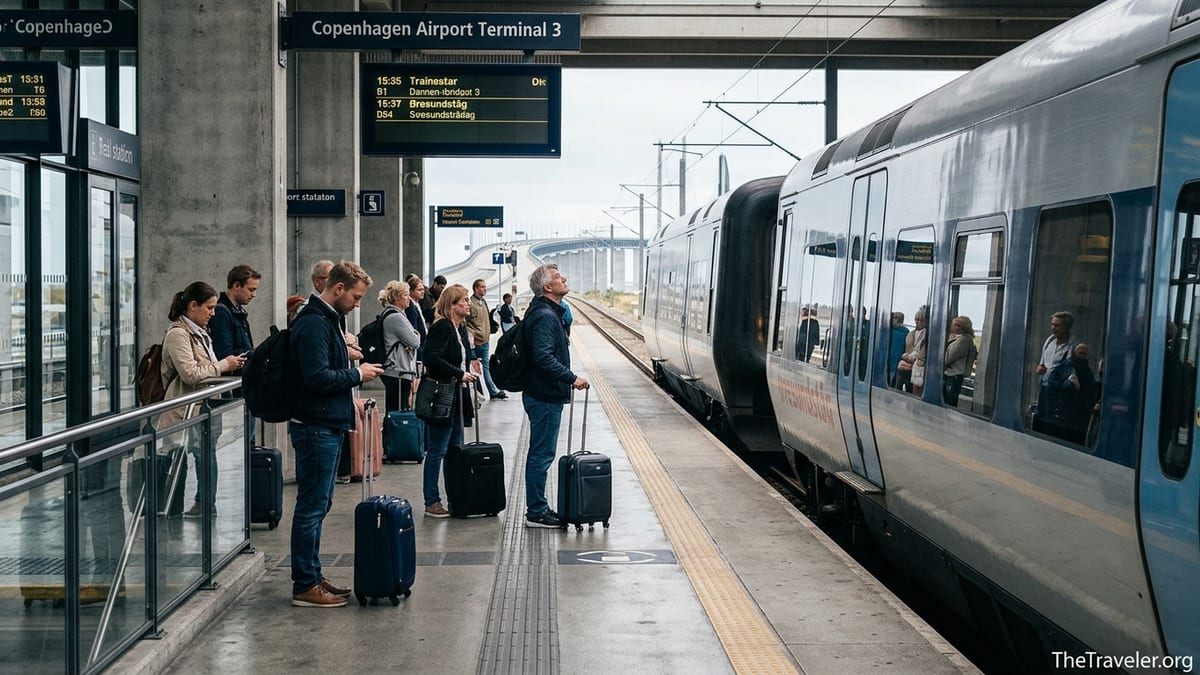
Why Use Copenhagen Airport for a Trip to Malmö
For most international travelers, Copenhagen Airport is effectively the main gateway to Malmö and southern Sweden. Copenhagen Airport handles far more long-haul and European flights than Malmö Airport, with multiple daily services from hubs such as London, New York, Paris and Dubai. When you factor in the short rail transfer, it is often faster and cheaper to fly into Copenhagen and complete the final leg by train than to hunt for a direct flight to Malmö.
The airport’s railway station is integrated directly into Terminal 3. After collecting your luggage, you walk into the arrivals hall, follow the train symbols and take an escalator or lift down to the platforms. There is no need for a shuttle bus or long walk outdoors, which is a relief if you have heavy bags or are arriving late at night in winter.
Travel time from Copenhagen Airport to Malmö Central is typically around 25 minutes on the direct Øresund regional trains, with an extra few minutes if you get off earlier at Hyllie or Triangeln. In practice, many Malmö residents treat Copenhagen Airport as their “local” international airport, commuting back and forth for work trips or weekend breaks.
A practical example helps put this in context. A traveler flying from Chicago to Malmö in July might only find awkward connections and higher prices via small European airports. By switching the search to Copenhagen and planning to take the train across the bridge, they could fly nonstop to Copenhagen, catch an Øresund train from beneath Terminal 3 and be at Malmö Central station in just over an hour from landing, including time for passport control and baggage claim.
The Direct Øresund Train Route From Copenhagen Airport to Malmö
The Øresundståg, often simply called the Øresund train, is the main rail link between Copenhagen and cities in southern Sweden. Trains run from Copenhagen Airport station through the Øresund fixed link to Malmö, often continuing further north to Lund, Helsingborg or Gothenburg. For airport passengers, the key section is a short, direct hop that feels more like a suburban commuter line than an international border crossing.
From Copenhagen Airport, Malmö is usually the first or second stop in Sweden. Typical station order is Copenhagen Airport, then across the bridge to Hyllie (first stop in Sweden), then Triangeln, then Malmö Central. If you are staying at a hotel near Malmö Central or in the old town, you will ride all the way to the terminus. If your accommodation is in the Hyllie area, such as near the Emporia shopping center or Malmö Arena, you simply get off at Hyllie instead and avoid doubling back.
Frequency is a major advantage. Øresund trains typically run every 15 to 20 minutes during the day, with slightly reduced frequency in late evenings and at night. Even if you miss one train because baggage took longer than expected, you rarely wait more than 20 minutes for the next departure. Night owls catching a red-eye flight from North America will still find trains running in the small hours, which is why many Malmö locals rely on this connection for early-morning flights from Copenhagen.
Schedules can change for planned engineering works, especially on weekends or during summer. On those occasions, transport operators may replace part of the route with buses or reroute services. It is worth checking a journey planner or the Stockholm-region operator’s app on the day of travel. If you are landing on a Saturday evening in August, for example, you might see that trains are running only to Hyllie with bus replacement on a short stretch, so planning a few extra minutes is wise.
Tickets: What to Buy, Where to Buy and Typical Prices
Buying a train ticket from Copenhagen Airport to Malmö is straightforward, but the exact options vary depending on whether you prefer apps, ticket machines or staffed counters. The most flexible solution for many visitors is to buy a standard Øresund train ticket from the airport to Malmö Central at one of the red DSB ticket machines in Terminal 3 or on the station concourse. These machines accept major credit cards and can be switched to English, which helps if you have just landed from overseas.
As of mid 2026, a one-way adult ticket for the airport to Malmö Central segment typically costs in the region of 120 to 150 Danish kroner or roughly 160 to 200 Swedish kronor, depending on currency and the seller’s exchange rate. Prices can vary slightly between operators and apps, and you may see rounded prices in euros on some international ticket platforms. Children, students and seniors often benefit from discounts when using Swedish regional transport apps, but those reduced fares generally require age or student ID if inspected.
Many travelers now prefer digital tickets. You can buy cross-border tickets through regional Swedish transport apps, the Øresund train website, or international booking platforms used for European rail journeys. For example, a traveler planning a city break in Malmö might book their entire rail journey from Hamburg to Malmö on a major ticketing platform and find that the final sector is explicitly shown as “Copenhagen Airport to Malmö Central by Øresundståg.” In that case they simply show the digital QR code when inspectors come through the train.
If you have accidentally bought a ticket starting from Copenhagen Central instead of Copenhagen Airport, all is not necessarily lost. In many cases the ticket covers the continuous Copenhagen to Malmö stretch, and conductors often accept it from the airport station as well because the train passes the airport on the way. That said, it is best not to rely on goodwill or old anecdotes. If you are unsure, ask at the DSB ticket office in Terminal 3, which can reissue or top up tickets so that you are correctly covered.
Border Checks, Passports and Schengen Rules on the Øresund Route
Both Denmark and Sweden belong to the Schengen Area, which normally allows passport-free travel within the zone. However, Sweden reintroduced internal border controls on its frontier with Denmark in 2015 and has periodically extended them for security reasons. In practice this means that passengers on the Øresund trains may be subject to identity checks when entering Sweden, usually by Swedish police boarding the train at Hyllie, the first station on the Swedish side.
These checks are not guaranteed on every train, and many regular commuters report long periods when their documents are never inspected. Nonetheless, travelers should plan as if they will be checked. Citizens of EU and Schengen countries should carry a valid passport or national ID card. Non-EU nationals, including visitors from the United States, the United Kingdom, Canada or Australia, should carry the passport they used to enter Schengen, along with any required visas or residence permits.
A typical real-world scenario illustrates how this works. You board at Copenhagen Airport with your luggage and sit near the doors. The train crosses the Øresund Bridge and rolls into Hyllie. Sometimes the doors open and everyone simply stays seated as passengers get on and off. Other times uniformed Swedish police officers enter the carriage, walking down the aisle and briefly inspecting passports and ID cards. The check is usually quick and polite, but if you cannot produce acceptable ID you may be asked to leave the train for further questioning.
There is an important distinction between immigration control for entering the Schengen Area and police checks between Schengen countries. If you are arriving at Copenhagen from outside Schengen, your first immigration and biometric check will be at the airport itself under the EU’s entry-exit system. Once in the Schengen Area, the Hyllie check is primarily a police identity control, not a second full immigration interview. However, the outcome is the same for travelers without proper documents: you can be refused entry to Sweden and sent back toward Denmark.
Practical Tips for Luggage, Seating and Onboard Comfort
The Øresund trains are set up as regional commuter services rather than long-distance expresses, but they are well suited to passengers with airport luggage. Carriages typically have wide doorways and low floors, which make it easy to roll suitcases on and off. Inside, you will find luggage racks near the doors and overhead shelves above many seats. On busy summer days and Sunday evenings, trains can be crowded with both travelers and commuters, so it is wise to keep bags close and visible.
If you are traveling with several large suitcases, try to board near the center of the train where there is more open space and at least one larger luggage area. Many regulars recommend staying within sight of your bags, particularly if there is a border check at Hyllie. During inspections, unattended luggage can cause alarm and may delay the train while officers verify ownership, so avoid leaving bags in a different carriage or far down the aisle.
For families, the short journey works in your favor. Parents arriving from overseas often report that children barely have time to settle with a snack or tablet before the train is crossing the bridge and the Malmö skyline comes into view. If you are pushing a stroller, aim for the doors with wheelchair and stroller symbols, where carriages usually have extra standing room and priority spaces.
Winter travel adds a few extra details. The platforms at Copenhagen Airport and Malmö stations are partially sheltered, but crosswinds from the Øresund can be intense. If you are changing layers after a long-haul flight, it makes sense to do so in the airport terminal rather than on the open platform. Once on the train, heating is effective, and the enclosed crossing under the bridge’s road deck means you are not exposed to the elements while moving between countries.
Using Copenhagen Airport as Your Main Gateway for a Malmö Stay
When planning a trip centered on Malmö, it is worth deciding early whether to treat Copenhagen Airport as your default arrival and departure point. For many itineraries, the answer will be yes. The combination of wide flight choice, competitive fares and a direct 25 minute rail link means the overall door-to-door time can beat flying into smaller regional airports with long layovers.
Consider a long weekend from New York to Malmö in September. Flights to Malmö might involve two connections, limited operating days and higher prices. In contrast, a nonstop overnight flight to Copenhagen combined with the Øresund train allows you to land in the morning, clear passport control, pick up your suitcase and be at your Malmö hotel around lunchtime. On the return leg, you can check out after breakfast, catch a late-morning train back to the airport and still have time for security and duty-free shopping before an afternoon departure.
There are, however, circumstances where Malmö Airport could make sense. If you find a direct low-cost flight from your European departure city to Malmö on the exact dates you need, and your accommodation is very close to the city, the simplicity of landing directly in Sweden may outweigh the hassle of backtracking through Copenhagen. Even then, many Malmö residents still compare options against Copenhagen, especially for longer trips where flight comfort and reliability matter more than staying strictly local.
For travelers combining Copenhagen and Malmö in a single trip, Copenhagen Airport remains the better arrival hub. You can spend a few nights in Copenhagen first, using local trains and metro from the airport, then continue to Malmö by Øresund train later in the week. Because the trains to Sweden depart from the same station under Terminal 3, there is no separate “international” station to worry about when you eventually fly home.
Common Pitfalls, Safety Notes and Money Matters
One of the most common mistakes visitors make is underestimating the importance of carrying valid identification even though both countries are in Schengen. People who are used to fully open borders elsewhere in Europe sometimes hop on the train with only a driver’s license, only to be caught out by a spot check at Hyllie. If you are a non-EU visitor, always keep your passport within easy reach in your daypack or coat pocket, not buried at the bottom of your largest suitcase.
Another avoidable pitfall is forgetting to validate or activate certain regional tickets when required. While most modern digital tickets on the Øresund route are sold ready to use for a specific connection or validity period, some local passes or paper tickets require stamping in a small machine before boarding. If you have bought a multi-zone pass or a Swedish regional ticket and see validation machines on the platform, ask a staff member or another passenger if you are unsure. Traveling on an unvalidated ticket during an inspection can result in a fine, even if you paid for it.
Petty crime levels on these trains are generally low, but standard city precautions apply. Keep wallets and phones in zipped pockets, especially when boarding or standing near doors where people move on and off quickly. If you set a suitcase in the door area racks, position yourself nearby or at least in a seat within clear line of sight. Travelers on online forums occasionally mention minor issues such as forgotten bags or brief confusion during border checks, but incidents of serious theft or aggression are rare.
On the money side, both Danish kroner and Swedish kronor are in use, and the euro is not the official currency in either country. Ticket machines at Copenhagen Airport generally accept major credit and debit cards, which is often the simplest payment method right after landing. If you are buying snacks or coffee at Malmö Central after arrival, card payments are widely accepted there as well. Many visitors complete an entire weekend in Copenhagen and Malmö without withdrawing physical cash, relying solely on cards and mobile payments.
The Takeaway
Traveling from Copenhagen Airport to Malmö by train is one of Europe’s most convenient cross-border hops. Direct Øresund trains run frequently from beneath Terminal 3, crossing the Øresund Bridge and reaching Malmö Central in around half an hour. With clear ticket options, simple station layouts and short journey times, it is a practical choice even for tired long-haul passengers with multiple bags.
The key is to treat the journey as both a routine commuter ride and a genuine international border crossing. Book or buy a valid ticket for the airport to Malmö segment, carry your passport or national ID card in easy reach and allow a small buffer in your schedule in case of a spot check at Hyllie. If you do that, Copenhagen Airport becomes a highly effective gateway for trips focused on Malmö and the wider Skåne region.
In real terms, this means you can comfortably plan a Friday evening arrival at Copenhagen, catch an Øresund train straight from the airport, check into your Malmö hotel before midnight and be ready for a full day of exploring canals, cafes and coastal paths on Saturday. On Sunday evening, another short train ride returns you to the terminal in time for your flight home. The journey is short, efficient and, with a bit of preparation, pleasantly uneventful.
FAQ
Q1. How long does the train from Copenhagen Airport to Malmö take?
The direct Øresund train from Copenhagen Airport to Malmö Central usually takes around 25 to 35 minutes, depending on intermediate stops and timetable on the day.
Q2. How often do trains run from Copenhagen Airport to Malmö?
During most of the day, Øresund trains run every 15 to 20 minutes between Copenhagen Airport and Malmö. Late at night and early morning the frequency can drop, but services usually continue through the night.
Q3. Do I need my passport for the train from Copenhagen Airport to Malmö?
Yes, you should carry a valid passport or national ID card. Sweden maintains internal border checks with Denmark, and Swedish police may board the train at Hyllie to verify identity, even though both countries are in Schengen.
Q4. Where can I buy train tickets at Copenhagen Airport?
You can buy tickets at DSB ticket machines and counters in Terminal 3 and on the station concourse under the terminal. Many travelers also use official transport apps or international rail booking platforms to buy digital tickets in advance.
Q5. How much does a ticket from Copenhagen Airport to Malmö usually cost?
As a broad guide, a one way adult ticket typically costs somewhere in the range of 120 to 150 Danish kroner or about 160 to 200 Swedish kronor, depending on the seller and exchange rate.
Q6. Is the train from Copenhagen Airport to Malmö safe at night?
The route is generally considered safe, including in the late evening. Normal city travel precautions apply: keep valuables secure, stay aware of your surroundings and keep luggage within sight.
Q7. Can I use Copenhagen Airport as my main airport for a Malmö trip?
Yes. Many Malmö residents and visitors treat Copenhagen Airport as their primary international airport because it has many more flights and a quick direct train connection to Malmö.
Q8. What happens during border checks at Hyllie?
If Swedish police conduct checks, they board the train at Hyllie, walk through the carriages and briefly inspect passports or ID cards. Trains may pause for a few extra minutes, but inspections are usually quick and orderly.
Q9. Do I need to reserve a seat on the Øresund train?
No, the Øresund trains operate as regional services without compulsory seat reservations. You simply board with a valid ticket and choose any available seat or standing space.
Q10. What if there are engineering works or disruptions on the route?
During planned works, operators may replace sections of the line with buses or adjust timetables. Check a local journey planner or transport app on the day of travel and allow extra time if you are heading for a flight or a fixed appointment.