


Copenhagen Airport can feel surprisingly compact when you are walking through it, yet confusing when your ticket simply says “CPH” and does not clearly mention Terminal 2 or Terminal 3. Both terminals are physically connected and share the same airside area, but they work quite differently on the landside for check-in, arrivals and ground transport. This guide explains, in practical terms, which terminal you actually need and how to move smoothly between them.
Get the latest updates straight to your inbox!
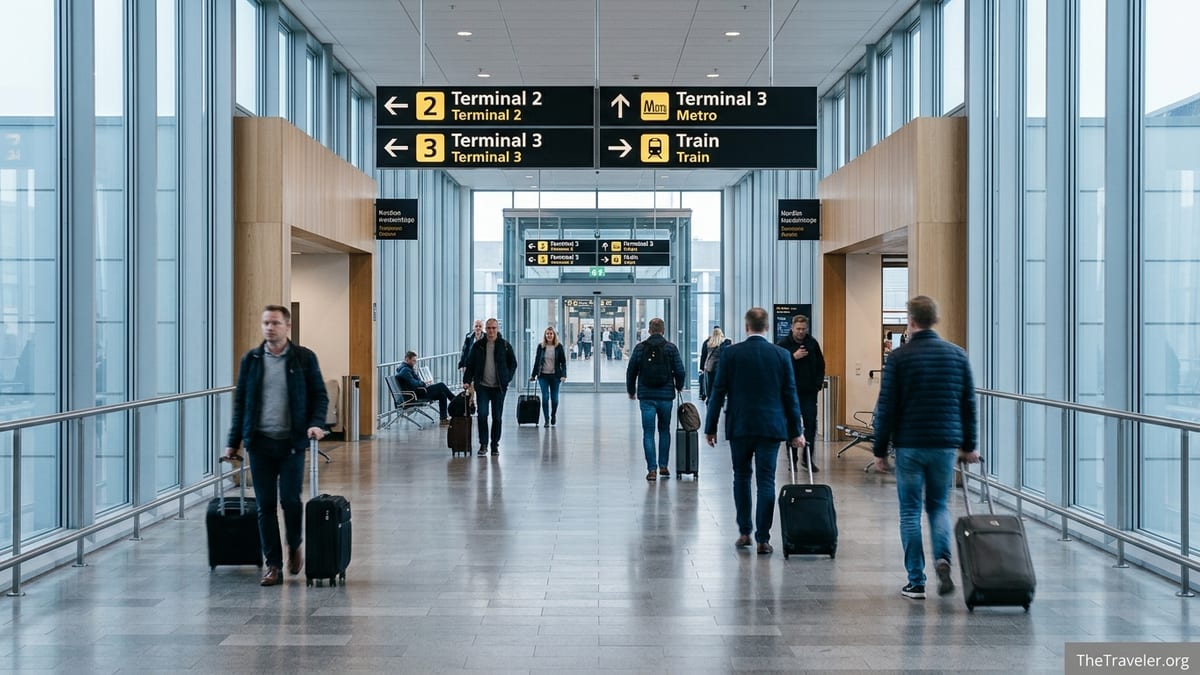
Terminals 2 and 3 at a Glance
Copenhagen Airport has two active passenger terminals for check-in: Terminal 2 and Terminal 3. All flights, whether on Scandinavian Airlines, low-cost carriers like Norwegian and easyJet, or long-haul operators such as Emirates or Qatar Airways, use one of these two terminals. Once you pass security, there is a single shared departures area with piers A through F, so the terminal listed on your ticket matters mainly for check-in and bag drop, not for your departure gate.
On the ground level, Terminal 2 and Terminal 3 sit side by side, linked by a bright indoor arcade. Most international travelers first encounter Terminal 3, because this is where the main arrivals hall, baggage claim and railway/metro station are located. Terminal 2 is slightly further along the same building complex, a short walk of a couple of minutes from Terminal 3.
The simplest way to think about it is this: Terminal 3 is the ground transport and arrivals hub, while Terminal 2 is primarily an additional check-in and bag-drop area. For example, if you land from New York with SAS you will walk into Terminal 3 arrivals, and if the same day you depart to Paris with Norwegian, you will likely check in at Terminal 2 and then use the shared central security between the two.
Because there is one common security checkpoint and one shared airside concourse, moving between terminals is mostly a matter of walking, not re-clearing security. This is particularly reassuring if you have a tight connection like 55 minutes between two SAS flights: you might arrive at a C-gate connected to Terminal 3 but depart from a B-gate associated with Terminal 2 without ever seeing a “terminal change” sign, just normal wayfinding to your next gate.
Which Terminal Do You Actually Need?
Your boarding pass or booking confirmation is usually the most reliable source for which terminal you need at CPH. Many airlines specify “Terminal 2” or “Terminal 3” next to the flight number. For instance, SAS short-haul flights often use check-in in Terminal 3, while budget carriers such as Norwegian or Ryanair commonly use counters in Terminal 2. However, exact allocations can change seasonally, and code-share flights might use a different terminal from what you expect, so always double-check on the airport’s departure screens when you arrive.
If your airline or app simply says “Copenhagen Airport” without a terminal, a good rule of thumb is to start in Terminal 3. This is where you emerge if you arrive by train or metro, and it has extensive self-service check-in kiosks for many airlines. For example, if you are flying Lufthansa to Frankfurt, you can often use a generic Star Alliance self-service kiosk in Terminal 3, print your boarding pass, then follow signs either to a specific bag-drop area in Terminal 2 or to security if you have hand luggage only.
Passengers on long-haul flights with large legacy carriers often check in at Terminal 3. Think of airlines such as Emirates, Qatar Airways, or Singapore Airlines, whose counters are typically grouped nearer the main arrivals and rail station hub in Terminal 3. In contrast, European leisure and low-cost operators like Vueling, Transavia, or Sunclass Airlines more frequently use the check-in island clusters in Terminal 2. If you arrive and find you are at the wrong terminal, do not panic: walking from one set of counters to the other usually takes less than five minutes.
For connecting passengers, the “terminal” matters far less than the “zone” of your gate. Schengen flights typically use piers A, B and some C gates, while non-Schengen flights use C, D, E and F. The main extra step for a non-Schengen connection is passport control, not switching terminals. For example, if you fly from Paris to Copenhagen and then connect to Chicago with SAS, you might land at an A gate, pass through passport control toward the C or D gates, and never think about whether that connection corresponds to Terminal 2 or 3 landside.
Check-in, Bag Drop and Departures: T2 vs T3
Both Terminal 2 and Terminal 3 offer full check-in facilities, including staffed counters, self-service kiosks and bag-drop machines. The busiest check-in islands are in Terminal 3, facing directly toward the exit to the train and metro station. Here you will find long banks of desks serving carriers like SAS and other Star Alliance partners, plus self-tagging bag-drop machines that can significantly speed up your departure if you have already checked in online.
Terminal 2 has its own cluster of check-in counters laid out in several zones. This area is particularly used in the morning and late afternoon waves when low-cost and holiday airlines operate multiple departures to southern Europe. You might see queues for flights to Malaga, Alicante or Athens stretching toward the entrance, but even then, the distance from the far end of Terminal 2 to security is short compared with many larger European hubs. Because of this compact layout, travelers with early-morning departures at 6:00 or 7:00 often find that arriving 2 hours before departure is comfortable, although during peak school holiday periods some prefer 2.5 to 3 hours.
Departures boards are spread across both terminals, and you can use any of them to locate your check-in zone regardless of terminal. Imagine arriving by train into Terminal 3 for a Norwegian flight that checks in at Terminal 2. You would step off the escalator from the station, look up at the big central departures board in Terminal 3, see “Norwegian – Oslo – Check-in 87–94, Terminal 2,” then follow simple overhead signage along the indoor corridor. Two or three minutes later you are standing in front of the correct check-in island in Terminal 2.
If you are traveling with hand luggage only, you can often skip the check-in desks entirely. Many airlines that operate from Terminal 2 still allow you to use the self-service machines in Terminal 3, print your boarding pass or scan your phone, then walk straight toward the shared security control between the two terminals. This is especially useful if you are arriving at the airport by metro late in the evening, when some counters may have shorter opening hours than the self-service area.
Security and the Shared Airside Area
One of the most important features of Copenhagen Airport is that it has a single central security checkpoint located between Terminals 2 and 3. No matter which terminal you check in at, you will use this same security area to enter the airside departures zone. This design keeps walking distances relatively short and means you do not have to worry about choosing the “correct” security line for your airline.
The central security hall has multiple lanes, including CPH Express fast-track lines at each end, which airlines offer to business class and status passengers. In practice, you approach security from either the Terminal 2 side or the Terminal 3 side, depending on where you just checked in. For example, if you dropped your bag with SAS in Terminal 3, you walk a short distance along the arcade and then veer left into the main security entrance. If you checked in with a leisure carrier in Terminal 2, you approach from the opposite side but still end up funneled into the same central checkpoint.
After security, the old distinction between Terminal 2 and Terminal 3 disappears. You emerge into a unified shopping and dining area with duty-free, cafes and restaurants, then continue toward your gate zone. Piers A and B spread to one side, serving mostly Schengen destinations like Oslo, Stockholm and Amsterdam. Piers C, D, E and F extend in the other direction for longer-haul and non-Schengen flights, including services to the United Kingdom, North America and Asia. Walking from the middle of the duty-free area to the furthest F-gates can take 15 to 20 minutes at a normal pace, so build in time if you have an onward connection from one extreme of the airport to the other.
While security technology and staffing can vary over time, wait times at Copenhagen are usually moderate compared with some larger hubs. On an ordinary weekday morning, a typical traveler might spend 10 to 25 minutes from joining the queue to emerging airside, though this can be longer at school-holiday peaks. The key point for planning is that your security experience does not depend on whether you used Terminal 2 or Terminal 3 for check-in; all passengers funnel through the same system and reach the same departure hall.
Arrivals, Baggage Claim and Meeting Points
Almost all international passengers arrive into Terminal 3 on the landside, regardless of where they departed from. After landing, you will walk through the airside concourse, pass passport control if needed, and then follow the “Baggage Claim” signs down to the carousels located directly behind the Terminal 3 arrivals hall. Once you have collected your luggage and walked through customs, you emerge into a spacious public area with cafés, car rental desks, ticket machines and the main exit doors.
If someone is meeting you at the airport, they will almost always wait in Terminal 3. The arrivals hall is clearly signposted, and there are designated meeting points close to the information desk. For example, a common arrangement for visiting families is to agree to meet at the big central arrivals board or near a recognizable café chain in Terminal 3. Because both terminals are connected, a person arriving at Terminal 3 can still easily walk over to Terminal 2 check-in to meet friends who are departing.
Although there are some facilities landside in Terminal 2, they are fewer than in Terminal 3. You will find a handful of cafés, ATMs and service counters, but the densest cluster of services remains near the arrivals and transport hub. If you land late at night and need to buy a SIM card, get cash or ask for assistance with onward travel, your first stop should be the Terminal 3 arrivals area before you consider walking elsewhere.
For travelers with reduced mobility or heavy luggage, the airport provides assistance services and relatively short walking distances between key points. The official guidance notes that the walk from the metro and train station to the check-in areas is roughly 75 to 100 meters for Terminal 3 and around 250 meters for Terminal 2. If this is a concern, you may prefer airlines operating from Terminal 3 or request mobility assistance in advance so that staff can help you move between terminals comfortably.
Metro, Train, Bus and Taxi: Why Terminal 3 Matters
All rail connections at Copenhagen Airport converge in one place: Terminal 3. The airport railway station is located directly beneath the arrivals hall, and the Lufthavnen metro station is attached at the far end of Terminal 3 on an upper level. As a result, whether you arrive or depart via Terminal 2 or 3, you will almost certainly pass through Terminal 3 to catch your onward metro, regional train or intercity service.
The metro, on line M2, runs 24 hours a day and is one of the fastest ways to reach the city center. In normal daytime conditions, the ride to Nørreport, a key downtown interchange, takes about 15 minutes. Metro trains depart every few minutes during the day and slightly less frequently at night. At the airport, the metro platforms are located in a glass-roofed hall connected directly to the Terminal 3 building. You simply follow the “Metro” signs up an escalator or elevator from the arrivals area, purchase a ticket from machines before the gates if needed, and board the next train.
Regional and intercity trains also depart from Terminal 3, using platforms beneath the same central area. These trains connect the airport to Copenhagen Central Station in just under 15 minutes, typically with at least four departures per hour during the day, as well as to destinations across Zealand and onward to Sweden via the Øresund Bridge. For example, if you are heading straight from the airport to Malmö, you would follow signs to “Trains,” go down one level from Terminal 3 arrivals, buy a ticket for the Øresund train, and board at the clearly marked platforms serving Sweden-bound services.
Buses and taxis also cluster around Terminal 3. Public city bus routes stop just outside the arrivals exit, while airport coaches and some regional buses use bays nearby. Taxis line up in front of the terminal, and there are clear signs in English and Danish directing you toward the official taxi ranks. Because all these ground transport options are centered on Terminal 3, passengers who check in at Terminal 2 for departure will often arrive at the airport through Terminal 3 first, then walk to Terminal 2 along the indoor corridor.
There are a few practical consequences of this layout. If you are catching an early-morning flight from Terminal 2, you might still plan your arrival around train or metro timings to Terminal 3, then allow an extra 5 to 10 minutes to walk to your check-in area. Similarly, if your inbound flight used Terminal 2 for check-in at the origin, you will still reclaim your bags in Terminal 3 and access the train and metro there, so you can safely tell anyone picking you up that you will come out through Terminal 3 arrivals.
Walking Between Terminal 2 and Terminal 3
Moving between Terminal 2 and Terminal 3 at Copenhagen Airport is straightforward: you walk. The two terminals are connected by a covered indoor arcade on the landside, lined with shops, cafés and seating areas. Walking at a relaxed pace, most travelers cover the distance from the central arrivals area in Terminal 3 to the middle of the Terminal 2 check-in zone in about 3 to 5 minutes. There are no shuttle buses or trains involved, and you do not need to show a boarding pass to walk between them on the public side.
On the airside, the terminals are not physically separated at all. Once you have passed through the central security checkpoint, you are effectively in a single large departures building. If your boarding pass says “Terminal 2” but your gate begins with a C or E, you will simple follow gate signs from the central duty-free area, without any indication that you are “changing terminals.” Travelers connecting from one flight to another usually focus only on whether they need to pass passport control when moving between Schengen and non-Schengen zones, not on any terminal label.
For example, consider a traveler arriving on an Emirates flight from Dubai that uses a non-Schengen D or E gate. After disembarking, they pass through passport control and then walk toward baggage claim, eventually emerging into Terminal 3 arrivals. If that same traveler has a separate low-cost ticket on Norwegian to Oslo departing later in the day from Terminal 2, they would follow the signs from arrivals up to the check-in level, walk through the arcade to Terminal 2, check in with Norwegian, and then return through the same shared security to the airside concourse. At no stage do they need to go outdoors or navigate buses.
Travelers with heavy luggage carts can push them easily along the smooth floors between terminals, and there are clear pictogram signs above head height showing directions to “Terminal 2,” “Terminal 3,” “Check-in,” “Arrivals,” and “Train/Metro.” If you are unsure which way to go, airport staff members in bright vests are usually stationed near the central information points in the arcade and can point you to your correct terminal within seconds.
The Takeaway
The most important thing to remember about Copenhagen Airport is that Terminals 2 and 3 are two faces of a single, compact hub. Terminal 3 is your anchor point: it holds arrivals, baggage claim, the metro and train station, and the largest cluster of services. Terminal 2 is primarily an additional check-in and bag-drop area just a short walk away along an indoor corridor. Once you clear the shared security checkpoint, the distinction between terminals disappears entirely.
If you land and are unsure where to go, head for Terminal 3 arrivals and ground transport. If you are departing and not certain which terminal your airline uses, follow signs to Terminal 3 first, check the big departures boards, and then walk to Terminal 2 if needed. Walking times are short, and there is no need for buses or shuttles between terminals. With this mental map in mind, Terminal 2 vs Terminal 3 stops being a source of stress and becomes just a detail in an otherwise efficient Nordic travel experience.
FAQ
Q1: How do I know if my flight uses Terminal 2 or Terminal 3 at Copenhagen?
Check your booking confirmation or boarding pass, where the terminal is often listed next to the flight number. If it is not shown, use the airport departure screens on arrival at Terminal 3, which display each airline’s current check-in area and terminal.
Q2: Can I walk between Terminal 2 and Terminal 3 without going outside?
Yes. The two terminals are linked by an indoor arcade on the landside, and walking between them typically takes 3 to 5 minutes at a normal pace.
Q3: Do Terminal 2 and Terminal 3 have separate security checkpoints?
No. There is a single central security checkpoint located between the two terminals. All departing passengers, regardless of airline or terminal, use this shared security area.
Q4: If I arrive on one airline and depart on another, do I need to change terminals airside?
Not in a traditional sense. After security, Terminals 2 and 3 share the same departures area. For connections, you simply follow gate and, if necessary, passport control signs, without worrying about terminal labels.
Q5: Which terminal should I use to catch the metro or train into Copenhagen city center?
Both the metro and mainline trains depart from stations integrated with Terminal 3. Even if you checked in at Terminal 2, you will walk through Terminal 3 to reach the rail platforms.
Q6: Is Terminal 2 or Terminal 3 better for passengers with reduced mobility?
Terminal 3 is slightly closer to the metro and train station and hosts arrivals, making it a bit more convenient overall. However, distances are relatively short in both terminals, and dedicated assistance services can help you move between them.
Q7: Can I check in at Terminal 3 for a flight that departs from a Terminal 2 gate?
In many cases, yes. Numerous airlines allow you to use self-service kiosks in Terminal 3 even if their primary check-in counters are in Terminal 2. Always follow the check-in instructions from your airline, but do not worry if the gate and terminal labels differ.
Q8: Where should someone pick me up if I am arriving at Copenhagen Airport?
They should head to Terminal 3 arrivals, which is where baggage claim and customs exit are located for most flights. From there, you can walk together to Terminal 2 or the parking areas if needed.
Q9: How early should I arrive at Copenhagen Airport for departure?
For most European flights, arriving around 2 hours before departure is usually sufficient outside of peak holiday periods. For intercontinental flights or during busy school holidays, consider 2.5 to 3 hours to allow extra time for check-in and security.
Q10: Do I ever need a bus or shuttle between Terminal 2 and Terminal 3?
No. The two terminals are directly connected by covered walkways inside the main building. You simply walk between them; there is no internal shuttle bus or train required.