


Landing at Copenhagen Airport, most visitors immediately face the same question: should I take the train or the metro into the city centre? Both run directly from Terminal 3 and use the same tickets, but they are not identical. For many trips, especially if you are heading to Copenhagen Central Station or carrying heavy luggage, the mainline train is the smarter and more comfortable choice. This guide explains exactly how the airport train works, when it beats the metro, and what to expect step by step, from ticket machines and platforms to travel time and luggage handling.
Get the latest updates straight to your inbox!
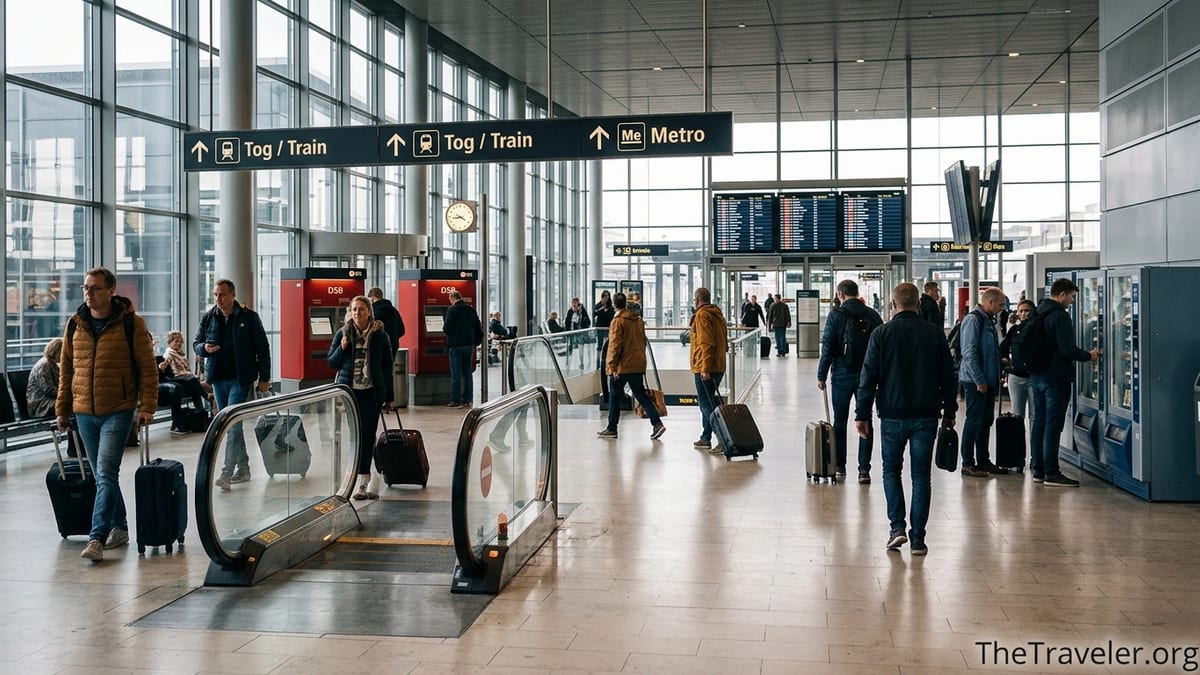
Overview: Train vs Metro from Copenhagen Airport
Copenhagen Airport sits directly on both the regional train and metro networks, which makes getting into the city quick and uncomplicated. The metro (line M2) runs 24 hours a day and is excellent for destinations like Kongens Nytorv, Nørreport, and Frederiksberg. The mainline train operated by DSB runs to Copenhagen Central Station, Nørreport, and Østerport in roughly similar times, often under 15 minutes from the airport. Both options depart from the same general area of Terminal 3, but they serve different types of journeys.
The key difference is that the metro is a light, driverless urban system with frequent stops and level boarding, while the train from the airport is part of the regional and intercity network. The train uses longer carriages, has more space for luggage between seats and doors, and connects directly to long distance and S-train services at Copenhagen Central Station. If you are staying around the Central Station, Vesterbro, the Tivoli area, or catching onward trains across Denmark or into Sweden, the train is usually the better door-to-door choice.
Another important point is that tickets and prices are integrated across metro, train, and bus. You do not pay extra for using the train instead of the metro within Copenhagen’s core zones. A standard city ticket that covers the three zones between the airport and central Copenhagen is valid on both. That means you can decide which is better purely on comfort, luggage, and where you need to end up, rather than on cost.
For visitors who value simplicity, think of it this way: metro if you are staying near Kongens Nytorv, Nørreport, or within the inner pedestrian area; train if you are heading to the Central Station, connecting to another train, or want more space for bags after a long flight.
Finding the Train at Copenhagen Airport
Both the metro station and the railway platforms are attached to Terminal 3, which handles most international arrivals. After you leave baggage claim and walk into the arrivals hall, simply follow the signs marked “Train” and “DSB” for the mainline trains. You do not need to go outside. The railway station is located one level below the arrivals hall, connected by escalators and lifts, while the metro is at the far end of the same hall on an upper level.
As you walk straight out of customs into Terminal 3, you will see a large central information board and a cluster of ticket machines and service points beneath it. The main tunnel down to the airport railway platforms is close to this area. Overhead signs show train symbols and indicate directions to “Copenhagen H” (Copenhagen Central Station), as well as Sweden-bound services such as Malmö and Lund. The walk from the arrivals doors to the train platforms typically takes three to five minutes at a normal pace with luggage.
The airport railway station has side and island platforms that serve different directions. On recent layouts, the platform signed for trains to Sweden generally sits on one side, while the platform for trains into Copenhagen and beyond is on another. Information screens at the top and bottom of the escalators clearly show which platform serves “København H” and other central stations. If in doubt, make a quick check of the large departure boards which list the next trains, their platform numbers, and all major stops.
Because the airport also serves long distance services toward Jutland and regional trains over the Øresund Bridge, the station can appear busy at peak times. The good news is that signage is multilingual and designed for international travellers. Announcements are typically made in Danish and English, and staff in the DSB service area at Terminal 3 can answer questions in English if you are unsure which platform or type of train you need.
Tickets, Zones, and Real-World Prices
Copenhagen uses a unified, zone-based ticket system, which means the same ticket works on the metro, trains, and city buses. The airport sits in an outer zone compared with the historic centre, so a trip from Copenhagen Airport to central stations like Copenhagen Central, Nørreport, or Kongens Nytorv requires a multi-zone ticket, usually three zones. This is the same whether you take the metro or the train, and you do not need separate tickets if you change between them within the ticket’s time validity.
As of mid 2026, a typical single adult ticket from the airport to central Copenhagen purchased from a machine costs in the region of a few tens of Danish kroner. Travel cards and passes bring the per-journey cost down. For example, a 24-hour or 72-hour city travel card that covers the airport zones may be good value if you plan to ride public transport several times a day. Many city passes marketed to visitors, such as tourist cards that include attractions, also cover unlimited rides on the train and metro between the airport and the city, which can quickly pay off if you are visiting multiple museums and using public transport daily.
You can buy tickets in several ways. The most common are red DSB ticket machines in the Terminal 3 arrivals area and in the station hall, which accept international credit and debit cards and let you choose English on the first screen. There are also blue Rejsekort machines for Denmark’s reusable smart card system, but these are mostly designed for residents or frequent visitors. Occasional travellers typically stick to single-use tickets, time-limited passes, or mobile tickets purchased through official apps such as DOT or DSB. Many visitors find it easiest to buy a mobile ticket through the DOT app once they have data service, as it shows the exact zones and price for their journey and avoids figuring out the zone map on the spot.
For a concrete example, imagine you are staying two nights near Tivoli Gardens and plan to use public transport a few times a day. Buying two separate airport trips plus single fares around the city may quickly add up. In that case, a 72-hour city travel pass that includes the airport zone means you tap or carry one product for your airport train ride, sightseeing around the city, and the return trip back to the airport. On the other hand, if you are in town only for a few hours between flights and will make just two rides, single tickets from the machine to and from the airport are usually simpler and more economical.
On the Platform and Onboard: What to Expect
Once you have your ticket in hand or your mobile ticket activated, you can proceed to the platform indicated on the departure board. At Copenhagen Airport’s railway station, information screens above the platforms clearly show the line number, destination, and intermediate stops. For central Copenhagen, look for services that list København H, Nørreport, or Østerport as early stops. Many trains continue beyond Copenhagen, for example toward Helsingør or other Zealand towns, but you simply get off at the central station that suits you.
The platforms are equipped with lifts and escalators, so handling suitcases is usually straightforward. Yellow or white markings on the platform edges show where to stand safely, and speakers announce approaching trains several seconds before they arrive. Because these are regional and intercity trains, doors do not open automatically on every carriage in all cases. Look for a large door button at waist height and press it once the lights indicate boarding. In most modern DSB trains, the doors open level with the platform, which makes it relatively easy to wheel luggage straight on.
Inside the train, you will typically find two seating classes, marked as standard and first class in Danish and English. Most visitors use standard class, which has open coaches with 2+2 seating. Luggage racks are usually located near the doors and occasionally between seat blocks. Overhead racks above the seats accommodate handbags and small backpacks, while large suitcases are better placed in the floor-level racks where you can keep them in sight. Because airport trains often carry people with baggage, it is common to see several suitcases clustered by the doors of each carriage, so arriving a few minutes early can help you secure a convenient spot for yours.
Travel time from Copenhagen Airport to Copenhagen Central Station is typically a little under 15 minutes when the rail network is running normally. To illustrate, a regional train might leave the airport, stop briefly at Tårnby and possibly Ørestad, then continue directly to Central Station. From there, S-train and long distance connections depart from adjacent platforms, and you can change to the City Ring metro via an underground passage. If you are heading to Nørreport, staying on the same train for another three or four minutes saves you changing to the metro at Central. This directness is one of the reasons many travellers prefer the train over the airport metro when their accommodation is close to these mainline stations.
When the Train Beats the Metro
Although the metro from Copenhagen Airport is well marketed and runs continuously, there are many situations where the train is simply the better choice. The most obvious is when you are heading to an address near Copenhagen Central Station, Vesterbro, or the area around Tivoli Gardens. In that case, the train drops you directly at the main station in under 15 minutes, and from there it is an easy walk to many hotels such as those on Vesterbrogade or near the main entrance to Tivoli. Taking the metro instead would require changing onto another line or walking farther from stations like Kongens Nytorv or Nørreport, which can be tiring with luggage.
The train also wins for onward rail connections. If you are catching a long-distance service to Odense, Aarhus, Aalborg, or even international trains further into Sweden or continental Europe, going by train from the airport to Copenhagen Central Station keeps you on the railway network the whole time. You can step off your airport train, check the big departure board inside the station, and move to the platform for your next service without switching to the metro system at all. This is especially useful if you are managing several suitcases or traveling with children and want to minimise changes.
Luggage and comfort are another factor in favour of the train. Metro carriages are modern and clean, but they are also narrower and designed for short urban hops, which means they can feel crowded at peak times. The airport train’s larger coaches, more generous luggage areas, and mix of seated and standing space make it easier to settle in after a long flight. Families often prefer being able to secure seats together around a table, while solo travellers appreciate a quiet corner near the window. On a real-world winter evening, for instance, when commuters and airport passengers fill the metro to capacity, the parallel train service to Central Station can feel noticeably less congested.
Finally, disruptions on the metro sometimes make the train the more reliable choice. When planned engineering works or unexpected issues reduce metro frequencies or require replacement buses, public transport announcements often advise using the train between the airport and Central Station instead. Because the two systems run in parallel for this key corridor, the train offers a strong backup option and helps ensure you can still reach the city centre on time even if one mode is temporarily compromised.
Copenhagen Central Station: Arrivals, Exits, and Connections
Arriving by train from the airport, you will pull into Copenhagen Central Station, locally known as København H or Hovedbanegården. This is Denmark’s largest railway hub and a major landmark in its own right, with a high arched roof and multiple island platforms. As you step off the train, overhead signs indicate exits to the main concourse, S-train platforms, and the metro. Most visitors follow the flow of passengers through the tunnel or up the stairs to the main hall, where you will find ticket machines, information boards, food outlets, and small shops.
If your destination is nearby, you may not need any further transport at all. Popular hotels such as those along Vesterbrogade, the Tivoli area, and streets immediately behind the station are within a five to ten minute walk. The main entrance on Banegårdspladsen opens almost directly toward Tivoli Gardens and City Hall Square, while the back exit on Reventlowsgade leads into Vesterbro. For example, a traveller staying at a hotel just off Vesterbrogade can walk from the train platform to their reception desk in roughly ten minutes, avoiding the extra metro ride they would need if they had come into town via Kongens Nytorv.
For onward city travel, the station offers several options. S-train services depart frequently from dedicated platforms, serving suburban districts and outer neighbourhoods. The City Ring metro lines can be reached through an underground connection that avoids going outside, which is helpful in cold or wet weather. City buses leave from streets around the station and provide links to areas not served directly by rail. Because all of these modes share the same ticketing system, your valid airport ticket or city pass will generally cover these short onward hops, provided you are still within the time and zones printed on the ticket.
Longer connections are just as straightforward. If you are catching a fast intercity service to Odense or Aarhus, for example, you can check the large electronic departure boards in the main hall to see your platform and departure time. It is common for travellers to schedule 20 to 30 minutes between their airport arrival and their long-distance train departure, which allows time to walk from the platform, buy a coffee, and find their next train. Because the airport train delivers you directly inside the same station your long-distance train uses, you remove a whole layer of transfers compared with arriving by metro at another station and crossing the city with luggage.
Practical Tips for Luggage, Families, and Accessibility
Handling luggage is one of the strongest arguments for choosing the train from Copenhagen Airport to the city centre. The escalators and lifts at the airport station are designed for wheeled suitcases, and the step from platform to train is usually minimal. Once on board, you will find wide vestibules where you can park large bags and still stand comfortably, as well as dedicated luggage racks where you can keep an eye on your belongings during the ride. This can feel less stressful than trying to manoeuvre large suitcases into the narrower doors and aisles of the metro, especially when it is busy.
Families benefit from the train’s more spacious layout too. Parents with strollers can roll directly onto most modern trains without needing to fold them, and the open seating plan makes it easier to gather children, bags, and snacks in one place. Many trains also have quieter sections or designated family areas, which can be useful if a long flight has left younger travellers restless. For example, a family arriving from North America late in the morning might find the metro platform crowded with commuters, but the parallel train to Central Station offering available seats together and more room for a stroller.
Accessibility is generally good on both the metro and the train, but some travellers with reduced mobility find the train’s more gradual flow of passengers less stressful. Airport trains do not usually run as frequently as the metro, yet the extra time between departures means boarding can be calmer, with fewer people rushing the doors at once. At both the airport and Central Station, lifts connect the platforms to street level, and tactile paving helps visually impaired passengers locate safe boarding zones. If you need assistance, staff at the DSB service desk in Terminal 3 or at Copenhagen Central can arrange help in advance or on the day, particularly for wheelchair users boarding longer-distance services.
For solo travellers and business visitors carrying only hand luggage, the metro and train are almost equally convenient in terms of pure travel time. In these cases, your choice might come down to where your meeting or hotel is located. Yet even here, the train can be advantageous during peak commuter hours. If you are heading straight to a conference venue near the Central Station with a laptop bag and a carry-on suitcase, boarding the airport train gives you a higher chance of a seated, uninterrupted 15-minute ride compared with squeezing into a standing-only metro carriage filled with airport passengers and city commuters.
FAQ
Q1. Is the train from Copenhagen Airport to the city centre faster than the metro?
The pure journey time is similar, often around 15 minutes, but the train goes directly to Copenhagen Central Station, which can make the overall trip faster if your hotel or connection is nearby.
Q2. Do I need a different ticket for the train compared with the metro?
No. The same zone-based ticket is valid on both the train and the metro between Copenhagen Airport and the city centre, as long as it covers the required zones and time.
Q3. How often do trains run from the airport to Copenhagen Central Station?
Frequency varies by time of day, but trains to Copenhagen Central Station typically run several times an hour. During busy daytime periods, you rarely wait more than about 10 to 15 minutes.
Q4. Where exactly is the train station at Copenhagen Airport?
The airport railway station is directly beneath Terminal 3. After leaving baggage claim, walk into the arrivals hall and follow the “Train / DSB” signs down one level to the platforms.
Q5. Is the train a better option with a lot of luggage?
Yes. The train has wider aisles, larger vestibules, and dedicated luggage racks, which generally makes it easier and more comfortable when you have big suitcases or multiple bags.
Q6. Can I go straight from the airport train to other trains at Copenhagen Central Station?
Yes. The airport train arrives on the same network used by S-trains and long-distance services. You can change platforms inside the station without leaving the building or using the metro.
Q7. What happens if my flight is delayed and I arrive late at night?
The metro runs 24 hours a day, while the train has reduced frequency overnight. If you arrive very late, check the current timetable; you may find the metro more frequent, but there are usually at least some night trains as well.
Q8. Can I buy tickets with an international credit card at the airport?
Yes. The red DSB ticket machines and most staffed service points in Terminal 3 accept major international credit and debit cards, and you can also buy mobile tickets through official apps.
Q9. Is the train from the airport suitable for families with children?
Very much so. Families often appreciate the extra space, the ability to sit together more easily, and the room for strollers and luggage compared with a crowded metro carriage.
Q10. When should I definitely choose the metro instead of the train?
The metro is preferable if you are staying near Kongens Nytorv, Nørreport, or stations along the M1 or M2 lines, or if you arrive very late at night when metro services are more frequent than trains.