


Relocating to Thailand involves more than adjusting to a new climate and language. For most foreign nationals, the most significant adaptation is cultural. Thailand’s social norms, nonverbal cues, and underlying values differ substantially from those in many Western and some Asian countries. Understanding these differences in advance is critical for assessing personal fit and planning a successful relocation, whether for work, retirement, or long-term assignment.
Core Values Shaping Everyday Interactions
Several deeply rooted Thai cultural concepts shape daily life and are often immediately noticeable to new arrivals. Among the most referenced are jai yen (cool heart), kreng jai (deferential consideration), sanuk (the expectation that activities should be enjoyable), and the importance of “face” and social harmony. Together, these ideas promote calm, nonconfrontational behavior and avoidance of public conflict, in contrast with more direct and expressive norms in many Western cultures.
Over 90 percent of Thailand’s population identifies as Theravada Buddhist, and Buddhist teachings permeate social expectations, including the value placed on self-control, moderation, and merit-making. This religious backdrop helps explain why open displays of anger, aggressive argument, or overt criticism are widely regarded as inappropriate. Expats who are accustomed to “speaking their mind” or raising their voice in discussions may find that such behavior quickly damages relationships and professional credibility.
For relocation planning, this means candidates who are comfortable moderating emotional expression, reading indirect cues, and prioritizing group harmony typically adapt more easily. Individuals who strongly prefer highly direct, confrontational styles may experience ongoing friction unless they intentionally adjust their communication approach.
Sanuk, the preference for maintaining a sense of lightness and enjoyment even in routine tasks, also influences workplace and social dynamics. Meetings or errands may be interspersed with humor and informal conversation, which some expats misinterpret as lack of seriousness. In reality, this balance between productivity and a pleasant atmosphere is considered a desirable norm rather than a sign of low commitment.
Hierarchy, Respect, and the Wai
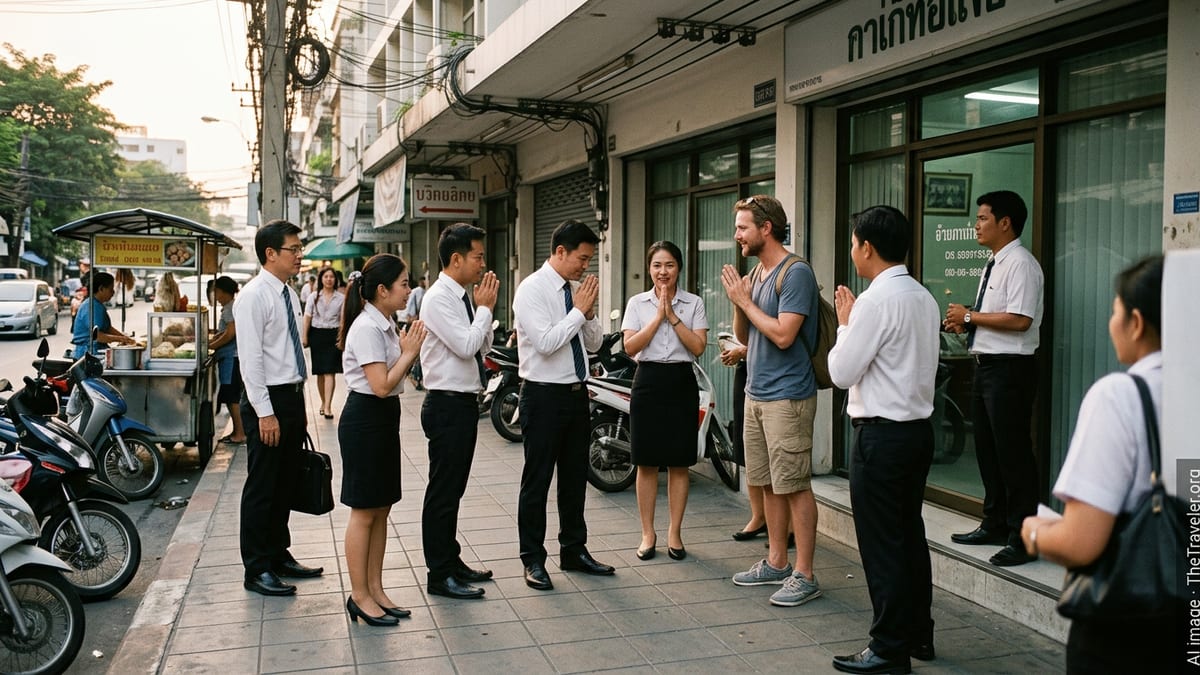
Thai society is strongly hierarchical compared with many Western countries. Age, professional title, educational background, and perceived social status guide how people address each other, sit, speak, and even gesture. The traditional greeting, the wai, with palms pressed together and a slight bow, encodes this hierarchy. A wai given to a senior is executed at a higher level than one given to a peer, and the junior person usually initiates the gesture.
Foreigners are generally not expected to master every nuance of the wai, but misunderstandings are common. For example, offering a wai to service staff in situations where a nod or verbal thank you would be more typical can invert expected status relationships. Conversely, failing to return a wai from a colleague or elder may be seen as rude. New arrivals often take several weeks to recognize when a wai is appropriate and when a verbal greeting is sufficient.
Respect for hierarchy also appears in seating arrangements, order of speaking in meetings, and patterns of decision-making. Senior figures are often addressed with titles rather than first names, and their opinions may be accepted without open debate. For expats, this can require deliberate adjustment, especially for those from flatter organizational cultures where junior staff challenge leadership openly and routinely.
In practical relocation terms, individuals moving into management or client-facing roles should receive orientation on local etiquette, including the wai, forms of address, and expectations around deference. Mismanaging these symbolic aspects of respect can create barriers that are difficult to correct later.
Communication Style and Conflict Management
Thai communication is typically high-context and indirect. Meanings are often conveyed through tone, silence, and nonverbal cues rather than explicit statements. It is common to soften refusals or disagreement, for example by saying “maybe,” “we will see,” or offering partial alternatives, instead of a direct “no.” This approach protects face for all parties but can frustrate expats who rely on unambiguous verbal commitments.
A key adjustment for newcomers is learning to interpret what is not said. A lack of follow-up, a change of subject, or a polite laugh can all signal discomfort or disagreement. Raising sensitive topics directly, especially in group settings, can be perceived as confrontational. As a result, problems are often handled informally, privately, and incrementally, rather than through formal, open conflict resolution.
Volume and emotional tone also differ from many Western norms. Speaking loudly, interrupting, or displaying visible frustration is often equated with immaturity or poor self-control. Maintaining jai yen, or a cool heart, especially under stress, is highly valued. New arrivals who adapt to this style tend to gain trust more quickly in workplaces and communities.
From a relocation-readiness perspective, candidates who have previously lived in high-context cultures, or who are comfortable with nuance and patience in negotiations, generally report smoother adaptation. Those who expect rapid, explicit decisions and direct feedback may need structured cultural training and clear local intermediaries when handling negotiations or performance discussions.
Workplace Culture and Management Expectations
In Thai workplaces, hierarchy, indirect communication, and face-saving norms combine to create a distinct management environment. Decision-making is often centralized, with senior managers expected to provide direction and juniors expected to follow instructions rather than actively challenge them. Brainstorming formats that rely on open criticism or rapid-fire debate may produce limited participation from Thai team members, especially in mixed seniority groups.
Feedback is typically delivered in a gentle, private manner. Direct public criticism can cause significant loss of face and may be remembered long after the specific issue has passed. Expats who manage Thai staff usually find better results by pairing clear written expectations with constructive, one-on-one feedback delivered in a calm tone, often framed around collective improvement rather than individual blame.
Team cohesion and loyalty are also significant. Colleagues may socialize together and expect managers to show personal concern for staff well-being and family circumstances. Refusing invitations consistently, or insisting on purely transactional relationships, can be interpreted as aloof or disrespectful. However, these social obligations can be balanced with clear boundaries once trust has been established.
These cultural characteristics affect role fit. Managers who are comfortable with a more paternalistic or relationship-centric leadership style may adapt well. By contrast, professionals whose approach is heavily based on confrontation, public debate, or frequent restructuring may encounter sustained resistance and slow implementation.
Religion, Ritual, and Everyday Etiquette
Buddhism is not only a religious identity in Thailand but also a framework for everyday behavior and public life. Temples serve as community centers, and religious observances, merit-making, and interactions with monks are woven into routine activities. Expats often notice public displays of religious devotion, such as offerings at shrines, alms giving to monks in the early morning, and frequent references to karma and merit in casual conversation.
These practices translate into specific etiquette expectations. For instance, respect toward monks is very important: people typically avoid sitting or standing above a monk, and women are expected not to touch monks or hand items directly to them. In temples and some formal settings, individuals remove shoes, dress modestly with covered shoulders and knees, and avoid pointing feet at people or religious images. These norms can feel stricter than in many secular Western settings and require conscious adjustment.
Importantly, open criticism of Buddhism, the monarchy, or national symbols is socially unacceptable and can in some cases have legal consequences. Relocating professionals accustomed to robust public debate about political or religious institutions must recognize that Thai norms are considerably more restrictive, both socially and in terms of formal regulation.
For relocation decisions, the key consideration is comfort with operating in a public environment where religious symbols and rituals are prominent and where certain topics are effectively off-limits for casual critique. Those who view religion strictly as a private matter may take time to adjust to its visibility in professional and civic spaces.
Social Etiquette, Body Language, and Personal Space
Beyond language and religion, expats typically experience a range of differences in nonverbal communication and social etiquette. Touching someone’s head is considered disrespectful, as the head is viewed as the highest part of the body. Feet, by contrast, are regarded as low and unclean, and pointing feet at people, religious objects, or even placing them on furniture is frowned upon. These norms often differ sharply from more relaxed attitudes in Western households and casual environments.
Public displays of anger are strongly discouraged, but public displays of affection, especially between couples, are also traditionally limited, particularly in more conservative or rural areas. Handholding between friends of the same gender may be more accepted than overt romantic contact. For some expats, this results in an initial perception of greater formality in public behavior, even among close friends and partners.
Hospitality and politeness are highly valued, and visitors may be offered food or small gestures of assistance even by casual acquaintances. However, this outward warmth should not be confused with deep personal intimacy. Building genuinely close friendships often requires time, consistency, and evidence that the expat respects local norms. Those who display cultural insensitivity, for example by mocking local customs or ignoring basic etiquette, may find relationships remain superficial.
These patterns indicate that candidates who are observant of nonverbal cues and willing to modify body language practices tend to encounter fewer misunderstandings. Structured cross-cultural training that explicitly covers gesture, personal space, and public conduct can significantly reduce early-stage social friction.
Time Orientation, Flexibility, and Reliability Perceptions
Many expats report that Thai culture is somewhat more flexible about time and scheduling than tightly clock-driven societies. While punctuality is increasingly important in international business environments and in sectors such as finance, aviation, and manufacturing, some social and informal professional interactions may start later than scheduled or be subject to last-minute change.
Indirect communication can also affect perceptions of reliability. Agreeing to a meeting or task in order to avoid direct refusal does not always mean that the other party has the resources or intention to follow through as expected. This can create frustration for expats who equate verbal agreement with firm commitment.
However, it is important to recognize that many Thai professionals working in multinational contexts adopt stricter time and project management standards, especially in Bangkok and other major urban centers. The variation is therefore substantial by industry, organization type, and region. Generalizations about “Thai time” can be misleading if applied without nuance.
From a relocation planning standpoint, professionals in roles that depend on rigid deadlines or regulatory timetables should clarify internal expectations and build in buffers where possible. Those who can remain patient in the face of occasional rescheduling while still communicating their own time constraints calmly are more likely to succeed.
The Takeaway
For prospective expats, Thailand’s cultural environment combines strong hierarchy, indirect communication, and a pronounced emphasis on social harmony and respect. These traits are underpinned by Buddhist values and expressed through numerous everyday practices, from use of the wai and patterns of speech to expectations around emotional self-control and deference to seniority. The overall effect is a society that often appears outwardly relaxed and friendly, yet operates according to subtle and firmly held norms.
Relocation suitability depends less on language ability or technical skills and more on an individual’s willingness to adapt behavior. Those who can accept and work within a high-context, nonconfrontational, and hierarchical framework tend to report high levels of satisfaction and strong local relationships. In contrast, expats who insist on applying their home-country standards of directness, informality, or public critique without adjustment commonly encounter avoidable conflict and professional stagnation.
For organizations, structured pre-move cultural training and ongoing local mentorship are strongly advisable, particularly for leadership assignments. For individuals, a realistic self-assessment of comfort with indirect communication, deference to hierarchy, and public religious presence can provide a more accurate preview of long-term fit than climate, leisure options, or even financial conditions.
Understanding these cultural differences in advance transforms Thailand from a superficially familiar destination into a more predictable environment where expats can make deliberate, informed choices about how and whether to integrate.
FAQ
Q1. How important is it for expats to use the wai correctly in Thailand?
Correct use of the wai is important as a sign of respect, especially toward seniors and elders, but foreigners are given some leeway. Learning when to return a wai and when a verbal greeting is sufficient is more critical than mastering every nuance.
Q2. Are Thai workplaces always strictly hierarchical, or is this changing?
Hierarchy remains strong in most Thai workplaces, but multinational companies and startups in major cities may operate with somewhat flatter structures. Even in these environments, respect for seniority and avoidance of open confrontation usually remain important.
Q3. Why do some Thai colleagues avoid saying “no” directly?
Avoiding a direct “no” helps maintain face and social harmony. Indirect language, delays, or alternative suggestions are commonly used to signal disagreement or inability to comply without causing embarrassment.
Q4. Is it acceptable for expats to openly criticize local customs or institutions?
Open criticism of local customs, religion, or key national institutions is strongly discouraged socially and can in some cases have legal implications. Expats are expected to show respect even when they do not personally share local beliefs.
Q5. How visible is Buddhism in everyday life for residents in Thailand?
Buddhism is highly visible in daily life through temples, shrines, religious holidays, and routine merit-making activities. Even in urban business districts, religious symbols and rituals are a normal part of the public landscape.
Q6. Do expats need to change how they show emotions in Thailand?
Expats generally need to moderate visible displays of anger, frustration, or aggressive argument. Calm, controlled communication is valued, and losing one’s temper can quickly damage both professional and personal relationships.
Q7. Are public displays of affection acceptable for couples in Thailand?
Conservative norms still limit overt public displays of affection, especially in traditional or rural areas. Light gestures may be tolerated in urban settings, but more intimate behavior is usually considered inappropriate in public spaces.
Q8. How should expats approach giving feedback to Thai colleagues?
Feedback is best given privately, clearly, and calmly, with an emphasis on solutions rather than blame. Public criticism or confrontational language can cause loss of face and long-term strain in working relationships.
Q9. Is the concept of time in Thailand very relaxed in all situations?
Time expectations vary by sector and setting. International business, transport, and regulated industries often follow strict schedules, while informal social events and some local operations may be more flexible about punctuality.
Q10. What personal traits help expats adapt most successfully to Thai culture?
Patience, cultural curiosity, emotional self-control, and willingness to accept hierarchy and indirect communication are consistently associated with successful long-term adjustment for expats in Thailand.