


Standing on the wind‑scoured acropolis of Cuma and then walking the busy streets of Pompeii, it is hard to believe these two ancient sites sit less than an hour apart. One is vast, famous and crowded, the other compact, myth‑laden and quiet. Both are unforgettable in very different ways. If you only have time for one, or you are wondering whether Cuma can really hold its own against world‑famous Pompeii, this guide unpacks how each place feels, what you actually see on the ground and which site is more likely to leave a deeper impression on different types of travelers.
Get the latest updates straight to your inbox!
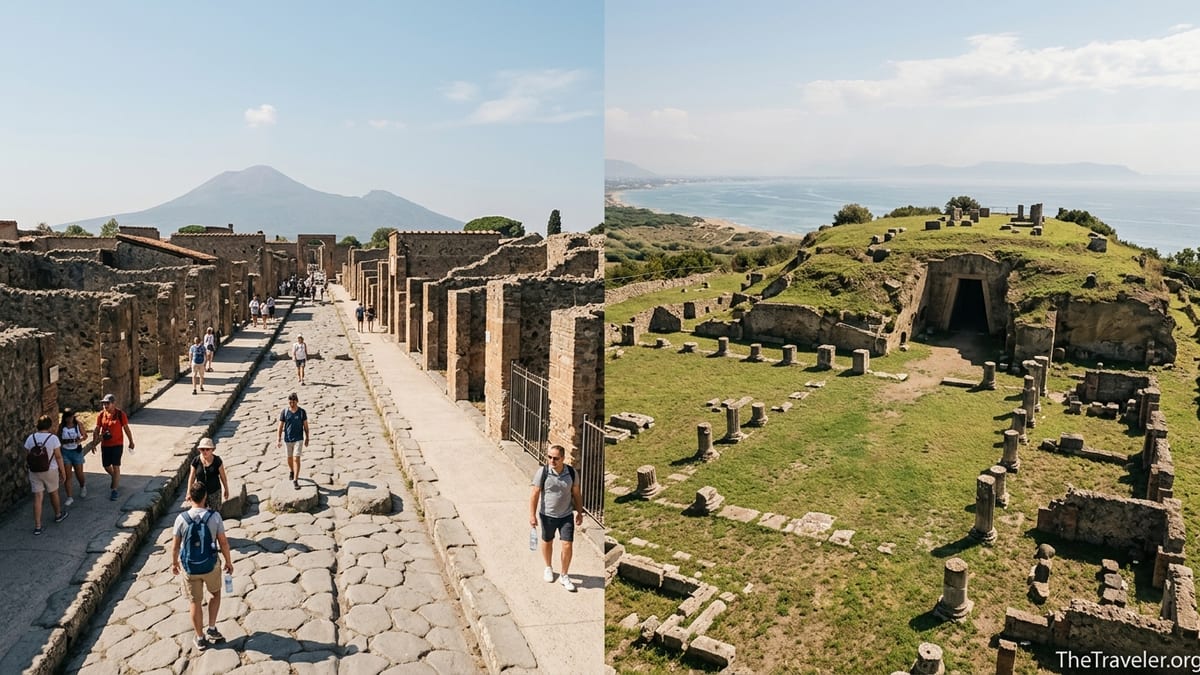
The Emotional Impact: Overwhelming City vs Haunted Acropolis
The first difference most visitors feel is emotional scale. Pompeii is a whole Roman city opened up: a grid of streets, apartment blocks, bakeries with carbonized loaves still in their ovens, an amphitheater, bath complexes and villa gardens. You can easily walk six or seven kilometers in a day here, moving from humble taverns to elegant houses like the House of the Faun. Many travelers describe the moment they see plaster casts of victims caught in the eruption of 79 AD as one of the most sobering experiences of their trip to Italy. The sense of everyday life cut short is hard to shake.
Cuma strikes a very different emotional chord. The site is smaller and less immediately legible as a city, but it carries a mythical weight. This was the first Greek colony on mainland Italy, founded around the 8th century BC, and later home to the Cumaean Sibyl, the oracle who appears in Virgil’s Aeneid. Walking through the long, trapezoidal rock‑cut corridor known as the Antro della Sibilla, with side chambers opening off into darkness, feels less like sightseeing and more like stepping into a legend.
On a practical level, this means Pompeii impresses with its completeness and detail, while Cuma impresses with atmosphere and imagination. At Pompeii, you visualize carts rumbling past stone stepping‑stones in the street. At Cuma, you imagine heroes and priests consulting prophecies. Travelers who are moved by tangible, domestic details usually find Pompeii more powerful. Those drawn to myth, early Greek history and moody landscapes often come away saying Cuma stayed with them longer than they expected.
What You Actually See: Ruins, Highlights and Storytelling
Pompeii’s core strength is the sheer number of accessible structures. In a typical five‑hour visit you might start at the Forum and its temples, visit a bathhouse with intact mosaics, climb the steep steps of the theater, wander the Garden of the Fugitives with its casts of fleeing residents, and then explore at least a few of the grand houses famous for their frescoes. Recent excavations have opened new areas with vivid wall paintings and even painted banquet scenes, and special routes sometimes allow visitors to peer directly into active digs. Interpretive panels, official guided tours and audio guides help you read the city grid so that each doorway, oven and fountain fits into a bigger story.
At Cuma, the story unfolds through fewer but more symbolic landmarks. After you pass a modest entrance area, you climb toward the acropolis, with views over the Tyrrhenian Sea and the wetlands of the Campi Flegrei. The main draw is the Antro della Sibilla, a long tunnel cut into tuff rock, punctuated by lateral chambers and side openings. Above, you find the remains of temples, including structures that began as Greek sanctuaries to Apollo and Zeus and were later reshaped into Roman and then early Christian buildings. Masonry from different eras lies side by side, so a single wall might contain Greek blocks, Roman brickwork and medieval modifications.
Interpretation at Cuma is more basic. Expect some panels in Italian and often English, but far fewer explanations than at Pompeii. There is generally no on‑site museum and far fewer guided tour options departing directly from the gate. As a result, Cuma rewards travelers who arrive having read a little background, perhaps with passages from Virgil in mind. Pompeii, meanwhile, can be powerfully understood even if you arrive knowing only that Vesuvius erupted; the city layout and modern signage do much of the storytelling work for you.
Crowds, Noise and Pace: Throngs vs Solitude
Numbers alone shape a lot of the experience. Pompeii is one of Italy’s most visited archaeological sites, with annual visitor figures in the low millions in recent years. On a typical spring or autumn morning, trains from Naples deposit streams of tour groups at the main Porta Marina entrance. The area outside the gates bristles with souvenir stands, snack bars and unofficial touts offering guided tours. Inside, popular spots like the Forum and the House of the Vettii can feel intensely crowded between about 10 a.m. and 2 p.m.
This intensity has practical consequences. Walkways can be congested, queues form at restrooms and some houses operate on timed entry windows that can close temporarily when capacity is reached. In high season, it is common advice to prebook a timed ticket, arrive at opening time or in late afternoon, and mentally prepare for a full day of walking in the sun alongside many other visitors. For some, the buzz adds energy; for others, it makes contemplation difficult.
Cuma is the opposite. Even in peak summer, many visitors report sharing the site with only a handful of other people, especially in the cooler morning or late afternoon hours. School groups sometimes pass through on weekdays, but you are as likely to hear cicadas and wind in the grass as you are other languages. There are no dense clusters of stalls at the entrance, and parking is usually straightforward, with costs that are often lower than at major Amalfi Coast hubs.
If the idea of exploring ruins almost alone appeals to you, Cuma can make a deeper impression precisely because of that solitude. You can stand in the Sibyl’s corridor with no one else around, or sit on a piece of ancient masonry looking toward the islands and imagine ancient sailors making landfall. Travelers sensitive to noise and crowds often describe Cuma as a welcome psychological counterbalance to days spent in Naples, Sorrento or Amalfi.
Practicalities: Access, Tickets and Time on Site
Reaching Pompeii without a car is straightforward. From central Naples, the Circumvesuviana or regional trains run to the Pompei Scavi station, which sits only a short walk from the main entrance. Journey times are commonly around 35 to 40 minutes on local services. Many travelers also visit on day trips from Rome, taking a high‑speed train to Naples and connecting onward. Once you arrive, multiple entrances offer flexibility: Porta Marina near the Forum, Piazza Anfiteatro near the amphitheater, and Piazza Esedra in between.
Ticketing at Pompeii is increasingly structured, with named tickets and timed entry windows now the norm. Official prices change periodically, but a standard adult ticket is usually in the same range as major European museums. There are occasionally multi‑site passes valid for associated sites such as Oplontis or Boscoreale, as well as free‑entry days, particularly the first Sunday of the month, when crowds can be even heavier. Guided tours bought on the spot range from modest group walks to private half‑day experiences that can easily exceed one hundred euros for a small group.
Cuma is more low‑key and usually cheaper. The entrance fee is often comparable to a small regional museum, and in some periods there have been combined tickets with neighboring Campi Flegrei sites. Opening hours can vary seasonally and may be reduced around holidays, so it is sensible to confirm the schedule locally shortly before you go. Facilities are basic: simple restrooms, sometimes a small kiosk or vending machines, but not the full range of services you see at Pompeii.
Public transport to Cuma is possible but requires more effort. Travelers typically take a local train such as the Cumana or Circumflegrea line from Naples to a station near the coast, then connect by bus or walk a substantial distance, following local directions. Many visitors therefore opt for a rental car or hire a driver for a half‑day, pairing Cuma with nearby Baiae or the Flavian Amphitheater in Pozzuoli. Because the site is compact, you can see its main features in about two hours, making it an easier half‑day commitment than Pompeii’s sprawling grid.
Landscape and Setting: Vesuvius vs the Phlegraean Fields
Visually, Pompeii is defined by its relationship to Mount Vesuvius. Many of the most striking photographs frame a straight Roman street or the columns of the Forum against the backdrop of the volcano that destroyed the city. The surrounding modern town is quite built up, but inside the archaeological park you look across roofless blocks, stone walls and occasional trees toward the slopes of Vesuvius. On clear days this contrast between apparent normality and looming threat underscores the drama of 79 AD.
Cuma belongs to a different volcanic landscape: the Campi Flegrei, or Phlegraean Fields, a broad caldera pocked with craters, lakes and fumaroles. From the acropolis at Cuma, you look out over coastal dunes, the remains of ancient harbors and the low arc of the coastline curving toward Cape Miseno. The ruins themselves sit amid grass, shrubs and pine trees rather than a tight urban grid. In late afternoon, the light slants across the tuff blocks and the sea beyond, and the entire scene feels more like a windswept hilltop sanctuary than a city.
For photographers, this matters. Capturing Pompeii often means working with strong midday light, crowded streets and detailed close‑ups of frescoes, mosaics and shop counters. At Cuma, wide landscape shots of the acropolis and the corridor of the Sibyl are as compelling as the ruins themselves. Travelers who are drawn to quiet viewpoints and sea horizons may find Cuma unexpectedly photogenic, especially when combined with nearby viewpoints over Lake Avernus or the port of Pozzuoli.
Who Each Site Is Best For
If this is your first and possibly only trip to southern Italy, Pompeii is exceptionally hard to skip. It is an anchor of world archaeology, a UNESCO World Heritage Site and a place that many visitors have read about since childhood. Families with school‑age children often find that Pompeii’s streets feel instantly understandable: they can point out a crosswalk, a bakery counter or a bar with a stone counter for serving wine, and younger travelers can imagine living there. History buffs focused on the Roman Empire also get extraordinary value from seeing a whole city plan laid out underfoot.
Cuma, by contrast, tends to appeal most to travelers who have more time in the Bay of Naples, those who prefer to avoid crowds, or those with a special interest in early Greek colonies, mythology or religious sites. If you have already visited Pompeii or Herculaneum on a previous trip, Cuma feels fresh. It also rewards repeat visitors to Naples looking for a new angle on the region’s past. Couples on a slower itinerary, photographers chasing less‑known viewpoints and independent travelers who enjoy piecing together stories from fragmentary remains all speak warmly of Cuma.
Budget can also play a role. While neither site is prohibitively expensive relative to other European attractions, a day at Pompeii can add up when you factor in transport, tickets, a guided tour and meals near the site. A calm morning at Cuma, especially by car, often involves lower overall costs and less time in queues. For some travelers, that lower logistical friction allows the experience to land more deeply.
Planning an Itinerary: Either–Or or Both?
One of the most useful questions is not “Cuma or Pompeii?” but “In what order, and how much time do I have?” If you have three full days in the Naples area, a common pattern is to dedicate one full day to Pompeii, one to the Amalfi Coast or Capri, and then use a third day to explore the Campi Flegrei, combining Cuma with Baiae’s sunken Roman villas or the amphitheater at Pozzuoli. In that context, Cuma acts as a quiet counterpoint to Pompeii’s intensity rather than a rival.
If you are extremely short on time, the decision becomes starker. With only one spare day from Naples or Sorrento and no car, Pompeii is generally the more practical and impactful choice. Its world‑class status, ease of access by rail and density of sights mean you are unlikely to regret prioritizing it. In that scenario, Cuma is best saved for a future trip when you can do it justice as part of a broader exploration of the Phlegraean Fields.
For travelers staying specifically in the western suburbs of Naples or along the coast toward Pozzuoli, Cuma can become the more convenient option. A half‑day there, followed by lunch in a seafood trattoria overlooking the harbor, feels luxurious without being rushed. Some visitors even report that seeing Cuma first deepens their appreciation of Pompeii later, because they arrive at the more famous site already tuned into the region’s layered Greek and Roman history.
Ultimately, the two sites tell different chapters of the same story: the arrival of Greek settlers, the rise of Roman power and the ever‑present volatility of the volcanic landscape. Seen together, they deliver a richer, more nuanced impression of the Bay of Naples than either can alone.
The Takeaway
So which site leaves the bigger impression: Cuma or Pompeii? For most first‑time visitors, Pompeii’s sheer size, famous frescoes and haunting casts of the dead make it the more overwhelming experience. It is the place where you feel you are walking through a Roman city stopped in time. Its popularity, sophisticated visitor services and easy access all amplify that impact.
Cuma, however, excels in a different key. Its power lies in silence, myth and landscape. On a quiet afternoon among the tumbled blocks of the acropolis, with the sea on one side and volcanic lakes on the other, you can almost hear the footsteps of pilgrims and the whispered questions posed to the Sibyl. For travelers who value solitude, early Greek history or a more contemplative atmosphere, Cuma may well linger longer in memory than even the most dramatic street in Pompeii.
In practice, the ideal choice often comes down to your travel style and schedule. If you crave iconic, bucket‑list experiences and can tolerate crowds, prioritize Pompeii. If you are building a slower, more exploratory trip around Naples and the Phlegraean Fields, make space for Cuma as a place where history feels personal and unhurried. Either way, you are not just ticking off ruins, but engaging with two very different ways the ancient world still speaks on the shores of southern Italy.
FAQ
Q1. If I only have one day, should I choose Cuma or Pompeii?
With a single day and no car, Pompeii is usually the better choice because it is easier to reach by train, has more extensive remains and offers a clearer sense of a complete Roman city.
Q2. How much time do I need to visit Pompeii properly?
Plan at least five to six hours on site to see the Forum, a selection of houses, the theater area and the amphitheater without rushing. Many visitors spend a full day.
Q3. How long does a visit to Cuma take?
Most travelers explore Cuma comfortably in about two hours, allowing time for the Sibyl’s cave, the acropolis temples and viewpoints over the surrounding coast.
Q4. Is Cuma suitable for children?
Cuma can work well for children who enjoy castles and myths, especially if you frame the Sibyl’s cave as part of a story, but there are fewer explanatory signs and facilities than at Pompeii.
Q5. Are guided tours easy to find at both sites?
Guided tours are widely available at Pompeii, both prebooked and from licensed guides inside the gates. At Cuma, tours are less common and are usually arranged in advance through local operators.
Q6. Which site is better for visitors who dislike crowds?
Cuma is generally much quieter, often with only a handful of visitors on site, while Pompeii can be very busy, especially from late morning in spring and summer.
Q7. Can I visit Cuma and Pompeii on the same day?
It is technically possible by car, but it makes for a long and rushed day. Most travelers get a better experience by dedicating separate days or pairing Cuma with closer Phlegraean sites instead.
Q8. How accessible are the sites for people with limited mobility?
Pompeii has a long step‑free route and some adapted paths, but many streets are uneven. Cuma also has slopes and rough ground, with generally fewer accessible facilities. Checking current conditions before visiting is important.
Q9. Is it worth visiting Cuma if I have already seen Pompeii and Herculaneum?
Yes. Cuma offers a different perspective as an early Greek colony and sacred acropolis. Many repeat visitors to the region appreciate its quieter, more contemplative atmosphere.
Q10. Which site is better for photography?
Pompeii offers endless details of streets, frescoes and daily life set against Vesuvius. Cuma is stronger for wide, moody landscapes, sea views and the dramatic corridor of the Sibyl’s cave.