


Currency stability and inflation dynamics in Thailand are central considerations for individuals and organizations evaluating relocation. While Thailand is generally perceived as a relatively low-inflation, stable-currency economy by emerging-market standards, the period from the pandemic through 2025 has seen alternating episodes of inflation spikes and unusually low or even negative price growth. Understanding these trends, the policy framework of the Bank of Thailand, and the behavior of the Thai baht against major currencies is essential for assessing financial planning risks over a multi‑year stay.
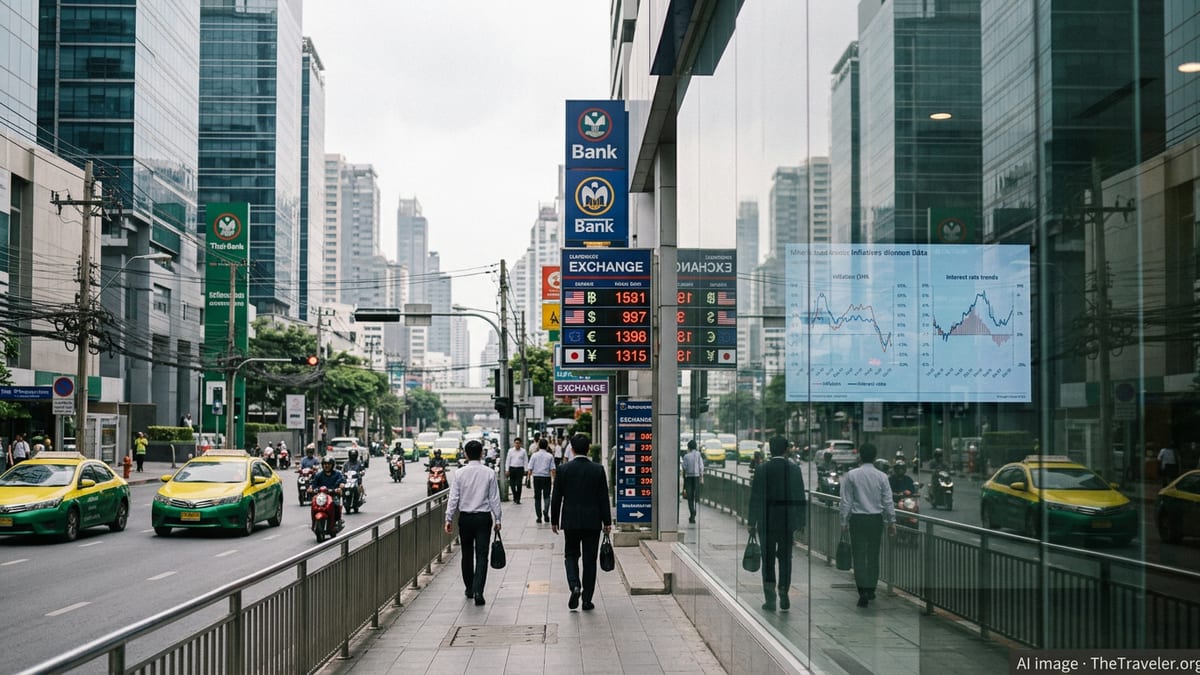
Overview of Thailand’s Monetary and Inflation Framework
Thailand operates an inflation-targeting monetary policy regime with a flexible exchange rate. The Bank of Thailand (BoT) and Ministry of Finance currently define an official inflation target range of approximately 1 to 3 percent for headline consumer price inflation, with the central bank required to explain deviations if actual or forecast inflation falls outside that band. This framework has been in place in various forms for more than a decade and is intended to anchor expectations while allowing the exchange rate to move according to market conditions rather than being rigidly fixed.
In practice, Thailand has experienced relatively low and moderate inflation compared with many emerging markets. Over the five years to the end of 2025, average inflation is estimated at below 2 percent, with only one clearly elevated year around the global 2022 price surge. At the same time, the BoT has tolerated periods where inflation slipped significantly below target, including several months of negative headline inflation in 2024 and 2025, prioritizing medium‑term stability over reacting to every short‑term shock.
For potential relocators, this policy structure implies that price dynamics in Thailand are managed with a strong emphasis on predictability and credibility. While the target range is not always achieved, observed outcomes have typically remained within a low single‑digit corridor, reducing the likelihood of sudden and severe erosion of purchasing power in local currency terms over a typical 3‑ to 5‑year assignment horizon.
The flexible exchange rate regime means the Thai baht is allowed to adjust in response to global capital flows, interest‑rate differentials and trade conditions. This can generate short‑term currency swings, but also reduces the risk of abrupt devaluations associated with rigid pegs that become unsustainable. As a result, currency and inflation risks for residents tend to materialize gradually rather than as abrupt crises, giving households and employers time to adjust compensation or savings strategies.
Recent Inflation Trends: From Pandemic Shock to Low-Inflation Environment
Thailand’s inflation path since the late 2010s has been characterized by low baseline price growth, a pandemic‑era slump, a temporary spike in 2022, and a subsequent return to very subdued rates. Headline inflation averaged below 2 percent in the late 2010s, dropped into negative territory in 2020 during the COVID‑19 shock, then moved back into moderate positive territory in 2021. In 2022, as in many countries, global energy and food prices pushed Thai inflation markedly higher, with annual consumer price increases moving into the mid‑single‑digit range before easing again in 2023.
By 2023, headline inflation had largely normalized, with full‑year averages in the low single digits and core inflation (which excludes volatile food and energy) remaining near the lower bound of the BoT’s target range. Into 2024 and 2025, inflation slowed further. Several data releases showed headline inflation hovering around zero or slightly negative at various points, reflecting weak domestic demand, government subsidies on energy and some basic goods, and favorable global commodity prices. Forecasts from international institutions for 2025 place average inflation in Thailand at well under 1 percent, still below the central bank’s desired range.
This low‑inflation environment has prompted multiple interest‑rate cuts since 2024, with the policy rate declining from earlier post‑pandemic highs toward the low single digits again by late 2025. Analysts generally interpret the combination of low inflation and only moderate growth as a sign of slack in the economy rather than entrenched deflation. For relocators, this combination suggests a relatively stable consumer price backdrop, though it can also mean limited nominal wage growth in some sectors.
Importantly, Thailand’s inflation volatility has been far lower than that experienced by many other emerging markets in the same period. While 2022 did bring above‑target price rises, the spike was milder and shorter‑lived than in commodity‑importing peers, and the reversion toward low inflation occurred relatively quickly. This pattern supports the assessment that Thailand’s institutional and policy framework has been broadly effective in containing inflation shocks, a positive signal for those planning medium‑term financial commitments in the country.
Structural Drivers of Inflation in Thailand
Understanding the structural composition of Thai inflation is important for gauging how prices may behave over the medium term. Thailand is a significant food producer and exporter, which dampens the pass‑through of global food price shocks to domestic consumers. At the same time, the country is an energy importer, leaving it exposed to swings in global oil and gas prices that directly affect transport and utility costs. Historically, food and energy together account for a substantial share of the Thai consumer basket, so global commodity cycles can still influence headline inflation, even if the magnitude is moderated by domestic supply.
Another key structural feature is administered and regulated prices. The Thai government has tended to use fuel excise adjustments, temporary subsidies and regulated tariffs to smooth price increases for households, particularly during periods of international price spikes. These measures have contributed to keeping headline inflation comparatively low, but they also mean that some underlying cost pressures may be hidden or deferred, and can re‑emerge when subsidies are reduced or tariffs are adjusted.
Domestic demand conditions also play a central role. Thailand’s growth performance in the first half of the 2020s has been modest, with output expanding around 2 to 3 percent annually on average. Weak investment, an aging population, and uneven income growth outside major urban centers have kept demand‑driven inflation pressures contained. As a result, episodes of higher inflation have tended to come from external shocks rather than internal overheating, and have dissipated as those shocks faded.
Finally, expectations appear reasonably well anchored. Surveys and analyses suggest that medium‑term inflation expectations among businesses and financial markets cluster around the middle of the BoT’s target band. This anchoring reduces the risk of self‑reinforcing price and wage spirals and helps limit the persistence of shocks. For individuals relocating to Thailand, this anchoring supports a planning assumption of low single‑digit annual price increases over the medium term, subject to occasional temporary deviations driven by global factors.
Thai Baht Exchange Rate Behavior and Currency Stability
The Thai baht (THB) trades under a managed float where market forces dominate but the central bank reserves the right to intervene to smooth excessive volatility. Over the past decade, the baht has not exhibited the extreme devaluations seen in some emerging markets, but it has experienced noticeable cycles of appreciation and depreciation linked to global risk appetite, US interest‑rate cycles, and domestic political developments.
From the mid‑2010s through the late 2010s, the baht generally appreciated gradually against the US dollar, supported by Thailand’s sizable current account surpluses and ample foreign exchange reserves. During the COVID‑19 period, the collapse in tourism and rising risk aversion triggered a depreciation, taking the baht from its pre‑pandemic strength to weaker levels in 2020 and 2021. As borders reopened and external conditions improved, the currency recovered part of its losses, moving back toward stronger levels in 2021 and early 2022.
The global monetary tightening cycle beginning in 2022 saw renewed downward pressure on the baht as higher US yields and risk‑off sentiment led investors to rotate toward dollar assets. The baht fluctuated within a broad range, at times weakening notably before recovering, but crucially it avoided disorderly collapse. In early 2026, the currency has recently traded near its strongest levels in almost five years against the dollar, reflecting expectations of eventual US rate cuts, positive sentiment on Thai external balances, and the perception that domestic inflation is under control.
For relocators, the key point is that while the baht is not immune to global financial market swings, its movements have tended to occur within a moderate band rather than via extreme multi‑year devaluations. This relative stability, alongside large official reserves and a cautious central bank, suggests that currency risk for typical household budgets is meaningful but manageable. Employers may still need to consider exchange‑rate clauses for long‑term contracts, particularly when compensation is benchmarked in foreign currency, but catastrophic currency events have been rare since the late 1990s crisis.
Interaction Between Inflation, Interest Rates, and Relocation Planning
Thailand’s low inflation and moderate currency volatility influence the real value of salaries, savings, and debts for residents. With average inflation over recent years below 2 percent and policy rates in the low single digits, real interest rates have at times been mildly positive, particularly when headline inflation slipped toward zero or negative readings. For local currency savers, this can preserve purchasing power, although nominal deposit rates offered by commercial banks are often low, especially on basic savings accounts.
Borrowers may benefit from relatively low nominal interest rates, but banks also tend to apply conservative lending standards and risk‑based pricing. For foreign individuals considering local borrowing, such as for vehicles or local expenses, it is important to note that quoted retail lending rates will typically exceed the policy rate by several percentage points. From an inflation perspective, the environment suggests limited risk of debt burdens being rapidly eroded by high inflation, but also limited risk of them becoming unmanageable through sudden spikes in price levels.
Salary planning is another crucial dimension. In a low‑inflation context, annual cost‑of‑living adjustments for local‑currency salaries may be modest, sometimes in the low single digits or even flat in sectors facing weak demand. Multinational employers that benchmark compensation in foreign currency may need to monitor both local inflation and baht exchange‑rate movements when deciding on annual adjustments for staff in Thailand. Over the medium term, relatively stable prices make it easier to project real income paths than in highly inflationary environments.
For individuals with income in foreign currency but expenses in baht, periods when the baht strengthens can reduce effective purchasing power, while episodes of depreciation can improve it. Given that the BoT tolerates currency flexibility while guarding against excess volatility, such swings are typically gradual. Prospective relocators should nonetheless stress‑test their budgets against plausible exchange‑rate ranges to ensure resilience in the face of a stronger or weaker baht over a multi‑year stay.
Forward-Looking Inflation and Currency Outlook
Recent projections from the BoT and major international institutions indicate that Thailand’s inflation is expected to remain subdued in the near term. Forecasts for 2025 and 2026 generally cluster around 0 to 1 percent for headline inflation, with core inflation closer to the lower bound of the 1 to 3 percent target range. This reflects expectations of only gradual economic growth, ongoing structural headwinds, and the lagged effect of earlier policy tightening globally. There is currently little evidence of de‑anchored inflation expectations or a shift toward persistent high inflation.
On the currency side, forward‑looking assessments point to a continuation of moderate volatility. The baht’s trajectory will largely depend on external factors such as the timing and pace of US and European interest‑rate adjustments, investor risk appetite toward emerging markets, and the strength of Thailand’s export and tourism earnings. Analysts generally view Thailand’s external position as fundamentally sound, supported by a diversified export base and sizeable foreign reserves, factors that underpin confidence in the baht even during global stress episodes.
Policy direction also matters. The BoT has signaled a willingness to keep monetary policy accommodative while inflation remains below target, but has also emphasized the importance of maintaining credibility and avoiding financial imbalances. Fiscal policy initiatives, including stimulus measures and large‑scale schemes aimed at boosting consumption, could temporarily push inflation higher if implemented aggressively, but the current baseline remains for low single‑digit price growth rather than a regime shift to high inflation.
For relocation planning, the most plausible baseline scenario over the next three to five years is one of continued low inflation with occasional short‑term deviations and a baht that fluctuates in response to global conditions but remains broadly stable relative to other major emerging‑market currencies. This does not eliminate risk, but it allows individuals and organizations to plan using conservative inflation assumptions and reasonable exchange‑rate bands, rather than needing to price in high double‑digit inflation or extreme currency depreciation.
The Takeaway
Thailand offers a macroeconomic environment characterized by generally low and well‑contained inflation and a currency that, while flexible and responsive to global financial conditions, has demonstrated relative resilience. The inflation‑targeting framework, history of moderate price movements, and ample foreign exchange buffers collectively support a picture of medium‑term monetary stability. Relocators can reasonably expect that local‑currency purchasing power will not be rapidly eroded by domestic price surges under normal conditions.
At the same time, the very low inflation observed in 2024 and 2025 reflects underlying economic softness and policy interventions as much as it does structural stability. Episodes of negative headline inflation should not be interpreted as a guarantee of permanently falling prices. Instead, they underline that Thailand’s inflation dynamics are sensitive to global commodity prices, domestic demand cycles, and government pricing policies. Future fiscal measures, energy price adjustments, or shifts in global interest‑rate cycles could temporarily raise inflation above recent readings.
For decision makers assessing relocation to Thailand, the implication is that currency and inflation risks are present but manageable with prudent planning. Conservative budgeting that assumes low single‑digit annual inflation, combined with regular monitoring of baht exchange‑rate movements and policy signals from the BoT, should be sufficient for most individual and corporate mobility programs. Compared with many other emerging‑market destinations, Thailand’s track record suggests a relatively predictable monetary environment, which can be an important supportive factor in long‑term relocation decisions.
FAQ
Q1. Is Thailand currently a high-inflation country?
Thailand is not currently a high‑inflation country. Recent years have seen mostly low single‑digit inflation and, at times, even slightly negative headline inflation, placing it well below global averages for emerging markets.
Q2. How volatile is the Thai baht compared with other emerging-market currencies?
The Thai baht experiences noticeable short‑term swings but has avoided the extreme multi‑year devaluations seen in some peers. Its movements are meaningful for budgeting but generally moderate in scale compared with more fragile currencies.
Q3. What inflation rate should relocators reasonably assume for planning over the next few years?
Based on recent trends and published forecasts, a conservative planning assumption would be low single‑digit annual inflation, often in the range of around 1 to 3 percent, while recognizing that actual outcomes can temporarily fall below or rise above this band.
Q4. Can government subsidies significantly distort measured inflation in Thailand?
Yes. Fuel, electricity and some basic goods are periodically supported by subsidies or regulated pricing, which can suppress headline inflation figures. When subsidies are reduced, some previously muted price pressures may surface.
Q5. How does Thailand’s inflation targeting affect everyday price stability?
The inflation‑targeting framework encourages the central bank to respond to large and persistent deviations from the target range, which helps keep medium‑term price growth contained and reduces the risk of prolonged high inflation episodes.
Q6. Does low inflation in Thailand mean wages will not grow?
Low inflation tends to coincide with modest nominal wage growth, especially in sectors facing soft demand. However, real purchasing power can still be preserved or improve slightly if wage increases, even small ones, outpace very low inflation.
Q7. How exposed is Thailand’s inflation to global energy prices?
Thailand is an energy importer, so changes in global oil and gas prices affect transport and utility costs. Government interventions can smooth these effects, but sustained increases in global energy prices typically feed through to higher domestic inflation over time.
Q8. How likely is a sudden large devaluation of the Thai baht?
While no currency is entirely free from such risk, Thailand’s sizable foreign exchange reserves, flexible exchange rate, and cautious monetary policy reduce the probability of a sudden, sharp devaluation under normal conditions.
Q9. Should expatriates keep savings in baht or in foreign currency?
This depends on individual circumstances. Keeping some savings in baht can match local expenses and reduce exchange‑rate risk, while holding part in a stable foreign currency can diversify exposure if the baht weakens.
Q10. How often should relocation budgets for Thailand be reviewed for currency and inflation changes?
For most individual and corporate relocations, reviewing budgets and compensation at least annually is advisable, with more frequent reviews if there are significant changes in inflation readings, interest‑rate policy, or notable moves in the baht’s exchange rate.