


Understanding how Thai bureaucracy operates is essential for any foreigner considering medium or long term residence in Thailand. The country combines a rules heavy, document intensive administrative culture with incremental moves toward digital services. For expats, the practical experience is shaped by multiple agencies, in person procedures, and varying interpretations between provinces. This briefing explains how the system works in practice for foreign residents, highlighting the structures, workflows, and pain points that affect day to day compliance.
Structural Features of Thai Bureaucracy Affecting Foreigners
Thailand’s bureaucracy is formally centralized but functionally fragmented, with different agencies responsible for immigration control, civil registration, labor regulation, and investment promotion. For foreign residents, the core public facing bodies are the Immigration Bureau, local district offices, provincial and municipal authorities, and, for workers and investors, the Department of Employment and the Board of Investment. While laws and regulations are national, each local office has discretion in how requirements are interpreted and enforced, which leads to regional variation in documentation standards and processing culture.
Administrative procedures remain strongly paper based. Forms must often be completed in duplicate or triplicate, signed in ink, and accompanied by photocopies of every relevant passport page, visa, and entry stamp. Officers frequently request that photocopies be signed and dated on every page. Digital tools are being introduced, but the underlying mindset is that physical documents and in person appearances are the default, and electronic systems are an overlay rather than a replacement.
The system is also rule driven rather than outcome driven. Officers are evaluated on procedural compliance rather than customer experience, so individual officials may have limited discretion to waive formalities even when a case is straightforward. This reinforces a culture in which small errors in paperwork can lead to rejections or the need for repeated visits, and where applicants are expected to conform to the process rather than the process adapting to the applicant.
Language and communication create additional friction. Official forms and internal regulations are primarily in Thai, and while many immigration officers in major cities speak some English, more complex explanations are often delivered in Thai administrative jargon. As a result, many foreign residents rely on informal translations, agents, or community produced guides to understand what is required for specific procedures.
Key Government Interfaces for Foreign Residents
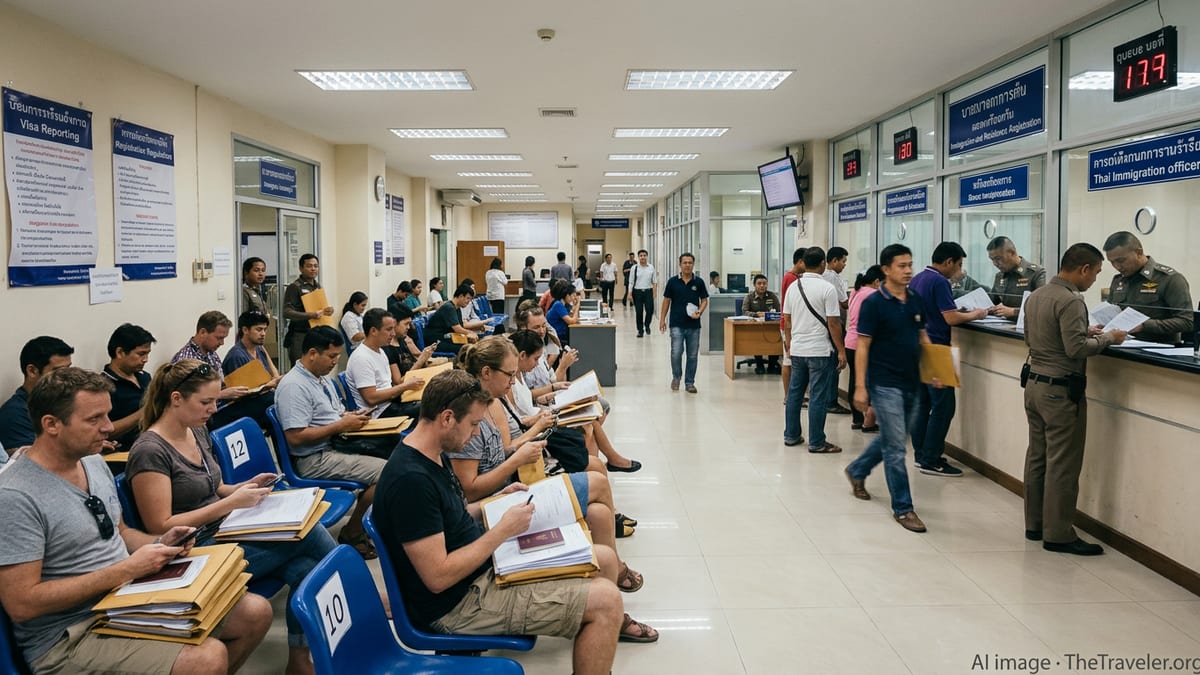
For most expats, the Immigration Bureau is the main interface with Thai bureaucracy. The central office for Bangkok and some national level procedures is located at the Government Complex on Chaeng Watthana Road, while provincial immigration offices handle cases in their jurisdictions. Immigration is responsible for arrival and departure control, reporting of residence, extensions of stay, and permanent residence applications. Processing practices vary between offices, so a procedure that takes thirty minutes in one province might require several hours in another.
District offices, known as amphoe or khet, handle civil registration matters that can become important for long term residents, such as house registration, issuance of the yellow house book for foreigners, and recording of marriages. These offices are often crowded with Thai citizens completing local administrative tasks, and their procedures are designed with Thai documentation in mind. Foreigners are generally an exception, and additional documents such as certified translations and embassy letters may be requested.
For foreign employees and certain business owners, the Department of Employment and investment related units are crucial. The One Stop Service model for visas and work permits, historically located at Chamchuri Square in Bangkok, has been consolidated into the Thailand Investment and Expat Services Center at the One Bangkok complex, where investment promotion, work permit, and certain visa extension functions are co located. This reflects a policy trend to centralize services for targeted investor and skilled worker segments while standard immigration offices continue to serve the broader foreign population.
Other line agencies occasionally become relevant for foreign residents, particularly the Department of Land Transport for driving license issuance and renewal, and municipal offices for local registrations. Each agency runs its own queues, forms, and documentary standards. There is limited horizontal coordination, so applicants are routinely required to obtain certificates from one office to use as supporting documents in another.
Residence Registration, House Books, and Proof of Address
Thai bureaucracy gives high importance to residence registration, and this affects foreigners through multiple overlapping mechanisms. Thai citizens are recorded in a blue house registration book, while certain long term foreign residents may be entered into a yellow house book issued at the district office where the property is located. Obtaining a yellow house book typically requires evidence of lawful stay, a certificate of residence from immigration, and identity and property documents from the Thai owner or lessor. The process can involve several visits and the presence of Thai witnesses, reflecting the emphasis on community based verification.
Separate from the house book system, immigration regulations require that property owners or managers report the presence of foreign occupants using a specific notification form whenever a non Thai national resides at their property. This obligation applies to hotels, guesthouses, serviced apartments, and private landlords. In practice, hotels and larger condominiums usually submit electronic reports routinely, while smaller landlords may be unfamiliar with the requirement and may need guidance or support from tenants to complete the paperwork.
For the foreign resident, proof of address becomes a recurrent requirement in bureaucratic interactions, including driving license issuance, banking relationships, and certain visa related processes. Where a yellow house book is not available, a residence certificate issued by immigration or the local municipality is often used. Obtaining this certificate generally requires a passport, photos, a copy of the lease or property document, and evidence that the relevant residence notification has been filed. The reliance on documentary proof of address means that foreign residents benefit from keeping rental contracts, landlord identification copies, and previous certificates organized and up to date.
Incomplete address registration can create circular challenges. Without a properly reported address, a foreigner may find it difficult to obtain a residence certificate. Yet some landlords are reluctant to provide copies of title deeds or identity cards that are requested as part of the process. Experienced residents often pre negotiate documentation obligations in their leases to reduce friction with future bureaucratic interactions.
Regular Reporting Obligations and Workflow
Thai immigration rules require foreigners staying longer than a short visit to comply with periodic reporting obligations that exemplify the bureaucratic style. The most visible is the requirement for foreigners who remain in Thailand for more than ninety consecutive days on a long stay permission to confirm their current address with immigration every ninety days. The counting restarts each time a person leaves and reenters the country, and failure to comply is subject to fines that are usually calculated on a per day basis up to a capped amount.
The ninety day report can be submitted in several ways, including in person at an immigration office, by an authorized representative, via postal mail, or through the Immigration Bureau’s online notification system. Online reporting is intended to reduce queues and is generally available starting seven to fifteen days before the report due date and for a limited period afterward. However, in practice foreign residents report inconsistent system reliability, with occasional outages, rejections requiring in person follow up, or interface issues. As a result, many long term residents continue to submit reports in person to ensure compliance.
Offices manage high volumes of routine traffic for these reports with ticketed queues and standardized counters. In busy locations, foreign residents may wait several hours for a process that takes only a few minutes at the counter. Timing visits early in the day and avoiding days surrounding national holidays can significantly reduce waiting times. Offices generally require the applicant’s passport, a completed form, proof of address, and past reporting receipts, and may reject applications that lack any element of the expected package.
Similar patterns apply to other recurring interactions, such as annual extensions of stay, updates to work permit details following a change of employer or job location, and renewals of residence certificates. Each procedure has its own checklist of required documents, photographs, and copies, and the onus is on the applicant to arrive fully prepared. Where documentation is incomplete, officers usually instruct the applicant to return with the missing items rather than accepting partial submissions.
Digitalization, E Services, and Practical Limits
Thailand has articulated a national digital government agenda, and immigration related services for foreigners form part of this effort. The Immigration Bureau has rolled out online platforms for ninety day notification and an e extension tool that allows foreigners to submit applications electronically, upload supporting documents, and schedule an appointment for biometric verification and visa sticker issuance. Official statements emphasize greater convenience, shorter in office processing times, and the ability to use the services from anywhere within Thailand.
In practice, digitalization remains partial. Many long term residents report that certain categories of applications are not consistently accepted online, or that the online submissions are subsequently rejected without clear reasons, forcing a shift back to in person processing. Technical issues such as downtime, browser compatibility, and difficulty accessing systems during maintenance windows are not uncommon. These factors encourage a cautious approach in which foreign residents test e services but retain paper based fallbacks close to the reporting deadline.
The government has also invested in multi agency service centers for targeted foreigner segments. The Thailand Investment and Expat Services Center at One Bangkok consolidates investor support, visa and work permit services, and related administrative assistance in a single building. For eligible investors and highly skilled workers, processes such as work permit issuance and certain extensions of stay can be completed within the same day when documentation is complete. This stands in contrast to the more traditional and fragmented experience that regular foreign residents encounter at standard immigration and labor offices.
Despite these advances, core bureaucratic logic remains unchanged. Even when applications are initiated online, applicants are still expected to appear in person for verification, bring original documents, and sign paper forms. Systems are designed to enable officers to check and print submissions rather than to replace frontline interactions. From a relocation planning perspective, this means that digital tools can reduce inconvenience but cannot eliminate the need to allocate time and attention to bureaucratic compliance.
Local Variation, Discretion, and Use of Agents
A defining characteristic of Thai bureaucracy from the foreign resident’s perspective is local variation. Immigration offices in Bangkok, major resort areas, and provincial capitals operate under the same regulations but may apply them differently at the practical level. Some offices request additional supporting documents that are not explicitly listed in central regulations, such as photographs of the applicant at their residence, neighborhood maps, or supplementary financial statements. Others follow a leaner checklist and focus only on core statutory requirements.
Officer discretion plays a significant role. Individual officials may have different thresholds for what constitutes adequate proof of address, sufficient financial evidence, or acceptable documentation of family relationships. While decisions are rarely arbitrary, they are shaped by internal guidance, local management attitudes, and personal risk aversion. Foreign residents should be prepared for requests that differ from those experienced by others in a different province or at a different time, even for similar cases.
The complexity and variability of bureaucratic requirements have created a robust market for visa and work permit agents. These intermediaries, often law firms or specialized consultancies, maintain close familiarity with local practices and assemble applications to match the expectations of specific offices and officers. For routine processes, agents can significantly reduce the foreign resident’s learning curve and time spent in queues, though their services come at an additional cost that may be substantial relative to official fees.
From a governance standpoint, the reliance on agents underscores the information asymmetry between the bureaucracy and its users. Official English language guidance is often brief or high level, and front line staff may not have the mandate to explain detailed reasoning behind documentary requirements. As a result, foreign residents benefit from gathering multiple recent accounts of specific processes in their local area, rather than assuming that national level guidance will match local implementation exactly.
The Takeaway
For expats and foreign residents, Thai bureaucracy is characterized by a dense network of agencies, detailed documentary requirements, and significant dependence on in person interactions. While reforms are gradually introducing digital tools and centralized service centers for targeted groups, the underlying administrative culture remains paper oriented and process focused. Foreigners who succeed in navigating the system typically do so by planning ahead, maintaining meticulous records of all previous interactions, and allowing sufficient time for repeat visits when needed.
This environment does not necessarily prevent relocation, but it does impose a predictable layer of administrative effort on long term residence in Thailand. Those considering relocation should factor in the time and organizational resources required to comply with recurrent reporting obligations, obtain and maintain proof of address, and respond to evolving local practices at immigration and related offices. Understanding how Thai bureaucracy works in practice allows potential residents to make more realistic assessments of the practical demands of living in the country.
FAQ
Q1. How frequently will a long term foreign resident need to interact with Thai bureaucracy?
For most long term residents, interactions occur at least every ninety days for address reporting and annually for extensions of stay or work related renewals, with additional visits as needed for residence certificates, driving licenses, or changes in personal circumstances.
Q2. Are Thai immigration and registration procedures the same nationwide?
The legal framework is national, but practical implementation varies between immigration and district offices, so document checklists and expectations can differ by province and even between officers in the same office.
Q3. How important is proof of address in dealing with Thai authorities?
Proof of address is central to many procedures, from immigration reporting to obtaining a residence certificate or driving license, so maintaining clear leases, landlord documents, and previous certificates is critical for smooth interactions.
Q4. Can most bureaucratic procedures for foreigners in Thailand be completed online?
Only a limited subset, such as ninety day address notifications and some visa extensions, can be initiated online, and even these often still require in person verification and presentation of original documents at an office.
Q5. How much time should be budgeted for in person visits to immigration offices?
Processing time at the counter is usually short, but queues in busy locations can last from under an hour on quiet days to several hours near deadlines or holidays, so half a day is a prudent allowance for important visits.
Q6. Do foreign residents need a yellow house book to function in Thai bureaucracy?
A yellow house book is useful but not mandatory; many foreigners rely instead on residence certificates issued by immigration or local authorities when dealing with banks, licensing offices, and other agencies.
Q7. What happens if a foreign resident misses a ninety day address report?
Missing a ninety day report typically results in a monetary fine assessed when the person next reports in person, and a history of missed reports can complicate future dealings with immigration.
Q8. Why do many foreigners in Thailand use visa or work permit agents?
Agents help interpret local office practices, assemble documents to meet specific expectations, manage queues, and reduce language related misunderstandings, which can be valuable in a system where rules are detailed and interpretations vary.
Q9. Are English language materials from Thai authorities sufficient to navigate bureaucracy unaided?
English language guidance is improving but often remains brief or generalized, so for complex cases or in smaller provinces, foreign residents may still need Thai language support or local advice to understand detailed requirements.
Q10. Is Thai bureaucracy becoming easier for foreigners over time?
There is a gradual trend toward centralization and digital services, particularly for investors and skilled workers, but for the average foreign resident, the system still demands careful preparation, physical paperwork, and regular in person contact with officials.