


If you are planning a trip to Cusco and Machu Picchu in the next few years, you will almost certainly fly into Alejandro Velasco Astete International Airport (airport code CUZ). Yet just outside the city, one of Peru’s most important infrastructure projects is taking shape: the new Chinchero International Airport, designed to eventually replace CUZ and transform air access to the region. Understanding where each airport stands today, what is planned, and how timelines keep shifting is essential for anyone booking flights to Cusco between now and the late 2020s.
Get the latest updates straight to your inbox!
CUZ Today: How Alejandro Velasco Astete Airport Actually Works
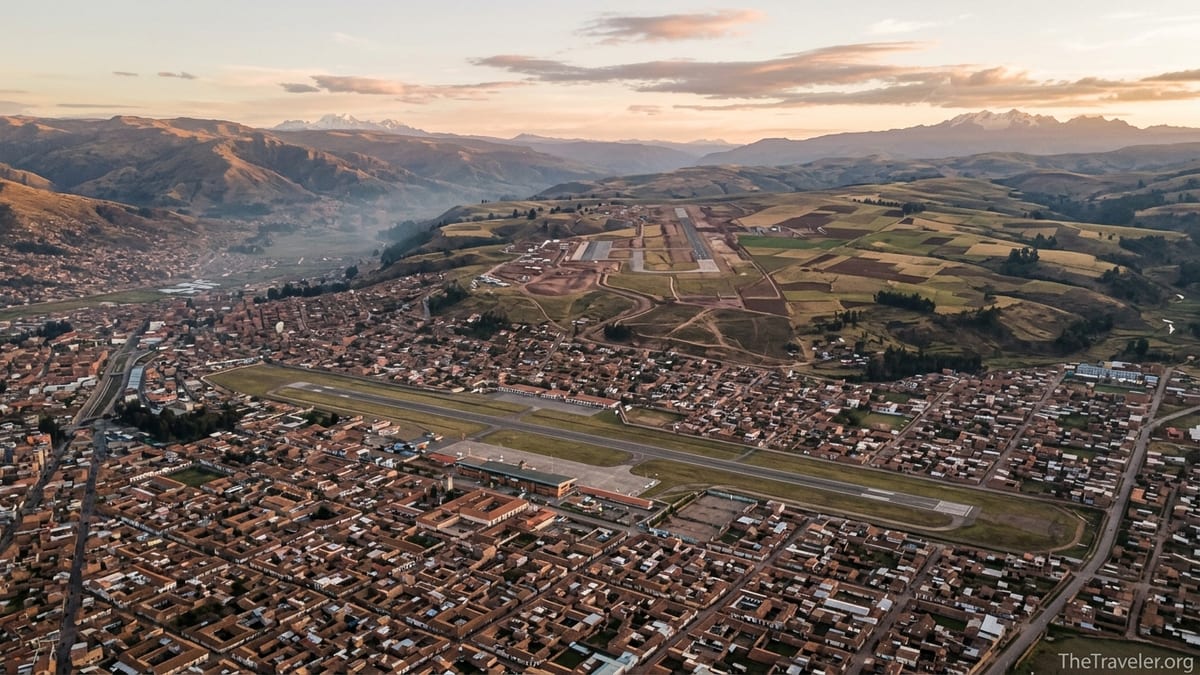
Alejandro Velasco Astete International Airport sits right in the urban fabric of Cusco, hemmed in by hillsides and residential neighborhoods. The runway is short by international hub standards, and the surrounding Andean terrain means aircraft rely on special approach procedures and daytime-only operations in many cases. In practical terms, this is still the gateway every traveler uses to reach Machu Picchu and the Sacred Valley, but it operates under tight physical and operational constraints.
For visitors, the experience starts with an internal connection rather than a nonstop international flight. Most travelers fly into Lima’s Jorge Chávez International Airport, then connect on a domestic leg to Cusco with airlines such as LATAM, Sky Airline or JetSMART. On a typical high season day, you will see waves of morning departures from Lima to Cusco, with one-way fares often hovering around the equivalent of 60 to 150 US dollars if booked well in advance, and climbing higher close to travel dates or around holidays. Delays are not uncommon, especially in the wet season when low clouds and visibility can temporarily shut down operations.
Inside the terminal, CUZ feels more like a busy regional airport than an international hub. Facilities include a small arrivals hall, ATMs, taxi counters, car-rental desks and basic cafés selling espresso, empanadas and bottled water. There are some souvenir shops, but no sprawling duty-free promenade. Security and check-in are usually efficient in early morning and mid-afternoon, though queues can build quickly during peak tourism months between June and August. The airport’s location within the city means that, despite the congestion, you can step into a taxi and be in the historic center of Cusco in roughly 15 to 25 minutes depending on traffic.
From a safety and performance standpoint, airlines that serve CUZ use specific aircraft types and weight restrictions tailored to the altitude and runway length. This is one reason long-haul jets do not fly directly to Cusco from North America or Europe. Instead, single-aisle planes such as Airbus A320 family aircraft shuttle passengers back and forth from Lima and a handful of other Peruvian and regional cities. For travelers, this means factoring in a domestic connection and allowing extra buffer time on itineraries, especially if you are trying to connect onward to trains into the Sacred Valley or Machu Picchu.
Why Travelers Still Fly into CUZ Now
Despite persistent headlines about the “new Cusco airport” for more than a decade, Alejandro Velasco Astete remains the only operational commercial airport for Cusco as of mid-2026. All scheduled passenger flights still arrive and depart here. Construction at Chinchero has not yet reached the stage where any regular flight operations are possible, and government timelines for completion have shifted repeatedly since the first opening targets around 2021.
For someone booking a trip in 2026 or 2027, this means you will continue to route all air plans through CUZ. A typical itinerary from the United States might involve a late-night arrival into Lima on an airline such as Delta, American, LATAM or United, followed by an early-morning domestic departure to Cusco. Travel agencies in Cusco still plan all their logistics around CUZ: they schedule pick-ups at the current airport, coordinate hotel transfers in the city, and time afternoon tours of Sacsayhuamán or the San Pedro Market based on incoming flights landing at Alejandro Velasco Astete.
Even travelers who stay in the Sacred Valley still overwhelmingly arrive at CUZ and transfer by road. For example, if you book a night at a riverside lodge in Urubamba or a boutique hotel in Ollantaytambo, your driver will meet you at CUZ arrivals and then take the winding road out of Cusco, climbing to the high plateau and descending into the valley. This journey can take between 1.5 and 2.5 hours depending on traffic and weather. Until Chinchero opens, there is no alternative air gateway that lets you bypass this route.
Crucially, airlines and booking platforms treat Chinchero as a future project rather than an active option. When you search for flights into Cusco on major travel sites, you will only see CUZ offered as the arrival airport. Even once Chinchero approaches opening, there is likely to be a period where both airport codes appear in systems but only CUZ has real availability. Travelers should be wary of assuming that news about construction progress means they should plan around the new facility today, because timetables for such large infrastructure projects in Peru have a track record of delays and renegotiations.
Inside the Chinchero Airport Project and Its Shifting Timeline
Chinchero International Airport is being built on a high plateau near the town of Chinchero in the Urubamba province of Cusco Region. The site is roughly 30 kilometers from the current airport and much closer in driving time to the heart of the Sacred Valley. Official communications from Peru’s Ministry of Transport and Communications describe the project as one of the most important infrastructure works in southern Peru, intended eventually to handle up to about 12 million passengers per year and serve as a regional hub. As of a government update in March 2026, authorities reported that construction was around 40 percent complete and again presented it as a strategic priority for tourism and connectivity.
The project has moved through multiple phases of planning and construction, from early earthworks and leveling of the plateau through to contracts for the runway, control tower and terminal buildings. A consortium known as Natividad de Chinchero, which includes large construction firms from South Korea, China, Mexico and Peru, has been responsible for major works. Previous updates from the Ministry of Transport noted milestones such as surpassing 30 percent overall progress and signing addenda to advance components like the tower and runway structures.
However, the timeline has been fluid. Past statements suggested that core construction would be finished by the first half of 2026, followed by equipment installation. Later reporting in Peruvian media and statements from oversight bodies have indicated that the contractor has proposed extending the completion deadline to late 2028. Local newspapers have quoted projections of operations starting around late 2027 or early 2028, while more recent commentary from the national comptroller has highlighted attempts to push the handover date to December 2028. In practice, travelers should understand these as evolving estimates rather than fixed, guaranteed opening dates.
Beyond engineering, Chinchero has generated significant debate. Archaeologists, conservationists and local communities have raised concerns about the airport’s impact on surrounding Inca and pre-Inca heritage, terraced landscapes and the broader Sacred Valley environment. International coverage, including reporting by major global newspapers, has spotlighted fears that increased visitor numbers may put additional strain on already pressured sites such as Machu Picchu. While these discussions are not visible in a day-to-day travel booking interface, they shape regulatory oversight, court challenges and design modifications that can slow large projects, and they help explain why Chinchero is still years away from receiving its first regular passengers.
Key Differences Travelers Will Notice Once Chinchero Opens
Although Chinchero remains under construction, planning documents and government statements make clear how the new airport is expected to differ from CUZ. The most obvious change is physical space. The Chinchero site allows for a longer, more modern runway and a larger terminal complex than can ever be squeezed into downtown Cusco. This should accommodate larger aircraft types and more daily operations. In theory, that could enable nonstop international flights from hubs such as Bogotá, Panama City or even select US cities into the Cusco region without connecting in Lima, though airlines will ultimately decide based on demand and profitability.
For travelers focused on Machu Picchu and the Sacred Valley, the location of Chinchero may significantly shorten transfers. The airport site sits on the route from Cusco toward Urubamba. When operations begin, it is realistic to expect hotels and tour operators in the valley to offer direct pick-ups from Chinchero, potentially cutting 30 to 60 minutes from travel times compared with today’s pattern of landing in CUZ, driving into or around the city, and then heading back out toward the valley. A guest staying at a high-end property near Urubamba, for example, might face a transfer of under an hour from Chinchero, compared with closer to two hours from CUZ in current traffic.
Inside the terminal, design briefs suggest a more spacious and modern environment, closer to what travelers encounter in newer regional airports across Latin America. That could mean more check-in counters, improved baggage handling systems, expanded security lanes and a wider selection of eateries and shops. Although exact concessions are unknown this far out, it is reasonable to expect a mix of national coffee chains, local food outlets and perhaps Peruvian handicraft boutiques positioned for last-minute souvenir shopping. Regulatory agencies and international aviation organizations have also been advising on technical standards, which should translate into more up-to-date air traffic control infrastructure and safety systems compared with those at CUZ.
Another significant difference will be how Chinchero operates in relation to city life. Alejandro Velasco Astete currently sits in a dense urban context, generating noise concerns and limiting expansion. Once Chinchero is fully operational and CUZ eventually closes, residents of Cusco will experience quieter skies, while tourists may find that airport-related services such as car rentals and hotel shuttles shift their main bases closer to the new facility. Over time, the land currently occupied by CUZ is likely to be redeveloped for other urban uses, though what exactly that will look like is still the subject of local planning debates.
Planning Trips in the Transition Years
Between 2026 and at least the late 2020s, travelers to Cusco will be navigating a transition period: CUZ fully operational today, Chinchero gradually rising in the distance, and opening dates being revised as works progress. The safest approach when planning is to assume that all flights will continue using Alejandro Velasco Astete until airlines and Peru’s civil aviation authority officially publish timetables for the new airport. Do not make decisions such as booking nonrefundable hotels in the Sacred Valley solely on the assumption that Chinchero will open by a particular month; instead, treat government announcements about target years as guidance rather than guarantees.
In practical terms, that means booking itineraries that are resilient to disruption. For example, if you land in Lima from an overnight flight from North America, avoid scheduling an extremely tight connection to Cusco. Giving yourself at least a three- or four-hour buffer is advisable to accommodate delays, potential weather-related hold-ups in Cusco, or crowds at domestic security checkpoints. Many travelers opt for an overnight in Lima before heading to Cusco the next morning, which can reduce stress and allow time to adjust slightly to altitude before flying even higher into the Andes.
As the Chinchero project moves closer to completion, you can expect to see early signs in the aviation ecosystem before the first tourist boards a flight there. These might include the new airport receiving an official three-letter code, preliminary flight schedules appearing in global booking systems, and airlines announcing new route launches months in advance. When that happens, it is likely that major tour operators and hotels around Cusco and the Sacred Valley will update their transfer instructions, specifying whether they collect guests from CUZ or from Chinchero and adjusting prices accordingly. For instance, a hotel in Cusco’s historic center might continue offering short, relatively low-cost transfers from CUZ, while properties deeper in the valley might advertise premium direct transfers from the new airport.
In the meantime, pay attention to where your ticket says you are arriving. If you are traveling in 2026 or 2027 and see “CUZ” as the airport code, you can confidently plan on landing at Alejandro Velasco Astete. Any references to Chinchero in airline marketing or tourism campaigns should be read as forward-looking rather than an immediate operational reality. When in doubt, contacting your airline or tour operator directly a few weeks before travel is a good way to confirm which airport they will be using and how they arrange pick-up logistics.
What May Change for Airline Routes, Costs and Crowds
Once Chinchero becomes operational, air connectivity patterns to Cusco are likely to evolve in stages rather than overnight. In a first phase, airlines may simply move existing Lima and domestic routes from CUZ to the new airport, keeping similar schedules and aircraft types while taking advantage of improved infrastructure. Over time, as passenger numbers grow and operations stabilize, carriers may test new point-to-point routes, such as seasonal services from neighboring countries or additional domestic links from cities like Arequipa or Trujillo, using the new airport’s greater capacity.
For long-haul travelers, the most visible potential change will be the eventual appearance of more one-stop options that bypass Lima. A European visitor might one day connect through a hub like Madrid, Bogotá or Panama City and fly straight into Chinchero, while a traveler from North America could see options via hubs such as Dallas, Houston or Atlanta. Whether these routes materialize will depend on demand forecasts, bilateral agreements and airline strategies. Early on, such flights might run only a few times per week, similar to how new routes to secondary destinations are usually tested elsewhere in South America.
In terms of pricing, it is reasonable to expect a period of adjustment. Initially, fares for Lima–Cusco flights might not change dramatically simply because the airport moves location. However, if Chinchero attracts more competition and new routes, increased seat capacity could exert downward pressure on average fares during shoulder seasons. Conversely, improved accessibility may fuel higher demand in peak months, which could keep prices firm or even push them up at the most popular times, similar to how better infrastructure around other famous heritage sites has sometimes led to surges in visitation.
Crowding is another important variable for travelers. CUZ today already feels busy in high season, with early-morning departure banks and congested check-in areas. A larger terminal at Chinchero should relieve some of the pinch points, but more efficient infrastructure also makes it easier to bring in more visitors. For Machu Picchu specifically, the Peruvian state already manages entry through pre-booked time slots and daily caps. As air access improves, getting your train tickets and site entrance arranged well in advance will become even more critical, especially in the June-to-August and December holiday peaks.
The Takeaway
For the foreseeable future, Alejandro Velasco Astete International Airport remains the sole functioning gateway to Cusco and Machu Picchu. It is constrained and often busy, but well integrated into city logistics, with straightforward transfers to both downtown hotels and the Sacred Valley. All real-world itineraries for 2026 and likely several years beyond should be built around CUZ, with travelers allowing for weather-related delays and the quirks of a high-altitude Andean airport.
Chinchero International Airport, meanwhile, is a major long-term bet on the future of tourism in southern Peru. Construction is advancing, but official projections for completion have shifted from mid-decade targets toward the later 2020s. When it finally opens, the new airport is expected to move the region’s air gateway closer to the Sacred Valley, support larger aircraft and more routes, and offer a more modern passenger experience. It will reshape transfer patterns, push new hotel and service development toward the plateau and valley, and eventually allow authorities to close CUZ and reclaim that urban land for other uses.
For travelers, the most sensible approach is to plan based on what exists today while staying lightly informed about what is coming. Book flights into CUZ, check schedules carefully around the rainy season, and give yourself buffer time in Lima. Keep an eye on credible news coming out of Peru’s transport authorities and local press about milestones at Chinchero, but treat specific opening months as provisional until airlines begin selling tickets. That balance of realism and anticipation will help you enjoy Cusco, the Sacred Valley and Machu Picchu now, while watching one of Latin America’s most talked-about airport projects gradually take shape on the horizon.
FAQ
Q1. Is Chinchero Airport open yet for commercial flights?
As of July 2026, Chinchero International Airport is still under construction and not open to regular passenger flights. All scheduled commercial flights to the Cusco region use Alejandro Velasco Astete International Airport (CUZ).
Q2. When is Chinchero Airport expected to start operations?
Official projections have shifted over time. Recent statements from Peruvian authorities and oversight bodies suggest construction may not be fully completed until the second half of the 2020s, with some estimates pointing toward operations beginning around late 2027 or 2028. These dates should be treated as provisional.
Q3. Which airport should I book for a trip to Cusco in 2026 or 2027?
For any trip in 2026 or 2027, you should plan to fly into CUZ, Alejandro Velasco Astete International Airport. Airlines currently sell tickets only to CUZ for the Cusco area, and tour operators base their logistics on that airport.
Q4. How far is CUZ from central Cusco compared with Chinchero?
CUZ lies within the city of Cusco, and typical taxi rides to the historic center take about 15 to 25 minutes in normal traffic. The Chinchero site is roughly 30 kilometers away, so transfers to downtown Cusco will be longer, but it will likely be closer to hotels in the Sacred Valley once it opens.
Q5. Will Chinchero Airport offer direct international flights to Cusco?
The project is designed to handle more passengers and larger aircraft than CUZ, so it could support additional international routes in the future. However, specific airlines and routes have not yet been confirmed, and most travelers should still expect to connect through Lima or another regional hub for the foreseeable future.
Q6. What happens to Alejandro Velasco Astete Airport once Chinchero is operating?
Peruvian planning documents describe Chinchero as a replacement for Alejandro Velasco Astete in the long term. The expectation is that once Chinchero is fully operational and stable, CUZ will eventually close to commercial traffic and the land will be redeveloped, though detailed plans and timelines for that transition are still evolving.
Q7. Will getting to the Sacred Valley be faster from Chinchero?
Yes, for many travelers. Chinchero is positioned closer to key Sacred Valley destinations like Urubamba and Ollantaytambo. Once the new airport opens, transfers to valley hotels should be shorter and more direct than the current route that starts at CUZ inside Cusco city.
Q8. Should I change my hotel plans based on the future opening of Chinchero?
If you are traveling within the next couple of years, you should not make hotel decisions based solely on Chinchero’s potential opening date. Continue to book in Cusco or the Sacred Valley based on your itinerary, and adjust airport transfer plans later if airlines begin operating to the new airport during your travel window.
Q9. How will the new airport affect crowd levels at Machu Picchu?
Improved air access could increase total visitor numbers over time, but Machu Picchu is already regulated by daily entry limits and timed tickets. Even with Chinchero, you will still need to secure train tickets and site entry well in advance, especially in high season.
Q10. How can I stay updated on Chinchero Airport’s progress before my trip?
In the months leading up to your journey, check announcements from Peruvian transport authorities, national news outlets and your airline. The clearest sign that Chinchero is truly nearing operation will be when airlines begin selling flights that list the new airport’s code in their booking systems.