


Landing at Alejandro Velasco Astete International Airport in Cusco is the starting point for most journeys to Machu Picchu and the Sacred Valley. One of the first practical decisions you will face is how to get from the airport directly to Ollantaytambo, the small Inca town that serves as the main train gateway to Machu Picchu. With limited daylight flight schedules, concerns about altitude, and a maze of transport choices, it pays to have a clear plan before you step out of the terminal.
Get the latest updates straight to your inbox!
Understanding the Route from Cusco Airport to Ollantaytambo
The drive from Alejandro Velasco Astete International Airport to Ollantaytambo is roughly 65 to 70 kilometers and usually takes about 1 hour 45 minutes to 2 hours by road in normal daytime traffic. Private transfer companies that specialize in this route commonly quote a duration of around 1 hour 45 minutes, which matches what many travelers actually experience when the road is clear. The route climbs out of Cusco, crosses high plains and passes through or near towns such as Chinchero and Urubamba before dropping into the Sacred Valley and reaching Ollantaytambo.
Although Google Maps may sometimes suggest slightly shorter times, travelers regularly report that the curves, speed bumps and occasional construction along the way keep the realistic journey closer to two hours. At busy times of day, particularly late afternoons when tour buses are returning to Cusco, travel can stretch a little longer. For planning purposes, it is wise to assume at least two full hours door to door from the airport to a hotel or guesthouse near Ollantaytambo’s main plaza or train station.
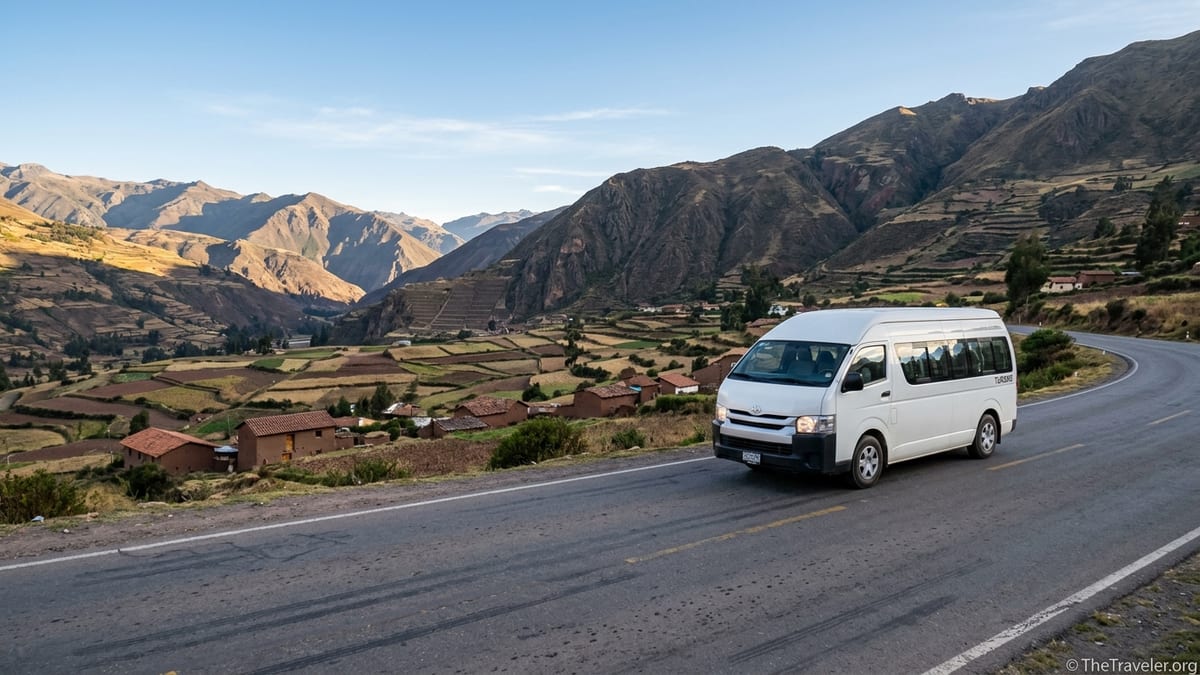
The road itself is paved and generally in good condition, but it is a mountain route with switchbacks and occasional fog or rain, especially in the wet season roughly from November through March. Most reputable transfer companies use modern minivans or SUVs with seat belts and experienced drivers familiar with the curves. If you are prone to motion sickness, it helps to sit near the front and avoid heavy meals immediately before departure. The views, however, can be spectacular, with sweeping panoramas of the Andes and glimpses of terraced fields and small villages.
From Ollantaytambo, most travelers continue by train to Machu Picchu Pueblo (Aguas Calientes). PeruRail and Inca Rail both run multiple daily departures from the Ollantaytambo station, with popular afternoon services around mid to late afternoon that connect well if you land in Cusco in the late morning. Because train schedules change seasonally, it is essential to check current timetables and build in at least a 3 to 4 hour buffer between your scheduled flight arrival in Cusco and your intended train departure from Ollantaytambo.
Private Transfers and Taxis: The Most Convenient Option
For most visitors flying into Cusco and heading straight to the Sacred Valley, a prebooked private transfer from the airport to Ollantaytambo offers the best balance of comfort, reliability and value. Several local transport operators focus on this exact route and publish current pricing online. As of mid 2026, typical one way rates for a private car or minivan for up to 3 or 4 passengers run in the region of 60 to 80 US dollars for the whole vehicle, depending on vehicle type, time of day and whether you include sightseeing stops en route.
For example, some well reviewed operators advertise 2025 and 2026 prices around 60 to 70 US dollars for a straightforward airport to Ollantaytambo transfer in a private sedan or compact SUV, and slightly higher prices for a larger van that can take 6 to 10 passengers with luggage. Travelers on recent trips have also reported paying about 250 Peruvian soles, roughly equivalent to 70 US dollars, for a customized transfer from Cusco airport to Ollantaytambo including stops at Pisac and the Maras salt mines. In many cases, the driver waits with the luggage locked in the vehicle while you explore, which removes a major concern if you are arriving with backpacks and suitcases.
Booking directly with a local company through their website, or by email or messaging app, has become the norm. Companies often confirm flight details in advance and monitor delays, so drivers wait at arrivals holding a sign with your name. This is particularly valuable if you land in the afternoon or evening when you may not want to negotiate with unknown taxis outside the terminal. Several travelers mention using the same transfer provider for multiple segments, such as airport to Ollantaytambo, then Ollantaytambo back to Cusco or direct to the airport after visiting Machu Picchu, which can sometimes result in small discounts or at least consistent service.
Taking an informal taxi from outside the airport is still possible and usually cheaper than a prebooked private transfer, but it is less predictable. Drivers around Cusco airport commonly quote prices to the city center in the range of 20 to 30 soles, and to Ollantaytambo you will usually be quoted a flat price in soles after bargaining. Reports from recent visitors suggest that an airport taxi to Ollantaytambo may start around 200 to 250 soles if you speak some Spanish and are comfortable negotiating, but English may be limited and there is less assurance regarding vehicle quality, seat belts or insurance. For a once in a lifetime trip, many travelers find that the extra 10 to 20 dollars for a vetted private driver is worthwhile.
Shared Vans, Buses and Budget Options
Travelers watching their budget have a cheaper but more involved alternative: using local shared transport between Cusco and Ollantaytambo. The most common method is to first take a taxi from the airport to a departure point for colectivos, the shared minivans that run fixed routes. Drivers and hostel owners in Cusco often direct people toward departure areas near Calle Pavitos or the Santiago district, where vans to Urubamba and Ollantaytambo wait until they fill with passengers before departing.
From Cusco to Ollantaytambo, a seat in a colectivo typically costs the equivalent of just a few US dollars per person, often in the range of 15 to 25 soles. The downside is that you must pay separately for the short airport taxi ride, usually another 10 to 20 soles to reach the departure street, and then possibly wait 15 to 30 minutes or more while the van fills. Luggage space can be tight, especially if you are carrying large suitcases, as colectivos are primarily designed for local commuters rather than tourists with oversized bags.
Another low cost variation involves taking a shared van or bus from Cusco to Urubamba, then changing to another colectivo or taxi for the final stretch to Ollantaytambo. This can make sense if you are staying in the Urubamba area or the bus to that town happens to be leaving first. A few companies also run tourist shuttles that resemble colectivos but with slightly more comfort and luggage space. These usually depart from central Cusco rather than the airport and must be reached by taxi.
While these shared options are easy enough during daylight, they become less attractive for afternoon or evening arrivals. Vans thin out later in the day, signage is minimal and communication can be challenging without Spanish. Safety is not usually a major issue, but taking shared local transport with all your luggage after dark is rarely the most relaxing way to start a trip. As a result, budget options generally work best for those already staying in Cusco who want to move on to Ollantaytambo the next morning, rather than for people landing at the airport with limited time before a train.
Timing Your Arrival for Sacred Valley and Train Connections
One of the biggest questions for travelers planning this route is how to coordinate flight arrival times in Cusco with onward travel to the Sacred Valley and Machu Picchu by train. Because most domestic flights into Cusco operate in the morning and early afternoon, many visitors find themselves landing between about 8:00 and 13:00. If your flight arrives by late morning, it is entirely realistic to transfer directly from the airport to Ollantaytambo and catch an afternoon train toward Machu Picchu Pueblo.
For instance, if you land around 10:00, clear the airport and meet your driver by 10:30, then you could reasonably arrive in Ollantaytambo by about 12:30 to 13:00 in normal conditions. This timing connects well with popular mid afternoon trains from Ollantaytambo to Machu Picchu Pueblo that depart roughly between 14:00 and 16:00, depending on the date and operator. That window gives you a buffer for minor flight delays and traffic, time to pick up tickets at the station and perhaps a quick bite in town.
If your flight arrival is later, such as mid to late afternoon, the equation changes. Evening trains from Ollantaytambo exist on many dates, but connections become tighter, and road travel after dark in the mountains is slower. In that scenario, many travelers choose to spend the night in Ollantaytambo itself and take a morning train the next day. This has the added benefit of allowing time to explore the impressive Inca terraces and cobbled streets of Ollantaytambo, which are a highlight in their own right rather than just a transit point.
In high season, roughly June through August and around major holidays, it is particularly important to leave generous margins between transport segments. Seasonal weather events, occasional road works, or crowd related delays can all slow movement through the valley. Travelers who cut their schedule too tightly sometimes discover that a short delay out of Lima cascades into a missed train in Ollantaytambo. A simple rule of thumb is to allow at least three clear hours between scheduled flight arrival and your intended departure by train, and four or more if traveling in the wet season.
Should You Go Direct to the Sacred Valley or Sleep in Cusco?
Another strategic decision for many visitors is whether to leave the airport and drive directly to the Sacred Valley, or to spend at least one night in Cusco first. There are three main factors to weigh: altitude, flight arrival time and your intended sightseeing plan. Cusco sits at about 3,400 meters, while Ollantaytambo is noticeably lower, around 2,800 meters. For travelers concerned about altitude sickness, going straight down to the Sacred Valley is often recommended to allow the body to acclimatize more gently.
In practice, many people arriving from sea level in Lima or elsewhere find that driving directly from the airport to Ollantaytambo on day one, then exploring Machu Picchu and the valley before returning to spend time in Cusco, provides a smoother adjustment. Several recent travel reports describe itineraries where a private driver meets guests at the airport, drives them to Ollantaytambo with a lunch stop, and then they continue to Machu Picchu the following day. These travelers typically comment that they felt better starting in the lower valley rather than sleeping immediately at Cusco’s higher elevation.
There are, however, good reasons to stay in Cusco if your flight schedule or interests push you in that direction. If you land late in the afternoon or evening, the prospect of a two hour mountain drive after dark may be unappealing, especially when tired from long international travel. In that case, spending the night at a hotel in Cusco, perhaps near the historic center or closer to the airport, and transferring to the Sacred Valley the next morning can be more comfortable. It also gives time to pick up any last minute essentials and briefly experience Cusco’s architecture and restaurants.
One hybrid strategy that is increasingly common is to combine a Sacred Valley tour with a transfer to Ollantaytambo. Several local guides and drivers offer one day private tours that start in Cusco or at the airport, visit sites such as Pisac, Moray and the Maras salt mines, and then end in Ollantaytambo in the late afternoon or evening. Prices for these private full day circuits tend to fall in the range of around 400 to 600 soles in total for a small group, plus entry tickets, which can be good value when split between several travelers. This approach lets you use your transfer day as a sightseeing day, avoiding extra backtracking between Cusco and the valley.
Night Arrivals, Safety and Luggage Considerations
Although most flights to Cusco aim to land in daylight because of the surrounding mountains, itinerary changes, delays or seasonal variations can push some arrivals into the late afternoon or early evening. When planning a direct transfer to Ollantaytambo under those circumstances, safety and comfort become the main concerns. Prebooking a transfer with a reputable operator is especially important if you expect to leave the airport after about 16:00, as it ensures that a known driver and vehicle will be waiting for you and that the route has been assessed recently for conditions.
Road safety in the Cusco region is generally good, and the main highway to the Sacred Valley is well traveled, but mountain roads always carry some extra risk in darkness and bad weather. Heavy rain, fog or occasional landslides during the wet season can slow traffic and may cause temporary diversions. When booking, it is reasonable to ask the company how their drivers handle night conditions, whether they limit speeds and if they carry basic safety equipment. Some travelers deliberately schedule itineraries so that the airport to valley drive happens in daylight, even if it requires a night in Cusco.
Luggage security is another frequent question. With private transfers, standard practice is for the driver to load your bags into the trunk or rear compartment at the airport and keep the vehicle locked when not moving. Travelers who combine their transfer with sightseeing stops commonly report leaving backpacks and suitcases in the locked vehicle while visiting ruins, with the driver waiting nearby. As always, passports, cash and electronics are safer kept on your person in a daypack. If you choose to travel partly by shared transport, it is wise to keep a close eye on your bags, sit where you can see them and avoid storing valuables in the roof rack or in an area where they are out of sight.
In terms of luggage size, private cars and SUVs can usually comfortably handle two or three large suitcases plus carry on bags for a couple or small family. Larger groups or those with bulkier gear, such as trekking equipment, may prefer a minivan. Some companies provide photos of their vehicles so you can gauge capacity before booking. For visitors planning to leave luggage in Cusco while they travel the valley and Machu Picchu, many city hotels and reputable tour operators offer short term storage, which can simplify onward travel to Ollantaytambo with lighter bags.
Booking Tips, Realistic Prices and Avoiding Pitfalls
Because Cusco and the Sacred Valley are such popular destinations, there is no shortage of people and companies offering transfers between the airport and Ollantaytambo. This abundance is positive in terms of choice, but it can also be confusing. A sensible first step is to get a rough sense of current going rates. Around 60 to 80 US dollars for a private vehicle between the airport and Ollantaytambo for up to three or four people is a realistic benchmark in 2025 and 2026. Prices significantly below this threshold warrant extra questions about licensing, insurance and vehicle condition, while much higher quotes should come with clear added value such as luxury vehicles or multi stop tours.
When comparing providers, look not only at price but also at communication responsiveness, clarity on meeting points and policies for delayed flights. Many established operators clearly state that they monitor incoming flights and adjust pickup times without extra fees for reasonable delays. Asking for the driver’s name, vehicle type and license plate in advance provides an extra layer of reassurance when arriving in an unfamiliar airport. If your hotel in Cusco or Ollantaytambo offers to arrange a transfer, it is often through a trusted local partner and can be worth the small commission for the convenience.
Travelers posting recent reports frequently mention the benefits of using the same driver or company for multiple legs of their Sacred Valley itinerary. For example, one couple described hiring a driver to meet them at Cusco airport, stop at Pisac market and the Maras salt pans on the way to Ollantaytambo for about 250 soles, then use the same driver a few days later for a simpler Ollantaytambo to Cusco transfer for around 35 US dollars. Building a relationship with a single driver can help with flexibility, such as slight schedule shifts or added photo stops, and reduces the need to renegotiate prices at each leg.
Common pitfalls include underestimating travel time, booking a train from Ollantaytambo that departs too soon after landing in Cusco, or assuming that shared transport will be equally available at all hours. Another avoidable issue is arriving in Ollantaytambo with no local currency; while some services accept cards or US dollars, small purchases and tips are easier in soles. Finally, keeping printed or offline copies of your transfer and train confirmations is advisable, as mobile data can be spotty in the valley and around the station.
The Takeaway
Reaching Ollantaytambo from Alejandro Velasco Astete International Airport is a well trodden route, and with realistic expectations and a bit of advance planning it can be a smooth and even scenic part of your journey. For most travelers, a prearranged private transfer offers the best mix of comfort, safety and flexibility, particularly if you are traveling with luggage or arriving in the afternoon. Shared vans and buses are a viable budget alternative for those already in Cusco with time to navigate local systems, but they are less convenient directly from the airport.
Whether you decide to go straight to the Sacred Valley or spend a night in Cusco depends largely on your arrival time, your sensitivity to altitude and your interest in the city itself. Using your transfer as an opportunity to tour the valley, stopping at places like Pisac and Maras on the way to Ollantaytambo, can turn a simple transit into a memorable day. Above all, leave generous margins between flights, road transfers and trains, and treat the journey from Cusco to Ollantaytambo not merely as a connection but as the moment you begin to experience the landscapes and culture of the Andes.
FAQ
Q1. How long does it take to get from Cusco airport to Ollantaytambo?
The drive usually takes around 1 hour 45 minutes to 2 hours in normal traffic, though it can be a bit longer at peak times or during bad weather.
Q2. How much should I expect to pay for a private transfer from the airport?
As a guideline, expect to pay roughly 60 to 80 US dollars one way for a private car or small SUV for up to three or four passengers, with larger vans costing more.
Q3. Is it safe to travel from Cusco to Ollantaytambo at night?
The road is generally safe, but driving mountain routes after dark is slower and can be less comfortable. If you arrive late, many travelers prefer to sleep in Cusco and transfer in daylight.
Q4. Can I use public transport or colectivos directly from the airport?
Colectivos do not leave from the terminal itself. You would need a short taxi ride to streets where shared vans depart, then connect onward, which is easier by day and with light luggage.
Q5. Should I go directly to the Sacred Valley or stay in Cusco first?
If you arrive by late morning and are concerned about altitude, going straight to the lower Sacred Valley makes sense. For late arrivals or those keen to see Cusco, a city overnight is more practical.
Q6. How much time should I leave between my flight and a train from Ollantaytambo?
It is wise to allow at least three hours between scheduled flight arrival and train departure, and preferably four or more in the wet season or at very busy times.
Q7. Are there shared shuttles from Cusco airport to Ollantaytambo?
A few tourist shuttle services operate, but most shared options start from central Cusco, not directly from the airport. They can be cost effective but require extra steps and time.
Q8. Is it easy to stop at sites like Pisac or Maras on the way?
Yes. Many private drivers offer customized routes that include stops at Pisac, Moray or the Maras salt mines, with luggage secured in the vehicle while you visit the sites.
Q9. What about luggage security during transfers and stops?
With reputable private transfers, bags are normally kept locked inside the vehicle when you stop. You should still keep passports, money and electronics with you in a small daypack.
Q10. Do I need to book my airport transfer in advance?
Advance booking is strongly recommended, especially in high season or if you are arriving in the afternoon, so that a known driver is waiting and you avoid bargaining at the curb.