


Landing at Alejandro Velasco Astete International Airport in Cusco is both exciting and daunting. At 3,399 meters above sea level, the thin air can make even the short walk through arrivals feel intense, and you still need to reach your hotel in the Sacred Valley. Choosing the right route and first overnight stop is about more than convenience. It can shape your entire acclimatization, your budget, and how relaxed your first days in Peru feel.
Get the latest updates straight to your inbox!
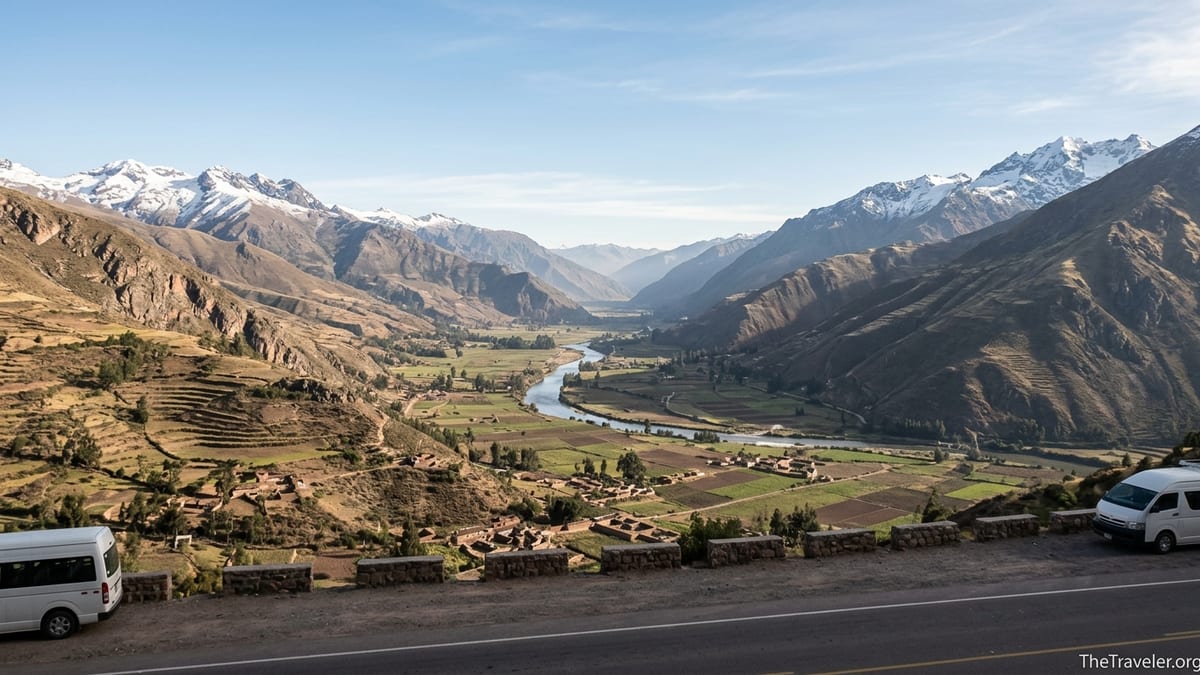
Understanding the Geography and Altitude Strategy
The first thing to grasp when your plane rolls into Cusco is the altitude profile of the region. Cusco itself sits at around 3,399 meters, while most Sacred Valley towns are significantly lower. Urubamba is roughly 2,800 meters, Ollantaytambo about 2,790 meters, and Pisac just under 3,000 meters. Chinchero, on the other hand, is higher than Cusco at about 3,750 meters. These numbers matter because your body needs time to adjust to high elevation, and symptoms such as headache, shortness of breath, and poor sleep are common in the first 24 to 48 hours.
Many travelers now follow an “arrive high, sleep lower” strategy. Instead of staying in Cusco on the first night, they go directly from the airport down into the Sacred Valley to Urubamba or Ollantaytambo, where the lower altitude can feel noticeably gentler. For example, a traveler arriving on a midday flight from Lima in July might hire a private driver at the airport and head straight to a hotel near Urubamba’s Plaza de Armas, arriving in about 1 hour 30 minutes. They might still feel the altitude, but typically with milder symptoms than if they slept in Cusco immediately.
Your personal health and itinerary should shape this decision. If you have heart or lung issues or are particularly sensitive to altitude, starting in a lower point like Urubamba and keeping your first afternoon quiet is a prudent move. On the other hand, if you only have limited time and want to dive straight into city sights, spending that first night in Cusco is still common, but you will want to move more slowly and hydrate aggressively.
One thing to avoid on day one is a detour to high Chinchero for sightseeing before you have acclimatized. While many classic valley circuits include Chinchero’s market and archaeological site, it is better suited for a later day when your body has had time to adjust, rather than as a first stop out of the airport.
Arrival Logistics at Alejandro Velasco Astete Airport
Alejandro Velasco Astete International Airport is compact by international standards, which works in your favor. After clearing immigration and bags, arrivals funnel you into a small hall where you will see official taxi counters, a few tour desks, and often a crowd of freelance drivers holding signs. Most Sacred Valley travelers either pre-book a private transfer, arrange a pick-up with their hotel, or negotiate a taxi on the spot to reach their chosen first town.
Official airport taxis typically quote rates in soles and, increasingly, in US dollars for longer rides. For context, travelers in 2025 and 2026 commonly report airport-to-Urubamba private car prices in the range of 180 to 260 soles, depending on the size of the vehicle and late-evening surcharges. A run to Ollantaytambo can be slightly higher because of the extra distance, while trips to nearby Cusco hotels are much cheaper. It is wise to confirm before getting in whether the price is per car, not per person, and whether there are any added fees for tolls or airport parking.
Some visitors arrange a transfer in advance through local agencies or hotel partners. For example, mid-range hotels in Urubamba often partner with private transport companies that run Hyundai or Kia sedans and small vans. You might receive an email confirming that your driver will meet you with a sign showing your name and the hotel logo, and that the ride for two people with luggage will be a fixed 220 soles. This removes the need to bargain after a long flight, which can be especially appealing if you land after dark.
There are also budget-conscious options, but they usually involve first going from the airport into Cusco proper, then changing to a colectivo or bus for the Sacred Valley. For most first-time visitors dragging luggage and feeling the altitude, a direct transfer is far more comfortable and eliminates time spent wandering unfamiliar streets looking for terminals.
Choosing Your First Base: Pisac, Urubamba, Ollantaytambo or Chinchero
Each Sacred Valley town offers a different feel and works better for certain types of trips. The question of where to stay first after landing is not only about geography but also about what you want your first 24 to 48 hours in Peru to be like. Imagine three travelers landing on the same afternoon: a family with kids, a couple aiming for Machu Picchu, and a solo hiker. Each might make a different choice.
Pisac, about 32 kilometers from Cusco, sits near the eastern end of the valley and is known for its hillside ruins and busy artisan market. At just under 3,000 meters, it is a bit lower than Cusco but still high enough that some travelers feel strong altitude effects. Pisac works well if you want an artsy, small-town feel with plenty of cafes and a quick jump to spectacular ruins. A solo traveler arriving from Lima might go straight to a small guesthouse off the main square, spend the next morning exploring the terraced ruins, and move on toward Urubamba the following day.
Urubamba is often considered the most comfortable acclimatization base. At around 2,800 meters, it is noticeably lower, with a wide valley floor and easy vehicle access to both Pisac side and Ollantaytambo side attractions. Many full-service hotels have large gardens, on-site restaurants, and even small spas. A family traveling with children might check into a resort-style property along the river, let the kids run around the lawns, and do only a short walk into town for dinner on the first evening.
Ollantaytambo, further west, is the rail gateway to Machu Picchu. Its well-preserved Inca street plan and fortress-like ruins give it a special atmosphere. Staying here first makes sense if you have an early train to Aguas Calientes on day two or three. For example, a couple might land in Cusco at 9 a.m., meet a pre-booked driver, stop briefly for lunch in Urubamba, then continue to Ollantaytambo and sleep in a small inn near the train station. They can wake up the next morning and board a train without retracing their steps from Cusco.
Chinchero, while beautiful and culturally rich, is the least suitable first-night base for most people because of its high altitude. It shines later in your itinerary, when you can enjoy weaving demonstrations and the archeological terraces without struggling too much for breath. A better strategy is to visit Chinchero as a stop between Cusco and Urubamba on day three or four, once your body has adjusted.
Best Overland Routes from Cusco Airport into the Sacred Valley
From Alejandro Velasco Astete Airport, the main paved route to the Sacred Valley climbs slightly out of Cusco and then either cuts through the plateau near Chinchero or winds toward Pisac. The most direct drive to Urubamba and Ollantaytambo typically follows the Cusco–Chinchero–Urubamba road, even if you choose not to stop in Chinchero itself. This route gives sweeping views across the snow-capped Andes and the patchwork farmland, but it also means briefly topping out at altitudes higher than Cusco before descending into the valley.
Travelers heading for Pisac usually take the road that follows the Vilcanota River eastward. This route starts from Cusco city and quickly begins to descend, with curves that reveal glimpses of terraced hillsides and the village spreading along the riverbank. A private car can make the airport-to-Pisac journey in about one hour under light traffic. Hiring a driver who is used to this specific road is helpful because buses and trucks frequently pass each other on bends.
If your destination is Urubamba, your driver will commonly take the highway past Chinchero and then descend in long switchbacks into the valley floor. Under normal dry-season conditions, many report the airport-to-Urubamba trip taking 1 hour 20 to 1 hour 40 minutes. To reach Ollantaytambo, you add another 25 to 35 minutes driving west along the valley, passing fields of maize and quinoa and small clusters of adobe houses. During the rainy season from roughly December to March, heavier traffic and wet pavement can lengthen these times, so build in extra margin if you are catching a later train.
You can also combine route choice with sightseeing if you feel reasonably well. For instance, some visitors landing on a morning flight arrange with their driver to stop at a llama and alpaca farm on the plateau between Cusco and the valley, spend 45 minutes learning about traditional weaving and feeding the animals, then continue down to Urubamba. Others ask for a brief photo stop above the valley, where you can see Urubamba and the river snaking below, before heading straight to the hotel for rest.
Private Transfers vs Colectivos and Buses
For most travelers going directly from Cusco Airport to the Sacred Valley, a private transfer is the most practical choice. A typical private car or van will meet you at scheduled time, handle your luggage, and take you door to door. As of mid 2026, prices frequently range from around 180 to 280 soles for a one-way airport-to-Urubamba trip in a sedan, and more for larger vans that can seat families or small groups with multiple suitcases. Some agencies quote in US dollars, with common figures of about 60 to 80 dollars per vehicle for this route, reflecting demand from international visitors.
Private drivers also allow for flexibility. If you want to stop at a supermarket on the outskirts of Cusco to pick up bottled water, snacks, or a local SIM card before dropping into the valley, you can often include a 20 minute shopping stop if you agree on it in advance. Travelers planning to self-cater in an apartment in Urubamba or a rented house near Ollantaytambo frequently take advantage of this and do a small grocery run before leaving the city.
Budget travelers can shave costs by taking a regular taxi or rideshare from the airport into downtown Cusco and then using colectivos. Colectivos are shared minivans that run set routes, such as Cusco to Urubamba or Cusco to Ollantaytambo, and you pay per seat. Fares on these routes are usually a fraction of private transfer prices, often under 15 soles per person as reported by recent visitors, but you trade off comfort and convenience. You may wait until the van fills up, sit with your luggage on your lap or on the roof, and you will be dropped in a central area rather than at your hotel door.
Larger intercity buses are less commonly used directly from the airport because you must still reach the bus terminal first. Services from Cusco to Urubamba operate from various small terminals in the city and can be booked through on-the-ground agencies or online platforms. They are more comfortable than colectivos and cost-effective for solo travelers, but the logistics are more complex when you have just landed at high altitude. For that reason, organized tours or pre-arranged transfers remain the easiest solution for people on short trips.
Sample First-Day Itineraries by Town
Thinking through a concrete first day can help you decide where to go. Imagine arriving in Cusco around 11 a.m. on a typical dry-season day in June. A couple traveling independently has pre-booked a private driver through their Urubamba hotel. They clear baggage, meet their driver at noon, and reach Urubamba by 1:30 p.m. After check-in, they have a light lunch of quinoa soup and grilled trout in the hotel restaurant and spend the afternoon napping and strolling gently through the garden. The next morning, they take a slow half-day visit to nearby Maras and Moray, returning to Urubamba for another night before heading to Machu Picchu.
In another example, a group of friends focused on hiking and photography lands on an early flight from Lima. They grab a taxi from the airport to a colectivo stand in Cusco, squeeze into a minivan to Ollantaytambo, and arrive a couple of hours later, slightly tired but thrilled by the cobbled streets and stone walls. They drop bags at a simple guesthouse close to the plaza, drink coca tea, and climb partway up the free Pinkuylluna ruins across from the main fortress in the golden late-afternoon light.
A third scenario involves a family with young children arriving from sea level in the United States. With jet lag and altitude in mind, they choose Pisac as an in-between base. Their pre-arranged driver fetches them from the airport and heads east. They check into a small lodge just outside town with a playground and hammocks. Instead of rushing to the ruins, they walk only as far as the market, buy some fruit and simple textiles, and head back early. The next morning, while the parents take turns visiting the ruins, the kids relax at the lodge, before the family continues deeper into the valley.
These examples illustrate how route planning is not just about maps. It is about matching drive times, altitude changes, and local pace to your energy level after the flight. Being realistic about what you can enjoy on day one often leads to better memories than trying to check off too many sights immediately.
When Chinchero Fits into the Picture
Although it is not ideal for your first night’s sleep, Chinchero deserves a place in a well-rounded Sacred Valley itinerary. Perched on a high plateau north of Cusco, it offers a mix of Inca terraces, colonial church architecture, and living textile traditions that many travelers remember as a highlight of their trip. The key is timing your visit for when you are better acclimatized and integrating it into an efficient route.
One common approach is to schedule Chinchero on a transfer day between Cusco and Urubamba. For example, after spending two nights in the valley, you might organize a private driver to pick you up in Urubamba, stop for two hours in Chinchero for a weaving demonstration and a walk through the archaeological area, then continue to Cusco for your final nights. Another variation is to visit Chinchero along with Maras and Moray in a loop that starts and ends in Urubamba or Ollantaytambo, turning a simple transfer into a full sightseeing day.
Weaving cooperatives in and around Chinchero typically demonstrate the whole process from washing the wool with natural soaps to spinning, dyeing, and weaving, all while explaining their symbolism and patterns. Visitors often sit around low benches in a courtyard, sip herbal tea, and watch as garments take shape. This makes Chinchero particularly engaging for travelers who value cultural immersion over ticking off a list of archaeological sites.
Since Chinchero is higher than Cusco, be prepared for cooler temperatures and stronger sun. Many travelers who feel fine in Urubamba or Ollantaytambo notice shortness of breath when they climb the terraces here. Planning your visit as a mid-trip excursion instead of as your first stop from the airport helps reduce the chance that altitude discomfort overshadows your experience.
The Takeaway
Deciding how to get from Alejandro Velasco Astete International Airport to the Sacred Valley, and where to spend your first night, is one of the most important choices of a Peru itinerary. The region’s dramatic altitude differences mean that a town only an hour away by road can feel significantly easier on your body. For many travelers, heading directly to the lower Sacred Valley, especially Urubamba or Ollantaytambo, offers a smoother acclimatization than staying in Cusco right away.
There is no single best town for everyone, but there is usually a best town for you. Pisac offers artsy markets and convenient ruins, Urubamba delivers space and comfort at a manageable elevation, Ollantaytambo positions you perfectly for Machu Picchu trains, and Chinchero enriches later days with its textiles and terraces. Private transfers from the airport are the simplest, while colectivos and buses suit those with tighter budgets and more patience for logistics.
By matching your health, travel style, and timetable to these options, you can turn what might have been a stressful transfer into a memorable part of your journey. Instead of just enduring the road out of Cusco, you will be watching the valley open up below you, knowing that the town waiting at the bottom is the right one for your very first night in the Sacred Valley.
FAQ
Q1. Is it better to go straight from Cusco Airport to the Sacred Valley instead of staying in Cusco first?
For many travelers, especially those coming from sea level, going directly to a lower-altitude town like Urubamba or Ollantaytambo can make the first night more comfortable and reduce the intensity of altitude symptoms.
Q2. How long does it take to drive from Alejandro Velasco Astete Airport to Urubamba or Ollantaytambo?
Under typical conditions, it takes about 1 hour 20 to 1 hour 40 minutes to reach Urubamba and around 2 hours total to reach Ollantaytambo from the airport, depending on traffic and weather.
Q3. Roughly how much does a private transfer from Cusco Airport to the Sacred Valley cost?
Recent travelers report paying roughly 180 to 280 soles for a one-way private car from the airport to Urubamba, with slightly higher prices for larger vehicles or for the longer run to Ollantaytambo.
Q4. Which Sacred Valley town is best as a first-night base after landing?
Urubamba is often the most comfortable first base thanks to its moderate altitude, wide choice of hotels, and central position for later day trips, while Ollantaytambo is ideal if you have an early Machu Picchu train.
Q5. Is Pisac a good place to stay right after arriving in Cusco?
Pisac works well for travelers who want a small-town feel and easy access to ruins and markets, but it is still close to 3,000 meters, so you may feel the altitude more than in Urubamba.
Q6. Why is Chinchero usually not recommended as a first stop out of the airport?
Chinchero sits even higher than Cusco, around 3,750 meters, which can make altitude symptoms stronger. Most visitors enjoy it more as a mid-trip excursion once they are partially acclimatized.
Q7. Are colectivos from Cusco to the Sacred Valley a safe and practical option?
Colectivos are widely used by locals and budget travelers and are generally safe, but you sacrifice comfort, luggage space, and door-to-door convenience compared with a private transfer, which matters on your arrival day.
Q8. Can I stop at viewpoints or attractions on the way from the airport to my Sacred Valley hotel?
Yes, many private drivers will include short stops, such as at an alpaca farm or a scenic lookout above the valley, if you agree in advance and factor the extra time into your schedule.
Q9. What is the best town to stay in if I have an early train to Machu Picchu?
Ollantaytambo is the most convenient choice because most trains to Aguas Calientes start or stop there, allowing you to walk from your hotel to the station in the morning.
Q10. How should I manage altitude when planning my first 48 hours in the Sacred Valley?
Plan to move slowly, drink plenty of water, eat light meals, avoid heavy exertion on day one, and, if possible, sleep at a lower altitude like Urubamba or Ollantaytambo before spending full days in high places such as Cusco or Chinchero.