


The Cyclades look close together on the map, but getting between islands and to and from Athens quickly eats into a holiday. Ferries can take anywhere from under 2 hours to more than 6 hours depending on route, vessel and wind, and there is always check-in, waiting and transfer time on top. For most visitors, the most satisfying trips focus on a small cluster of islands, accepting that fewer bases mean more genuine holiday time: lingering on beaches, exploring villages and enjoying long Aegean evenings instead of hauling luggage and watching departure boards.
Get the latest updates straight to your inbox!
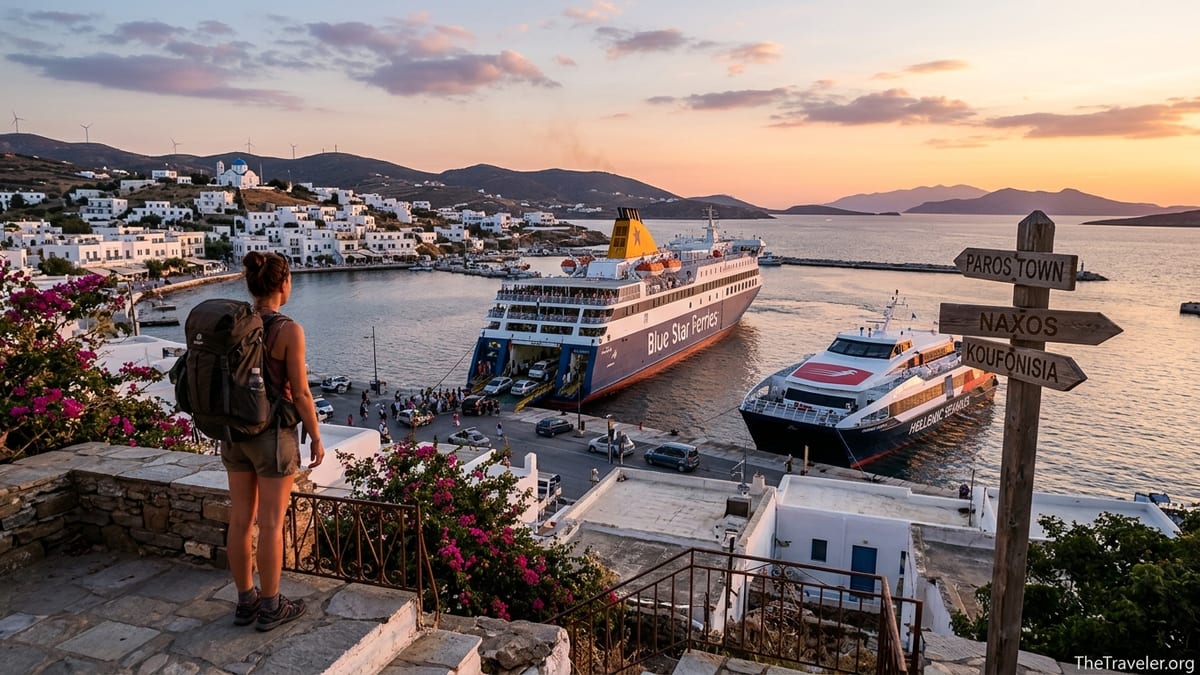
How Travel Time Shapes Any Cyclades Itinerary
Most Cyclades trips begin and end in Athens, usually via Piraeus port or Athens International Airport. Conventional summer ferries from Piraeus to headline islands such as Santorini, Paros, Naxos or Milos typically take around 4 to 8 hours as of schedules checked in November 2026, while high-speed catamarans often reduce that to roughly 2.5 to 5 hours but with higher fares and more sensitivity to sea conditions. On top of sailing time you should allow at least 60 to 90 minutes pre-departure to reach the port, collect tickets if needed and board in an orderly way.
Flights from Athens to major islands like Santorini, Mykonos and Paros are around 40 to 50 minutes in the air, but check-in time and security still dominate the experience. Greek domestic carriers are currently advising passengers to arrive about 2 hours before domestic departures, with check-in often closing 40 minutes before take-off according to 2026 guidance from airlines such as Sky Express. That means a “quick hop” often claims half a day once transfers and occasional queues are included.
Given these realities, adding extra islands can easily remove a full daytime from your trip for every extra ferry leg. Island-to-island ferries such as Naxos to Koufonisia or Paros to Naxos can be as short as 35 minutes on a fast boat in summer, but the same routes can also involve conventional vessels taking 2 to 3 hours, especially on local lifeline services. Building in only one or two travel days on a short itinerary allows more actual time in villages, at beaches and on terraces, and greatly reduces stress if weather delays a sailing.
The following sample itineraries are built around current or typical ferry corridors operated by companies such as Blue Star Ferries, Seajets, Hellenic Seaways and Small Cyclades Lines, based on schedules published for 2025 and 2026. Connections and frequencies change every year, so treat these as patterns rather than fixed timetables and always confirm routes again for your own travel dates.
Itinerary 1: 5 Days, One Island Plus a Simple Day Trip
A five day trip to the Cyclades effectively offers three solid full days once you remove arrival and departure logistics. For most travelers, that argues strongly for a single-island stay with perhaps one nearby day trip if schedules line up. Naxos and Paros both work especially well for this because they combine beaches, villages and good food with frequent links from Piraeus and onward connections to smaller islands.
One realistic five day pattern is four nights on Naxos and a final night back in Athens before your international flight. Ferries from Piraeus to Naxos with operators such as Blue Star Ferries typically take about 4 to 5.5 hours in summer, while high-speed catamarans can be closer to 3 to 3.5 hours on certain days. If you land in Athens in the morning you can usually reach Naxos the same afternoon, then wake on day two with a full day on the island.
From a Naxos base, a classic structure is one full beach day around Agios Prokopios or Plaka, one day focused on the main town and its Venetian Kastro, and one flexible day for a hike or mountain village tour to places like Apeiranthos. If seas are calm and you want some light island hopping, the local Express Skopelitis ferry and other services link Naxos with Iraklia, Schinoussa and Koufonisia, with typical sailings around 2 to 2.5 hours to Koufonisia and around 1.5 hours to Iraklia based on 2026 timetables. In summer there are also faster seasonal boats that can bring Naxos to Koufonisia down to under an hour on some dates, which makes a long day trip feasible.
This short itinerary is most practical from late May to late September, when ferry frequencies are highest. In April, early May and October, shoulder-season reductions can make a day trip to the Small Cyclades harder to line up with a same-day return, so plan to stay entirely on Naxos or choose a simple excursion like a bus tour into the interior. Whatever the month, keep your final night in Athens to avoid a missed ferry jeopardising your flight; domestic disruptions from wind in the Aegean are relatively common in high summer.
Itinerary 2: 7 Days, Two Islands: Iconic Plus Quieter
With seven days on the ground you can realistically enjoy two bases without feeling rushed, especially if you keep one as a major transport hub. A popular and practical pattern is Santorini paired with a calmer island such as Naxos or Paros, or Paros combined with one of the Small Cyclades. These pairs work because there are regular direct ferries in summer, limiting the need to backtrack via Piraeus.
One proven route is three nights in Santorini and three nights in Naxos, followed by a final night in Athens. Conventional ferries from Piraeus to Santorini operate up to several times weekly and typically take around 7 to 8 hours as of 2025 and 2026 schedules, while high-speed boats often complete the crossing in about 4.5 to 6 hours depending on intermediate stops. Starting in Santorini makes sense because there are also frequent flights from Athens; you can often fly directly there after landing in Greece, use three nights to settle into Oia or Fira and explore the caldera paths and Akrotiri archaeological site, then move on once the island’s crowds begin to weigh.
The Santorini to Naxos leg is usually a mid-length ferry hop of roughly 2 to 3 hours in summer, with several operators running the Naxos–Paros–Ios–Santorini corridor. Plan a midday crossing that still leaves you time for an afternoon beach stroll on Naxos. Three nights there gives you two full days, enough to sample at least one long sandy beach such as Plaka and spend a separate day in the mountain villages or visiting the Portara at sunset in Naxos Town.
This itinerary is best from mid May through late September, when Santorini–Naxos ferries are frequent. In early April or late October some direct sailings disappear and wind disruptions can be more likely, so a safer spring or late autumn pairing is to connect Santorini with Paros or simply spend all seven nights split between Santorini and Athens. Whichever option you choose, schedule the last night on the mainland or on an island with an airport and multiple daily flights back to Athens so you are not entirely dependent on one ferry.
Itinerary 3: 7 Days, Paros Plus the Small Cyclades
For travelers less interested in the famous caldera views and more drawn to beaches and small-village life, a week split between Paros and one Small Cyclades island can be both realistic and deeply relaxing. Here, Paros functions as the hub for flights and high-frequency ferries, while islands like Koufonisia, Schinoussa or Iraklia provide the slower pace.
A typical structure is three nights on Paros, three nights on Koufonisia and one final night back in Paros or Athens. Piraeus to Paros ferries generally run around 3 to 4.5 hours by conventional boat in high season and around 2.5 to 3.5 hours on faster vessels, depending on stops. That makes it one of the quicker major Cyclades reaches from Athens. Base yourself near Naoussa or Parikia to avoid long transfers, and use your two full days for a beach day in Kolymbithres or Golden Beach and a day exploring villages such as Lefkes.
From Paros, ferries to Koufonisia may run directly on certain Seajets or other high-speed routes in peak summer, but more commonly you will connect via Naxos. The Paros to Naxos leg can be under an hour on a fast catamaran or around 1.5 to 2 hours on a slower ferry, then Naxos to Koufonisia ranges from roughly 35 minutes on a high-speed summer boat to about 2.5 hours on the local Express Skopelitis, which calls at Iraklia and Schinoussa en route according to current Small Cyclades Lines information. To keep this reasonable in a one week itinerary, devote most of one daytime to the transfer and aim for morning or midday sailings.
On Koufonisia you will have two full days if you spend three nights. That is enough time for one day of relaxed beach-hopping east along the island’s famous coves and another quieter day in the main village or with a short boat trip to nearby Kato Koufonisi if services are running. Schedules checked in November 2026 indicate year-round connections between Naxos and Koufonisia, with extra high-speed options in July and August, but frequencies to smaller neighbours like Schinoussa and Iraklia can be limited in shoulder months. Outside June to September, it may be wiser to stay within Paros and Naxos rather than pushing deeper into the Small Cyclades.
Itinerary 4: 10 Days, Three Islands Along a Logical Corridor
Ten full days allow for three islands if you keep your moves aligned with established ferry chains. One classic western Cyclades route is Milos, Sifnos and Serifos, which commonly sit on the same Piraeus corridor for both conventional and high-speed ferries. Another eastern option links Mykonos, Paros and Naxos along one of the busiest tracks in the Aegean, simplifying logistics even in shoulder seasons.
For the western chain, a realistic pattern is three nights on Milos, three on Sifnos, three on Serifos and one final night in Athens. Piraeus to Milos has up to several departures a day in summer with conventional vessels often taking about 6 to 7 hours and high-speed ferries closer to 3.5 to 4.5 hours. Milos rewards at least two full days so you can explore its volcanic coastline, perhaps on a day boat around Kleftiko, and visit colourful villages like Klima without feeling rushed.
The Milos to Sifnos and Sifnos to Serifos legs are typically short hops of about 1.5 to 3 hours depending on the vessel and the number of intermediate stops. Sifnos offers a mix of beaches and a notable inland village, Apollonia, while Serifos is smaller and sleepier, with a hilltop Chora and sandy bays such as Livadi and Psili Ammos. Because all three islands often share services from operators like Seajets, Hellenic Seaways and Blue Star Ferries as of recent seasons, you can usually move along the chain without returning to Piraeus, but you should still treat each transfer as a half-day operation that might be impacted by meltemi winds in July and August.
If you prefer the central-eastern Cyclades, a Mykonos, Paros and Naxos route follows a similarly logical line. Mykonos is well served by both ferries and flights, with high-frequency services from Piraeus and Rafina in summer that can be under 3 hours on some fast boats. Spending three nights there gives you time for its famous town and nearby beaches. Short ferry crossings of roughly 45 to 90 minutes typically connect Mykonos to Paros, and Paros to Naxos can be even quicker, especially on high-speed summer sailings. Ending on Naxos before heading back to Piraeus or flying to Athens works well because it offers both a relaxed final beach day and reliable links back to the mainland.
Itinerary 5: 14 Days, One Hub Plus Remote Islands
Two full weeks in the Cyclades open up more ambitious combinations that mix a major hub island with smaller, more remote destinations. A practical structure is to pick one well-connected base, such as Naxos, Paros or Syros, then add two or three quieter islands that sit naturally on nearby ferry chains. This keeps your longest sea journey to the beginning or end of the trip and limits cross-country backtracking.
One appealing pattern is three nights on Syros, four on Tinos, four on Amorgos and two back on Naxos before a final night in Athens. Syros, with its administrative capital Ermoupoli, is a key ferry node from Piraeus, commonly reached in about 3 to 4 hours on conventional ferries and around 2.5 to 3 hours on high-speed vessels. Staying there at the start helps you adjust to Greek time in a real working town while keeping onward options open, as Syros maintains year-round links to many Cyclades islands.
Syros to Tinos and Tinos to Naxos or Paros are typically short crossings often under 2 hours as of current schedules, making them manageable even outside peak season. Tinos is known for its religious sites and traditional villages and offers a quieter atmosphere than nearby Mykonos. From a Naxos or Paros leg mid-trip, you can then aim for Amorgos, which lies on longer interisland routes that can run 3 to 5 hours from Naxos or about 6 to 8 hours from Piraeus depending on vessel and stops. Spending four nights there provides at least three full days to balance hiking, visits to the famous cliffside monastery of Hozoviotissa and time in villages like Chora and Aegiali.
Alternatively, base five or six nights on Naxos and use the central days to visit one or two of the Small Cyclades such as Schinoussa and Iraklia, then add a final leg to Folegandros if summer connections are running. Recent information from regional tourism sites confirms regular all-year links between Naxos and the Small Cyclades islands with Small Cyclades Lines, plus additional high-speed links in peak season that extend onward from Koufonisia to islands including Folegandros, Sifnos and Serifos. Because these smaller islands have limited accommodation and reduced ferry frequencies outside June to September, a 14 day window lets you build spare days around the longest hops so that a cancelled boat due to wind does not cascade into missed flights.
With a fortnight to play with, you might be tempted to add even more islands, but each extra move introduces another travel day with potential weather and schedule risk. Instead, use the extra time to slow down: three full days on a tiny island like Schinoussa or Iraklia can feel transformative precisely because there is little to do beyond walking, swimming and eating, and you always have a flexible buffer back on Naxos or Syros before returning to Athens.
Seasonality, Timetables and Connection Margins
All of these itineraries depend heavily on season. Summer schedules, usually from mid June to early September, are dense and often include express high-speed runs that connect islands directly without detouring via Piraeus. Shoulder months like May and October still offer reasonable coverage on main lines such as Piraeus to Paros, Naxos, Mykonos, Santorini and Milos, but thinner frequencies can make ambitious chains involving very small islands risky.
For early April or late October trips, it is usually wiser to focus on larger islands with more residents and year-round traffic, such as Syros, Naxos, Paros and Milos, rather than remote places like Donoussa or Anafi where services are more sporadic and some tourist facilities may be closed. When sketching your route, always cross-check at least one reputable timetable platform and, where possible, the websites of the ferry companies themselves, because third-party aggregators may lag behind last-minute adjustments.
For air connections, current practice at Athens Airport suggests arriving at least 2 to 3 hours before an international departure and about 2 hours before domestic flights, particularly in 2025 and 2026 as new border control systems can create extra queues. Travel forums and recent traveler reports suggest that very tight self-made connections under 2 hours between an arriving long-haul flight and a separate domestic ticket to an island are increasingly risky. When possible, build in 3 or more hours between separate tickets or plan an overnight in Athens before your long-haul flight home.
Within the islands, treat each ferry day as occupying at least half a day, and sometimes more if you need to check out of accommodation in the morning and cannot check in at the next place until mid afternoon. Booking morning or midday sailings can free up at least a late afternoon and evening in your new destination, whereas late afternoon departures often fragment an entire day. Whenever you have an early-morning international flight, spend the night before either on the mainland or on an island with a reliable airport and multiple daily flights such as Santorini, Mykonos or, increasingly, Paros and Naxos.
Adapting and Swapping Islands Safely
The sample routes here are starting points rather than fixed recipes. Many islands can be swapped for others with a similar atmosphere provided the ferry links line up. For example, in the seven day “iconic plus quieter” itinerary, Paros can stand in for Naxos as a more compact, slightly busier alternative that still has strong summer connections to Santorini and Athens. In the ten day western chain, Kimolos or Folegandros can sometimes be added or substituted for one of Milos, Sifnos or Serifos when high-speed routes are running that call at several of these islands on the same loop.
When considering substitutions, look first at where your chosen island sits in the ferry network. Islands like Syros and Naxos function as hubs with many spokes, making it easier to recover from a cancelled crossing. Tiny islands on the periphery, such as Donoussa or Anafi, may see only a few boats a week in shoulder seasons, which can turn a missed sailing into a two-day delay. Also check not only whether a route exists but on which days and at what times it runs; a connection that looks perfect on paper may in practice require a dawn departure or a middle-of-the-night arrival.
Always recheck timetables in the season you plan to travel, as routes that operate daily in August may be reduced to once or twice weekly in June or September and not at all in April. This applies especially to triangular or circular routes used by many high-speed catamarans, which can change direction or skip stops from year to year. When swapping islands, try to keep to a simple geographic line rather than zig-zagging back and forth across the Aegean, both to reduce travel times and to minimise your environmental footprint.
Finally, remember that the most successful Cyclades itineraries are those that leave room for flexibility. Booking fully changeable ferry tickets where possible, avoiding the very last boat of the day before a flight and choosing at least one hub island with multiple exit options all increase your chances of a smooth trip. Once you accept that you will not see every island in one visit, it becomes easier to design a route that truly feels like a holiday rather than a race.
What You Can Decide Now
By understanding how much time travel days consume, you can now decide realistically how many islands to include. For about five days on the ground, sticking to a single island such as Naxos or Paros with a gentle day trip is usually most enjoyable. With a week, two islands on a strong direct route, for example Santorini plus Naxos or Paros plus a Small Cyclades island, strike a good balance between variety and rest.
At ten days, three islands along a single ferry corridor become viable, whether that is Milos, Sifnos and Serifos in the western Cyclades or Mykonos, Paros and Naxos in the central group. With fourteen days you can combine one hub island with smaller and more remote options, such as Syros and Naxos paired with Amorgos or the Small Cyclades, or a longer stay that threads in Folegandros, Tinos or Serifos while still keeping margin for delays.
For each option, your next steps are to match the pattern to your season, confirm that every island pair you are considering has at least one direct or straightforward connection for your dates, and check current recommendations for airport check-in times and safe connection margins at Athens and any island airports. If you then keep your final night on the mainland or on an island with robust flight options, you will have an itinerary that respects both the romance of the Cyclades and the practicalities of getting around them.