


More news on this day
Travelers moving between Australia and New Zealand are facing another day of disruption, with publicly available tracking data indicating 249 delayed services and three cancellations affecting flights in and out of Melbourne, Sydney and Auckland across multiple airlines.
Get the latest news straight to your inbox!
Major Carriers See Knock-On Delays Across Key Trans-Tasman Routes
Real-time tracking platforms and airline operational updates show that delays are concentrated on busy trans-Tasman and domestic trunk routes linking Melbourne, Sydney and Auckland with other major cities. Services operated by Virgin Australia, Jetstar, Qantas and Air New Zealand are among those most affected, alongside a number of regional and codeshare partners.
The disruption pattern reflects how tightly interconnected operations have become between Australia and New Zealand. Aircraft and crew frequently rotate between trans-Tasman and domestic sectors, meaning an initial delay on an early service can cascade through the day. When several carriers experience small schedule issues at once, the result can be the kind of broad-based disruption now being reported across the region.
Published on-time performance statistics for trans-Tasman corridors already highlight relatively modest cancellation rates but wide variation in punctuality, particularly on routes such as Sydney to Auckland and Melbourne to Wellington. Current conditions, with 249 delayed flights and three outright cancellations recorded, are pushing those networks close to their operational limits.
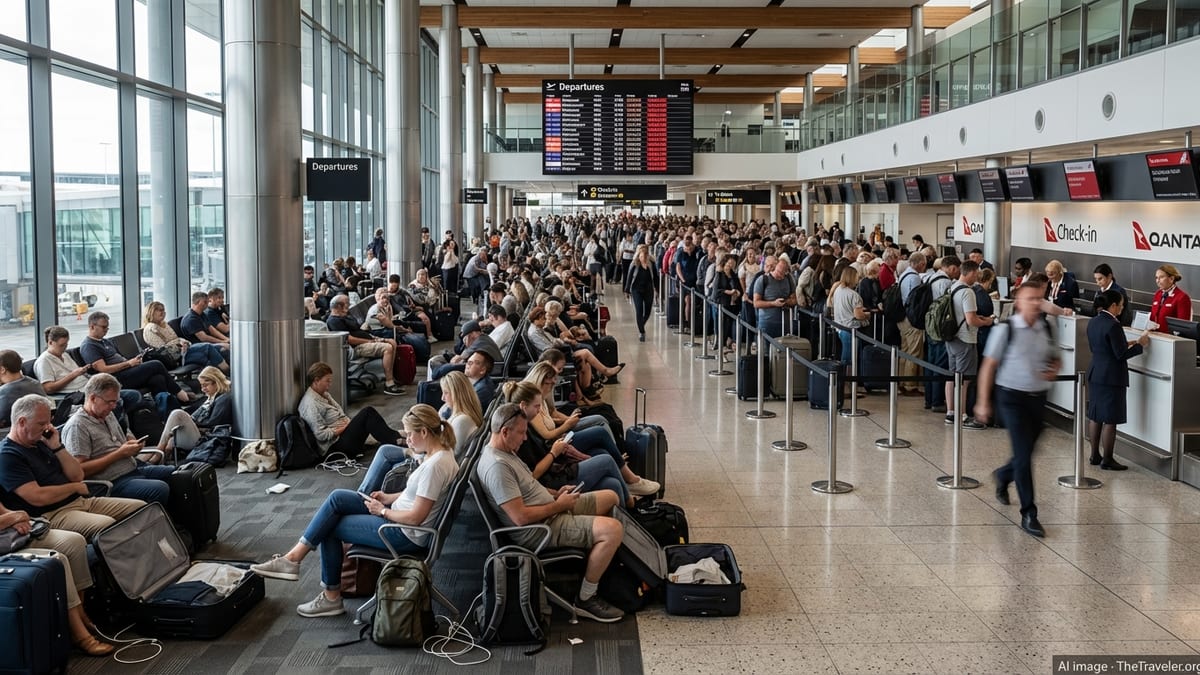
While individual flights may still depart close to schedule, the cumulative effect is being felt in crowded departure areas, longer queues at check-in and security, and mounting pressure on rebooking systems as disrupted passengers seek alternative options.
Melbourne, Sydney and Auckland Airports Under Strain
Melbourne, Sydney and Auckland are the primary gateways for travel between Australia and New Zealand, handling large volumes of traffic from full-service and low-cost carriers. Publicly available passenger data for recent years underscores their importance, with Sydney and Melbourne consistently ranking among the busiest domestic and international hubs in the region, and Auckland serving as New Zealand’s main long-haul and trans-Tasman base.
When delays begin to accumulate in these hubs, the impact is quickly felt on surrounding networks. A late arrival from Auckland into Melbourne can delay an onward domestic rotation, while disruptions on Sydney services can ripple out to secondary airports across both countries. With many flights operating at high load factors, even relatively small timetable changes leave little slack for reaccommodating disrupted travelers.
Operational data from tracking services also indicates that some affected flights involve codeshare arrangements, including services where Air New Zealand or Qantas operate aircraft on behalf of international partners. In such cases, schedule changes can affect not only point-to-point passengers but also those connecting to or from long-haul services, increasing the risk of missed onward flights and overnight stays.
Airport staff and airline ground teams are working within these constraints to move aircraft, crew and passengers through constrained gate and runway capacity. However, with so many interdependent schedules, each additional delay makes recovery slower and more complex.
Virgin Australia, Jetstar, Qantas and Air New Zealand Among Affected Airlines
The disruption spans a mix of full-service and low-cost operators. Virgin Australia, Qantas and Air New Zealand handle a significant share of trans-Tasman and domestic trunk capacity, while Jetstar continues to operate as a key budget option on routes such as Sydney to Auckland and Melbourne to major New Zealand centres.
In recent months, publicly available performance data and regulatory reporting have shown that punctuality on flagship routes can fluctuate widely from month to month. Some carriers record strong on-time departure rates on particular corridors, while others show higher percentages of late operations or isolated cancellations, often linked to aircraft availability, maintenance requirements or staffing constraints.
Industry statistics published by transport authorities illustrate that even in typical months, on-time departure rates on busy Australia to New Zealand routes often sit in the 60 to 80 percent range, with a small proportion of flights cancelled outright. When an unusual cluster of delays and a handful of cancellations occur on the same day, passengers experience that statistical margin as very real queues and missed plans.
While the current disruption includes only three confirmed cancellations compared with 249 delays, cancellations tend to draw the most attention, as they require full rebooking or refunds. However, high volumes of shorter delays can collectively affect more travelers and place greater strain on airport infrastructure and airline scheduling systems.
Impact on Passengers and Limited Same-Day Alternatives
For passengers in Melbourne, Sydney and Auckland, the immediate impact is longer waiting times in terminals, uncertainty about boarding and arrival times, and an elevated risk of missing connections on multi-leg itineraries. Travelers on tight schedules for work, events or onward international flights are particularly vulnerable when delays grow beyond an hour or begin to stack across multiple sectors.
The heavy use of narrow time windows for trans-Tasman departures means that same-day alternatives are not always available. Once key morning and midday waves of flights are disrupted, remaining services quickly fill, leaving some passengers with only late-evening or next-day options. This dynamic is being reported on several linkages between Australian capitals and New Zealand cities, where midweek schedules can already be thinner than peak holiday or weekend patterns.
Travelers who booked through one airline but are flying on a codeshare-operated service can also face added complexity. Changes to a single flight number may require coordination between multiple airlines’ reservation systems, slowing the rebooking process and increasing the likelihood of passengers receiving staggered or conflicting updates on revised departure times.
Families, older travelers and those unfamiliar with self-service tools are more likely to rely on airport desks to navigate these issues, further increasing congestion at check-in and customer service counters during already busy periods.
What Travelers Can Do as Disruption Continues
Publicly available guidance from airlines in the region consistently encourages passengers to monitor flight status closely via official airline apps and websites on the day of travel. With disruptions reaching the scale now seen across Australia and New Zealand, checking real-time information multiple times before leaving for the airport can reduce the risk of extended waits at the terminal.
Airline policies for delays and cancellations vary by carrier and route, but most major airlines operating between Australia and New Zealand outline options for rebooking onto the next available flight, credit vouchers or refunds where flights are cancelled or significantly disrupted. Passengers are generally advised to review these policies in advance so they understand what support may be available if their service is affected.
Travelers with non-flexible tickets, separate onward bookings or tight connections may wish to build extra time into itineraries during periods of elevated disruption such as the current one. Those with critical time-sensitive commitments, including business meetings or events, are often encouraged by travel advisers to consider earlier departures or contingency plans when widespread delays are being reported.
As airlines and airports work through today’s wave of disruption, recovery will depend on how quickly carriers can return aircraft and crew to planned positions. With 249 delays and three cancellations already recorded, any additional operational challenges or weather-related constraints could prolong the effect on schedules in Melbourne, Sydney, Auckland and beyond into the coming days.