


More news on this day
Delays and cancellations are continuing to ripple through major UK airports days after a serious air traffic control failure forced hundreds of flights to be grounded, leaving airlines struggling to restore normal schedules and passengers facing prolonged disruption.
Get the latest news straight to your inbox!
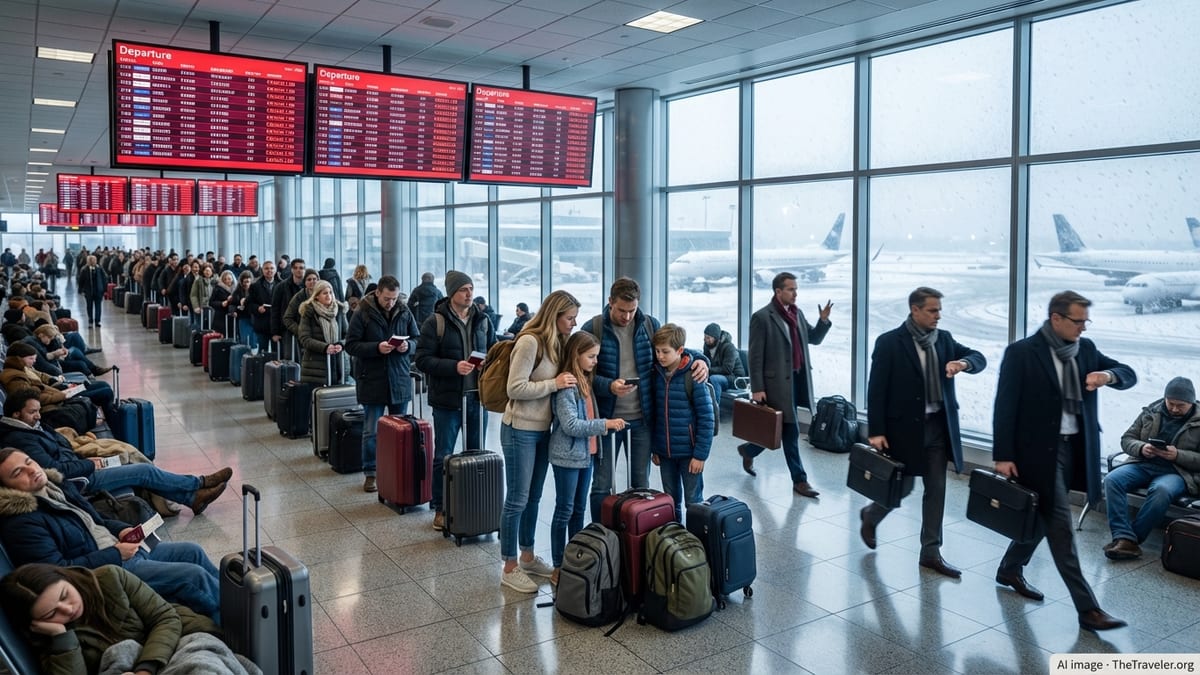
Backlog Builds After 8 September System Failure
Travel across the United Kingdom’s busiest airports remains heavily disrupted following a technical fault at the national air traffic control provider on 8 September 2026. Publicly available information indicates that the issue affected systems used to manage flight plans, triggering widespread restrictions on departures and leading to knock-on disruption for arriving services.
Flight-tracking data cited in published coverage suggests that close to 1,000 flights were cancelled on the day of the outage, with hundreds more significantly delayed. London Heathrow and Gatwick, the country’s two largest hubs, were among the worst affected, alongside other major airports including Manchester, Bristol and Edinburgh. Reports from passenger forums and airline updates indicate that congestion continued into 9 September as aircraft and crews remained out of position.
Although the technical fault was identified and operations moved into a recovery phase later on 8 September, the scale of the disruption means schedules have remained fragile. Airlines have been trimming services, consolidating flights and prioritising long-haul operations as they work through the backlog, with further cancellations announced into the weekend on some routes.
The latest disruption has revived scrutiny of the resilience of the UK’s air traffic management infrastructure. Commentators have noted that this is the third major technical incident attributed to the same provider in three years, following a widely reported system failure on 28 August 2023 and an earlier radar-related issue in 2025.
Airlines Struggle to Rebuild Schedules
According to airline statements and airport departure boards, operators are facing a complex logistical challenge as they attempt to restore normal schedules. Aircraft and crew are scattered across Europe after flights were halted or turned back during the incident, creating bottlenecks that can take days to unwind even after the underlying technical problem has been resolved.
Several UK and European carriers have warned customers to expect continued delays and short-notice cancellations while recovery operations continue. Public updates from low-cost and leisure airlines show advisories urging passengers to monitor apps and email for rebooking details, with some carriers offering flexible rebooking or refunds for those no longer wishing to travel this week.
At hub airports, reports from passengers describe long queues at check-in, transfer desks and security as travellers attempt to rearrange disrupted journeys. Social media posts and user-generated reports highlight cases of travellers being rebooked two or three days later than planned, particularly on busy leisure routes where spare capacity is limited.
The disruption is also affecting airline finances and operations more broadly. Published commentary from industry analysts following the 2023 incident noted that mass cancellations generate substantial costs for carriers through hotel stays, meal vouchers, crew overtime and aircraft repositioning. Similar pressures are expected this time, with some airlines already signalling that the event could weigh on quarterly earnings.
Regulators Revisit Resilience and Passenger Rights
The Civil Aviation Authority has previously examined the vulnerability of the UK’s air traffic systems following the August 2023 failure. An independent review commissioned after that event concluded that an anomalous flight plan message triggered a shutdown of parts of the automated processing system, and made 34 recommendations aimed at improving technical resilience, communication and contingency planning across the aviation sector.
Government publications from 2024 and 2025 show that steps have since been taken to strengthen oversight, including calls for better consumer protection and improved powers for the regulator to enforce standards. Progress reports indicate that work has focused on system redundancy, incident response procedures and clearer communication between the air traffic provider, airlines and airports when capacity is constrained.
In the wake of the latest failure, there is renewed debate over whether those earlier recommendations have gone far enough. Commentators in the UK media and aviation forums argue that repeated large-scale outages suggest structural weaknesses, and some are calling for closer scrutiny of investment in critical systems and staffing levels at control centres.
The question of passenger rights is also back in focus. Guidance published by the Civil Aviation Authority explains that, where delays or cancellations are caused by an air traffic control failure outside the airline’s direct control, cash compensation under UK261 rules is generally not owed. However, airlines are still expected to provide care and assistance, such as meals and accommodation, which can be a source of frustration when demand for hotel rooms around major hubs is already high.
Travelers Face Difficult Choices in the Days Ahead
For passengers with imminent travel plans, the ongoing disruption presents a difficult set of decisions. Travel advisories from affected airlines recommend that customers do not travel to the airport until their flight is confirmed as operating, and encourage the use of mobile apps and websites as the primary source of schedule updates.
Reports from major hubs show that some travellers have opted to cancel or postpone trips rather than face uncertainty around departure times and potential missed connections. Others have been re-routing via alternative European hubs where space is available, with some long-haul passengers choosing to connect through Dublin, Amsterdam or Paris to avoid the most congested UK airports.
Industry data referenced in recent coverage suggests that operational performance is gradually improving, but with a continuing tail of disruption. While a significant proportion of flights are now departing, many are doing so behind schedule, and short-haul sectors remain particularly vulnerable as airlines balance the need to clear backlogs with crew duty-time limitations.
Travel organisations are advising passengers to check the status of both outward and return legs, ensure contact details are updated with airlines and consider travel insurance policies that include cover for air traffic control disruption. For those already stranded abroad, consumer guidance stresses the importance of retaining receipts for essential expenses to support any claims made once travel is complete.
Long-Term Questions Over UK Aviation Reliability
The events of this week are likely to feed into a broader discussion about the reliability of UK aviation at a time when air travel demand has largely recovered to, and in some markets exceeded, pre-pandemic levels. Air traffic control failures are rare compared to the total volume of flights handled, but when they occur, the scale of disruption highlights the sector’s dependence on a small number of highly complex systems.
Previous technical reports and official reviews into the 2023 failure emphasised that safety protocols functioned as intended, with capacity reduced to maintain separation between aircraft. However, they also pointed to the need for more robust backup systems, faster incident recovery and clearer communication channels to reduce the impact on passengers and airlines.
As the latest investigation into the 8 September outage gets under way, attention is likely to focus on whether lessons from earlier incidents were fully implemented and what additional safeguards may now be required. Industry observers note that investments in modernising air traffic technology are competing with other priorities, but argue that the reputational and economic cost of repeated large-scale disruptions strengthens the case for accelerated upgrades.
For now, travellers passing through the UK’s airports in the coming days are being urged to prepare for longer journeys, be flexible with plans and allow extra time at the airport. With schedules still finely balanced, even minor operational issues have the potential to cause fresh delays until aircraft, crew and passengers are once again broadly where they are supposed to be.
Associated Press coverage of the UK air traffic control outage
UK Civil Aviation Authority statement on 8 September disruption and passenger rights