


More news on this day
Fort Lauderdale-Hollywood International Airport experienced widespread disruption on June 29, as publicly available tracking data showed at least 59 delays and three cancellations affecting Spirit, JetBlue, Avianca, Southwest, United and other carriers, leaving passengers bound for the United States, Canada and Latin America facing hours-long waits and missed connections.
Get the latest news straight to your inbox!
Dozens of Flights Affected Across Major Carriers
Online flight boards and tracking platforms for Fort Lauderdale-Hollywood International Airport on June 29 pointed to an unusually high volume of flight disruptions, with scores of departures and arrivals listed as delayed and several services canceled outright. The impact stretched across a broad portfolio of airlines that use the South Florida hub, including low-cost leaders Spirit and JetBlue as well as Avianca, Southwest and United.
The 59 delayed flights and three cancellations translated into cascading disruption for travelers heading to and from key cities in the United States, Canada, Colombia, Guatemala, Jamaica and the Dominican Republic. Delays on early morning departures were visible on multiple services, including JetBlue routes to New York, the Caribbean and Latin America, with some flights showing revised gate departure times more than an hour after the original schedule.
Spirit, which remains one of Fort Lauderdale’s largest operators by passenger volume, also appeared among the affected carriers, alongside Southwest and United services to domestic hubs. Regional and international partners that rely on code-share arrangements with these airlines were indirectly caught in the gridlock, compounding confusion for travelers connecting onward to smaller markets.
While disruption levels can fluctuate throughout the day, snapshot data from the mid-morning and early afternoon periods indicated a system under pressure, with a mix of late-arriving aircraft, ground congestion and tight turnaround times contributing to extended waits at the gates and in terminal seating areas.
Ripple Effects for US, Canada and Latin America Routes
The disruption in Fort Lauderdale had an outsized impact due to the airport’s role as a key low-cost and leisure gateway to the Caribbean and Latin America. Published schedules show that carriers such as JetBlue, Spirit, Avianca and Southwest connect the South Florida hub to destinations across Colombia, Guatemala, Jamaica and the Dominican Republic, while United, Air Canada and others link it to major Canadian and US cities.
When departures from Fort Lauderdale run late, aircraft and crews often arrive behind schedule at their destination airports, compressing turnaround windows and potentially triggering further delays on subsequent legs. This effect is particularly acute on multi-stop routings linking Florida with Central and South America, where missed connections can leave passengers stranded for a full day if alternative flights are limited.
Travelers heading to and from Canada also faced knock-on effects. Regular links from Fort Lauderdale to cities such as Toronto and Montreal rely on tight scheduling to support winter and shoulder-season demand, and even moderate holdups at the Florida origin can require rebooking or overnight stays for those connecting onward to smaller Canadian markets.
In the Caribbean and Latin American markets, where leisure and visiting-friends-and-relatives traffic is strong, families traveling together reported through social media posts that extended waits with young children and elderly relatives proved especially challenging. The combination of crowded gate areas, limited seating and uncertainty around revised departure times contributed to mounting frustration as the day progressed.
Operational Strain at a Rapidly Growing Hub
Fort Lauderdale-Hollywood International Airport has grown into one of the busiest airports in Florida, driven heavily by the expansion of low-cost carriers over the past two decades. Public traffic statistics for 2026 show that Spirit and JetBlue alone account for nearly half of all passenger movements at the airport, with Southwest and United also handling significant volumes.
This concentration of low-cost and hybrid carriers means that schedules are often optimized for aircraft utilization and rapid turnarounds, leaving limited margin when bad weather, airspace restrictions or technical issues arise. Even a short ground delay for refueling, catering or baggage loading can ripple through the day’s operations once gate space becomes scarce and inbound aircraft stack up waiting for stands to open.
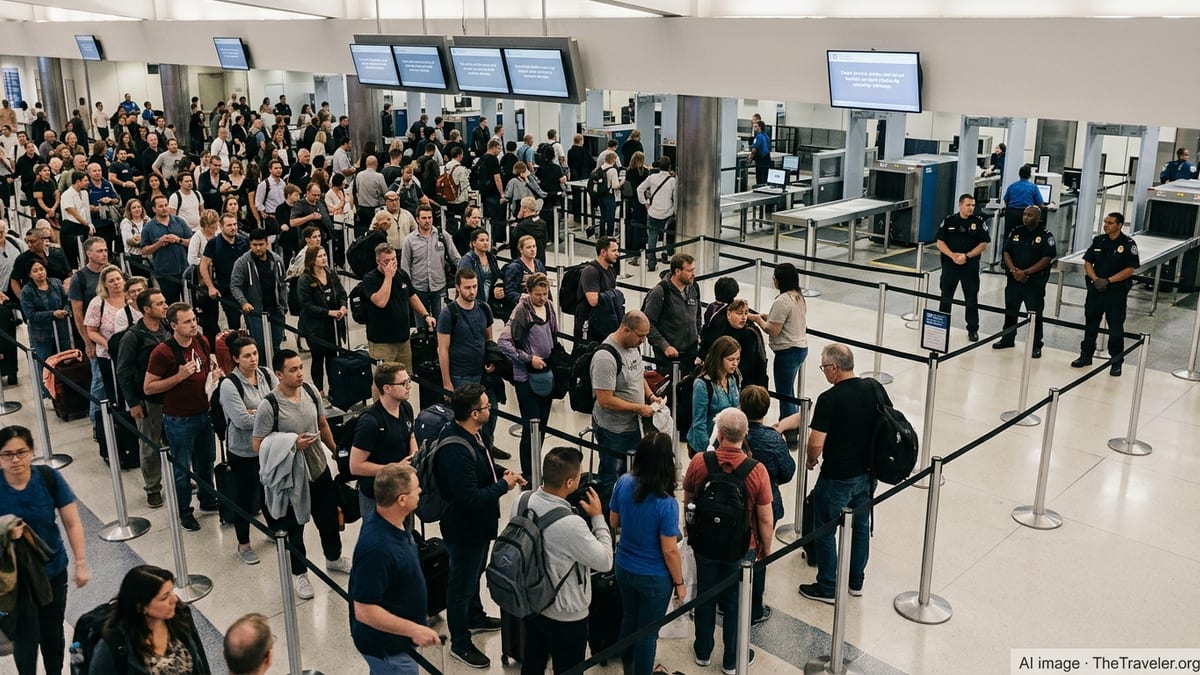
Terminal infrastructure is another factor. Fort Lauderdale’s terminals handle a dense bank of early morning and late evening departures, particularly to the Northeast United States and Caribbean islands. On days when multiple flights in these waves run late at once, passengers can experience long lines for check-in, security and boarding, along with crowded concourses as travelers from several delayed services cluster around the same limited seating and amenities.
Observers tracking on-time performance trends note that as JetBlue continues expanding its Fort Lauderdale schedule to record levels, and as Spirit remains a dominant player, maintaining reliability at peak periods becomes increasingly complex. Any constraint in the broader national airspace system or at downstream airports can quickly feed back into congestion in South Florida.
Passengers Face Missed Connections and Overnight Stays
The practical consequences of Sunday’s disruption for travelers were significant. Many passengers connecting through Fort Lauderdale to onward flights within the United States or to international destinations found themselves rebooked on later services after missing narrow connection windows.
For some, especially those traveling to secondary cities in Colombia, Guatemala or the Dominican Republic served by limited frequencies, the missed connection meant an overnight stay near the airport or a lengthy rerouting via alternate hubs such as Miami, Orlando or Atlanta. Social media images from the terminal on June 29 showed lines at customer service counters and groups of passengers camped out near power outlets as they attempted to rearrange itineraries and contact family members abroad.
Travel disruptions also carried financial implications. Travelers reported additional out-of-pocket expenses for hotel rooms, meals and ground transportation when rebooked on next-day flights or diverted to nearby airports. Those relying on tight schedules for business meetings, cruises or special events highlighted the broader knock-on effects beyond the immediate airport experience.
For families and leisure travelers facing the tail end of vacations, extended delays or cancellations on return flights meant unexpected extra nights away from home and complications with work or school commitments the following day.
Advisories for Upcoming Travelers Through Fort Lauderdale
Given the scale of Sunday’s gridlock, travel industry observers suggested that passengers scheduled to fly through Fort Lauderdale in the coming days take additional precautions. Publicly available guidance frequently emphasizes the importance of monitoring flight status in real time through airline apps or airport information screens and enrolling in text or email alerts.
Travel planners also recommend allowing longer connection times at busy hubs such as Fort Lauderdale, particularly when traveling during peak holiday periods or on itineraries involving international links to Latin America and the Caribbean. Booking earlier flights in the day, when possible, can increase the options for same-day rebooking if the original service is disrupted.
Passengers are further encouraged to keep essential items, medications and a change of clothes in carry-on bags in case checked luggage is delayed or overnight stays become necessary. For those traveling with children or elderly relatives, packing snacks, entertainment and basic comfort items can help ease the strain of unexpected waits in crowded gate areas.
While Sunday’s episode highlighted the vulnerabilities of an increasingly busy airport serving a complex web of domestic and international routes, it also underlined the value of contingency planning and flexible itineraries for travelers navigating one of the country’s most important leisure gateways.